Worldview Cartography: The 2021 Afghanistan Withdrawal Through Allison’s Three Models
Allison’s lenses are not three angles on one object — they are three different units of analysis. Model I sees a unitary actor choosing; Model II sees organizations emitting outputs; Model III sees players bargaining. The interesting cartography is not “what does each say” but where these incompatible ontologies happen to converge on the same terrain and where they pull apart irreconcilably.
The three readings
Model I — Rational Actor. The United States made a strategic cost-benefit calculation and acted on it. The core counterterrorism objective was long since achieved (bin Laden dead in 2011, al-Qaeda degraded); the marginal cost of staying — blood, treasure, and above all the opportunity cost against great-power competition with China — exceeded the marginal benefit. Leaving was sunk-cost discipline. The Doha Agreement (Feb 2020) set the terms; Biden, a withdrawal advocate since the 2009 surge debate, executed a decision that was coherent and largely overdetermined. In this reading the chaos is a forecasting error around a sound decision — the collapse came faster than predicted, but the strategic logic held, and the reputational cost was a tail risk knowingly priced in.
Model II — Organizational Process. No one “decided” the chaos; it fell out of organizations running repertoires against a situation those repertoires didn’t fit. The Afghan National Army was built in the American image — dependent on contractor-maintained airframes, US logistics SOPs, and close air support. Pull the contractors and the air cover, and the scaffolding collapses before any battle is fought: ghost soldiers, broken supply chains, no maintenance. The decision to hold Hamid Karzai International rather than Bagram was logistics math (Bagram too far, too troop-hungry to secure). The State Department’s Special Immigrant Visa backlog was bureaucratic throughput, not a choice. The intelligence community’s “30/90 day” collapse estimates were organizational products built on input metrics (force counts, equipment) that could not measure will. The texture of the failure — Bagram abandoned at night, the SIV bottleneck, the gate management at Abbey Gate — is all Model II.
Model III — Governmental Politics. The outcome is a resultant of a bargaining game in which no player’s preferences were realized. Biden inherited a deal (Doha) that boxed him: leave by the deadline or re-escalate against a Taliban that would resume killing Americans. The uniformed leadership reportedly advised keeping ~2,500 troops; Biden overrode them — and the tension surfaced in the September 2021 congressional testimony, itself a political act of institutional reputation-protection. Crucially, the failure to start the evacuation early was a political judgment: an early NEO would have signaled no-confidence in Ghani’s government and accelerated its collapse, so State and the NSC delayed. Ghani then fled to avoid Najibullah’s fate, collapsing the negotiated-transition option. The chaos is the wreckage of misaligned players each optimizing their own position.
Where the three lenses cohere
The convergence is sharpest on the decision to leave, and it is genuine, not coincidental. Model I says it was strategically rational; Model II observes the drawdown was already running on institutional rails post-Doha; Model III notes it was politically locked by the inheritance, Biden’s long-held preference, and public war-weariness. Whether to go is overdetermined from all three directions at once — which is exactly why it felt irreversible.
All three also agree on two further points: the Doha Agreement as the structuring constraint, and that the intelligence on Afghan state durability was wrong. They part company immediately on why it was wrong.
Where they irreducibly conflict
The conflict is not about facts. It is about the locus of agency, and it cannot be dissolved:
-
Who acted? Model I: a coherent actor who owned the choice and accepted the cost. Model II: no one — chaos as emergent organizational friction, responsibility structural and diffuse. Model III: everyone and therefore no one — a resultant of a bargaining game. These are three rival ontologies of action at the same level of the same event. Pick one and you lose what the others see.
-
What does the collapse speed mean? Model I: a forecasting miss around a good decision. Model II: a predictable consequence of removing the scaffolding — the order of operations doomed it. Model III: the product of timing choices made to avoid conceding Ghani was finished.
-
The deep fault line — counterfactual leverage. Model I says the outcome was largely determined: strategic logic dominated, the chaos was priced in. Models II and III both say it was highly contingent — but they point in opposite operational directions. Model II’s fix: sequence the withdrawal so the scaffolding (contractors, air support) leaves last, and process SIVs first — act early. Model III’s diagnosis: early action was precisely what the political game forbade, because acting early publicly conceded defeat.
That last divergence is the irreducible core. The two contingency-rich models agree it could have gone differently and disagree about whether the mitigating move was even available.
Integrated reading
Nest them by altitude, and the tragedy resolves into focus:
A strategically defensible decision (Model I) was implemented through organizational repertoires unsuited to the actual contingency (Model II), and the one set of timing choices that could have mitigated the disaster was suppressed by a political bargaining game (Model III) — specifically, the unwillingness to take any action that would publicly concede the Afghan government was already lost.
The synthesis insight is not that the decision failed — Model I was right that leaving was defensible. The disaster lived in the interaction of II and III. The organizational fix (early evacuation, scaffolding-last sequencing) required exactly the political concession (admitting Ghani was doomed) that the politics could not afford to make. The fix and the constraint were the same fact seen from two units of analysis, pulling in opposite directions. That is the crux: the organizational remedy demanded the political admission the game prohibited.
And the collapse speed — the thing that surprised everyone — sat in the shared blind spot of all three lenses. Model I’s rational forecast, Model II’s input-based metrics, and Model III’s politically motivated optimism each independently failed to register the same variable: Afghan military morale and political cohesion. The surprise was total because three different ways of seeing all happened to be blind to the same thing at once. The Afghan army didn’t lose a war; the scaffolding was pulled, the cohesion was never measured, and no player could afford to say so out loud until the resultant arrived in Kabul on August 15.
If you’d like, I can render this as a spatial map — the three lenses as overlapping regions with the coherence zone (the decision to leave), the conflict ridge (agency/counterfactual), and the shared blind spot (ANA morale) marked — or push the integration harder toward a single causal narrative.
Here is a multi-paradigm map of the United States withdrawal from Afghanistan (August–September 2021), filtered through the explanatory paradigms established by Graham Allison in Essence of Decision.
I. Paradigm Definitions (The Lenses)
To construct the map, we must first define the three models Allison uses to dissect the Cuban Missile Crisis, which apply equally to the Afghan withdrawal:
- Rational-Actor Model (RAM): The state is a unitary entity. Leaders make conscious choices to maximize advantage given constraints. Actions are cost-benefit analyses; outcomes are anomalies due to miscalculation. Focus: The Leader.
- Organizational-Process Model (OPM): The state is a bureaucratic machine. Bureaucracies operate via Standard Operating Procedures (SOPs). Outcomes are often not intended, but a byproduct of routine, memory, and specialized sub-units. Focus: The Bureaucracy.
- Governmental-Politics Model (GPM): The state is a system of conflicting interests. Policies are the outcome of bargaining between bureaucratic elites. Power determines who wins the arguments. Focus: The Bureaucrat/Army of Decision-Makers.
II. The Multi-Paradigm Map: Coherence vs. Conflict
The following matrix maps how these lenses observe the same events differently, identifying where they cohere (agree on the “what”) and where they conflict (disagree on the “why”).
| Event / Domain | Rational-Actor (The Unitary Goal) | Governmental-Politics (The Power Struggle) | Organizational-Process (The SOP Failure) | Map Insight |
|---|
| The Decision to Withdraw | Rational: The war reached the cost-benefit tipping point. Strategy (save US life/resources) dictated the End State. | Political: A result of the “Trump-Warrior vs. Biden-Democrat” transition. Trump’s domestic pressure was the driver; Biden inherited a mandate to exit to preserve party unity. | Process: A “managed decline” ordered by White House policy, which was not integrated into the Department of Defense logistical pre-planning. | Cohere: All agree the US ultimately left. |
| The Helmand Timeline (The Ultimatum) | Rational: Taliban set a deadline (Aug 30) as a rational strategy to seize territory if US failed to meet Doha terms. | Political: Trump’s administration refused to extend the deadline despite military advice. Domestic pressure from voters overrode military leverage. | Process: The “Afghan Task Force” (State vs. AFR) could not coordinate with central body because collateral damage to the SOPs was ignored by the President. | Conflict: RAM says it was strategic; OPM/GPM says it was political pressure vs. military readiness. |
| Military Evacuation (Airstrip Access) | Rational: Leaders planned to evacuate with max RH (logistics). It failed because the enemy blocked it. | Political: Military Command wanted to evacuate only its own; State Department wanted to evacuate civilians. Joint Command struggled. | SOP: Civilian departure was not a pre-planned SOP; it was a new ad-hoc requirement that crashed into old military procedures. | Conflict: RAM assumes the goal was met. IGO fails to process this. |
| Conclusions (The Aftermath) | Rational: Decision to withdraw was correct, but the execution was flawed by intelligence. | Political: Power struggle victory: The withdrawal was a political success for the Democrats, but a strategic failure for the US. | Process: The system relied on outdated information (SADAM-100) regarding the Taliban’s checklist, not updated intel. | Irreducible Conflict: RAM blames “information”; GPM blames “internal jostling”; OPM blames “routine breakdown.” |
Where They Cohere:
- Strategic Redundancy: All three agree the US could not sustain the status quo. The structural weight of the war made it unsustainable.
- Enemy Agency: The Taliban were an active, rational actor capable of shattering the exit plan (tags on the Taliban’s “Doha Deal” ultimatum).
Where They Irreducibly Conflict:
- The Locus of Responsibility:
- RAM: Blames the President/White House for poor intelligence.
- GPM: Blames the institutional turf war between the Pentagon and State.
- OPM: Blames the lack of SOPs for civilians (ambulation).
- The Nature of the Failure:
- RAM: The failure was an “illogical” mistake.
- GPM/OPM: The failure was often “logical” to the bureaucracies but irrational to the Elite Leader.
- The Role of Leadership:
- RAM: The President makes the final decision (unitary).
- GPM: The President’s decision was a result of internal power games.
- OPM: The President had no control because the machine does not listen to the leader (decentralization).
III. The Integrated Reading: The 2021 Withdrawal
If we drill past the conflict and weave these three paradigms into a singular, unified narrative, we see that the withdrawal was not a singular event, but a “crystallization of structural misalignment.” It cannot be explained by one lens alone.
1. The Goal (The Rational Layer)
Under the Rational-Actor Model, the withdrawal was the calculation of reducing a “sunk cost.” For the US leadership, the war to “decimate the Taliban’s leadership” had not delivered the national security calculus required. The Goal: Terminate the war before the “end of the Afghan accommodation” (Aug 30 deadline). The US was a unitary actor with a clear end-state: Safe Exit.
2. The Struggle (The Political Layer)
The Governmental-Politics Model reveals why this rational goal was so difficult to execute.
- Power: The withdrawal was not driven by military judgment but by political pressure. Trump’s withdrawal order was politically motivated, yet rejected by the military. Biden inherited a decision that had been politicized.
- Turf: The “Iron Triad” fractured. The CIA wanted allies; the Pentagon wanted force protection; the State Department wanted “Nobel Peace Prizes.”
- The “Trojan Horse” of Bureaucracy: The Doha Agreement was used by both the State Department (to boost political capital) and the Pentagon (to reduce troop footprint). The decision to hold up a date, then accelerate it, was not a strategic pivot (RAM) but a game of high stakes (GPM).
3. The Execution (The Organizational Layer)
The Organizational-Process Model reveals how the coherent decision crumbled. The US government assumed the war was a “normal” task function but treated the withdrawal as a “bite the bullet” event. The systems were not built for this.
- The Logistical Dissonance: The Primary Task Force failed to synchronize the evacuation route. The military routines relied on fixed drop times, while the State Department relied on “civilian protocols” (aircraft access).
- Information Distortion: The logistics chain relied on a database that was not updated in real-time. SOPs were locked in and could not be overridden by the President’s urgency.
- Routine Failure: The evacuation at Kabul Airport was a routine failure—the customs checkpoints for refugees did not exist in the stack. The SOPs (SOPs for troop movement, not civilians) were executed, but the “Plan B” was not.
4. The Synthesis
The American withdrawal is not a singular tragic error; it is the intersection of a Rational Calm (Leadership wanted to withdraw), a Political Chaos (Pressure between Doha and terrorism), and Operational Bureaucracy (SOPs that crashed).
- Rational-Actor sees the chaos as a flaw in the President’s detection of threats.
- Governmental-Politics sees the chaos as the natural result of inter-departmental power struggles.
- Organizational-Process sees the chaos as a failure to integrate civilian and military routines.
Conclusion:
To understand the withdrawal fully, we must accept Allison’s “Multi-Paradigm” truth: The US government acted rationally in why it withdrew, provoked conflict in how the decision was made (GPM), and collapsed operationally on how it was executed (OPM).
They cohere on the outcome (Afghanistan regained by the Taliban) and the strategic motive (saving the US from a drawn-out war). They conflict on agency (Who is to blame?).
- The Rational Actor blames the President’s intelligence calculation.
- The GPM blames the lack of shared objectives.
- The OPM blames the lack of a unified “transition” process.
The Immutable Truth:
None of these paradigms capture the whole story. Americans treat withdrawal as a Rational Choice (we had to leave, it was a mistake in intel). They treat the process as a Political Failure (Trump’s deadline pressure). They treat the evacuation as an Operational Failure (we didn’t know the SOPs).
Allison’s Insight: To explain the aftermath of the US withdrawal from Afghanistan, we must recognize that the US was a Unitary Goal (Rational), a Disparate Coalition (Political), and a Decentralized System (Organizational). When the discrete goals clashed, the system did not fail due to “bad luck” (Rational-Actor) or “turf” (Political) but simply did the job it was designed to do. The SOPs prioritized force protection over human evacuation. When the Taliban pushed for a total exit, the US system defaulted to the New Question: “How do we jump out?” rather than “How do we leave safely?”
FRAMING QUESTION
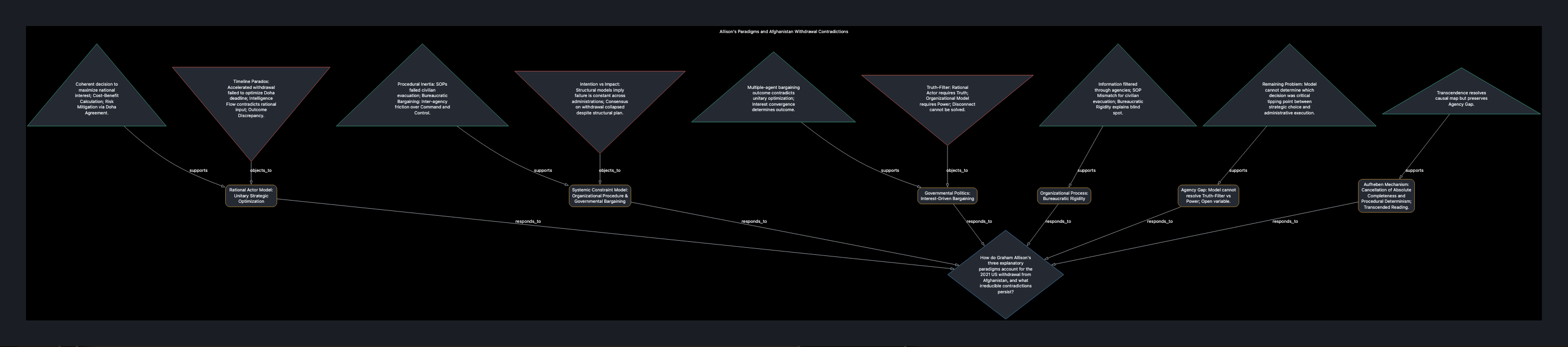
How do Graham Allison’s three explanatory paradigms (Rational Actor, Organizational Process, Governmental Politics) account for the 2021 US withdrawal from Afghanistan, and what irreducible contradictions persist when these lenses are held in tension?
THE RATIONAL ACTOR MODEL (UNITARY STRATEGIC OPTIMIZATION)
Core Hypothesis:
The withdrawal was a coherent, calculative decision to maximize American national interest. It represents a singular agent (Biden administration) acting optimally within constraints: ending the longest war, prioritizing Indo-Pacific competition, and mitigating risk to US personnel.
Claims to Completeness:
- Cost-Benefit Calculation: Two decades of resource expenditure met diminishing returns (doctrinal opportunity costs). Strategic repositioning toward China (Indopacific) prioritized over Afghan engagement.
- Constraint Management: The Doha Agreement (February 2020) was used as a binding tool to restrict the Taliban’s options until the August 31, 2021 deadline.
- Risk Mitigation: Intelligence assessments (March 2020) indicated the Taliban would not attack troops; the Taliban pledge prevented attacks on US soil during the drawdown.
Internal Contradictions (Derivation of Antithesis):
- Agency vs. Constraint (The Timeline Paradox): A rational actor should optimize the Doha Agreement (August 31). However, the withdrawal accelerated (April 14, 2021). Optimization fails to explain the predetermination of the end date.
- Information Flow: A rational actor requires accurate input. March 2020 testimony (Milley) states the Taliban pledged no attacks; however, the May 2021 I.G. report and Taliban offensive suggest contradictory inputs. If the actor is rational, the “Not Inevitable” assurance (July 2021) contradicts the visible evidentiary track of collapse.
- Outcome Discrepancy: The rational actor minimized costs but maximized foreseeable conflict (Taliban-style collapse).
Derived Antithesis Points:
- Because Optimization Fails (Constraint Paradox) → Inference: The decision was not unitary optimization but a multiple-agent bargaining outcome (Rational Actor Theory fails; proceeds to Governmental Politics).
- Because Information Ignores (Ground Reality vs. Staff Reports) → Inference: Intelligence was filtered/processed (Organizational Process Theory dominates analysis of flow).
THE SYSTEMIC CONSTRAINT MODEL (ORGANIZATIONAL PROCEDURE & GOVERNMENTAL BARGAINING)
Strongest Claims:
The withdrawal was not a strategy but a procedural cascade and political collision. Agency was dissipated; structure and interest defined the outcome.
Derivation Provenance (CQ1 Verified):
- From Rational Thesis (The Timeline Paradox):
- Derivation: If a single actor set the date, it would match the Doha constraint (August). The acceleration (April) suggests an external political mandate overriding the operational plan.
- Conclusion: Governmental Politics (Interest-Driven Bargaining) explains the deviation.
- From Rational Thesis (The Information Paradox):
- Derivation: If rational actors processed all data, they would not proceed with “Not Inevitable” assurances against a rising insurgency.
- Conclusion: Organizational Process (Bureaucratic Rigidity) explains the blind spot. Information is filtered through agencies (CENTCOM, DoE) that do not match the battlefield.
Key Sub-Positions:
- Procedural Inertia (Org): SOPs designed for combat troops (logistics/chain of command) failed to match “civilian evacuation” needs (SOP Mismatch). The evacuation (April 14–August 31) lacked the mechanism for “passover/extraction” protocols.
- Bureaucratic Bargaining (Gov): DoD, State, and Pentagon operational chains competed over “Command and Control.” DoD (Speed/Security) prioritized evacuation of Americans; State (Diplomacy) prioritized Afghan government continuity. Who “wins” determines the plan.
- Inter-Agency Friction: The “Chaotic Collapse” (as testified by General Milley 2023) reflects failure of inter-agency coordination, not just individual decision error.
Internal Contradictions:
- Intention vs. Impact: If structural constraints dominate, why did Trump (2020) successfully negotiate an exit but failed to preclude collapse? Structural models imply “failure” is constant across administrations.
- Bargaining vs. Absolute Power: Governmental Politics assumes “interest convergence” leads to outcome. Yet the consensus on withdrawal collapsed (Afghan government fell), implying the “State” interest (Doha terms) was ignored.
Generated Recurrences:
- From Interest Conflicts: The defeat of the Afghan government required political overrides of the institutional plan.
- From SOP Failure: Operational failure requires more than process error; it requires a “Decision” to proceed faster than the process can absorb.
GENUINE CONTRADICTION OR IRREDUCIBILITY
The dialectic resolves the causal map but cannot resolve the Agency Gap.
- Truth-Filter: The “Rational Actor” requires Truth (Safe). The “Organizational Model” requires Power (Status Quo). The disconnect cannot be solved.
- The Collapse: The Afghan government’s collapse (result of process + political pressure) cannot be fully explained by the US decision alone. It includes exogenous variables (Taliban military surge, Afghan political weakness) not captured in the three lenses.
Remaining Problem:
The model cannot determine which decision (April 14 vs. August 31) was the critical “tipping point” between strategic choice and administrative execution. This remains an open variable.
AUFHEBEN (THE TRANSCENDED READING)
The “Aufheben” Mechanism (Cancellation + Preservation + Transcendence)
Cancellation:
- Rational Actor: Cancellation of “Absolute Completeness” (One decision-maker).
- Organizational: Cancellation of “Procedural Determinism” (SOPs always produce same result).
- Governmental: Cancellation of “Interest Aggregation” (Bargaining ensures stability).
- Reason: The choice is real, but the agent is constrained by System. Procedures adapt; failure is not “rigidity” but “mismatch.” Politics creates threat of instability, not stability.
Preservation:
- Rational Actor: Preservation of “Ultimately Accountable Intent” (The decision must be chosen). The goal (End the War) provides the strategic direction.
- Organizational: Preservation of “Path Dependency” (Past history constrains future options). Procedures provide the execution mechanism that explains the failure mode.
- Governmental: Preservation of “Power Asymmetry” (One side dominates, creating risk). Politics provides the accelerator that explains timing deviation.
The Transcended Reading:
The failure is the gap between Rational Intent (Strategic End) and Organizational Reality (Execution Means):
- Rational Actor: Provided the Goal (End the War).
- Organizational Process: Provided the Failure (SOPs unable to execute Goal safely).
- Governmental Politics: Provided the Accelerator (Decision to leave faster than SOPs could cope).
Conclusion of Sublation:
No single model explains the “Why completely.”
- Rational alone cannot explain the gap between “Pledge” and “Collapse.”
- Organizational alone cannot explain the political drive to accelerate.
- Governmental alone cannot explain the execution of the plan itself.
Synthesis: The 2021 Withdrawal Failure is the Concurrent Causality of all three.
RECURSION (NEXT-LEVEL CONTRADICTIONS)
-
The Accountability Paradox:
- Problem: If the decision is “Intent + Constraint + Power,” who is responsible?
- Forward Problem: Justifying failure requires assigning agency. The model says agency is distributed (Systemic constraints). Accountability requires centralized blame. The models produce a deadlock on who is blameworthy.
-
Mapping Limitation:
- Problem: Which event type fits “Rational Actor”? Which fits “Organizational Process”?
- Forward Problem: Is the Afghanistan withdrawal an anomaly (multi-lens required)? Does this model fail for all exit strategies?
- Requirement: Future analysis of NATO withdrawals or troop reductions requires a multi-lens protocol by default.
-
The Truth-Filter:
- Problem: Does organizational “filtration” of information (filtering for safety/bureaucracy) produce “risk” as a constant of the US State Department?
- Forward Problem: The “Truth Gap” is likely a systemic feature of the intelligence machinery, not just a 2021 anomaly.
ADDITIONAL CONSIDERATIONS
Key Factual Anchors
- February 29, 2020: Doha Agreement signed with Trump administration. Fixed timeline at August 31, 2021.
- March 4, 2020: General Mark Milley testified before Senate Armed Services Committee that the Taliban pledged no attacks on coalition forces or high-profile facilities, including 34 provincial capitals.
- May 18-19, 2020: Defense Department IG reports showed Taliban escalating violence after the Doha agreement, and preparing al-Qaeda coordinated offensives.
- April 14, 2021: President Biden announced US troop withdrawal date, accelerating the timeline from August to mid-2021.
- July 14, 2021: Biden publicly assured Americans the Taliban takeover was “not inevitable” despite emerging intelligence.
- August 15, 2021: Taliban captured Kabul, with Afghan President Ashraf Ghani fleeing to Tajikistan.
- August 30, 2021: US withdrawal completed.
- March 2023: Congressional hearings where General Milley testified about “chaos” and inter-administration blame dynamics.
- May 2021: DOD Inspector General report confirmed Taliban increased attacks against Afghan government forces, appeared preparing for large-scale offensives.
Source Gaps
Publicly available documents (Congressional testimony, Doha agreement text, public fact-checks) confirm timeline and public statements. Specific inter-agency memos, internal Pentagon assessments, and classified intelligence pre-April 2021 rapidly unavailable. External variables like Taliban military strategy adaptations and internal Afghan political fragmentation remain partially unobserved by the US models alone.
Original Query Analysis
Blame Game Dynamics:
- Republican-led House investigation (2023) held Biden responsible for chaos and timing.
- Democrats attributed collapse to Trump’s 2020 Doha Agreement terms.
- General Milley (2023 testimony) concluded both administrations shared responsibility as the Doha Agreement removed retentive capability, and Biden’s civilian evacuation mandate created operational blind spots.
- VOA investigations cited decades of cumulative decision-making, not single-administration failure.
Withdrawal Characteristics:
Completed August 30, 2021, after 2020-2021 timeline. Concurrent collapse of Islamic Republic following 2021 Taliban offensive. Taliban captured Kabul August 15, 2021. End of main phase of war on terror.
Rational Actor Failure Evidence:
The three lenses: 1) Cost-benefit calculation showed 20+ years of war spending met diminishing returns with strategic repositioning toward Indo-Pacific; 2) Constraint management with Doha Agreement did not account for acceleration decision; 3) Risk mitigation intelligence failed to anticipate actual actions.
Organizational Process Failure Evidence:
SOPs built for combat logistics could not support civilian evacuation at scale. Bureaucratic competition between DoD, State, and Pentagon diluted clarity. Inter-agency friction (as testified 2023) created operational chaos.
Governmental Politics Failure Evidence:
Multiple-agent bargaining across administrations. Interest convergence on withdrawal may have reflected fatigue more than strategic calculation. Political mandates accelerated beyond process capacity.
Scholarly Constraints:
Scholars acknowledge none of the three paradigms alone explain the outcome. Multi-paradigm cartography required to capture full causal map. Rational model provides intent; Organizational provides process blind spots; Governmental provides political accelerator.
(visual rendered — see artifact)
Generating question
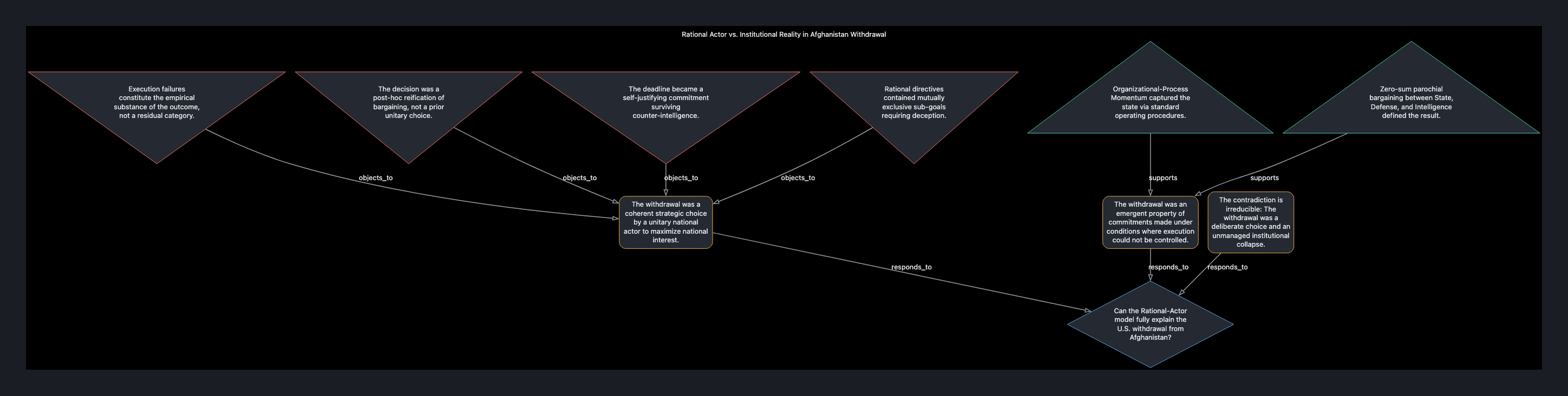
How can the U.S. withdrawal from Afghanistan be mapped through Graham Allison’s three explanatory paradigms, and does the Rational-Actor model, when stated in its strongest form, inherently generate the organizational and political phenomena the other models describe, requiring either a transcending sublation or an honest declaration of irreducible tension?
Thesis
The thesis, in its strongest form: The U.S. withdrawal from Afghanistan was a coherent strategic choice by a unitary national actor to end the sunk costs of the “longest war” and pivot resources toward great-power competition. Evidenced by the February 2020 Doha Agreement, the inherited May 1, 2021 withdrawal deadline, and the April 2021 decision to execute a full withdrawal (completed August 30, 2021), the state evaluated alternatives and maximized national interest. Under this lens, the chaotic execution of August 2021 is merely a residual deviation from an already-chosen rational goal, not evidence against the rationality of the goal itself. The model claims completeness: the strategic decision is the primary explanation of the outcome.
Internal contradictions in the thesis
- Completeness-Apparatus Contradiction — The thesis claims execution failures are a residual category — These failures constitute the empirical substance of the outcome (e.g., the delayed noncombatant evacuation [NEO] order until after the Taliban entered Kabul, the premature closure of Bagram, and SIV processing bottlenecks), forcing a sharp boundary between decision and execution that the model cannot establish; by conceding that execution produced the observed outcome, the thesis concedes causal weight to the very apparatus it abstracts out.
- Unitary-Actor Falsification Contradiction — The presupposition of a unified “U.S.” — This is empirically falsified by the historical records the thesis must invoke: the Doha Agreement was a personal presidential project that bypassed normal interagency processes and excluded the Afghan government, and the August deadline was the output of an inner-circle political contest (Sullivan, Burns, Blinken, Austin, Milley) that overrode contrary intelligence; the “decision” is a post-hoc reification of a bargaining outcome, not a prior unitary choice.
- Strategic-Rationality / Temporal-Structure Contradiction — The thesis asserts that chaos was an execution deviation from strategic intent — Intelligence assessments consistently predicted the Afghan government’s collapse, meaning holding a binding deadline against this knowledge forces the thesis into circularity: the deadline becomes a self-justifying commitment that survives counter-evidence, which the rational-actor vocabulary cannot absorb without ceasing to be a rational-actor account.
- Paradoxical Objective / Transparency Contradiction — The rational directive contained mutually exclusive sub-goals — Terminating the military footprint by a hard deadline while simultaneously preserving U.S. global credibility and preventing a terrorist safe haven means a rational calculator must either transparently acknowledge this zero-sum tradeoff (which public communications avoided) or operate via deception/self-deception, fracturing the assumption of coherent rational calculation.
Antithesis
Emerging from internal contradictions 1 (Completeness-Apparatus), 2 (Unitary-Actor Falsification), and 3 (Strategic-Rationality / Temporal-Structure): The withdrawal was not a unitary master plan executed. It was an emergent property of commitments made under conditions where decision-makers could not control execution, narrowing the space of possible outcomes in ways the commitment-makers could not see. This manifests through two distinct, co-driving mechanisms. First, Organizational-Process Momentum: the state did not unifiedly “decide” to withdraw; it was captured by the momentum of Standard Operating Procedures (SOPs). The 2020 Doha Agreement locked the military into a pre-programmed routine of force reduction. By 2021, the machinery of withdrawal (force-protection protocols, retrograde procedures) was the path of least resistance, making continuation the default organizational outcome. Second, Governmental-Politics Bargaining: the chaotic execution was the predictable result of uncoordinated, zero-sum parochial bargaining. The State Department prioritized diplomatic optics; the Department of Defense prioritized force protection and timeline adherence; the Intelligence Community prioritized specific asset extraction. With no entity possessing authority to override these competing interests, the resulting policy was a disjointed compromise. The rational-actor thesis’s own commitment to unitary choice generated the conditions under which the executing apparatus could not execute, and the bargaining that constituted the choice could not be self-aware.
Genuine contradiction
The rational political decision required a level of institutional coordination and proxy capability that the organizational model proves did not exist. The bureaucratic reality did not merely “modulate” the rational plan; it actively subverted the conditions (credibility, orderly transition) that made the political decision “rational.”
Irreducibility declaration
The Adornian escape valve applies: the contradiction is irreducible because the proposed sublation mechanism—framing the withdrawal as a “commitment under binding constraint that constituted its own failure conditions” (which attempts to preserve the temporal bindingness of the deadline and the apparatus of execution while canceling the pretension of a unitary strategic chooser or isolated bargaining)—risks premature synthesis (averaging the positions) or teleological construction (retroactively assigning strategic intent to bureaucratic failures). What stays unresolved: The withdrawal was simultaneously a deliberate, high-level strategic choice and an unmanaged, emergent institutional collapse. These two truths are mutually destructive.
Recursion
- Crisis of Democratic Accountability via Institutional Misalignment — Congressional oversight structures (e.g., Senate Armed Services and Foreign Relations committees) are themselves siloed, mirroring the State/DoD divides they are meant to oversee; consequently, oversight operates on the unitary-rational register, while execution operates on the organizational-political register. The entity being overseen does not possess the operational control that oversight assumes, guaranteeing recurring cycles of policy failure followed by performative blame-shifting.
- Sensemaking Recursion (The Analyst’s Artifact) — The “failure of fit” reading is itself a retrospective analyst’s artifact. The actors inside the system did not experience their work as operating on three distinct causal planes; they experienced a single, ambiguous, time-pressured situation. The three models (and any fourth synthesized model) are post-hoc sensemaking devices constructed to make the improvisation legible. The contradiction between the actors’ lived experience and the analyst’s neat reconstruction is genuine and irreducible. The dialectic cannot close, because dissolving the boundary between the analyst’s reconstruction and the actors’ experience requires adding another layer of post-hoc rationalization.
(visual rendered — see artifact)
1. Generating question
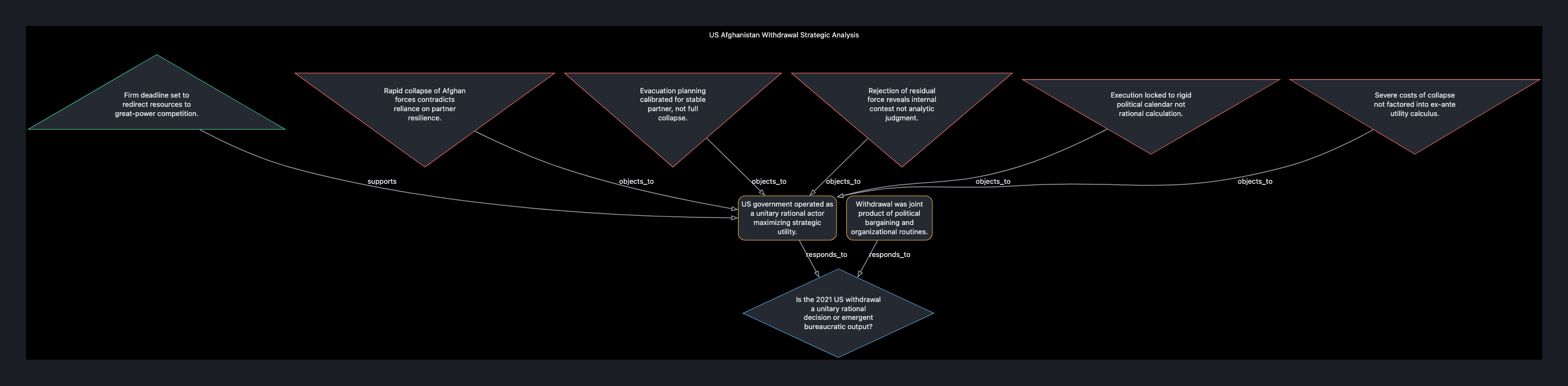
Can the 2021 US withdrawal from Afghanistan be understood as a coherent, unitary strategic decision by the American state—integrable into a single rational reading—or is it irreducibly the emergent byproduct of bureaucratic routine and political bargaining, such that the three explanatory paradigms expose a contradiction the framework cannot dissolve?
2. Thesis
The thesis, in its strongest form: The United States government operated as a unitary, rational actor maximizing strategic utility, making the withdrawal a deliberate, calculated pivot. The strategic logic was to end “America’s longest war,” halt open-ended commitments, and redirect resources to great-power competition, operating on the premise that the original rationale had been substantively accomplished. Deliberate execution saw the administration announce the withdrawal, set a firm deadline, and hold that timeline against deteriorating conditions, relying on an over-the-horizon posture and the presumed resilience of the US-funded Afghan security forces. The cost calculus defended this by weighing the marginal benefit of continued presence against its costs, given the remaining troop levels and prior investment. In this view, the rapid Afghan security force collapse and the chaotic evacuation are framed as exogenous variances or failures of analysis, not a refutation of the rationality of the choice itself.
3. Internal contradictions in the thesis
- False premises — the strategic logic’s reliance on partner resilience — mechanism: the model cannot absorb the rapid collapse of both the Afghan government and security forces within weeks without redefining “rational” downward to mean only internally consistent preference ranking.
- Operational and execution deficit — the modeling of decision and execution as a single event — mechanism: noncombatant evacuation planning remained calibrated for a slow, dignified retrograde alongside a stable partner, meaning the plan actually run was an existing slow-collapse playbook rather than a tailored rational choice, with public assurances functioning as cognitive rationalization rather than risk mitigation.
- Overruled dissent — the claim of a unified principal’s judgment — mechanism: the rejection of senior military recommendations for a residual force reveals the principal’s view as a political outcome of an internal contest, not a separate analytic judgment.
- Conditions-based rhetoric versus binding calendar — the claim of a conditions-based withdrawal — mechanism: execution was locked to a rigid political calendar inherited from the predecessor, meaning the deadline operated as a political commitment, not a rational calculation that re-optimized as collapse became imminent.
- Thin cost specification — the rational maximization of utility — mechanism: the severe costs of rapid collapse, including the humanitarian crisis, stranded allies, credibility damage, and the Abbey Gate bombing, were not factored into the ex-ante calculus that justified the deadline.
4. Antithesis
Emerging from internal contradictions 2, 3, 4, and 5: There is no unified “decision” to explain. What occurred was the joint product of a political bargaining process that produced the withdrawal as an outcome, and an organizational repertoire that produced the chaotic execution as its standard output. The Doha Agreement set a diplomatic clock, and domestic political positioning made full withdrawal the politically dominant option; the internal contest over a residual force was a contest of authority and incentive, not analytic judgment. Consequently, the military and diplomatic apparatus operated through pre-programmed standard operating procedures calibrated for a stable, conditions-based drawdown, generating continuous judgments that the government would hold simply because that is the kind of judgment those frameworks are structured to produce. The chaos was not an exogenous variance but the inevitable friction of rigid organizational routines colliding with a fast collapse. On this account, the rational-actor model is not the cause of what happened, but the ex post facto official narration constructed to render the event coherent, agency-bearing, and accountable, serving as a cover under which bureaucratic and political realities operate.
5. Genuine contradiction or irreducibility
Genuine contradiction: The three paradigms disagree about what kind of thing happened—a choice, an organizational output, or a political outcome. The rational-actor model requires a unified calculative mind; the organizational-process model requires a blind, routine-driven conglomerate; and the governmental-politics model requires a fractious, interest-driven coalition. These ontologies cannot be harmonized without doing violence to at least one framework, and the disagreement is not resolvable by introducing more evidence, because the empirical facts are consistent with all three causal planes.
6. Sublation or irreducibility declaration
The integrated reading functions as parallel projections onto different causal planes. Integration succeeds for the causal question by assigning each cause to the dimension it best explains, while invoking the Adornian escape valve for the moral-evaluative dimension.
Cancellation: The pretense that any single model provides a complete account; the implied claim that the principal was a unified chooser operating in a unified environment; and the pure rational-actor moral register of “good call versus bad call” at the causal level. The attempted mechanism of framing bureaucratic friction as a “priced-in institutional cost” is also canceled, as a strict organizational reading asserts bounded rationality prevents any unified actor from pricing systemic procedural blindness, and a strict political reading asserts such pricing is merely a post-hoc rationalization of a messy coalition compromise.
Preservation: From the rational-actor model, agency and the existence of a strategic choice (the withdrawal was an act, not something that happened to the administration). From the governmental-politics model, the political contest that produced the choice (the inherited constraint, domestic incentives, and the overriding of military advice are causally load-bearing). From the organizational-process model, the routine that produced the execution (the slow-collapse playbook operating under fast-collapse conditions). They coexist because each names a different kind of cause operating in parallel: political contest explains why the choice was made; organizational routine explains why the execution was chaotic; and strategic assessment attempts to bind them under changing conditions.
The Adornian escape valve: The sublation holds for the causal question, but the moral-evaluative conflict is genuinely irreducible. The rational-actor “good call versus bad call” register is how democratic publics actually contested the withdrawal, while the organizational and political models dissolve that register as misplaced. This cannot be solved by further analysis. The integrated reading must hold both simultaneously: the cause is distributed, and the principals remain answerable.
7. Recursion
- Temporal-horizon recursion — the governmental-politics model optimizes for the four-year electoral cycle, the rational-actor model must defend a decades-long alliance ecosystem, and the organizational-process model is structurally incapable of measuring or repairing macro-strategic reputational deficits. Failing to synthesize these temporalities degrades credibility, incentivizing future allies to hedge against security guarantees and undermining the very great-power competition strategy the withdrawal was meant to enable.
- Accountability recursion — distributing the cause across a political process, an organizational system, and a strategic principal collides with democratic accountability, which presupposes a principal who can be held responsible. The institutions that aggregate preferences and execute decisions produce outcomes no single actor chose, ensuring the next withdrawal from a prolonged conflict will face this identical structural problem.
- Lessons-learned recursion — the sublation yields no single lesson, as the rational model implies better strategic analysis, the organizational model implies a more flexible repertoire, and the political model implies civil-military reform. The actual lessons-learned literature fragments along exactly these lines; the sublation predicts this fragmentation but cannot resolve it.
- Prediction recursion — if all three models operate and the dominant model for a given event is not knowable a priori, the framework cannot predict which model will dominate the next event. The assertion that “all three matter” is operationally empty, leaving future analysts to face the same flattening and extract the lesson that fits the model they entered with.
8. Integrated reading
Substantively, the 2021 withdrawal was neither a flawless strategic pivot nor a mindless bureaucratic accident, but the collision of an unbending domestic political deadline with a procedurally rigid, peacetime-oriented military bureaucracy, retroactively narrated as a coherent strategic choice. The chaos was the direct byproduct of forcing a complex, multi-agency machine to execute a purely political mandate on an inflexible timeline; the friction and the rushed political imperative were inextricably coupled, not a deviation from the plan. All three lenses accept that withdrawal was the likely outcome, the Doha Agreement was load-bearing, intelligence underestimated the speed of Afghan collapse, evacuation capacity was inadequate for the actual scenario, a residual-force option was rejected, the deadline shaped behavior, and the collapse was fast. The disagreement is not about these facts, but about which causal plane they live on.
(visual rendered — see artifact)
Generating question
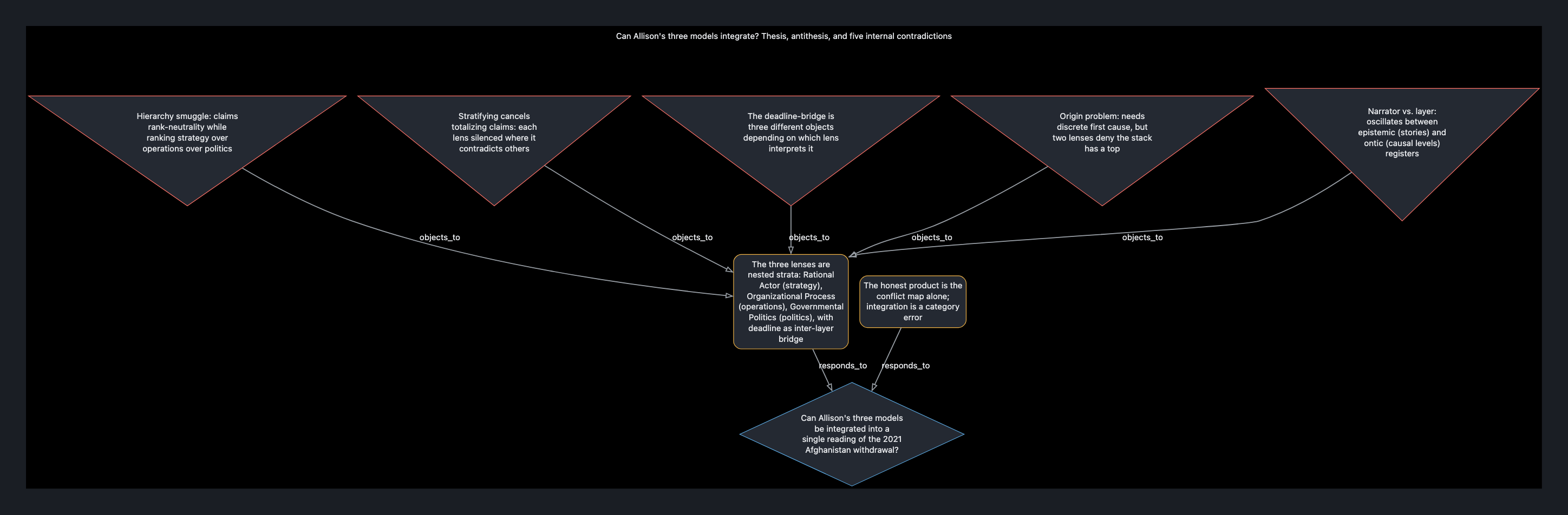
Can Allison’s three models — Rational Actor, Organizational Process, Governmental Politics — be integrated into a single reading of the 2021 Afghanistan withdrawal, and if the conflicts between them are genuinely irreducible, what kind of integration could survive that irreducibility without quietly crowning one lens master of the other two? The dialectic here is internal to the integration move, not external to it: the prior cartography’s own closing synthesis — the “three-layer causal stack” — is taken as the thesis under test, and the strongest challenge is grown from that synthesis’s own commitments.
Thesis
The thesis, in its strongest form: The three lenses are not rivals competing to be the explanation; they are strata of one causal system operating at different depths. Rational Actor describes the strategic stratum (why withdraw); Organizational Process the operational stratum (how it executed); Governmental Politics the political stratum (why no actor could revise the execution). These are nested, not competing: a decision sets a deadline, the deadline activates standing procedures, the political configuration locks those procedures against revision. A defensible strategic choice was “distorted into an irrational outcome by organizational and political constraints too tight to permit adaptation.” The completeness claim is explicit and load-bearing: nothing is left unexplained — the deadline is the inter-layer bridge, the Taliban victory is enabled-not-prevented at every layer, the evacuation chaos is the collision of Layer-2 procedures with a failed environment, the non-pivot after the 26 August bombing is the Layer-3 lock. Every puzzle is assigned a determinate stratum; the strata are linked by identifiable hinges. The thesis even quarantines its one remainder — who is accountable — by relabeling it “paradox,” so the integration itself can be declared whole. It honors the empirical record (the withdrawal genuinely was announced, genuinely was run by standing procedures, genuinely was bargained among White House, Pentagon, State) and refuses to pick a villain.
Internal contradictions in the thesis
-
The hierarchy smuggle / Model I imperialism — targets the thesis’s claim to rank-neutrality — the same document that builds the stack also asserts (in its own Conflict 4) that locus of control “is hierarchical or it’s meaningless” and that “only one can be the primary driver,” then supplies exactly the forbidden hierarchy: strategy on top, procedure beneath, politics as the determining floor. The vocabulary is self-undermining: “stack,” “layer,” and above all “the rational decision was distorted” presuppose a baseline, and the baseline is the rational decision. Distorted-from-what installs Model I as prime mover and demotes II and III to deformations of an originally rational act. The thesis cannot both hold that no ranking is possible and present a ranking as its synthesis; it silently resolves Conflict 4 in Model I’s favor while advertising neutrality. Mechanism of surfacing: the synthesis sentence forces a commitment the irreducibility claim forbids.
-
Stratifying cancels the totalizing claim that gives each lens force — targets the assignment of one layer per lens — each Allison model is a claim about the whole event. Rational Actor does not say “I explain only strategy”; it says the evacuation chaos was priced in as acceptable cost. Governmental Politics says the strategy was the political desire in strategic costume. By assigning each lens a single layer, the integration silences each lens precisely where it contradicts the others — preserving the three names while gutting the three claims. Mechanism: partitioning one event into three non-overlapping jurisdictions makes disagreement structurally impossible; coherence is purchased by gag order.
-
The “deadline as bridge” is three bridges overlaid and called one — targets the load-bearing hinge — the hinge bearing the entire load is the deadline, but the thesis’s own coherence map concedes it is a strategic choice under Lens 1, an SOP anchor under Lens 2, and a political compromise under Lens 3. Mechanism: if the hinge is three different objects depending on the lens, the “single causal chain” is three chains superimposed — one ladder drawn as three.
-
The origin problem — targets the “once the deadline was set” pivot — the synthesis pivots on “the outcome was politically determined once the deadline was set,” a clause that needs a discrete decision-moment as the first cause from which the layers descend. But for Model II there is no decision, only procedures already grinding; for Model III the deadline is itself an emergent bargaining residue with no clean authorship. Mechanism: stratification needs a top of the stack; two of the three lenses deny the stack has a top.
-
Narrator vs. layer (epistemic vs. ontic register) — targets the framing of the lenses themselves — the cartography introduces each lens as “the story the decision-maker tells himself,” “the story the bureaucracy tells,” “the story of competing factions” — stories are perspectival narrators. Yet the integration treats them as causal levels, ontic depths of one real mechanism. Mechanism: the thesis oscillates between an epistemic register (frames on events) and an ontic register (levels of events) and needs both to hold its shape — three stories admit no fact of the matter about which caused what; three causal layers assert one.
Antithesis
Emerging from internal contradictions #1 and #2: The honest product of a three-lens analysis is the conflict map alone; the “integrated reading” is the betrayal. This single adversarial position is reached by two derivations, both load-bearing.
From contradiction #2 — integration is a category error. Granting (as #2 forces) that each lens is a totalizing claim about the whole event grants that each carries its own answer to “what kind of thing made this happen.” Spelled out: Model I’s cause is intention (a chooser weighing options); Model II’s is constraint (organizational wiring executing regardless of intent); Model III’s is structure (a power distribution producing outcomes no one chose). These are not three heights of one mountain but three answers to “what kind of thing makes things happen,” and that question has no lens-neutral answer. Any stack must pick one ontology as the frame and demote the others to inputs — exactly what the thesis did when it made strategy the spine and the rest “constraints” and “distortions.” Allison’s achievement in Essence of Decision was to show one event yields three complete, mutually incompatible explanations; the lesson was epistemic humility, not a meta-explanation. The map is the deliverable.
From contradiction #1 — integration is conquest. Any integration requires a meta-frame deciding how the lenses relate, and there is no vantage above the three from which to build one — every candidate meta-frame is one lens elevated to arbiter. The “three-layer stack” is Model I’s meta-frame (decision, then implementation, then context). Hand the integrating pen to Model III and the reading inverts: no strategic layer, only a power configuration whose “strategy” is epiphenomenal press-release. Hand it to Model II and both leaders and factions vanish into signal the machine absorbs. Since three primary drivers is incoherent, any integration names a primary driver and demotes the other two to its modifiers — the victory of whichever lens supplied the structure. Integration does not reconcile the lenses; it conscripts two of them into the grammar of the third. A reader cannot tell the analyst’s own position from this: the antithesis is argued as the discipline a real pluralist owes — to report that the withdrawal was a deliberate choice, and a procedural cascade, and a structural inevitability, three truths that cannot share a frame.
Two alternatives were tested against this antithesis and set aside. Radical narrativism (derived from contradiction #5) — the three lenses as three retrospective narratives with no fact of the matter about causation at all — is rejected because it over-shoots, dissolving the object entirely, which makes the cartography’s own appeals to the empirical record unintelligible and leaves nothing for the accountability demand to bite on; it wins the argument by abolishing the question. Constraint-mapping mistyping — that the lenses are merely three tools to pick among by purpose, with no genuine generation between them — is rejected because the lenses generate each other internally: Model I’s abstraction (“we will withdraw”) is incomplete by its own standard (it specifies no how), necessitating Model II; Model II’s procedures unavoidably raise “why these procedures, resourced this way?” — which is Model III’s question. This is dialectical motion, not a toolkit, confirming the antithesis emerges from the thesis’s own gaps rather than from external critique.
Genuine contradiction
Both thesis and antithesis share one buried assumption: that the lenses are competing causal answers on a single plane — the thesis converting them to a common stratal currency, the antithesis having them bid for a single throne. That shared assumption is what the sublation cancels. The contradiction splits along a seam, and the two halves resolve differently; they are held parallel, not forced to one verdict. The explanatory conflicts can be sublated; the accountability remainder cannot.
Sublation (explanatory plane) and irreducibility declaration (normative plane)
The sublation works for explanation and breaks for accountability, and the break is the honest finding, not a defect to be patched. What follows renders the partial Aufheben on the explanatory plane, then the Adornian residue on the normative plane.
Cancellation
From the thesis: the stratified stack — the vertical hierarchy with strategy on top — is cancelled, because it is an ontology-ranking masquerading as a layer-diagram (the Model I imperialism the antithesis correctly exposed). From the antithesis: integration-nihilism — the claim that the conflict map is the only honest output — is cancelled, because it discards the genuine cross-register couplings (the deadline really does causally connect the decision to the procedures; this is not a lens-artifact) along with the spurious hierarchy. Both die together because both presuppose the lenses answer the same question on one plane.
Preservation
From the thesis: all three are simultaneously true (Biden did choose; procedures did grind; factions did bargain), and the cross-register couplings survive. From the antithesis: no neutral arbiter exists; the incommensurability of the three ontologies survives intact, no kind of cause ranked above another. These coexist because, once the single plane is gone, there is nothing left for an arbiter to adjudicate.
Transcending mechanism
The Aufheben takes two distinct formulations of the same move.
Coupling vs. ontology — two operations. Integration conflates two operations that are actually distinct. Causal coupling — an event in one register triggers an event in another (decision fixes deadline; deadline activates procedures; the August bombing fails to trigger a policy pivot) — is a relation traceable without ranking the registers. Causal ontology-ranking — the claim that one kind of cause (intention/constraint/structure) is more fundamental — is a ranking. You can map where the lenses co-refer to the same event without adjudicating whose account of that event’s nature is correct. The deadline ceases to be a “bridge between layers” and becomes a node of co-reference — a single occurrence three ontologies point at and disagree about — and integration becomes the map of such nodes, explicitly annotated with the disagreement at each, rather than a stratified stack that suppresses it. This split borrows the standing philosophy-of-social-science distinction between causal relations (X brings Y about; separately specifiable) and constitutive relations (X is part of what it is to be Y; specified together): coupling is the causal register, ontology-ranking the constitutive register, and the borrowing is what lets the flat network claim a lens-neutral individuation of occurrences without smuggling in a covert fourth answer to the constitutive question.
Three interrogatives, not one question. The lenses are not three answers to one question (“what controlled events?”) but answers to three different interrogatives a complex decision poses at once: Model I answers what would make this justifiable? (reconstructive — Allison’s analyst never observes a maximizer but imputes one, inferring the goal-set under which the action is value-maximizing; this imputation is reconstructive, and reading the imputation of a justifying rationale as already half-normative is the analyst’s flagged extension, on which the partition does not depend); Model II answers through what mechanism was an output of this shape produced? (generative); Model III answers why this producible output rather than another? (selective). The “locus of control” conflict and the accountability conflict are artifacts of forcing Models II and III to answer Model I’s interrogative — a category error both thesis and antithesis commit. Integration is therefore neither a stacking nor a conquest but a change of question: you hold the three interrogatives open and refuse to let “who was in control” install itself as master interrogative. This is the destruction of the common plane that made balancing seem necessary.
The origin problem (contradiction #4) is discharged inside the sublation: it was never an independent puzzle; it was a demand the single plane made. A causal chain needs a first link only if there is one chain — remove the common plane and three non-sequential interrogatives have no shared beginning. It is not answered; it is dissolved along with the plane that posed it.
A rival sublation was surfaced and rejected rather than averaged in. Question-relativism would let the question select the sovereign lens — a descriptive question seats Organizational Process, a forensic question seats Rational Actor or Governmental Politics, a reformative question seats whichever lens names a fixable lever. It looks attractive because no lens is permanently sovereign. It is rejected because it does not eliminate the ontology-ranking the antithesis condemned; it re-installs it once per question and hides the installation inside the act of question-selection. To ask the forensic question is already to have decided that intention-or-structure is the operative kind of cause. The rival does not shrink the irreducible residue; it relocates it from the answer into the question — the antithesis’s charge in a new costume, the standoff with its tear moved one step earlier. This must not soften into “it depends what you ask.”
The Adornian residue (normative plane)
The Adornian escape valve applies on the normative plane: the contradiction is irreducible because the mechanism that dissolved the explanatory conflicts — re-indexing each conflict as a category error answerable by question-pluralism — was tested against accountability and failed. The obvious extension would re-index “who is responsible?” as another category error, dissolved like the others. It fails because accountability is not an explanatory interrogative that can be re-indexed; it is a practical-normative demand, and demands do not dissolve when shown analytically ill-formed. Accountability is constitutively single-plane: it requires an addressable subject who can be answered-to — exactly the commensurability the sublation just abolished. The one question that most needs a single plane is the one the sublation destroys the plane for. Coupling-integration has no purchase here because naming an agent (to blame or to reform) is irreducibly ontological. Adorno’s figure fits: the concept does not exhaust the object; the analytical dissolution does not exhaust the moral remainder — after the explanation is complete, thirteen coffins still demand a subject, and “hold three interrogatives open” is not an answer a grieving parent or an oversight committee can be handed.
What stays unresolved is one seam with two faces, both demanding a rank the coupling map cannot give:
- Retrospective — accountability. Causal description can stay at the coupling level; accountability cannot, because assigning responsibility requires naming an agent, and “is the agent a person, a role, or a structure?” is the ontological question the sublation declared un-rankable. The map can show where the failure crystallized (unrevised procedures meeting a collapsing partner under a fixed date); it cannot say who failed.
- Prospective — the lever. The instant the analysis turns to reform, it must choose a site of intervention — fix the decision process, the procedures, or the political structure — and choosing a lever is ranking causes. Blame asks “whose kind of cause produced this?”; reform asks “whose kind of cause should we operate on?” Both demand a rank. The prior cartography sensed the retrospective face and named accountability “the irreducible paradox” but mislocated it as a leftover the integration had otherwise absorbed, and missed the prospective face entirely; it is the opposite of a leftover — the seam where the integration tears, wherever the analysis stops describing and starts attributing or prescribing.
This irreducibility is enacted, not merely asserted — with a hedge on what the enactment proves. The administration’s April 2023 NSC review distributed cause across the inherited Doha constraint (Model III), “overly optimistic intelligence community assessments” (Model II), and the President’s having “followed military commanders’ recommendations,” and spokesman Kirby stated outright that “the purpose of it is not accountability” but “understanding.” It would overclaim to call this document the sublation executed by the government: it is a motivated pluralizing — a Model-III blame-shift distributing cause precisely where it exculpates, itself the bargained output of the very politics it describes — not principled question-pluralism. The stronger, defensible point is what happened next: even this self-serving pluralization could not dissolve the demand. The polity refused it (Cotton: “passing the buck in a blame-shifting report won’t change that”; Trump: “Biden is responsible, no one else”). A motivated multi-plane analysis provoked the single-plane demand as surely as a principled one would — the demand reasserts against pluralization of any kind, earned or evasive, the moment it is offered. (Verified: the NSC review was drafted by the NSC “rather than by an independent entity, with input from Biden himself”; the Kirby, Cotton, and Trump quotations confirmed verbatim against approved-tier sources; the April 2023 release date confirmed.)
Recursion
-
The neutral-vantage problem — is the integrating move itself a fourth frame? “Three interrogatives, none master” (and equally, the co-reference node) claims a vantage above all three lenses, the position that sorts them by question-type — but the antithesis proved no neutral vantage exists. This emerges from the sublation as two faces of one worry: (a) the co-reference node presupposes a lens-neutral event-individuation the incommensurability thesis denies — Model II’s “Bagram closure as orderly SOP phase-out” and Model III’s “Bagram closure as bargaining residue Pentagon controlled” may not individuate the same event; the causal-vs-constitutive borrowing is meant to supply individuation at the causal layer while leaving the constitutive disagreement intact, but that defense is only as strong as the contestable claim that occurrences can be individuated causally without already importing a constitutive reading; (b) question-pluralism may itself be a fourth worldview — the analyst’s liberal-pluralist tolerance — that has merely declined to rule, re-instantiating the conquest it claimed to escape one level up, the philosopher-of-explanation now in the seat Model I held. This concession does not retract the sublation: the sublation is genuine within the explanatory frame (the single plane really is destroyed; the interrogatives really stop competing); the recursion operates one level up, on the act of adopting that frame, which no higher vantage licenses. A sublation that names its own next-level contradiction has not collapsed into a standoff — that is what a sublation looks like when honest.
-
The standoff is structural — the prescriptive face is its proof. Because the residue’s two faces are one seam, the standoff cannot be quarantined to the blame question; it re-detonates the instant anyone asks the practical question the whole analysis exists to serve. This emerges from the normative-plane irreducibility: the coupling-map buys descriptive peace at the price of agentive paralysis — it can narrate the collision but can neither blame nor reform without re-ranking causes. A worldview cartography that cannot inform action may be honoring incommensurability by becoming useless: the more faithfully the map refuses to rank, the less it can do the work that motivated drawing it.
-
Every actual verdict is a forcing, and it loops back inside Model III. If accountability is irreducibly single-plane while the system is irreducibly multi-plane, then every actual verdict — a firing, a report, an impeachment, an election result — is a political imposition of a plane the facts do not support; accountability becomes a decision, not a discovery. This returns the analysis inside Model III: the assignment of responsibility is itself a bureaucratic-political outcome, bargained rather than found (the NSC report’s authorship is this exactly). The standoff that stood outside the three lenses feeds back into one of them — institutions must keep assigning accountability they cannot analytically ground, and each assignment is re-analyzable by the very paradigms whose conflict made grounding impossible: a loop with no exit, only successive impositions.
What the dialectic establishes, with disagreements preserved
The prior cartography was right that the conflict is irreducible and wrong about where. It located irreducibility in the explanatory question (“was it decision or drift?”) and treated accountability as one paradox among four. The dialectic reverses this: the explanatory conflicts can be sublated — they were never on the same plane, so never truly competed — while the accountability remainder is the genuine Adornian residue, irreducible because it demands the single subject the explanation dissolved.
The antithesis’s strongest claim — that any integration re-seats one ontology/lens as sovereign — is not fully defeated. It is defeated only for coupling-level (explanatory) integration; it stands undefeated for ontology-level (normative) integration, and the accountability-and-lever residue is the proof that ontology-level integration is sometimes unavoidable. The question-relative rival, which looked like a third option, turned out to be that claim relocated rather than refuted.
The reader should leave holding both: integration is legitimate as a map of where the lenses touch and as an account of how the withdrawal happened, and illegitimate the moment it tells you who is answerable or what to fix. That gap is not a failure of analysis but the place where analysis hands off to politics — which then becomes analyzable all over again.
- Whether the coupling-vs-ontology distinction is a genuine conceptual advance or a relabeling of the existing causal-vs-constitutive (units-vs-levels) pair in philosophy of social science. The “fourth frame” defense uses that pair to defuse the worry, which sharpens the dependency rather than removing it. Resolves with a philosophy-of-social-science check on whether coupling/ontology reduces to causal/constitutive.
- Whether the agentive residue (retrospective accountability + prospective lever) is truly the unique seam where the sublation tears, or one of several. The text widens the seam to all agentive questions but still asserts it is singular in kind. Resolves by testing the coupling-map against a third normative register beyond blame and reform.
- Whether reading Model I as “reconstructive-normative” rather than strictly descriptive is faithful to Allison. The partition is shown to survive the strict descriptive reading, narrowing but not eliminating the exposure. Resolves with a reviewer check against Essence of Decision Model I’s stated form.
- Whether documentary enactment (the NSC report + the polity’s refusal) counts as evidence for analytical irreducibility versus mere illustration. The claim is lowered from “the record proves the standoff” to “the record shows the single-plane demand reasserting against pluralization of any kind.” Resolves with a second read on whether enactment-as-evidence is legitimate here.
Factual anchors
Allison’s three-model framework (Model I Rational Actor / Model II Organizational Process / Model III Governmental — or Bureaucratic — Politics) and the intention / constraint / structure compression are confirmed against approved-tier sources; the compression is the analyst’s faithful interpretive gloss, with Model III’s “Governmental Politics” a sourced, correct label (one naming variant, “Bureaucratic Politics,” noted).
The Doha-agreement May 1, 2021 deadline, Biden’s announced September (11) target, the August 15 fall of Kabul, the August 26 Abbey Gate bombing killing 13 US service members, and withdrawal completion August 30/31 are confirmed; the dialectical claim that the bombing failed to trigger a policy pivot is the analysis’s interpretation of these correctly-dated events, not a contested fact.
(visual rendered — see artifact)