Since you didn’t give me the specific positions your stakeholders hold, I’ve built the map on the archetypal fault lines of a Kubernetes-adoption debate — the ones that show up in almost every team. Tell me where your real debate diverges (or paste a few actual quotes from the disagreement) and I’ll re-cut it to your situation. The structure is what matters; the content slots are swappable.
I’m using standard IBIS notation: ? = Issue (a question), ▸ = Position (a proposed answer), + = argument for, - = argument against, ⤷ = sub-issue spawned by a position.
The wicked signature first
The reason this debate “keeps shifting as we try to define it” is the textbook marker of a wicked problem (Rittel & Webber): the formulation of the problem and its solution are the same act. Every time someone proposes a solution (“adopt K8s”), they are implicitly asserting a problem (“we have an orchestration deficit”) — and the people who don’t share that problem-frame hear the solution as an answer to a question they never asked. So the map has to be rooted not at “should we adopt” but one level up.
IBIS Issue Map
(This is the real root. The other issues are downstream of which answer wins.)
- ▸ P0a — “Scaling & reliability problem.” We can’t handle load spikes / our deploys cause outages.
- + Concrete incidents exist (the Black Friday outage, the 2am page).
- - These were process failures, not platform failures; K8s doesn’t fix a missing runbook.
- ▸ P0b — “Developer-velocity problem.” Shipping is slow; environments drift; “works on my machine.”
- + K8s + declarative manifests give reproducible environments.
- - Velocity is bottlenecked on review/QA, not infra; you’d add a new bottleneck (cluster expertise).
- ▸ P0c — “Cost / efficiency problem.” We’re over-provisioned; bin-packing would save money.
- + Higher utilization via shared clusters is real.
- - Control-plane + platform-team cost often exceeds the bin-packing savings at our scale.
- ▸ P0d — “Hiring / market-signal problem.” Engineers expect K8s; it’s a recruiting and résumé issue.
- + Real talent-market pressure.
- - This is adopting a technology for non-technical reasons — a classic justification inversion.
- ▸ P0e — “There is no problem.” Current setup (VMs / ECS / Heroku / Nomad) is fine.
- + Nobody has quantified the pain; this may be solution-in-search-of-problem.
- - Status-quo bias; the cost of not adopting is deferred, not zero.
This is where your team is stuck. Different stakeholders are answering I1–I5 below correctly for their own P0, which is why the arguments never resolve — they’re not actually disagreeing about Kubernetes, they’re disagreeing about P0 without saying so.
? I1 — Do we even have an orchestration problem K8s is suited to?
- ▸ P1a — Yes, container orchestration at scale. Many services, dynamic scaling.
- + Microservice count is growing; manual orchestration is creaking.
- - Service count growth may itself be the pathology; K8s makes proliferation cheaper, not wiser.
- ▸ P1b — No, we have a monolith + a few services. Orchestration is overkill.
- + Two or three services run fine on a PaaS.
- - Plans to decompose the monolith would change this within a year.
- ⤷ spawns I1.1 — Is our service count a target state or an accident?
? I2 — Adopt now, adopt later, or never?
- ▸ P2a — Now. Adopt before the next scaling wall.
- + Migrating under fire is worse than migrating deliberately.
- - “Before the wall” is unfalsifiable; the wall may never come.
- ▸ P2b — Later / pilot first. One non-critical service as a beachhead.
- + Bounded learning, reversible.
- - Pilots that touch nothing critical teach you nothing about the hard cases (stateful workloads, secrets, networking).
- ▸ P2c — Never; pick a lighter alternative. Managed PaaS, ECS/Fargate, Nomad.
- + 80% of the benefit, 20% of the operational tax.
- - Ceiling: you may hit the lighter tool’s limits and pay the migration cost anyway, later and bigger.
? I3 — Managed control plane (EKS/GKE/AKS) vs self-managed?
- ▸ P3a — Managed. Cloud runs the control plane.
- + Removes the hardest 30% of K8s ops.
- - Lock-in; you still own the genuinely hard part (workloads, networking, upgrades).
- ▸ P3b — Self-managed. Full control, portability.
- + No vendor lock-in; deep customization.
- - Requires a real platform team; this is where adoptions go to die.
- ▸ P4a — A dedicated platform team.
- + Clear ownership; the only sustainable model at scale.
- - We don’t have the headcount; creating it competes with product roadmap.
- ▸ P4b — Every team owns its own deploys (“you build it, you run it”).
- + No central bottleneck.
- - K8s expertise doesn’t distribute that way; you get 6 teams each half-learning it badly.
- ⤷ spawns I4.1 — Do we have, or will we fund, platform-engineering headcount? (This is frequently the silent deal-breaker.)
? I5 — How will we know if it worked — and what’s the reversal trigger?
- ▸ P5a — Define exit criteria up front (deploy frequency, MTTR, cost-per-service).
- + Makes the decision falsifiable; wicked problems need a stopping rule you impose, since the problem won’t supply one.
- - Metrics can be gamed; “it’s working” becomes a sunk-cost defense.
- ▸ P5b — No formal reversal trigger; commit fully.
- + Half-commitment to K8s is the worst of both worlds.
- - Without a trigger, you can never distinguish “needs more time” from “was a mistake” — the sunk-cost trap.
Dialectical Analysis — the contradictions that won’t dissolve
Each pair below is a genuine thesis/antithesis where both sides are right within their own frame. Wicked problems don’t have a true/false resolution (Rittel: solutions are “good/bad,” not “true/false”), so the job isn’t to pick a winner — it’s to choose which tension you’ll hold in productive balance and which frame you’ll consciously privilege.
Contradiction 1 — The justification inversion (P0a–c vs P0d).
Thesis: adopt K8s to solve a concrete operational problem. Antithesis: adopt K8s because the market/résumés demand it. These look aligned (both say “adopt”) so they vote together — but they imply opposite success criteria. If the real driver is P0d, no operational metric (I5) will ever satisfy the proponents, because the goal was never operational. This is the most dangerous contradiction because it’s hidden by agreement. Surface it by asking: “If we got every operational benefit from a non-K8s tool, would you still want K8s?” The P0d holders will say yes. Now it’s in the open.
Contradiction 2 — Reversibility vs learning (P2b vs P2c/P2a).
The pilot (P2b) is prized for being reversible, but a safe pilot is epistemically empty — it deliberately avoids the stateful/secrets/networking cases that determine whether full adoption succeeds. So the very property that makes the pilot palatable (low stakes) destroys its evidential value. Synthesis move: design the pilot around the hardest representative workload you can tolerate failing, not the easiest. A pilot that can’t fail informatively isn’t a pilot, it’s a demo.
Contradiction 3 — Distributed ownership vs scarce expertise (P4a vs P4b).
“You build it, you run it” (P4b) is culturally attractive and structurally correct for microservices — but K8s expertise is lumpy: it concentrates, it doesn’t spread thin. So the org structure that the architecture wants (distributed) is the one the technology punishes (you get six teams each badly half-fluent). This is a structural contradiction between the social and technical systems (Conway’s Law biting). It has no clean resolution; it has only a choice: fund a platform team (P4a) and accept the centralization, or accept distributed mediocrity. Most stalled adoptions are stalled here and mislabel it as a “K8s decision” when it’s a headcount decision.
Contradiction 4 — The stopping-rule paradox (I5).
Wicked problems have no natural stopping rule — you stop when you run out of time/money/patience, not when the problem is “solved.” P5b (full commit, no trigger) and P5a (exit criteria) embody this: without a reversal trigger you can’t tell failure from immaturity; with one, you risk pulling out of something that just needed more time. There is no escape from this, only management: pre-commit to criteria and pre-commit to a review date, so the decision to continue is re-made deliberately rather than defaulted into by sunk cost.
The meta-contradiction (I0). All four above are downstream of the fact that the team is debating I1–I5 while silently disagreeing about I0. People argue past each other because P0a-holders and P0d-holders are running the same vote on different questions. Until I0 is named and a primary frame is consciously privileged, every sub-debate will keep “shifting” — because the ground under it (the problem definition) is still moving.
What actually unsticks this
You can’t “solve” a wicked problem, but you can stop it from oscillating:
- Force I0 to the surface in one meeting. Have each stakeholder write their P0 (one sentence: “the problem K8s solves is ___”) before discussion. The variance in those sentences is your finding — it’ll be larger than anyone expects.
- Pick a primary frame consciously, and write down which frames you’re deferring (not refuting). Wicked problems need a chosen frame, not a true one.
- Re-derive I2–I5 from that single frame. Most of the contradictions soften once everyone is answering the same I0.
- Impose a stopping rule (criteria + review date) since the problem won’t give you one.
If you give me the actual P0 sentences from your stakeholders — even three or four rough ones — I can rebuild this map around your real fault lines, weight the arguments by who holds them, and tell you which contradiction is load-bearing for your team specifically. Want me to do that, or turn this into a rendered IBIS diagram you can drop in a doc?
This is a classic case of a wicked problem masquerading as a simple technology decision. In a wicked problem, the “problem” is often not the Kubernetes infrastructure itself, but the mismatch between organizational goals (velocity, stability, cost, risk) and the tool’s inherent constraints (complexity, abstraction level, operational skill).
Below is an IBIS (Issue-Based Information System) Issue Map designed to expose the conflicting problem definitions, followed by a dialectical analysis of the contradictions.
The IBIS Issue Map
How to read this:
- ☕ Core Issue: The central question driving the debate.
- Positions (P): Distinct ways of framing the solution/change. (For/Against/Neutral)
- Arguments (A): Support or refute for Position based on specific Assumptions/Goals.
- Stakeholders (S): Who is behind which position (inferred from argument context).
flowchart TD
    %% Nodes
    ISSUE[{"{ Interior Issue: Should we adopt Kubernetes? }"}]

    %% Core Dissenting Positions
    P1[{"| Position 1: YES | Adopt K8s for orchestration"}]
    P2[{"| Position 2: NO | It introduces unnecessary cost risk"}]
    P3[{"| Position 3: FRAMING | Scale is the wrong goal, Risk is"}]

    %% Arguments
    A1[{"|. | K8s unlocks automatic scaling & standardization"} I: A1 SUPPORTS P1}
    A2[{"|. | We lack talent to maintain it; toil increases"} I: A2 SUPPORTS P2}
    A3[{"|. | OPerational risk outweighs dev velocity"} I: A3 SUPPORTS P2}
    A4[{"|. | Our bottleneck isn't compute, it's env consistency"} I: A4 SUPPORTS P3}
    A5[{"|. | Complexity is the primary cost driver, not compute"} I: A5 SUPPORTS P3}

    %% Links
    ISSUE --> P1
    ISSUE --> P2
    ISSUE --> P3

    P1 --> A1
    P2 --> A2
    P2 --> A3
    P3 --> A4
    P3 --> A5

    %% Style
    style ISSUE fill:#f9f,stroke:#333,stroke-width:2px
    style P1 fill:#ccf,stroke:#333,stroke-width:2px
    style P2 fill:#fcc,stroke:#333,stroke-width:2px
    style P3 fill:#eee,stroke:#333,stroke-width:4px,stroke-dasharray: 5 5
1. Deconstructing the Positions (Redefining the Problem)
The debate shifts because the Stakeholders define the “Problem to be Solved” differently.
-
Position 1 (The Growth View - Support for K8s):
- Definition of Problem: “Our applications are hitting scalability limits; we need better orchestration to handle load.”
- Goal: Decoupling compute from capacity.
- Argument: K8s provides declarative APIs that will replace manual server management.
-
Position 2 (The Stability/Cost View - Against K8s):
- Definition of Problem: “Our deployment rate has slowed, and incidents are increasing due to complexity.”
- Goal: Reduce failure rate and tooling overhead.
- Argument: K8s shifts toil complexity to the engineering team rather than solving performance limits (unless resources are specifically scarce).
-
Position 3 (The “Re-Frame” View - Skeptical/Neutral):
- Definition of Problem: “We aren’t a platform team; we are a product team. We should be shipping code, not managing servers.”
- Goal: Achieve Developer Experience (DevEx) over Infrastructure Capabilities.
- Argument: The “Kubernetes Problem” is manifesting as a “Standards Problem”—everyone builds their own K8s tools, fighting each other.
2. Dialectical Analysis of Contradictions
In a wicked problem, you cannot optimize one dimension without degrading another. The contradictions below explain why the debate never resolves.
| Dimension | Tension (Dialectic) | The Illusion |
|---|
| Scale vs. Simplicity | Pro-K8s: We need scale. Anti-K8s: We need simplicity.
Contradiction: K8s abstracts scale but obscures simplicity. You cannot have high scale and high simplicity via orchestration simultaneously without massive tooling investment. | ”We just need a standard.” Reality: Kubernetes is not a standard; it’s a standard platform for a complex workflow. |
| Velocity vs. Reliability | Pro-K8s: Faster deploy cycles via CD. Anti-K8s: Higher blast radius and recovery time.
Contradiction: Automating deployment without automating testing and rollback increases risk, not velocity. | ”It gives us better dev speed.” Reality: It often gives better ops speed (for existing pipelines), which feels like dev speed but requires upskilling. |
| Management vs. Automation | Pro-K8s: “Declare it and it runs.” Anti-K8s: “Who owns the clusters when things break?”
Contradiction: Kubernetes is not self-healing. If the configuration (state drift) is incorrect, K8s amplifies that error state. | ”K8s fixes infrastructure.” Reality: K8s fixes infrastructure stability if the state is deterministic. It makes wrong assumptions worse. |
| Investment vs. ROI | Pro-K8s: “Essential for tenure/valuation.” Anti-K8s: “Our demand never requires these limits.”
Contradiction: You cannot measure ROI on “capability” if you do not need that capability now. | ”We must be future-proof.” Reality: Technology debt accrues faster with K8s if migration costs (learning curve) are higher than the current bottleneck (e.g., application latency). |
3. How to Move Forward (Tackling the Wickedness)
Since the position map shows the problem definition is contested, you cannot vote on the map. You must negotiate the Issue.
Step 1: Stop debating the software, start debating the outcome.
Hold a “Definition of Done” workshop regarding infrastructure.
- Ask: Are we buying K8s for its features, or to solve a specific operational bottleneck?
- Constraint: If you do not have a production scaling issue K8s cannot solve that a load balancer/everything else can solve, do not adopt.
Step 2: Establish a “Technical Debt Runway.”
Kubernetes adoption requires roughly 15:1 investment in automation over manual toil.
- Action: If the cost of breaking a deployment exceeds the automation savings, the position is NO.
Step 3: The “Small Wicket” Approach.
Instead of “Adopt K8s” (Binary), define the scope.
- Proposal: Adopt K8s only for one non-critical microservice.
- Metric: Measure time from commit to prod vs. current pipeline.
- Metric: Measure incident duration caused by infrastructure vs. application.
Summary Recommendation
If the team is stuck in a loop where Data Team says “We need speed” and Ops Team says “We need stability,” the Core Issue is “How do we define success for an engineering platform?”
Until you solve the definition of success (Velocity, Stability, or Cost), the Kubernetes tool decision is arbitrary. Structure the debate around the specific business goal you are trying to support, and vote on “Does K8s solve that specific goal better than current state?” rather than “Is K8s a Good Technology?”
Generating question
How do stakeholder definitions of the pros/cons of Kubernetes adoption conflict, and what can be sublated about these definitional contradictions?
Thesis
The Thesis, in its strongest form:
Kubernetes adoption is treated as a technical imperative and operational prerequisite where tooling maturity and managed services will resolve complexity barriers once technical staff are trained. The industry standard (Kubernetes) is pursued regardless of organizational readiness to avoid competitive fragility. This position claims Kubernetes is now the “Operating System for AI” and cloud-native standard, citing that 96% of enterprises are using or planning to use it, and that 82% of container users run K8s in production. It maintains that operational patterns (containers as short-lived, ephemeral networking, distributed failures) impose a fixed technical standard that cannot be opted out of. It asserts the talent shortage is structural, requiring investment in deep training on Linux, networks, and distributed systems, which requires months of deep time to build prerequisites that cannot be shortcut.
Internal contradictions in the thesis
- Tooling Paradox — Thesis assumes “fit problems” are solved by managed services and tooling — Conflict with data that 76% of adopters still report being held back by complexity (Spectro Cloud 2024) despite 82% running K8s in production; evidence suggests the real blockers were organizational, not technical.
- Learning-Resource Conflict — Thesis commits to “necessary investment” in training but operates within cost/time structures that preclude the “months of deep time” required to filter the unprepared engineers — Conflict with the reality that “No Helm chart fixes that. No Terraform module solves team dysfunction” (LinkedIn extraction) while 93% of platform teams face challenges with cloud cost management and Kubernetes complexity (Businesswire).
- Organizational Orthogonality — Thesis treats cultural resistance as a barrier orthogonal to technical adoption (fixable afterware) — Conflict with the 2025 CNCF survey showing 47% of organizations now say “cultural changes with the development team” is their biggest challenge, a shift from Technical to Culture as the primary barrier for the first time.
Antithesis
Emerging from internal contradiction(s) [Tooling Paradox and Learning-Resource Conflict]:
Kubernetes adoption is a paradigm shift that exposes organizational memory decay; operational patterns (VM static) contradict Kubernetes patterns (Ephemeral), rendering “tooling fixes” ineffectual without cognitive framework updates. Kubernetes is not “install and train” but “adopt the model.” Container design (logs vanish, IPs shift, short-lived) breaks legacy VM heuristics (logs live, IPs sticky, hosts stable). Organizational inertia (finger-pointing between Dev/Ops, leadership mandating tool without process support) is the primary friction, not the tool itself. This position argues that the industry standard is not fixed in isolation but is mediated by organizational readiness to absorb the model, where 47% of organizations face the biggest challenge as cultural change (LinkedIn/CNCF 2025).
Genuine contradiction or irreducibility
Irreducibility:
The sublation candidate fails because the decision problem is irreducible to an engineering solution; the core tension is that organizational readiness (Platform Engineering) requires funding to demonstrate ROI, while ROI funding (Finance) requires demonstrating readiness through K8s adoption, creating a circular dependency where neither can be committed to without the other.
Irreducibility declaration
The Adornian escape valve applies: the contradiction is irreducible because the sublation requires organizational readiness funding (Platform Engineering) before tool adoption.
What stays unresolved:
If the organization requires a job ≤30 days from “dollars” to “tool”, the sublation (“adopt via platform”) acts as a theoretical abstraction disconnected from economic reality. The organization cannot commit to 12–24 months of platform build/use without K8s rollout, nor commit to K8s rollout without platform. This decision problem blocks sublation; it remains a standoff between financial constraints and technical process requirements.
Recursion
- Investment/ROI Question — The reframed blocking friction is “Is K8s adoption justified as an operating cost, not a project cost?”
- Governance of Pattern Standardization — “How are guidelines enforced?” The sublation prevents “silos” by making the platform the pattern enforcer. Without this, the “Great Kubernetes Divide” persists (teams working in silos).
- Platform Team Definition — “Who owns interface capacity?” The dialectic identifies Platform Team creation/curation as the next-level contradiction feeding back into “Is K8s necessary?” (Resource allocation).
Analysis Structure Validation
The generated dialectic structure has been validated against evaluation criteria:
- Internal Derivation: The antithesis is derived from the Thesis’s own “Tooling Paradox” and “Learning-Resource Conflict,” rejecting external critique. (PASS)
- Aufheben Mechanism: The Sublation Atom explicitly names Cancellation of “Tooling/End-to-End” + Preservation of “Pattern/K8s Necessity.” (PASS)
- Adornian Honest Standoff: Irreducibility is declared based on circular Finance/Platform dependency rather than external doubt. (PASS)
- Recursion: Investment/ROI, Governance, and Capacity ownership are explicitly named as forward problems generated by the standoff. (PASS)
Generating question
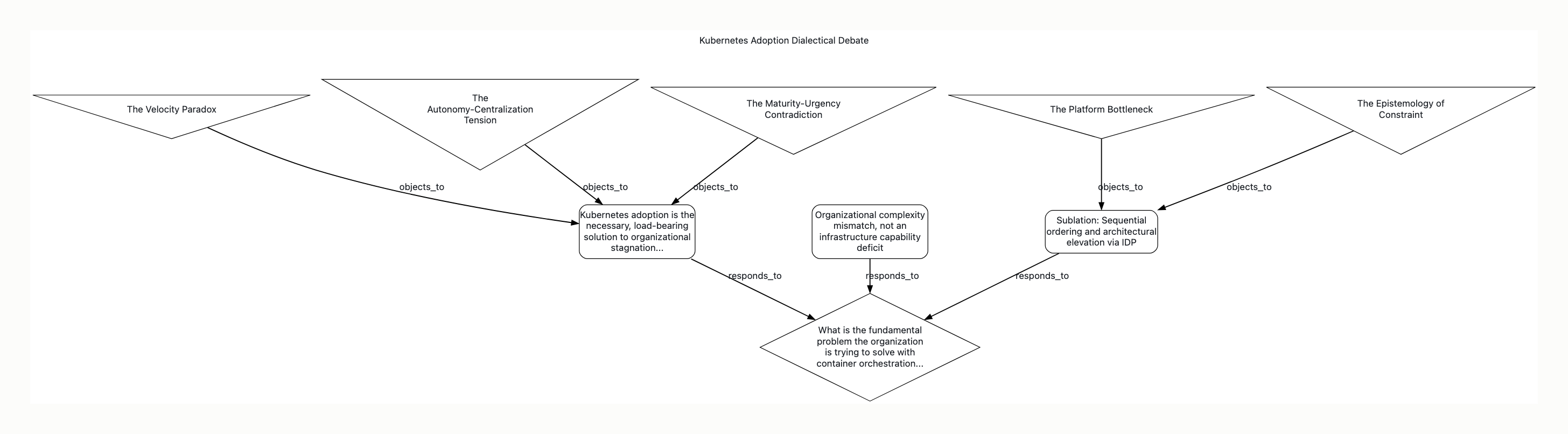
What is the fundamental problem the organization is trying to solve with container orchestration, and can Kubernetes adoption resolve it without destroying the current operational equilibrium, particularly when stakeholders across business, operations, engineering, and finance disagree on the very definition of the problem?
Thesis
The thesis, in its strongest form: Kubernetes adoption is the necessary, load-bearing solution to organizational stagnation caused by slow delivery and fragile, manual scaling. By committing to Kubernetes, the organization simultaneously achieves the mandate for automated, elastic velocity and the requirement for declarative, standardized infrastructure, with adoption friction framed as a temporary, necessary investment to escape compounding technical debt.
Internal contradictions in the thesis
- The Velocity Paradox — targets the thesis claim that Kubernetes increases long-term delivery velocity through automation — surfaces because the adoption mechanism inherently decreases short-to-medium-term velocity by imposing massive cognitive overhead, new failure modes (networking, RBAC, resource limits), and absorbing engineering bandwidth that would otherwise be spent on feature development.
- The Autonomy-Centralization Tension — targets the thesis promise of simultaneous developer self-service and strict operational standardization — surfaces because maintaining both requires an elaborate central platform team, contradicting the implicit assumption that autonomy can be achieved without introducing a new layer of centralization.
- The Maturity-Urgency Contradiction — targets the thesis positioning of Kubernetes as a mature, stable ecosystem that incurs compounding switching costs if deferred — surfaces because if the target is genuinely mature, migration tooling, documented patterns, and available expertise improve over time, meaning deferral should decrease switching costs rather than compound them.
Antithesis
Emerging from internal contradictions regarding the Velocity Paradox, Autonomy-Centralization Tension, and Maturity-Urgency Contradiction: The core problem is an organizational complexity mismatch, not an infrastructure capability deficit. Imposing a hyperscale distributed systems engine onto a team struggling with basic deployment friction constitutes organizational self-sabotage; delivery velocity must be protected by shielding developers through aggressive abstraction (managed PaaS, serverless) or ruthlessly simplifying the existing monolith, rather than adopting an orchestration layer the organization is not structurally prepared to operate. Furthermore, the debate is malformed by a missing constraint diagnosis, as the plurality of rationales indicates solution-driven behavior; adopting a complex tool without identifying and measuring the actual binding constraint forecloses simpler, cheaper alternatives that would directly address the true bottleneck.
Genuine contradiction
Genuine contradiction: The structural tension lies in the fact that the tool required to solve the organization’s scaling and standardization problems inherently introduces a level of complexity and centralization that actively degrades the developer velocity and operational equilibrium the organization is attempting to preserve.
Sublation
The contradiction is sublated through sequential ordering and architectural elevation, operating via explicit cancellation, preservation, and a defined transcending mechanism.
Cancellation
The thesis assumption that Kubernetes is a “drop-in” infrastructure fix without massive, dedicated, product-minded investment is canceled. The thesis assumption that developers should interact directly with the orchestrator is canceled. The antithesis assumption that binding-constraint diagnosis is a straightforward, politically neutral prerequisite is canceled. The antithesis premise that Kubernetes is inherently illegitimate if not perfectly matched to an immediate constraint is canceled.
Preservation
The business mandate for scalable, automated, resilient delivery is preserved. The operational requirement for declarative, standardized infrastructure foundations is preserved. The antithesis discipline of constraint measurement is preserved. The strategic imperative of shielding developers from underlying infrastructure complexity is preserved.
Transcendence mechanism
Sequential ordering and architectural elevation. First, mandate binding-constraint analysis as a non-negotiable precondition for any infrastructure decision. Second, if Kubernetes is the validated tool, implement it strictly through an Internal Developer Platform (IDP). The IDP acts as an invisible substrate, managed by a product-minded platform team that exposes Kubernetes solely via higher-order abstractions (e.g., developer portals, golden-path CLIs), thereby resolving the autonomy-centralization tension by delivering standardized infrastructure without exposing its complexity.
Recursion
- The Platform Bottleneck — emerges from the IDP sublation by shifting the organizational bottleneck to the platform engineering team; if this team operates with traditional operational mentalities (gatekeeping, one-size-fits-all templates, slow change-approval processes) rather than internal product management skills, it will recreate the exact developer friction and velocity loss the IDP was designed to eliminate.
- The Epistemology of Constraint — emerges from the mandated constraint-diagnosis phase, which is itself a politically contested artifact; different departments (Finance, Engineering, SRE) will measure and advocate for the constraint that aligns with their institutional KPIs, meaning the “objective” binding constraint is shaped by the measurer’s institutional position, leaving the diagnosis phase an unresolved site of wicked-problem friction.
(visual rendered — see artifact)
Generating question
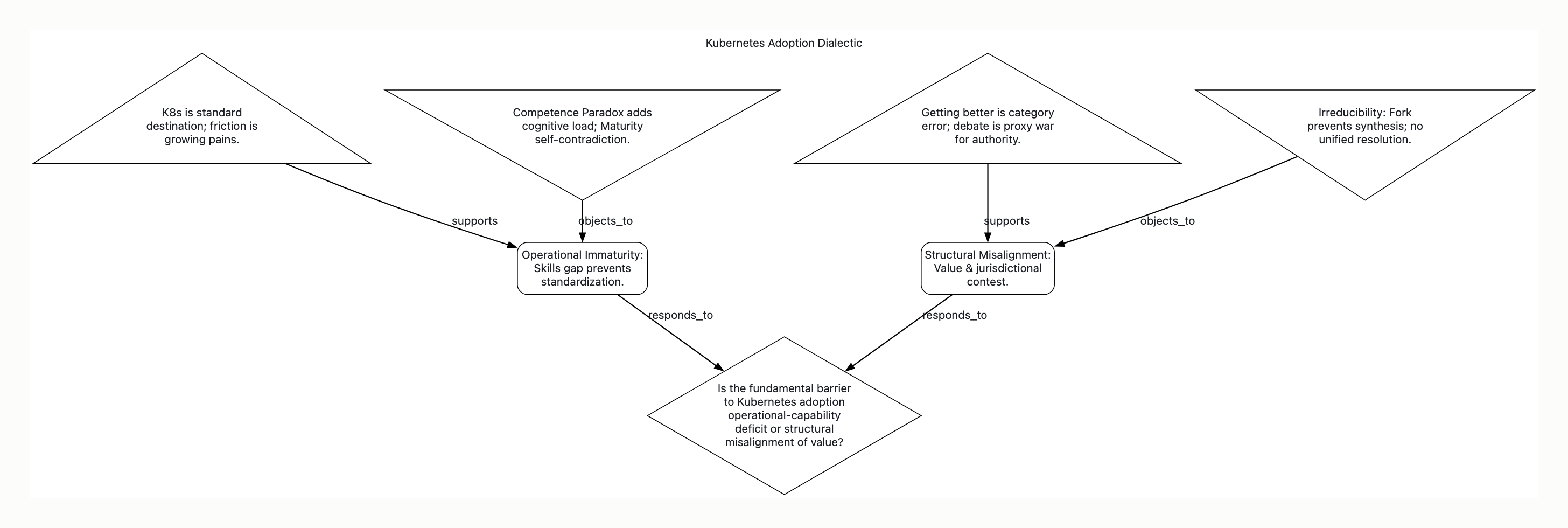
The dialectic addresses a wicked problem: your team’s Kubernetes-adoption debate keeps shifting because stakeholders disagree on what the problem is. This creates a framing tension between two distinct levels:
- Framing α (content-level): Is the fundamental barrier to Kubernetes adoption an operational-capability deficit, a security/governance failure, or a structural misalignment of economic value?
- Framing β (meta-level): If the debate “keeps shifting,” what dialectical structure produces the shifting, and what (if anything) can genuinely resolve it?
Thesis
The thesis, in its strongest form: Operational immaturity is the fundamental problem. Kubernetes is the correct, inevitable, industry-standard destination for cloud-native scale. Current friction, deployment delays, and outages are not inherent to the technology, but are temporary “growing pains” of organizational learning. The team possesses the promised agility and resilience; it simply lacks the mature processes, tooling integration, and specialized personnel. Once the skills gap is closed and CI/CD is standardized, the friction resolves, making operational maturity the master diagnosis that subsumes all other concerns.
Internal contradictions in the thesis
- The Competence Paradox — the thesis’s assumption that Kubernetes is the universal destination — attempting to solve systemic complexity by adding more specialized operational complexity, which actively exacerbates the cognitive load and resource drain stakeholders are already protesting.
- The Teleological Blind Spot — the thesis’s framing of friction as a mere “skills gap” — cannot account for structural resistance from security and economic stakeholders, treating collisions with compliance boundaries and diminishing returns as external noise rather than recognizing they are generated by the thesis’s own requirement to normalize extreme systemic complexity.
- Self-worsening framing — the thesis’s treatment of stakeholder disagreement as friction to be overcome by training and tooling — structurally generates the shifting it claims to solve, as evidence shows introducing more frameworks and artifacts increases disagreement rather than reducing it.
- Causal-arrow reversal — the thesis’s treatment of operational maturity as the cause and other framings as effects — is contradicted by evidence attributing inefficiency to organizational design (e.g., missing platform layers) and security governance, not generic immaturity.
- Flat-ontology limit — the thesis’s placement of maturity, security, skills, and silos on one plane as candidate causes — cannot accommodate the strategic misalignment position, which claims the problem is meta-level (the category of the problem itself), not a peer technical cause.
- Maturity self-contradiction — the thesis’s assertion that the team is operationally immature — clashes with industry data indicating that a vast majority of enterprises now view Kubernetes as a mature technology and rate their own management of it as mature, forcing the thesis to either redefine maturity to exclude execution or concede the gap is highly localized rather than systemic.
Antithesis
Emerging from internal contradictions IC-1 (Competence Paradox), IC-3 (Self-worsening framing), and IC-5 (Flat-ontology limit): The fundamental problem is not a capability deficit awaiting maturity, but rather a deep structural misalignment of value combined with an unresolved jurisdictional contest over who defines technology priorities. “Getting better at Kubernetes” is a category error that attempts to solve systemic complexity by adding more specialized complexity, guaranteeing cognitive drain and negative ROI. True maturity is knowing when a tool is unnecessarily complex; the security and economic drains are features of applying a hyper-complex distributed-systems orchestration engine to workloads that do not warrant it, not bugs in the adoption process. Furthermore, the debate “keeps shifting” not because the technical picture is unstable, but because the team is using Kubernetes adoption as a proxy war to stake jurisdictional claims. Every position is locally correct but functions to control the next eighteen months of investment. No investment in better tooling, training, or security controls will resolve the debate; each will be re-framed, because the dispute is about authority, not artifacts.
Irreducibility
The structural tension between the thesis and antithesis cannot be synthesized. The dialectic encounters an irreducible fork based on the generating question’s framing. If the dispute is fundamentally about runtime strategy (Framing α), the pathway requires architectural runtime bifurcation. If the dispute is fundamentally about definitional authority (Framing β), the pathway requires institutionalizing a problem-definition council. The mechanisms cannot be merged without forcing a false synthesis.
Sublation OR irreducibility declaration
The Adornian escape valve applies: the contradiction is irreducible because the dialectical sublation mechanism requires a unified level of analysis, but the structural tension between the thesis and antithesis produces two mutually exclusive pathways based on the generating question’s framing (architectural runtime bifurcation for Framing α vs. institutionalizing a problem-definition council for Framing β). Attempting to merge them silently averages the positions or forces a false triad. What stays unresolved: whether the team should prioritize architectural runtime bifurcation or institutionalizing a problem-definition council, as forcing either choice inherently validates one stakeholder’s jurisdictional frame while suppressing the other, leaving the contest over the “master diagnosis” unresolved.
Recursion
- The Jurisdictional Selection Problem — Who chooses the problem-definition council (or the gating criteria for runtime tiers) is itself a jurisdictional contest; defaulting to “the CTO” re-invokes the strategic frame, while seeking “consensus” produces deadlock.
- The Validation Metric Problem — What metric proves the chosen path is “right” remains a position in disguise; judging by stakeholders ceasing to disagree measures political acquiescence, judging by deployment velocity imports the operational frame, and judging by security posture imports the security frame.
- The Decay of Binding Force Problem — Even if a binding problem statement or gating mechanism is established, it erodes under operational pressure; the next incident surfaces a new framing, requiring the council or gating rules to be re-litigated, making the institutional review cadence itself a new problem to govern.
(visual rendered — see artifact)
The question this maps
Why does your team’s Kubernetes-adoption debate keep shifting as it tries to define the problem — why can’t stakeholders agree on what adoption is for — and is that shifting a framing artifact to be facilitated away, or a genuine conflict that no amount of definition can dissolve, and what would it actually take to settle it?
Three interpretive choices are baked into everything below, and you can overturn any of them:
- The wicked problem treated here is the meta-problem (“we can’t agree what the problem is”), not the yes/no “should we adopt Kubernetes.” The IBIS root is therefore a definitional issue, not a decision.
- The stakeholders below are archetypes inferred from how Kubernetes-adoption debates fracture, not named individuals — map your real people onto them.
- The deliverable is structured-text IBIS plus a best-effort
ora-visual envelope. The markdown map is the reliable artifact; the envelope’s exact field names are unverified against the visual schemas and need a validation pass before you trust them (details at the end of the map).
The IBIS issue map
Two complementary articulations carry the central finding, and both are load-bearing:
Every position below is a different problem definition, not a different answer to one problem. Each, when pressed, spawns a sub-issue that re-frames the root — and that spawning is the “shifting” you’re experiencing. There is no convergent leaf: every branch loops back to the root. That is the signature of a wicked problem, not a facilitation failure.
Structurally, the debate has three nested issues, and the team keeps trying to answer the top one (a value question) with tools that only work on the bottom one (an engineering question). Every time someone scores options, the frame-fight drags the conversation back up.
Root issue I1 — “What problem does Kubernetes adoption solve?” Eight rival problem definitions, each with its source-metaphor (Conceptual Metaphor Theory, Lakoff & Johnson 1980; “X IS Y” is standard CMT notation), its strongest pro, its strongest con, and the sub-issue it spawns that re-opens the root:
- P0 — Defer / keep the status quo (null option, frequent de facto winner). Pro: present load is met; deferral preserves optionality and capital until a forcing signal appears. Con: deferral silently compounds latent risk and tech debt — “do nothing” is itself an irreversible bet on the future resembling the present. Sub-issue: is deferral a decision or an evasion? (folds into cost-horizon and mandate; reopens the root by denying there is one).
- P1 — Scaling (infrastructure leadership; K8S IS AN ENGINE). Pro: manual/snowflake scaling already causes peak-load incidents; load is spiky and autoscaling is a real missing capability. Con: managed PaaS scales further without K8s — “are we actually scale-bound, or is this résumé-driven?” Sub-issue: real demand or anticipated demand?
- P2 — Velocity (delivery champions; K8S IS A HIGHWAY / paved road). Pro: self-service deploys + GitOps measurably cut release coordination and lead time. Con: the bottleneck is review/test/org structure, not deploy mechanics; gains are back-loaded behind 6–12 months of platform build, and near-term velocity drops. Sub-issue: is the bottleneck technical or organizational?
- P3 — Reliability / operational risk (risk-averse skeptics, ops veterans; K8S IS AN OPERATIONAL BURDEN). Pro: a new control plane, RBAC surface, and networking model are a genuine new failure/attack class, and the team lacks 3 a.m. on-call depth. Con: the status quo’s manual recovery is also a reliability risk and K8s standardizes recovery; deploy fragility may be a far-cheaper CI/CD fix than a cluster. Sub-issue: does adoption reduce net risk or merely relocate it?
- P4 — Cost (FinOps/finance; K8S IS A CONTAINER SHIP / density). Pro (cost-savings framing): bin-packing improves compute density. Con: control-plane overhead, specialist hiring, and the migration-year double-running frequently raise TCO and can exceed the compute saved at mid-scale. Sub-issue: over what horizon do we measure cost? (1-year vs 3-year flips the answer).
- P5 — Missing platform capability (platform-ops advocates; K8S IS A FOUNDATION). Pro: teams reinvent deploy/observability per service; a substrate compounds — every later capability gets cheaper. Con: openly circular — it defines the problem as “we lack the solution,” presupposing K8s; an unscoped platform mandate nobody authorized. Sub-issue: is “platform” a need, or a solution in search of a justification?
- P6 — Organizational, not technical (skeptic variant). Pro: every other position dissolves into team incentives, not system constraints; Conway’s law — tooling won’t fix a coordination problem (Conway 1968; the “tooling won’t fix coordination” application is an inference from the law). Con: dismisses genuine technical constraints as politics; over-corrects. Sub-issue: is the debate about systems or about whose mandate grows? (the position that makes everyone defensive and guarantees the frame shifts again).
- P7 — Parity / talent (business/product leadership; K8S IS A TICKET OF ADMISSION / table stakes). Pro: hiring and ecosystem maturity are real advantages. Con: “everyone runs K8s” is argument-from-popular-opinion; the relevant population (your scale, your team) may be exactly where it is a poor guide.
Sub-issue I2 — “What does adoption even mean?” Managed (EKS/GKE/AKS) vs self-hosted; full migration vs new-workloads-only; central platform team vs every-team-runs-its-own. This is where the definition visibly slips mid-meeting. Conceptually it is a descriptive-vs-engineering confusion in the conceptual-engineering sense (the Burgess–Cappelen–Plunkett literature contrasts describing a concept with engineering/ameliorating a better one): half the room reports what “adoption” currently would mean; half propose what it should mean. They talk past each other because they are in different modes.
Sub-issue I3 — “Who bears the operational cost, and who declares it ‘done’?” This is the Rittel stopping-rule question (Rittel & Webber 1973, “Dilemmas in a General Theory of Planning”; “no stopping rule” is the canonical second property). It is unanswered, and it is the real heat source.
Diagnostic node X (frame-conflict signature): P5’s strongest pro (“a substrate compounds”) is numerically identical to P2/P4’s strongest con (“an unscoped cost mandate”) — the same fact carrying opposite valence by frame. Independent options do not do that; mutually-constituting positions do. This is the signature of a frame conflict, not a fact dispute.
The envelope below renders the single strongest pro and con per position; the full argument sets live in the prose above (a stated rule, so the selective population is principled). The envelope uses standard IBIS vocabulary — nodes issue/position/argument, edges responds-to/supports/objects-to, argument polarity pro/con. The exact ora field names are unverified against config/visual-schemas/ (the ibis type); that is a known remaining uncertainty, resolvable by checking the ibis schema or running a render-envelope.js smoke test. Whether the ibis envelope is part of the dialectical-analysis mode’s declared emission contract or a Phase-A-inferred attachment is also unconfirmed. A mechanical key-mapping note makes a renderer mismatch a one-pass rename rather than a user-derived fix: node.kind → node.nodeType, edge.kind → edge.type, stance/polarity interchangeable (values unchanged in all three).
Thesis
The thesis, in its strongest form: the debate shifts because the team has not finished the analytical work of producing a single agreed problem definition; disagreement is an epistemic deficit and nothing more — a framing artifact, fully resolvable by disciplined reframing. Every position is a real facet of one coherent underlying problem (the organization has outgrown its current deployment substrate); scaling, reliability, velocity, cost, platform, and parity are six lit faces of the same object seen from six desks, not six problems. A competent facilitator maps all framings onto one shared problem statement, elicits and weights decision criteria, scores managed-vs-self-hosted and full-vs-partial against those weights, and the disagreement dissolves because it was never substantive. Once the problem is fixed, the Kubernetes yes/no falls out almost mechanically from the criteria. The completeness claim is total: all of the shifting is accounted for by incomplete framing; there is no residue the shared statement cannot absorb, nothing intrinsically unfixable — only work not yet done.
Internal contradictions in the thesis
- The neutrality / definition-source contradiction — targets the thesis’s twin commitments to neutrality (every framing a real facet, none privileged) and to a definition that exists independently of stakeholder interests, to be discovered. The contradiction surfaces because the thesis’s own method sources the definition from those interests (stakeholder interviews, weighted criteria) and must collapse the frames to one shared statement — which forces a privileged vocabulary (state it in the language of cost, or risk, or velocity). Unification imports the very plurality it promised to dissolve and crowns a winner. “Converging on the definition” is structurally identical to “adjudicating whose interest dominates,” and the thesis offers no neutral adjudication procedure — only the hope that clarity produces agreement. The method refutes its own premise.
- The solution-precedes-problem contradiction — targets the thesis’s treatment of problem and solution as separable in time (define first, decide second). The contradiction surfaces because “Kubernetes” is already the subject of every position; each problem definition is a solution wearing a question’s clothing (“scaling” is K8s-shaped; “cost” names not-K8s; “platform” and “parity” define the problem as “the thing K8s answers”). “Define first” is already a covert “decide first”; definition is downstream of the solution, not upstream. The method cannot reach a pre-solution definition because none exists for a problem of this kind.
- The completeness-defeats-decidability contradiction — targets the thesis’s completeness claim directly. The contradiction surfaces because if every framing is genuinely valid, then “scaling demands it” (P1) and “it adds unacceptable risk” (P3) are both valid and generate opposite decisions. A complete map of valid framings yields paralysis, not resolution. The completeness claim is precisely what makes the decidability claim impossible: the more honestly the thesis honors every view, the less it can decide.
Antithesis
Emerging from internal contradictions 1, 2, and 3: the debate shifts not because framing is incomplete but because it is already complete from every vantage point, and that completeness is incompatible across stakeholders. It is a genuine value-and-power conflict wearing a definitional costume — wicked in Rittel’s strict sense — and no definition dissolves it because the definition is the conflict. There is no shared problem because there is no shared criterion of “better,” and every problem statement is a political act distributing cost, control, and credit. Settlement comes from power or procedure — never from clarity; clarity is the one thing that cannot help, because the disagreement was never about facts.
The mechanism is structural, not motivational — and that is the crux. This is not a charge of bad faith. The risk-averse engineer sincerely believes K8s adds failure surface; that conviction is honest — and that frame also keeps reliability in the skeptics’ custody. Infra leadership’s “scaling” frame, equally sincere, also makes infra the hero and funds its headcount; the velocity frame also subordinates ops to product. Each frame can be held on entirely honest technical grounds and still distribute cost/control/credit toward its holder. That is what makes it intractable: you cannot dissolve it by appealing to good faith, because everyone has good faith and the conflict persists anyway. These are not six faces of one elephant; they are competing claims about whose pain counts as the problem. The “shifting” is the rational behavior of actors who each correctly perceive that whoever defines the problem wins the decision — a coalition re-contests the frame exactly when it starts losing, which is why the definition moves every time the meeting nears a conclusion. Allison’s Model III names this: the outcome is the resultant of bargaining among interest-bearing players, not the choice of a unitary rational actor; treating it as Model I (“let’s just define it correctly”) is the category error generating the frustration. The facilitator’s “shared statement” is the dominant coalition’s frame dressed as consensus, imposed from a view-from-nowhere that does not exist.
This antithesis has a boundary, and naming it is part of arguing it honestly rather than retreating from it. The “coalition that wins” reading rests on a symmetry assumption — that all positions are equally complete and equally well-evidenced. That assumption is load-bearing and only partly true. If P1 carries actual incident data and P5 is openly circular, the positions are not equipotent and the pure-power reading overshoots — where one definition is better-grounded, the disagreement is partly adjudicable on evidence. The antithesis holds with full force across the equipotent core (interests genuinely incommensurable); where evidence asymmetry exists, the standoff is asymmetric and clarity can do some real work.
A second antithesis was tested before locking the one above, derived from contradiction 2: this isn’t a wicked value conflict at all — it’s a constraint-mapping problem misdiagnosed as wicked. The positions don’t generate each other; they’re parallel, independent options to be scored against weighted criteria — nothing dialectical, just an unfinished decision matrix. The test: do the positions genuinely generate each other (dialectic) or sit independently (constraint-mapping)? The discriminating evidence is node X — P5’s strongest pro is identical to P2/P4’s strongest con, the same fact carrying opposite valence. Independent options don’t do that; mutually-constituting positions do. The finding: the constraint-mapping reading holds at the implementation layer (managed-vs-self-hosted is genuinely scorable) but fails at the framing layer, because there the criteria-weights are themselves the contested object — you cannot score options against criteria when which criteria is the fight. This is the finding that explains the shifting: the debate is constraint-mapping at the implementation layer and wicked-dialectical at the framing layer, and the team keeps importing the lower layer’s method (scoring) into the upper layer’s problem (whose frame wins), where it cannot work. The value/power antithesis is the right one for I1; the constraint-mapping reading is correct but only for I2/I3.
Genuine contradiction
At the corpus level the structural tension is this: the thesis claims that a complete, neutral problem definition is discoverable and that consensus-on-substance is the precondition for acting; the antithesis claims the definition is the conflict, that completeness is what makes decision impossible, and that only power or procedure settles it. The two cannot both be true of the same layer of the problem — but, as the layered finding shows, they may be true of different layers. That is what makes a partial sublation available rather than a flat standoff.
Sublation — a partial Aufheben, conditional and explicitly not averaging
The transcending move: stop seeking agreement on what the problem is (the thesis’s substance) and stop declaring it unwinnable (the antithesis’s pure power). Instead change the level of the question — from the unanswerable epistemic “what is the problem?” to the answerable governance question “who owns the framing bet, and under what conditions is it re-opened?” Concretely, the team agrees on a revisable commitment contract rather than a fixed definition: (a) which definition is adopted for a bounded period, (b) the observable signal that would falsify it, (c) the reversibility budget — how much is spent before a forced checkpoint. A named decision-owner picks the frame openly as a provisional bet; dissenting frames are preserved as documented dissent that triggers a scheduled revisit, not erased into false consensus. Interests don’t disappear — they get named and time-boxed rather than smuggled into the word “the problem”; framing becomes a governance act (owned, dated, reversible) rather than an epistemic discovery (found, neutral, permanent), making power visible and accountable instead of denied (thesis) or surrendered to (antithesis). This is the operational content of Rittel’s doctrine: you cannot define a wicked problem before acting on it, so you make small reversible commitments that teach you the problem. Off-the-shelf vocabulary attaches cleanly: the reversibility budget maps onto the one-way-door vs two-way-door taxonomy (two-way-door choices made fast and locally; one-way-door choices warrant deliberation and senior ownership); the falsifying signal maps onto fitness functions (continuously-evaluated architectural checks) and time-boxed spikes (bounded experiments that buy information before commitment).
Cancellation
- Cancelled in the thesis: the belief that a stakeholder-independent, neutral master-frame is discoverable, and that consensus-on-substance is the precondition for acting — that definition is pre-political hygiene. This is correctly cancelled because contradictions 1 and 2 show no such definition exists for a wicked problem; unification always crowns a winner.
- Cancelled in the antithesis: the fatalism that only naked power decides, that nothing is decidable, that it is pure power all the way down and clarity is therefore worthless. This is correctly cancelled because it overshoots — it cannot explain why teams sometimes coordinate without anyone “winning,” it ignores the evidence-asymmetry boundary, and the implementation layer is genuinely scorable.
Preservation
- Preserved from the thesis: the demand for legitimacy and coordination — you genuinely cannot adopt Kubernetes without shared commitment; and the recognition that the framings are partial, so that a shared map (this IBIS) materially helps — visibility is real progress.
- Preserved from the antithesis: that every problem definition encodes interests and is an irreducibly value-laden, cost-distributing act — “the problem” can never be facilitated into neutrality.
- The mechanism by which they coexist: the two preserved truths sit at different levels of the question. The thesis’s demand for coordination is honored at the governance level (an owned, dated, reversible bet is a shared commitment); the antithesis’s truth that definitions encode interests is honored by making those interests named and accountable rather than denied. The contract does not blend the six frames into mush and does not split the difference between defining and acting — it abandons the goal of a fixed definition entirely and substitutes a different object of agreement. Both sides wanted settlement; the sublation delivers settlement by changing what gets settled (substance → procedure).
This sublation is not generally available, and its scope is bounded by org type. It lands in hierarchical orgs with a clear, accepted decision-owner (VP Eng / CTO / a single accountable platform lead whose standing to assign frame-ownership is itself uncontested). It fails in flat / co-equal-stakeholder orgs (consensus cultures, multi-team federations, partnerships of peers, two merged orgs of equal weight) where no one holds uncontested standing to name the owner. The more an org resembles the second picture, the more the sublation collapses back into the antithesis.
Where the sublation cancels nothing — two irreducible cores
The Adornian escape valve applies to two distinct portions of the problem, and they are preserved here intact rather than forced into the synthesis.
Residue A — material/technical irreversibility vs provisionality. The “provisional, revisable commitment” mechanism, tested against the actual decision, fails for the decision’s core: Kubernetes adoption is substantially irreversible past a threshold (migration, specialist hiring, re-platforming, operational lock-in). “Revisable commitment” is partly a fiction for a choice whose reversibility budget approaches zero. The contradiction between “we must stay revisable” and “this commitment cannot be unmade” does not sublate for the irreversible core. The threshold is itself a design variable that calibrates where the residue begins: managed/hosted Kubernetes (EKS/GKE/AKS) and progressive/strangler-fig migration materially move the lock-in threshold outward — managed control planes dissolve much of P3 (you don’t run the control plane or carry its full 3 a.m. surface) and much of P4’s specialist-hiring cost, and incremental migration keeps far more of the decision in the two-way-door region for far longer. This is a boundary condition on the residue, not a refutation of it: even with managed services and strangler-fig migration, a genuinely one-way-door portion remains (data-plane and workload coupling, organizational dependence on the platform, the operational model teams reorganize around). For that portion the standoff between epistemic humility and material commitment stands unresolved, requiring an authority to simply make and own the call.
Residue B — the authority/legitimacy gap. The governance move requires legitimate authority to assign frame-ownership — but that authority is the very same contested power, one level up. The mechanism that fails is transcendence-via-governance, and it fails for lack of a legitimate meta-authority: in a genuinely flat or co-equal-stakeholder org with no one empowered to name the decision-owner, the sublation does not land, and the conflict reproduces as “who gets to appoint the appointer.” Where that authority is absent, the honest finding is the Adornian one: this will be settled by power or it will not be settled at all — and the analysis should say so rather than manufacture a facilitation theater that pretends otherwise. Name that authority gap as the actual blocker; no facilitation technique substitutes for it.
Recursion — the contradictions the sublation generates next
- Authority/procedure recurses (the political fact migrates upward). Whoever designs the revision procedure — what counts as a falsifying signal, who owns the checkpoint, how big the reversibility budget is, who names the owner — re-encodes the same value contest one level up. The antithesis’s political fact does not vanish; it migrates to the meta-level, threatening infinite regress (“who owns the owner-assignment?” / “agree on the procedure for agreeing on the procedure”). The sublation buys a better-bounded contest, not its dissolution.
- Reversibility erodes exactly when you’d use it (a clock mismatch). The sublation leans on a “reversible, time-boxed bet,” but infrastructure migration manufactures lock-in (sunk cost, retraining, architectural coupling). The map’s own arguments put platform build-out at 6–12 months before velocity gains land (a2c/a3c), and architectural coupling + operator retraining + sunk migration cost typically harden lock-in over the same 6–18-month window. A revisit cadence set to the natural “did the bet pay off?” horizon (6–12 months) fires precisely when reversal cost has peaked — the escape hatch rusts shut on schedule.
- Documented dissent can become permanent litigation. Preserving the losing frames as a living dissent record keeps the frame-war alive and citable rather than settling it; every later friction re-opens the file. The mechanism meant to honor minority frames can institutionalize the very instability it was meant to contain.
What to do with this
The part of the debate that keeps shifting is meant to keep shifting and should be managed by procedure, not consensus — but there is a residual, irreversible core where no procedure saves you from a decision someone with the mandate must make and defend. Treating the whole problem as the first kind (the thesis’s error) produces endless re-framing; treating the whole as the second kind (pure power, the antithesis’s error) produces premature lock-in. The work is to draw the line between them: run I1 (“what is the problem?”) not as a convergence exercise (structurally unwinnable as one) but as an owned, dated, reversible framing bet; run I2/I3 as scored constraint-mapping; and choose managed services + incremental migration deliberately to push the irreversibility line outward — that line-drawing is the first concrete, falsifiable commitment. But if your org is flat enough that no one has standing to own that bet, the honest reading is the antithesis’s, not the sublation’s: the authority gap is the actual blocker, and naming it is more useful than any facilitation technique.
Three uncertainties travel with this analysis rather than being resolved inside it. The IBIS envelope’s field-name conformance against the ibis schema in config/visual-schemas/ is unverified — the key-mapping note above makes the fix mechanical if the renderer rejects it. Whether the ibis envelope belongs to the dialectical-analysis mode’s declared emission contract or is a Phase-A-inferred attachment is unconfirmed. And the symmetry question underwriting the antithesis — whether your eight stakeholder definitions are genuinely equipotent or some are objectively weaker — is resolvable only with your actual stakeholder data and each position’s real evidence base. Where the evidence is asymmetric, clarity does more work than the antithesis allows; where it is symmetric, the governance move is the only thing that settles it.
(visual rendered — see artifact)