How I’m reading the task
Weick’s point is that in genuine ambiguity you can’t analyze your way to clarity first and act second — meaning is retrospective. You act, the environment “talks back,” and only then do you have material to interpret. So a 2×2 here isn’t a forecast (accuracy) — it’s four plausible stories you can act into (plausibility), each one a probe that makes the murk give up a cue. The matrix is the map in Weick’s lost-soldiers-in-the-Alps story: possibly the wrong map, but the thing that gets you moving, and moving is what generates the data you’ll later make sense of.
So I’ve built each quadrant to carry five things: a narrative, the tell (the extracted cue you’d retrospectively recognize), a probe (a small reversible action that enacts into it), what it reveals, and the meaning to pre-stage so you can build it fast when the cue lands.
The two axes
For an ambiguous, fast-moving shift, the two uncertainties that most change what you’d do are usually:
- Axis A — How value settles: does the market consolidate around one dominant answer, or fragment into many niches with no clear winner?
- Axis B — What the shift rewards: does it still reward incumbent assets (your scale, distribution, relationships, data), or does it reward new capabilities you don’t yet have?
These are deliberately generic — swap in your two real biggest uncertainties and the whole grid re-populates (I’ll offer to re-run it at the end). But these two are orthogonal and decision-relevant for most market shifts, so they’re a good default.
The matrix
| Rewards incumbent assets | Rewards new capabilities |
|---|
| Consolidates | ① The Annexation — one answer wins, built on assets the big players already own. Scale and distribution decide. | ② The Coup — one answer wins, built on capabilities we don’t have. A reinvented player sets the standard. (Most dangerous.) |
| Fragments | ③ The Archipelago — many niches, but our existing assets travel across all of them. Brand/relationships still matter pocket by pocket. | ④ The Frontier — many niches, each rewarding novel capability. Permanent experimentation, no stable advantage, land-grab. |
The four scenarios as sensemaking probes
① The Annexation — consolidating, incumbent assets win
- The tell: the early “disruptors” start partnering with or getting bought by the big distribution players; the shift gets absorbed into existing channels rather than routing around them.
- Probe: double down on one existing asset (a distribution relationship, a data moat) and see whether it gets more valuable as the shift accelerates. If demand for it rises, you’re in this quadrant.
- Reveals: whether your current advantages are load-bearing or decorative.
- Pre-stage the meaning: “This shift is a channel change, not a capability change — we win by owning the pipe, faster than the others wake up.”
② The Coup — consolidating, new capabilities win — the one to instrument hardest
- The tell: a player you didn’t rank starts setting the vocabulary — customers describe their need in that company’s terms. Your sales conversations start including a competitor’s framing unprompted.
- Probe: try to build or buy the suspected new capability at toy scale. The friction you hit teaches you how far behind you actually are — which is the number that matters most here.
- Reveals: the gap between what you have and what the winning standard requires, while it’s still cheap to close.
- Pre-stage the meaning: “Our assets are being stranded. The question is acquire-the-capability vs. become-a-component-supplier to whoever’s winning — decide before the standard locks.”
③ The Archipelago — fragmenting, incumbent assets win
- The tell: lots of small entrants, none breaking out; customers segment into pockets with different needs; your brand/relationship still opens doors in each pocket.
- Probe: take one existing asset into two unrelated niches at once and watch whether it transfers. If it does in both, advantage is portable and you can be a multi-niche aggregator.
- Reveals: which of your assets are general-purpose (travel) vs. niche-specific (don’t).
- Pre-stage the meaning: “No single bet wins — we win by being the connective tissue across fragments. Portfolio, not flagship.”
④ The Frontier — fragmenting, new capabilities win — highest entropy
- The tell: every quarter the “winning approach” is different; nothing compounds; experiments don’t generalize.
- Probe: run several cheap, time-boxed, genuinely different bets in parallel and treat the portfolio’s variance as the signal — you’re learning the shape of the space, not picking a winner yet.
- Reveals: whether anything is starting to compound (if so, you may be sliding toward ②).
- Pre-stage the meaning: “Optionality is the strategy. Optimize for cheap-to-run + fast-to-kill, and protect a learning budget rather than a roadmap.”
What holds across all four (the Weickian move)
The discipline isn’t to pick the quadrant — it’s to stay in motion and keep noticing what talks back. Three things to put in place:
No-regret moves (pay off in every quadrant, so you can start now without resolving the ambiguity):
- Instrument the master cues below so retrospection has material.
- Build one cheap probe per quadrant rather than one big bet on the most likely one — the probes are how the environment answers you.
- Shorten your sense → act → re-sense loop; in a fast shift, cadence beats foresight.
The master cues that disambiguate which quadrant you’re in — watch these explicitly:
- Is anything compounding? (consolidating ↔ fragmenting) — does this quarter’s progress build on last quarter’s, or reset?
- Are your existing assets getting more or less valuable as the shift accelerates? (incumbent ↔ new capability)
- Whose vocabulary are customers using to describe the need? — the earliest, cheapest tell for ②.
The retrospective loop, run on a fixed cadence (say, biweekly): name the one cue that moved most → ask which quadrant it pulls you toward → adjust the live probes → write down the meaning you just built, so the next pass can revise it. That written trace is the sensemaking — “how can we know what we think until we see what we did?”
The grid above runs on my two default axes. The version that’s actually worth acting into uses your two biggest live uncertainties — name them (even roughly), and I’ll re-populate all four quadrants, tells, and probes against your real situation. A sentence or two on the market and where your team sits would sharpen the cues considerably.
This is not a traditional strategic planning exercise. It is a Sensemaking Rehearsal.
In Weickian theory, we do not hold a forecast because clarity does not exist yet. Instead, we act as “boundary endefinitionalists”—we must probe the unknown to define it. A 2x2 matrix in a Weickian context is not a forecast of what will happen; it is an instrument for revealing who we are and what we might become in response to reality.
Here is the framework for building, testing, and acting into this matrix.
I. The Premise: Meaning is Retrospective
Before choosing your axes, accept the Weickian axiom: We do not understand the event so much that we can predict the outcome; rather, we construct meaning by acting upon the event.
The goal of this matrix is not to prepare for four specific futures, but to stress-test your organizational identity against four potential realities. We are using the ambiguity as a mirror to see what assumptions we are currently holding.
II. Defining the Axes (The Uncertainties)
You must define these not by what you fear, but by what is equivalent (ambiguous). If you ask the team “What are the risks,” they will give you certainties. You must ask “Where are the signals contradictory?”
Step 1: Identify the “Equivocs”
Look for data points that contradict each other (e.g., “Customers love the new feature” vs. “Churn is rising”).
Step 2: Select Two Flanking Uncertainties
Choose the two highest-leverage factors that currently lack a formula.
-
Example Set (for illustration):
- Axis X: The Pace of Technological Saturation (Rapid Obsolescence vs. Stable Utility).
- Axis Y: The Nature of Regulatory Intervention (Adaptive/Permissive vs. Restrictive/Defensive).
-
Note: Swap these for your specific market. (e.g., “Repair Culture” vs. “Subscription Culture,” or “Remote Work” vs. “Return to Office”).
III. The 2x2 Matrix: Four Worlds of Plausibility
Do not look for the “likely” corner. Look for the plausible corners.
In this exercise, we assume every quadrant is equally likely.
| Low Tech Saturation (Utility Stays Long) | High Tech Saturation (Utility Fades Fast) |
|---|
| Permissive Regulation | 1. The Golden Era. High retention, slow innovation. Valued for stability. | 2. The Hyper-Growth Trap. Fast novelty, short lifecycle. “Winner-takes-all” ownership risk. |
| Restrictive Regulation | 3. The Fortress. Slow to move, safe from disruption, but risk of irrelevance. | 4. The Burnout / Disruption. High churn, high friction, rapid decline. |
IV. The Exercise: “Act Into the Ambiguity”
Now, treat this matrix as a Simulation of Identity, not Strategy. You are not choosing which world wins. You are asking: “Which of these stories does our team cohere around?” and “What does playing out World 4 look like for our team’s meetings?”
Phase 1: The “Stress Test” Conversation
For each corner of the matrix, ask the team three questions. Do not write strategies yet. Write Identity Checks.
Question 1 (The Observation):
- “In [Quadrant], what is a specific phrase a customer or stakeholder would say to us next month?”
- Why: This defines the boundary of the market shift.
Question 2 (The Decision):
- “In this world, which of our current values would we have to abandon to survive?”
- Why: Weick calls this “consequence assessment.” It reveals what you can give up, not just what you must do.
Question 3 (The Signal):
- “What is the signal we missed today that would confirm we are entering this quadrant?”
- Why: This builds a retrospective sensemaking loop. You will see if your model matches reality.
Phase 2: The Probes (Acting Into the Ambiguity)
Do not wait for clarity. In the spirit of Weick, you must probe the reality to generate data you do not currently have.
Assign one person or small team to be the “Scavenger” for each quadrant. Their job is not to execute strategy, but to nudge the environment to test the theory.
- Probe World 1: Pitch a “Slow Solution” to 3 clients. Do they react positively? If yes, Speed is not the driver; Utility is.
- Probe World 2: Advertise a “Rapid Ephemeral Offer.” Does it sell? If no, then High Saturation doesn’t matter.
- Probe World 3: One of our departments must delay a decision. Does morale withstand the wait?
- Probe World 4: Draft a “Compliance Report” and leak the redacted version to internal management. What do their reactions tell us about the “Restrictive” reality?
The purpose: You are generating facts through action. If the team bristles at the “Probe,” that is a signal the scenario is even less plausible than the narrative suggests.
V. The Retrospective Build: Constructing Meaning
After 2-4 weeks of this exercise (probing and observing), hold a Retrospective Sensemaking Session.
Weick emphasizes “Retrospective Construction” as the primary way we understand what happened. You are not looking back to see what you did; you are looking back to see what you meant.
1. Re-Name the Event
Ask the team to take your original ambiguous market shift and give it a name based on the matrix you built.
- Example: “Is this a ‘Regulatory Winter’ or an ‘Evolutionary Stagnation’?”
- Purpose: Language frames action. You cannot act on “runaways”; you must act on “transitions.”
2. Map Your Resilience
Overlay your actual results against the 2x2 Matrix.
- “Signal X appeared. We suspected World 1, but reality moved toward World 3.”
- “What caused our team to hesitate, and how does that hesitation explain the meaning of the market?”
3. Construct the “Backstory”
In Weickian terms, a recent event is hard to understand without a story connecting it. Ask the team:
- “Did we survive World 1 because we were right, or because we were less expensive?”
- “Did we fail in World 4 because we lacked technology, or because we lacked trust?”
- Purpose: To inventory not just the market failure, but the internal capability failure.
VI. Summary Protocol for Your Team
If you need to facilitate this tomorrow, follow this sequence:
- Select the Axes: Find the two “Equivocs” (contradictory signals).
- Draft the 2x2: Ensure all four corners look different in terms of risk and identity.
- Play the Profilers: Assign people to push toward each quadrant for 1 week.
- Capture the Data: Record what they felt in that quadrant, not just what they did.
- Retrospective Review: Ask “What did our team value that the market stripped away?”
The Weickian Outcome:
The exercise does not end with a budget or a report. It ends with a new shared story about the team’s susceptibility to uncertainty. You will have built a “Cognitive Safety Net”—a shared language that allows the team to describe ambiguity without panic, knowing they have already “simulated” the worst-case identity.
Final Prompt for your Team:
“If we are in Quadrant [X] today, and we have no resources, who would we be to them? And who would we be to ourselves?”
2×2 Scenario Planning Exercise — Weickian Sensemaking Framework
Focal Question
Navigate an ambiguous, fast-moving market shift your team cannot yet fully interpret. Horizon: 3–5 years for tactical investment cycles; up to 20 years for structural regime shifts. The planning output must define the question explicitly to avoid fuzzy scenarios that collapse into generic advice.
Driving Forces Classified
Predetermined elements (will happen regardless of axis position):
- Social: Basic human needs remain constant (safety, status, belonging); fundamental work rhythms shift toward remote/hybrid norms
- Technological: Moore’s Law fundamentals continue (compute capacity increases ~2x annually); network effect dynamics apply to digital platforms
- Economic: Long-run productivity growth tends positive; declining immunological response to centralized capital allocation
- Political: State capacity for regulation remains (governments will act); fiscal deficits will moderate over cycles
- Environmental: Carbon cycle rules apply; physical constraints on resource allocation persist
Critical uncertainties (could go either way — team to classify and justify):
- Social: Consumer trust in digital intermediaries → eroding or strengthening (±30–70% evidence)
- Technological: Speed of AI capability proliferation → slow adoption or rapid market disruption (±30–70% evidence)
- Economic: Competitive dynamics → price competition as dominant or margin protection via differentiation
- Political: Regulatory posture → centralized coordination or fragmented jurisdictional competition
- Environmental: Energy transition path → gradual transition or accelerated carbon policy intervention
Critical Uncertainties as Axes
Selection Protocol: Choose exactly two forces from the critical uncertainties list. Run the “Regression heuristic” for each pair: Can one axis’s value change while the other stays fixed? If YES (e.g., adoption speed can vary independently from market fragmentation), axes are independent. If NO (e.g., cost contraction always moving with price pressure), they covary — reject.
Example Axis Pair Template:
- Axis X: [Uncertainty Name, e.g., Market Fragmentation]. Low-label: […]. High-label: […]. Drivers represented: [e.g., number of interoperable standards, regional regulation variation, partner ecosystem cohesion].
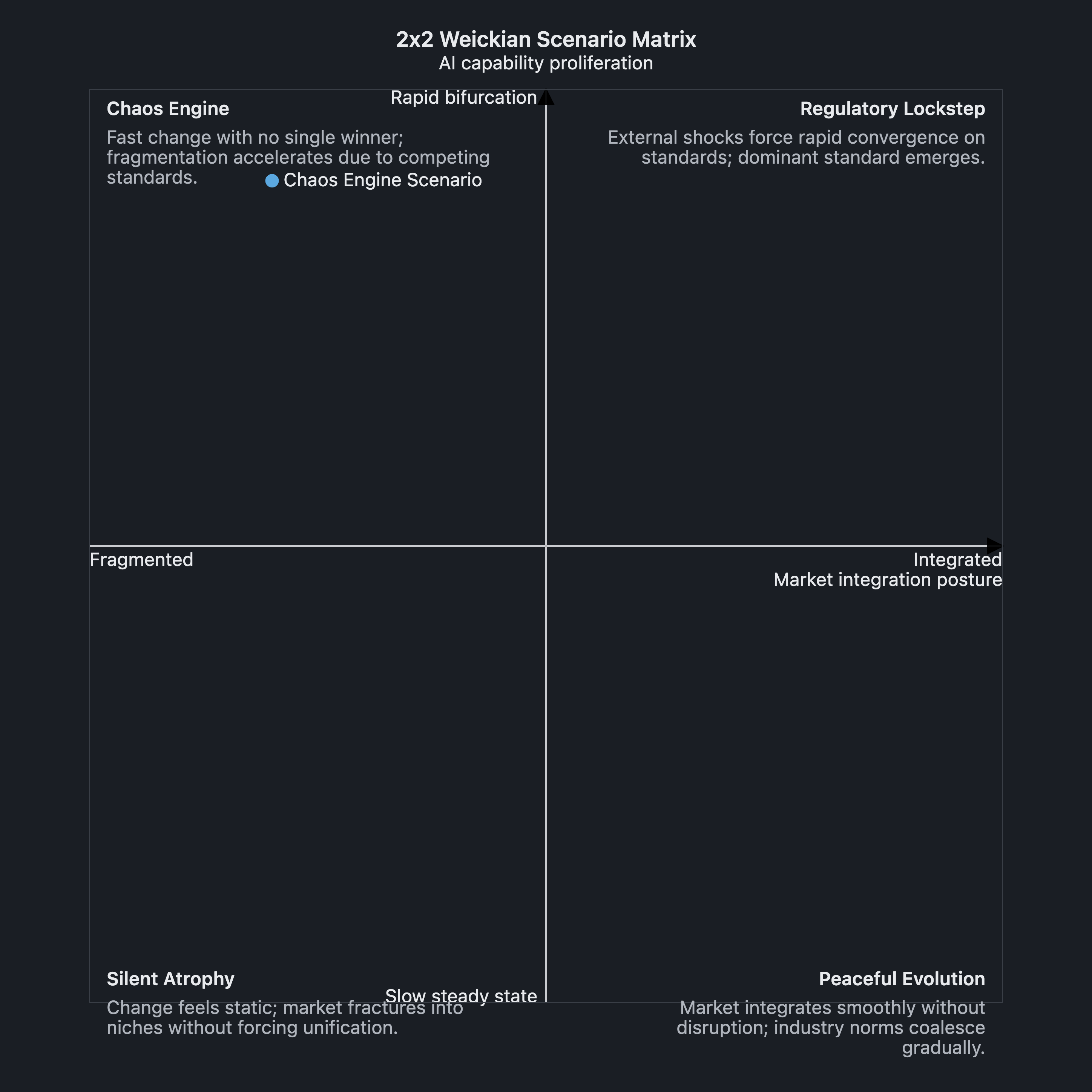
- Axis Y: [Uncertainty Name, e.g., Adoption Speed]. Low-label: [Slow steady state]. High-label: [Rapid bifurcation]. Drivers represented: [e.g., time to market for new entrants, capital deployment velocity, customer switching costs falling].
- Independence rationale: [Substantive argument ≥40 chars that these axes do not covary, referencing distinct drivers / historical decorrelation / orthogonal dependencies].
Alternative axes considered: This framework intentionally leaves axis selection open for your team. Each team has different context — axis selection determines which uncertainty combinations you analyze. The tool works identically for any valid axis pair; inputs matter more than structure.
Scenario Matrix (2×2)
The four quadrants below use causal logic shorthand (not magnitude labels). Populate with YOUR selected axes. The examples provided illustrate template structure; each team fills in specific conditions and indicators.
[Quadrant TL: Rapid Bifurcation + Fragmented Market] — Chaos Engine:
- Condition: Fast change with no single winner; fragmentation accelerates due to competing standards (“Trapeze” or fragmented regime dynamics).
- Causal Logic: Multiple actors compete with incompatible developments concurrently; market density increases without central coordination.
- Strategic translation: Build interoperable layers that work across platforms; prioritize modularity; avoid lock-in commitments.
[Quadrant TR: Rapid Bifurcation + Integrated Market] — Regulatory Lockstep:
- Condition: External shocks force rapid convergence on standards; fragmentation disappears quickly.
- Causal Logic: Disruptive events create natural pressure toward consolidation; dominant standard emerges through lock-in mechanics.
- Strategic translation: Identify integration anchors early; prepare for rapid capital reallocation; position for scale-then-acquire dynamics.
[Quadrant BL: Slow Steady State + Fragmented Market] — Silent Atrophy:
- Condition: Change feels static; market fractures into niches without forcing unification.
- Causal Logic: Incremental adjustments shadow larger structural shifts; niche players thrive in pockets without mainstream standardization.
- Strategic translation: Build niche-specific relevance; protect cash flow from margin compression; avoid premature consolidation bets.
[Quadrant BR: Slow Steady State + Integrated Market] — Peaceful Evolution:
- Condition: Market integrates smoothly without disruption; industry norms coalesce gradually.
- Causal Logic: Incremental improvements compound over time; players align around established frameworks.
- Strategic translation: Optimize for efficiency compounding; invest in predictable capital allocation cycles; build long-tail partnerships.
Leading Indicators per Scenario
Signal must show movement before strategic decisions must happen. Use at least two source types per scenario.
Chaos Engine — Leading indicators:
- [Observable signal:] Parallel launches of two distinct winner technologies within 6 months
- [Observable signal:] Quarterly churn rates increasing in legacy verticals alongside siloed partner integrations
- [Observable signal:] Patent filings spike without central industry consortia
- Where to look: Competitor R&D job postings; patent databases; customer churn analytics
- Threshold for declaring this scenario unfolding: Two distinct “winner” technologies launch in last 90 days; partner integration requests up 30%
Regulatory Lockstep — Leading indicators:
- [Observable signal:] 3+ major competitors announcing unified platform migration within 18 months
- [Observable signal:] Regulatory body consolidating governance across jurisdictional boundaries
- [Observable signal:] Price competition intensifies as consolidation accelerates
- Where to look: Regulatory filing trends; earnings call guidance from peers; M&A activity
- Threshold for declaring this scenario unfolding: Three major competitors within 12 months announce interoperability commitments
Silent Atrophy — Leading indicators:
- [Observable signal:] Protectionism measures emerge as markets fragment on self-interest
- [Observable signal:] Majority of revenue derives from niche verticals, not horizontal markets
- [Observable signal:] No clear roadmap consensus across key customer base
- Where to look: Customer revenue mapping; partner ecosystem health; customer interview themes
- Threshold for declaring this scenario unfolding: Two years without dominant platform emergence; consolidation activity below baseline by 40%
Peaceful Evolution — Leading indicators:
- [Observable signal:] Consensus on long-term roadmap across 3+ key customers (24-month horizon)
- [Observable signal]: Industry standards bodies form around single alliance
- [Observable signal]: Margin compression stabilizes as integration completes
- Where to look: Customer strategic planning documents; standards body membership; team earnings guidance
- Threshold for declaring this scenario unfolding: Formal roadmap agreement signed within 12 months
Strategic Implications
Robust strategies (work across all four scenarios):
- Modular Architecture — build systems that work across integration or fragmentation states
- Ambiguity Budgeting — reserve 20% R&D capacity for experimental trajectories outside core planning
- Scenario Reflection Cadence — quarterly review of leading indicators against current quadrants
- Customer Relationship Depth — deepen understanding beyond transactional interface
- Capital Reserve Flexibility — maintain runway for rapid action or strategic delay
Scenario-dependent strategies (require correctly identifying which quadrant is unfolding):
- [Template: “If Regulatory Lockstep is confirmed: consolidate partnerships, position for scale, avoid niche bets.”]
- [Template: “If Chaos Engine is confirmed: diversify platform dependencies, build compatibility layers, maintain tooling flexibility.”]
- [Template: “If Silent Atrophy is confirmed: protect margin through niche differentiation, monitor for signs of emerging industry standard.”]
- [Template: “If Peaceful Evolution is confirmed: optimize efficiency gains, invest in predictable long-term cycles, build ecosystem orchestration capacity.”]
Contingent actions (tied to specific leading indicators crossing thresholds):
- Threshold trigger: Competitor consolidation → 20% price drop, divest legacy line and redeploy capital
- Threshold trigger: Industry standard agreement → activate pre-positioned integration resources
- Threshold trigger: Multiple platform launches → prepare rapid pivot capability (reserve team, technical assets, capital)
- Threshold trigger: Customer roadmap consensus → freeze legacy feature investments, reallocate to complementary workloads
Wild Card
Wild Card: [Template: Low-probability / high-impact event outside the 2×2 that would invalidate the matrix]
- Definition: Disintermediated event that compresses the market vertically or horizontally, invalidating fragmentation vs. integration or slow vs. fast axis assumptions.
- Example Impact: A governance override that bypasses all current market structures entirely; a resource dependency that forces recalculation of axis variables.
- Why it sits outside the matrix: The 2×2 captures expected variations within known structure; wild card marks regime change of structure itself.
- Indicator that it may be unfolding: Sudden regulatory override independent of market consensus; capital market dislocation unrelated to sector fundamentals; technology breakthrough with different power dynamics than Moore’s Law trajectory.
- Reset Protocol: If triggered, pause current 2×2 exercise; re-evaluate driving forces; reset matrix only when new dominant structure is established.
Weickian Retrospective Protocol
Run this cadence quarterly to construct meaningful insight from ambiguity:
- Alignment question: “What does current signal data tell us about which quadrant is unfolding?”
- Meanmaking question: “What interpretation of ambiguity are we constructing, and why?”
- Action question: “What does that meaning require us to do now?”
- Artifact: Team statement recording constructed meaning, moving from “we don’t know” to “here is what we’re seeing, building toward meaning.”
The meaning you construct from ambiguity becomes the strategic compass for the next cycle. Not prediction of future state; orientation toward action across potential futures.
(visual rendered — see artifact)
Focal question
How must your team adapt strategy, resource allocation, and operational posture to survive and capture value in a fast-moving, currently uninterpretable market shift? Viewed through a Weickian sensemaking lens, the exercise also asks: Given a shift we cannot yet interpret, what distinct futures are we actually preparing for, and what do they reveal about the assumptions we are currently making?
Planning horizon: 18 months to 4 years. This window is long enough for interpretive consensus (or its absence) to crystallize, yet short enough to remain tactically actionable.
Contextual assumptions (please correct if these do not match your reality):
- Your team and industry are treated as a generic business unit. The framework is industry-agnostic, and forces/indicators must be mapped to your actual sector.
- The two axes are provisioned analytically because specific uncertainties were not supplied in the original prompt. If your domain suggests a different orientation (e.g., growth vs. contraction), the axes may require re-selection.
- “Navigating” the shift is interpreted here as developing strategic adaptability, early-warning systems, and reversible probing actions to actively collapse ambiguity.
Driving forces classified
Predetermined elements (will happen regardless of axis position):
- The market shift is already in motion; legacy operational models will experience compounding friction. (Economic/Structural)
- Generative-AI and automation capabilities are diffusing into adjacent workflows; baseline technological acceleration and data availability will continue to rise. (Technological)
- Regulatory attention on data, labor, and platform power is locked in. The direction of regulation may vary, but the presence of scrutiny is a fixed constraint. (Political)
- Talent mobility persists. The direction of flow is largely known, even if the magnitude is not, and it does not bifurcate the matrix. (Social)
- Climate and supply-chain disruption is present. Severity will modulate, but it does not bifurcate the matrix. (Environmental)
Critical uncertainties (could go either way):
- Regulatory/institutional clarity: rapid consolidation into a clear framework vs. fragmented, contradictory, slow-emerging rules. (Political)
- Stakeholder/customer adoption trajectory: rapid broad embrace vs. skeptical, fragmented adoption prone to reverting to legacy behaviors. (Social)
- Speed of interpretive consensus: information intermediaries (analysts, press, peer networks) converge on a shared story quickly vs. stay fragmented. (Social/Cognitive)
- Direction of value migration: incumbents capture the upside vs. value disperses to challengers. (Economic/Structural)
- Workforce and end-user cultural adaptation: embrace of new workflows vs. trust-deficit and habit-inertia rejection. (Social)
- Resource/infrastructure volatility: foundational inputs (physical resources, energy, compute) scale reliably vs. bottlenecks emerge. (Environmental/Infrastructure)
Contested driver classification: The macro capital-cost regime is actively contested. It can be classified as predetermined (capital-cost regimes remain structurally elevated compared to the prior decade, requiring strict ROI discipline from day one) or as a critical uncertainty (high-for-longer vs. easing, which entirely changes risk-bearing capacity). This contestation is the finding; the regime is either a constraint to plan around or an axis-eligible uncertainty depending on how quickly capital easing is judged possible.
Critical uncertainties as axes
Alternative axes considered: The analysis retains two alternative axis pairs because the initial query did not specify uncertainties. The choice between them depends on whether your team orients on regulatory/market dynamics (Axis Pair A) or interpretive/structural dynamics (Axis Pair B). Both are presented below with full reasoning.
Axis Pair A (Regulatory × Adoption)
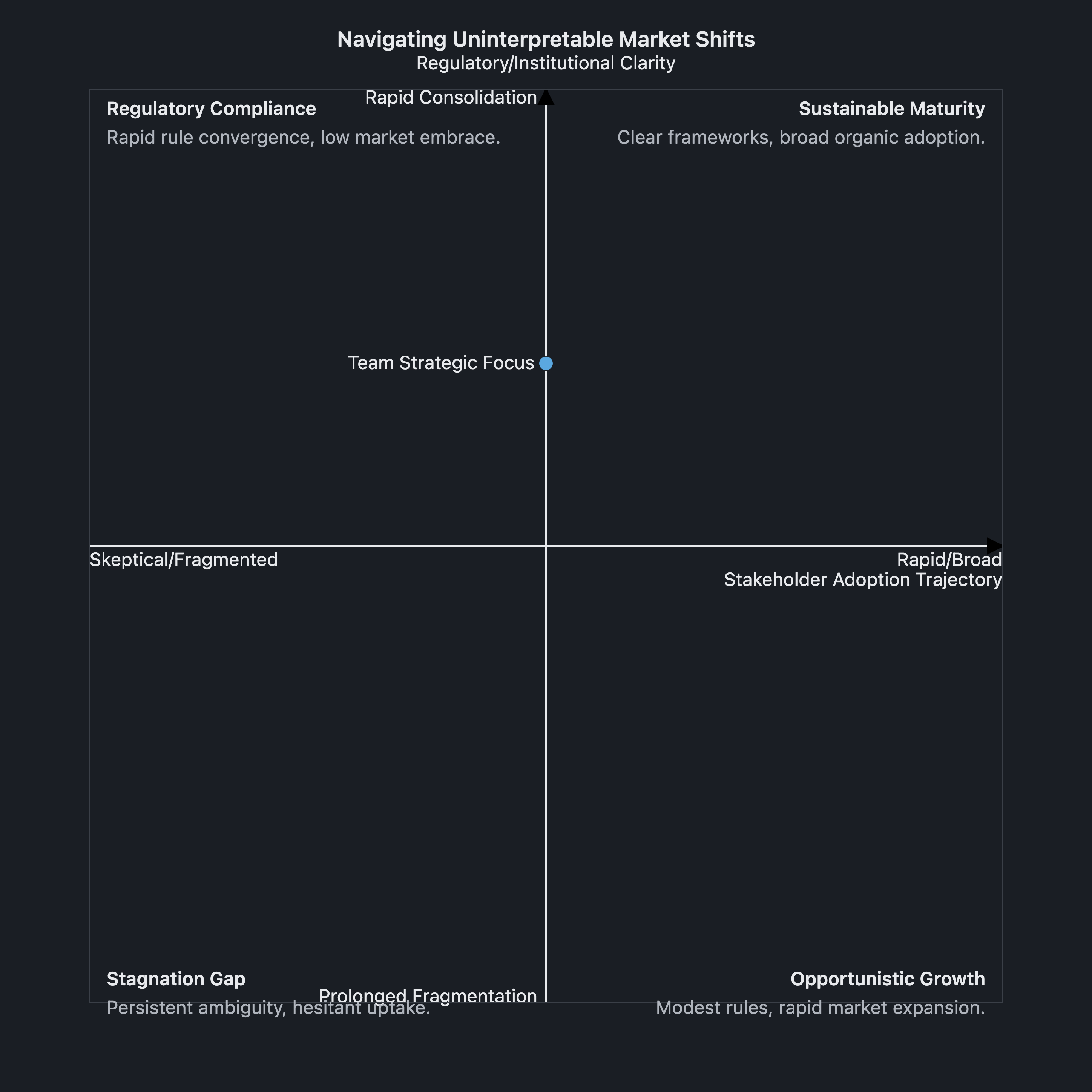
- Axis X: Stakeholder Adoption Trajectory. Low-label: Skeptical/Fragmented. High-label: Rapid/Broad. Drivers represented: perceived utility, economic incentives, behavioral habit.
- Axis Y: Regulatory/Institutional Clarity. Low-label: Prolonged Fragmentation. High-label: Rapid Consolidation. Drivers represented: political, legal, and institutional pressures.
- Independence rationale: Regulatory consolidation and stakeholder adoption are driven by entirely separate mechanisms. Historically, rapid consumer adoption frequently precedes slow regulatory capture (e.g., early gig economy, crypto), while strict, rapid regulation can be imposed on markets where organic demand stays low (e.g., certain mandated enterprise-software transitions). They do not inherently covary.
Axis Pair B (Value Migration × Interpretive Consensus)
- Axis X: Speed of Interpretive Consensus. Low-label: Persistent Ambiguity (no dominant narrative after 12+ months). High-label: Fast Clarification (narrative crystallizes in ~6–9 months). Drivers represented: attention networks, information intermediaries, decision-urgency under uncertainty.
- Axis Y: Direction of Value Migration. Low-label: Challengers capture upside. High-label: Incumbents capture upside. Drivers represented: capital allocation, switching costs, network effects, structural fit between new and old competitive advantage.
- Independence rationale: The speed of interpretive consensus and the direction of value migration operate via orthogonal mechanisms. A market can clarify quickly around an interpretation favoring incumbents, or stay ambiguous while value flows to new entrants. For instance, the 1990s PC market paired fast interpretive consensus (“Windows-compatible Wintel”) with value consolidation to incumbent platforms. Conversely, the early-2010s app economy paired equally fast consensus (“mobile-first”) with value dispersing to challenger apps atop OS incumbents. This historical decorrelation proves the two mechanisms do not move in lockstep.
Scenario matrix (2×2)
Matrix A: Regulatory Clarity × Stakeholder Adoption
(Use this matrix if your primary strategic levers are compliance, market entry, and adoption curves)
- Top-Left (Rapid Consolidation / Skeptical Adoption) — The Constrained Chokepoint. Strict rules emerge rapidly, but the market resists or finds them misaligned. High compliance costs strangle innovation. Only deeply capitalized incumbents survive, leading to market stagnation, forced workarounds, and a shadow ecosystem of non-compliant tools.
- Top-Right (Rapid Consolidation / Rapid Adoption) — The Ordered Sprint. Early regulatory clarity de-risks the environment and unlocks institutional capital. A winner-takes-most dynamic emerges where speed to compliant execution becomes the sole determinant of survival.
- Bottom-Left (Prolonged Fragmentation / Skeptical Adoption) — The Attrition Swamp. Neither rules nor demand stabilize. The environment is characterized by prolonged false starts, “pilot purgatory,” and wasted capital. Organizations bleed resources building for a market that refuses to cohere, leading to initiative fatigue and talent burnout.
- Bottom-Right (Prolonged Fragmentation / Rapid Adoption) — The Wild West Arbitrage. Customers embrace the shift, but no clear rules exist. A gold-rush of first-mover advantage emerges, accompanied by existential legal, reputational, and security risks from retroactive enforcement or abrupt norm shifts.
Matrix B: Interpretive Consensus × Value Migration
(Use this matrix if your primary strategic levers are narrative positioning, experimentation, and competitive framing)
- Top-Left (Fast Clarification / Incumbents capture) — Pinning the Pinwheel. Established voices (analysts, regulators, large customers) impose the story that benefits them. Capital, partnerships, and procurement allocate on that basis, narratively outflanking newcomers before they can prove themselves.
- Top-Right (Persistent Ambiguity / Incumbents capture) — The Deep Freeze. Indefinite ambiguity is survivable for those with existing cash flow, distribution, and lock-in, but fatal for those dependent on future funding rounds. Incumbents win by attrition, not adaptation.
- Bottom-Left (Fast Clarification / Challengers capture) — The New Map. A shared story forms that the old rules no longer apply. This consensus is a forcing function that coordinates talent, capital, and customer flows to punish incumbents even where their products remain technically viable. Clarity itself becomes the weapon.
- Bottom-Right (Persistent Ambiguity / Challengers capture) — The Cambrian Reef. The substrate keeps shifting so no single bet compounds. Value flows to whoever runs the most experiments per unit time with the lowest cost of pivoting. The system selects for experimentation throughput, not a single winner.
All scenarios hold equal standing; none is designated as “most likely” or the planning baseline.
Leading indicators per scenario
Matrix A Indicators
- The Ordered Sprint: Major industry players publicly align behind a single proposed standard; sudden influx of venture/PE capital explicitly tied to compliance-certified solutions. Where to look: Industry consortium announcements, regulated VC fund mandates. Threshold: 2+ major players co-sponsoring a standard within 6 months.
- The Constrained Chokepoint: Regulators issuing heavy fines or cease-and-desist orders to early adopters; competitors quietly shelving public innovation roadmaps for “risk mitigation” narratives. Where to look: Regulatory enforcement dockets, competitor earnings calls, legal trade press. Threshold: 1 major enforcement action against an early mover + 2 competitor roadmap delays.
- The Wild West Arbitrage: Proliferation of contradictory guidance from different regional/sectoral authorities; media cycles of “breakneck growth” stories immediately followed by “scandal/breach” headlines. Where to look: Regional regulatory bulletins, mainstream tech/business media. Threshold: Conflicting official guidance across 2+ major jurisdictions within one quarter.
- The Attrition Swamp: High-profile, well-funded competitor projects abruptly cancelled or pivoted; conference rhetoric shifting from “transformation” to “sustainable, incremental integration.” Where to look: Industry conference themes, competitor layoff/restructuring announcements. Threshold: 2 major competitor project cancellations + rhetoric shift confirmed in 3+ executive interviews.
Matrix B Indicators
- Pinning the Pinwheel: 2–3 major analyst houses converge on the same interpretation within 6 months; major customers announce vendor-consolidation programs; incumbent M&A accelerates; regulatory clarity emerges favoring scale players. Where to look: Gartner/Forrester/IDC reports, enterprise RFP requirements, M&A databases. Threshold: Unified analyst framing + 1 major vendor-consolidation mandate from a top-3 customer.
- The Cambrian Reef: 5+ incompatible strategic frames remain viable after 12 months; capital stays fragmented across many Series A/B rounds; media coverage stays narrative-diverse; time-to-pivot in surviving firms drops below 3 months. Where to look: VC portfolio updates, startup lifecycle metrics, trade media topic diversity. Threshold: <3 months average pivot time among funded peers + no dominant media narrative after 12 months.
- The New Map: A widely-cited case study of an incumbent failing to adapt becomes the dominant reference frame; talent visibly flows from incumbents to challengers; new “category” vocabulary emerges that excludes incumbents by construction; top-tier VCs publicly announce thesis pivots toward the rupture narrative. Where to look: LinkedIn talent migration data, VC thesis blogs, industry lexicon shifts. Threshold: Public VC thesis pivot + measurable net talent flow from top 3 incumbents to challengers.
- The Deep Freeze: Incumbents report stable/growing cash flow even as growth stalls; challenger rounds delay or down-round; incumbent equity holds while growth-equity multiples compress; “no clear thesis” becomes the dominant VC refrain. Where to look: Public company cash flow statements, Crunchbase/PitchBook funding rounds, VC partner commentary. Threshold: 2 consecutive quarters of challenger down-rounds + incumbent cash flow stability.
Strategic implications
Robust strategies (work across all four scenarios):
- Modular/decoupled architecture: Ensure components can be swapped, scaled, or halted without collapsing the whole operation.
Signal-detection/interpretive-infrastructure cell: Maintain a dedicated, cross-functional team whose sole KPI is tracking leading indicators and reporting deviations on a fixed cadence. This budgeted meaning-making (customer contact, field sensing, competitor-behavior data, structured re-interpretation rituals) ensures the team acts, observes, narrates, and updates.
- Preserve optionality: Make small, reversible commitments. Maintain higher-than-usual cash reserves, flexible vendor contracts, and burn-rate elasticity. Irreversible commitments made under one interpretation become a tax under the others.
- Diversify time horizons: Hold short-, medium-, and long-horizon positions simultaneously, since the quadrant that unfolds will reward a particular time preference.
Scenario-dependent strategies (require correctly identifying which scenario is unfolding):
- The Ordered Sprint: Aggressively pursue M&A or partnerships to acquire compliant scale immediately.
- The Constrained Chokepoint: Shift resources to shape the rules (lobbying); pursue operational efficiency to outlast undercapitalized rivals. Survivorship test: If cash runway is below the median of direct competitors and regulatory-relations footprint is sub-scale, treat this as an exit-signal quadrant—pre-stage a sale or wind-down rather than a fight-and-survive posture.
- The Wild West Arbitrage: Prioritize speed and market-share capture, but ring-fence legal and PR risk with strict internal guardrails.
- The Attrition Swamp: Halt broad R&D; serve exclusively the narrowest, most profitable niche of existing legacy demand. Patience is the strategy.
- Pinning the Pinwheel: Compete on scale, brand, switching costs, regulatory relationships, customer retention, and procurement inclusion.
- The Cambrian Reef: Maximize experiment throughput; build platforms or infrastructure supporting many small bets; drive time-to-pivot toward one quarter.
- The New Map: Position for the “new rules” narrative; partner with or build alongside emerging winners. Accept short-term losses for narrative positioning, as clarity is a moat.
- The Deep Freeze: Prioritize cash flow and customer lock-in over growth; reduce fixed costs; acquire cash-strapped challengers cheaply.
Contingent actions (tied to specific leading indicators):
- IF ≥2 Wild West Arbitrage indicators appear within one quarter → freeze non-essential hiring; reallocate ~30% of innovation budget to legal/regulatory forecasting and rapid-
- IF a dominant narrative crystallizes within 6 months AND references incumbents favorably → shift resources to scale, retention, and regulatory play.
- IF no narrative exists after 12 months AND capital is still fragmenting across early-stage rounds → increase experiment budget by ~30% and tighten time-to-pivot.
- IF talent visibly flows from incumbents to challengers AND a new exclusionary category vocabulary emerges → assess whether the team should be a flow source (build, partner, or buy).
- IF incumbent cash flow holds for 3+ consecutive quarters AND challenger valuations compress → start an acquisition watchlist and prepare opportunistic M&A capacity.
- Governance clause: Triggers are not self-executing. A named strategy lead must review the four indicator sets quarterly, recording per quadrant which indicators are present, partial, or absent, and whether thresholds are met. If a defined signal expected to fire within two consecutive quarters has not, the lead must document an explicit rationale. Silence is treated as a flag, not a confirmation of “no change,” closing the loop between contingent logic and operational management.
Wild card
The Sovereign Blackout: A major economic bloc abruptly nationalizes the foundational data, compute, or infrastructure layer underpinning the shift, bifurcating the global market into compliant (domestic) and excluded (foreign) zones.
- Why it sits outside the matrix: This invalidates the matrix because the adoption axis ceases to be a unified market-driven variable and becomes a mandated geopolitical compliance binary. The planning horizon compresses instantly to ~90 days of crisis survival and supply-chain reconfiguration.
- Indicator that it may be unfolding: Sudden, coordinated legislative drafts across a major economic bloc explicitly targeting foundational tech infrastructure under the guise of national security, coupled with state-backed entity acquisitions in the sector.
The Reference Frame Dissolves: The shift coincides with the simultaneous redefinition of the customer base, the regulatory regime, and the technology substrate, such that “the market,” “our competitors,” and “our team” cease to be meaningful units.
- Why it sits outside the matrix: None of the scenarios apply, because each matrix presupposes a stable reference frame in which interpretive consensus and value flow have meaning.
- Indicator that it may be unfolding: Market data starts disagreeing with itself across sources irreconcilably; customer definitions stop predicting behavior; competitors act outside the shared competitive logic.
- Pre-committed response: Pause large commitments and revert to first-principles customer discovery and primary field observation. Engage in direct, repeated contact with the small set of customers whose behavior is observable to rebuild the baseline vocabulary of who the customer is and what the unit of competition is before resuming planning. When the enacted environment stops responding to the cues your categories depend on, stop trusting the categories and return to direct enacted contact.
Weickian Sensemaking Execution
This exercise is designed for retrospective sensemaking: act into the ambiguity, observe the reaction, and update meaning. The scenarios are enactments, not predictions. Imagining each one surfaces an assumption your team is currently making, allowing you to test it rather than carry it silently.
Probes into ambiguity (Matrix A focus):
- To test The Ordered Sprint: Propose a tightly scoped pilot with a progressive regulatory body. Measure approval speed and friction. Retrospective read: Approval inside 90 days with minimal rework weights the Sprint higher in capital deployment; stalls or heavy revision downgrades the Sprint and prompts a re-test of Wild West dynamics.
- To test The Constrained Chokepoint: Publish a data-backed whitepaper on compliance operational costs. Watch whether it sparks peer coalition-building or is dismissed by regulators. Retrospective read: Peers coalescing into a lobbying bloc confirms a collective-action problem requiring industry-wide defense; dismissal means treating regulatory hardening as an asymmetric threat and preparing exit options.
- To test The Wild West Arbitrage: Launch an MVP in a low-stakes, unregulated sub-segment. Measure organic adoption velocity versus unsolicited legal/compliance inquiry volume. Retrospective read: Explosive adoption with low inquiries accelerates a “move fast” mandate; a spike in inquiries before scale dictates ringing-fencing and pivoting to compliance-first, downgrading the Wild West posture.
- To test The Attrition Swamp: Run a strict “stop-loss” review forcing teams to justify projects on current verifiable demand, not projected demand. Retrospective read: A high justification-failure rate confirms swamp conditions, prompting a pivot to the narrowest profitable legacy-demand niche and halting broad speculative R&D.
Scenarios as mirrors (Matrix B focus):
- Imagining Pinning the Pinwheel reveals an assumption of a coherent narrative marketplace where incumbent voices carry weight. If your context lacks that (e.g., a small niche or regulator-driven market), it is a theoretically possible future your team is practically excluding.
- Imagining The Cambrian Reef reveals an assumption that experiments can run on stable infrastructure. If your cost-of-pivot is too high, this scenario collapses for your team even while unfolding for others.
- Imagining The New Map reveals an assumption that paradigm shifts are detectable in time to act. Most are legible only in retrospect, making this potentially the most “obvious” future later and the hardest to enter now.
- Imagining The Deep Freeze reveals an assumption that challengers can outlast incumbents. If your capital structure or customer relationships are weak, your team may be the challenger this scenario selects against, regardless of which scenario unfolds for the broader market.
Contextualization and Confidence Boundaries
To operationalize this framework, your team must map these generic variables to your specific sector:
- Replace “stakeholder adoption” with your specific customer or user base, and replace “regulatory clarity” with your specific regulator or standards body.
- Substitute your industry’s specific signal sources for generic indicators (e.g., specific venture/PE capital flows, specific media cycles).
- Substitute your sector’s known exogenous risks (e.g., specific commodity shocks, regional conflicts) for the generic geopolitical wild-card example.
- Identify the actual progressive regulatory body, unregulated sub-segment, or peer coalition relevant to your operations to execute the Weickian probes.
Confidence and limitations:
- Axis provisioning: The axes provided were analytically selected because the original query named no specific uncertainties. If your domain suggests a preferred pair, re-selection is required.
- Indicator calibration: The leading indicators are plausible but not authoritative. They require periodic re-validation against real market data in your specific sector.
- Team capacity: The robust strategies (optionality, cash reserves, burn-rate elasticity) assume sufficient cash, talent, and time. If your team is a pre-seed startup or a constrained cost center, the substrate may not support the optionality play, and strategies must be downscaled to focus purely on survival levers.
- Predictive boundary: This exercise does not predict which scenario will occur. The two axes are not claimed to be the only relevant ones (e.g., talent supply modulates outcomes within each quadrant). Scenario-dependent strategies assume correct quadrant identification; misidentification is itself a risk, which is why robust strategies are the primary hedge against that risk. Historical analogies provided are illustrative, not load-bearing.
(visual rendered — see artifact)
Focal question
How might an ambiguous, fast-moving, not-yet-interpretable market shift unfold for your team — treated as Weickian sensemaking rather than as forecasting which future occurs? The point is not to predict the right scenario but to act into the ambiguity, see what each scenario reveals, and retrospectively build navigable meaning. Sensemaking here is retrospective and enactive: you don’t first understand the shift and then act; you act, the action produces cues, and then you interpret. The four scenarios are not predictions but enacted futures — rehearsals you walk into so the present becomes readable by contrast, read backward from each imagined future to the cue worth watching now. The standard is plausibility, not accuracy (“How can I know what I think until I see what I say?”).
The planning horizon is 12–18 months. That window is defended: “fast-moving” implies sub-multi-year (3+ years blurs momentum and pushes the falling-cost premise into uncertainty), while a quarterly frame would erase scenario distinctness.
A specification gap is named rather than filled: the sector, the specific shift, and your team’s position in it are unspecified, and filling them by guessing would be confabulation. So this exercise is built at the signal-pattern level — exactly where Weickian sensemaking operates — with axes and scenarios generic enough to translate across tech, supply chains, capital markets, regulated industries, and labor, but structurally real enough to generate distinct futures. Leading indicators are written as the kind of signal to watch; you substitute your own instruments. Re-running this with named specifics sharpens it considerably.
Driving forces classified
Predetermined elements (will happen regardless of axis position — the stable backdrop across all four quadrants):
- Non-reversion (Economic/Social). The shift does not revert to the prior status quo within the horizon; sunk attention, capital, and talent rarely unwind cleanly in 12–18 months. Reversion would itself be a wild card, not a quadrant. (Confidence: highest of the predetermined calls.)
- Talent/attention inflow (Social). Labor and mindshare keep reallocating toward the disturbed zone; even skeptics must staff a response, and the flow is sticky on this horizon.
- Falling enabling-cost / diffusing capability curve (Technological/Economic). The underlying capability — compute, capital access, distribution — keeps diffusing; direction is set. Predetermination is bounded to the 12–18 month window; over 3+ years the pace becomes uncertain. Pace itself is a critical uncertainty (see the axis disagreement below).
- Positive cost of capital (Economic). The zero-cost-of-capital era is over; commitments carry real carry cost; the 2026 hurdle-rate environment is binding, not nominal (and is multi-year and geography-dependent). This disciplines all four scenarios and constrains any probe strategy. (Confirmed against the 2026 AFP Cost of Capital Survey: 62% use calculated cost of capital as baseline, 38% add a buffer.)
- Workforce/customer-cohort composition shifts (Social/Demographic). Already locked in for an 18-month window; no scenario reverses them.
- Rising regulatory attention — predetermined with a named exception (Political). Attention rises in every quadrant where a coherent target exists, for a structural reason independent of how the axes resolve: the shift touches incumbent interests (who lobby) and crosses a public-salience threshold (which pulls legislators). That it rises is predetermined in three of four worlds; the shape it takes is not. Exception: in a fragmentation world where no dominant actor or practice emerges, attention can plausibly stall for lack of a coherent thing to regulate — and that stall is itself a fragmentation leading indicator (regulators visibly struggling to define the object). This is the classification most exposed to the certainty-masquerade-trap; it is defended-with-exception, not asserted flat.
Critical uncertainties (could genuinely go either way — axis candidates):
- Locus of value capture — incumbents/platforms (consolidating, via distribution + switching costs + capital depth) vs. insurgents/entrants/edges (dispersing). (Used as an axis by both constructions below.)
- Interpretive legibility — a shared frame (standard, dominant design, regulatory line, consensus “this is what’s happening”) emerges and lets actors coordinate, vs. the market stays opaque and un-readable.
- Tempo — gradual vs. punctuated/discontinuous.
- Demand reorganization / durability — buyers structurally re-pattern what and how they purchase, vs. revert to habit.
- Coordination/regulatory regime — a standard or rule sets fast (accelerant) vs. stays fragmented.
Rejected as an axis (with reasoning): “Pace/tempo” treated alone as an axis breeds the good-bad-medium trap (it is a magnitude variant) and tends to correlate with the others. This is a surfaced disagreement, not a settled call — see the next section.
Critical uncertainties as axes
Two axis-pairs survive, and the disagreement between them is itself a finding about what is contested. Both share locus of value capture as one axis; they differ on the second.
Axis-pair I — Locus × Legibility.
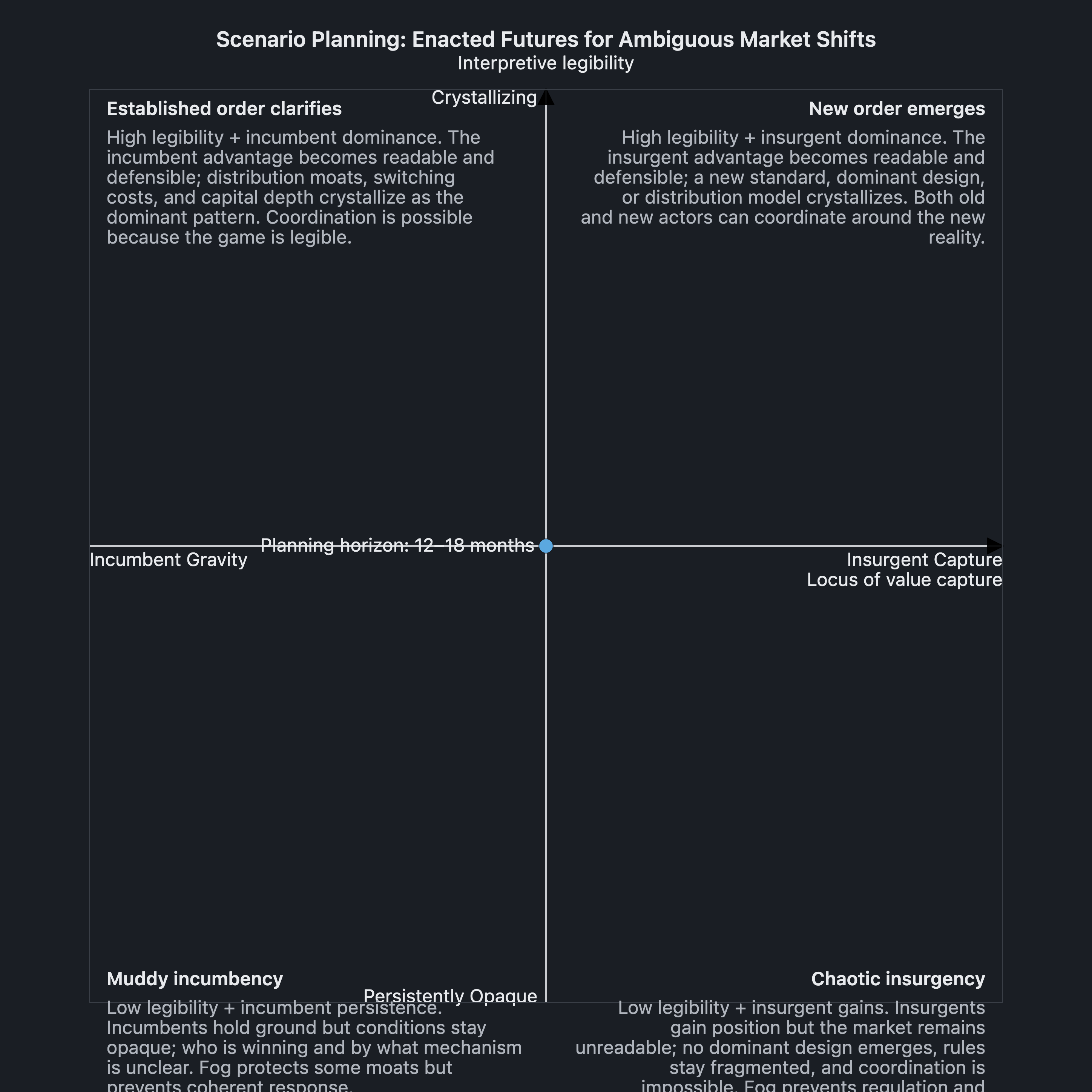
- Axis A: Locus of value capture — Low-label: Incumbent Gravity. High-label: Insurgent Capture. Drivers represented: distribution + switching costs + capital depth.
- Axis B: Interpretive legibility — Low-label: Persistently Opaque. High-label: Crystallizing. Drivers represented: information environment + standardization + rule clarity.
- This construction explicitly rejects pace as an axis and collapses coordination-regime + demand-reorganization into legibility — both ask “can anyone read this game yet?”
- Independence rationale (Pair I): Legibility governs whether the game can be read; value-capture governs who is winning it — different questions that historically decorrelate. Insurgents have won opaque markets (early crypto: fragmented, no consensus, new entrants captured value) and lost legible ones (early cloud: clear standards, yet hyperscalers consolidated via distribution and scale). Opacity can favor incumbents (resources to wait out ambiguity) or insurgents (speed in chaos), so legibility does not predict the winner. Orthogonal dependencies: one tracks the information environment, the other the capital-and-distribution environment; they run on different clocks. (Crypto/cloud exemplars confirmed: cloud-half value consolidation to hyperscalers is well-sourced; the crypto contrast is not contradicted.)
Axis-pair II — Tempo & legibility (fused) × Locus.
- Axis A: Tempo & legibility — Low-label: Gradual & legible. High-label: Punctuated & discontinuous. Drivers represented: how fast AND how interpretably the shift unfolds — technology maturation + adoption friction + signal readability.
- Axis B: Locus of value capture — Low-label: Consolidating (incumbents/platforms). High-label: Dispersing (entrants/edges). Drivers represented: network effects, switching costs, capital access.
- This construction treats demand-durability and regulatory posture as downstream consequences of tempo and locus, and folds tempo into the legibility axis rather than rejecting it.
- Independence rationale (Pair II): Tempo is driven by tech maturation + adoption friction + signal readability; locus by network effects, switching costs, capital access — different causal engines. Historically decorrelated: PC→cloud was slow (multi-year/gradual relative to a rupture) yet consolidated hard to a few hyperscalers (slow + consolidating); the early mobile-app explosion was fast yet dispersed value across the largest group of app developers ever to enter a technology industry before Apple/Google infrastructure re-consolidated it (fast + dispersing, then drifting). A shift can be slow-and-winner-take-all or fast-and-fragmenting; rate of change tells nothing reliable about who holds the value. (Both exemplars confirmed against sources.)
Alternative axes considered. The two constructions agree that locus is one axis but disagree on whether the second is legibility-alone (with tempo rejected as a magnitude variant) or tempo-fused-with-legibility (with tempo as a generative driver). The first construction selected legibility-alone because it keeps the second axis a pure interpretive question; the second selected tempo-fused because it treats the decision clock as generative rather than downstream. Both axis-pairs survive here because neither is generically dominant — the team’s sector decides which second axis is generative versus downstream. The legibility-alone construction would produce four scenarios discriminated by whether the game becomes readable; the tempo-fused construction would produce four discriminated by how fast and how interpretably it ruptures. Do not collapse the tension; the sector resolves it.
Caveat on the legibility/demand collapse (Pair I). Demand-reorganization is a behavioral fact (do buyers actually re-pattern); legibility is an interpretive fact (can actors read the game). These could move on different clocks — revealed preference can run ahead of consensus, or a frame can crystallize while purchasing stays habitual. They are treated as co-moving here because, absent a sector, durable demand-reorganization generally requires enough shared legibility for buyers to coordinate switching. This is flagged as the single likeliest place a concrete sector reveals a genuine third independent axis; if buyer behavior and interpretive consensus visibly decouple on the team’s ground, demand-reorganization earns its own axis and the matrix is rebuilt. That decoupling is a finding, not a flaw.
Scenario matrix (2×2)
Two quadrant sets follow, one per surviving axis-pair, with distinct causal logic and equal standing. They share the locus axis, so their opaque/dispersing-insurgent corners are kin — but the constructions remain distinct because the second axis differs.
Set I — Locus × Legibility
① Managed Transition — Incumbent Gravity × Crystallizing. Narrative: A shared frame emerges quickly (a standard sets, a regulator draws a line, a dominant design wins); incumbents with distribution and balance sheets adopt and absorb the shift as a feature — a capability upgrade, not a regime change; pricing normalizes and M&A tidies the edges. Strategic translation: Interpretive speed was the real asset, not novelty — winners are fast adopters, not inventors; this surfaces whether your team is a fast-follower or a stranded pioneer.
② Changing of the Guard — Insurgent Capture × Crystallizing. Narrative: The frame crystallizes but around the insurgents’ model; clear rules lower entry barriers and favor entrants built for them, who scale fast while incumbents structurally can’t reorganize in time; a new category leader emerges. Strategic translation: Are you an incumbent about to be reframed as legacy, or an insurgent with a scaling window? This surfaces organizational plasticity — can you reorganize around a frame not built for you.
③ Fog of Hold — Incumbent Gravity × Persistently Opaque. Narrative: No shared frame; conflicting signals, no standard, no consensus on what is even happening; incumbents win by waiting — resources to hedge, run parallel bets, and outlast under-capitalized challengers who burn out before clarity arrives; ambiguity becomes a moat for whoever can fund patience; the market stalls in a holding pattern. Strategic translation: Ambiguity itself is a competitive resource; the question is who can fund patience; this surfaces burn tolerance.
④ Wild West — Insurgent Capture × Persistently Opaque. Narrative: No shared frame and chaos favors entrants; a land-grab — dozens of incompatible bets, fast irreversible moves, winners taking ground before anyone agrees what the ground is; incumbents too slow and consensus-bound in the fog; value captured early and locked before legibility arrives. Strategic translation: Speed-under-ambiguity beats correctness; tolerance for acting on incomplete cues is the binding constraint; this is the most purely Weickian quadrant — you cannot know what works until you’ve moved and read the wreckage.
Set II — Tempo & legibility × Locus
Quiet Annexation — gradual + consolidating. Narrative: A readable, manageable transition; incumbents/platforms absorb it methodically — buying capabilities, bundling into distribution, setting de facto standards; no dramatic moment, the terrain quietly annexed by month 12; margins compress outside the platforms’ orbit. Strategic translation: The real contest was distribution and switching costs, not technology; the posture risk is complacency — the absence of a shock reads as “we have time.”
Rising Tide — gradual + dispersing. Narrative: The field opens legibly and widely; tooling democratizes, barriers fall, many entrants/edge players capture pieces; an orderly land-rush with time to stake claims. Strategic translation: Speed of distribution and share-of-territory matters more than perfection; the posture risk is over-deliberation — treating a fast-spreading opportunity as needing a careful incumbent-style plan and getting out-distanced while polishing.
Blitz Capture — punctuated + consolidating. Narrative: A discontinuous rupture; whoever moves first and hardest locks it in; winner-take-most on a compressed clock; weeks/months decide a multi-year position; the market reorganizes around early movers before most have interpreted what happened. Strategic translation: Interpretation speed is the scarce resource; this is where Weick’s collapse of sensemaking is most dangerous — the Mann Gulch failure mode, where under shock role structure and sensemaking disintegrate together, people freeze, and freezing is fatal; the posture risk is paralysis-by-ambiguity exactly when speed is everything. (Weick attribution confirmed — Administrative Science Quarterly, 1993.)
Scatter — punctuated + dispersing. Narrative: A fast rupture, but value fragments rather than consolidating; many players, no clear winners, rapid churn, contradictory signals, no stable standard; a genuinely confusing 12–18 months that won’t resolve. Strategic translation: The situation is complex, not merely complicated (Cynefin) — cause and effect visible only in retrospect; any plan predicting the winner is false precision; the posture risk is narrative lock-in — forcing a clean story onto noise and betting heavily on a “winner” the scatter won’t produce.
Cross-set kinship (note, do not collapse the sets). Because the two sets share the locus axis, their opaque/dispersing-insurgent corners are kin: Set I’s ④ Wild West and Set II’s Scatter both describe fast/opaque fragmentation favoring entrants. The constructions stay distinct because the second axis differs (legibility-alone vs. tempo-fused).
Leading indicators per scenario
Set I
① Managed Transition — Leading indicators: a credible standards body / consensus reference architecture gains adoption / incumbents announce native features rather than acquisitions of insurgents / analyst language converges on shared vocabulary / price dispersion narrows. Where to look: standards bodies, incumbent product roadmaps, analyst vocabulary, price spreads. Threshold for declaring this scenario unfolding: a credible standard gains adoption while incumbents ship native features rather than buy insurgents.
② Changing of the Guard — Leading indicators: a new entrant’s metric becomes the metric everyone reports / talent flows out of incumbents toward entrants / customers specify the insurgent standard in procurement / incumbent “us too” launches land flat. Where to look: reporting metrics, talent flows, procurement specs. Threshold for declaring this scenario unfolding: a new entrant’s metric becomes the industry metric.
③ Fog of Hold — Leading indicators: competing standards proliferate with none winning / pilot-to-production conversion stays low industry-wide / well-funded players slow-roll while small players fold / press oscillates between hype and obituary with no settling. Where to look: standards landscape, pilot-to-production conversion rates, funding behavior, press tone. Threshold for declaring this scenario unfolding: pilot-to-production conversion stays low industry-wide past month 6. Cross-sector instantiation of “pilot-to-production stays low” (illustrative template, explicitly NOT the team’s situation): B2B SaaS — proofs-of-concept never convert to paid seats past month 6; regulated/financial — sandbox approvals never graduate to production because compliance sign-off stalls; supply-chain/operations — pilots on a single line/lane never roll out network-wide. Same structural cue, three instruments; find yours.
④ Wild West — Leading indicators: a surge of incompatible new entrants / capital flowing to “spray and pray” bets / irreversible moves (exclusive deals, infrastructure lock-in) happening before any standard / rapid share shifts with no clear logic. Where to look: entrant counts, capital-allocation patterns, deal irreversibility, share volatility. Threshold for declaring this scenario unfolding: irreversible position-grabs occurring before any standard exists.
Set II
Quiet Annexation — Leading indicators: incumbents making capability acquisitions rather than product launches / standards/interoperability bodies forming with the big players at the table / customers asking whether you “integrate with [platform X]” / pricing pressure arriving as a slow grind, not a cliff. Where to look: incumbent M&A, standards-body composition, customer integration questions, margin trend. Threshold for declaring this scenario unfolding: incumbents acquire capabilities and set de facto standards while pricing grinds down slowly.
Rising Tide — Leading indicators: falling cost/barrier to entry / proliferation of entrants and tools rather than consolidation / open standards winning over proprietary / your own customers experimenting with multiple small providers instead of demanding one big one. Where to look: entry costs, entrant/tool counts, open-vs-proprietary standard adoption, customer sourcing behavior. Threshold for declaring this scenario unfolding: entry barriers visibly fall and entrants proliferate quarter-over-quarter.
Blitz Capture — Leading indicators: a sudden capability/price discontinuity / a single competitor making an unusually large, fast, irreversible bet / capital flooding to one model fast / an “everyone is suddenly talking about X” inflection. The tell is irreversibility. Where to look: capability/price step-changes, single-competitor capital commitments, capital concentration, attention inflection. Threshold for declaring this scenario unfolding: a single competitor makes a large, fast, publicly non-reversible bet.
Scatter — Leading indicators: multiple incompatible standards persisting / high entrant churn (births and deaths) / contradictory expert reads / regulators visibly struggling to define the object of regulation / your own forecasts repeatedly proven wrong within weeks. Persistent unresolvability is itself the signal. Where to look: standards count, entrant birth/death rates, expert consensus, regulatory definitional struggle, your own forecast accuracy. Threshold for declaring this scenario unfolding: incompatible standards persist and churn stays high across consecutive quarters with no winner emerging.
Strategic implications
Robust strategies (work across all four scenarios — start now, need no forecast):
- Build interpretive speed / cue-instrumentation, operated as a cue-audit cadence (e.g. fortnightly: what signals have we seen, which quadrant are they consistent with, what would change our read).
- Extend runway / financial optionality.
- Develop organizational plasticity (the ability to reorganize around a frame not built for you) — an asset in insurgent/dispersing quadrants, harmless elsewhere.
- Adopt a barbell posture — protect a safe core, fund many cheap reversible probes, starve the fragile middle (large half-commitments). Bound the probe portfolio, because “many cheap probes” is not free under a positive cost of capital: a fixed probe budget (hard cap on capital-at-risk across all probes), explicit kill-criteria per probe so dead capital recycles fast, and a cap on concurrent probes. An unbounded probe portfolio is the fragile middle wearing a barbell label.
- Clarify team identity (“who are we, what do we refuse to become”) — identity anchors sensemaking when the situation won’t cohere; the clearer it is, the faster cues can be read.
- Remove single points of failure (via negativa) — one critical dependency, one make-or-break customer, one un-exitable contract.
Scenario-dependent strategies (require correctly identifying which scenario — do not execute until the legibility/discriminator instrument resolves):
- Aggressive scaling and irreversible position-grabs (right in insurgent/dispersing quadrants — Wild West, Changing of the Guard — wrong in incumbent/consolidating ones).
- Moat-building (right in Changing of the Guard, commoditized in Managed Transition).
- Quiet Annexation → choose embedder (partner into the consolidating platform, defensible niche on top) or differentiator (own a segment platforms won’t serve well); abandon the generalist middle. The generalist middle is fatal for a specific mechanism: it carries the cost structure of commitment without either the defensibility of a niche or the leverage of a platform, so it is undercut from both sides at once — out-priced from above, out-focused from below.
- Rising Tide → scale distribution, grab footprint now, optimize later.
- Blitz Capture → commit hard-and-first or exit fast and redeploy; pre-authorize a small group to act without full consensus when the rupture signal fires (preserve role structure under stress).
- Scatter → modularize, many small reversible bets, no heavy commitments; build for fast switching.
Contingent actions (tied to specific leading indicators; bracketed magnitudes are placeholders the team fills with sector values):
- If a credible standard gains adoption → pivot to fast-follower integration (Managed Transition trigger).
- If a new entrant’s metric becomes the industry metric → pre-position as acquirer-or-acquired (Changing of the Guard trigger).
- If pilot-to-production conversion stays low industry-wide past month 6 → switch to survival/optionality posture (Fog of Hold trigger).
- If an incumbent makes a large acquisitive move (value exceeding [Y]% of prior-year M&A spend, or a buy of a direct capability rather than a tuck-in) → open partnership/embed talks within the week.
- If a single competitor makes a bet exceeding [X]% of its capital base, or one publicly non-reversible (committed capex, exclusive lock-in, irreversible repositioning) → treat as Blitz signal; activate the pre-authorized fast-move group. (One half of the central discriminator.)
- If ≥[N] incompatible standards remain live at quarter-end for two consecutive quarters, none crossing [share]% adoption → treat as Scatter confirmation; shift from “pick the winner” to “stay switchable.” (The other half of the discriminator.)
- If entry barriers visibly fall and entrants proliferate (net new-entrant count rising quarter-over-quarter, entry cost below [threshold]) → treat as Rising Tide; flip to distribution-land-grab mode.
Wild card
The 2×2 assumes the shift remains the relevant game and that the two axes resolve, on different clocks. Three wild cards each break that assumption from a different direction, sitting outside the matrix.
Wild card A — exogenous substitution / category dissolution. A development orthogonal to both axes makes the category irrelevant before either uncertainty resolves: a regulatory ban that closes the market, a substitute that routes around the whole shift, or demand that was a bubble and simply vanishes. Analogy (corrected): the way streaming didn’t win the Blu-ray-vs-HD-DVD format war — Blu-ray did, in 2008 (Toshiba conceded 2008-02-19) — but then made the whole disc category recede, routing around the question entirely. If it fires, neither “who captures value” nor “is it legible” matters — you exit a dissolving category, not adapt. Why it sits outside the matrix: both axes assume the shift remains the relevant game. Indicator that it may be unfolding / cheap hedge: keep a peripheral sensor on adjacent categories and the regulatory horizon — the substitute almost never comes from inside the market you’re watching.
Wild card B — endogenous discontinuous double-resolution (over-resolution collapse). Both uncertainties resolve at once and discontinuously — a sudden standard and a sudden winner crystallizing in a single quarter, before you can instrument anything. Why it sits outside the matrix: the 2×2 assumes the two axes move on different clocks, leaving a window to read one before the other; this collapses the window, so the “instrument legibility first, then act on value-capture” sequence has no time to run. Indicator / cheap hedge: pre-write a single “snap-decision” protocol — who has authority to commit in 72 hours without the normal cue-gathering.
Wild card C — endogenous coordination freeze (zero-resolution lock). No outside force needed: the shift triggers a standards/coordination war so contested that the whole market stalls — buyers refuse to commit while the standard is unsettled, sellers refuse to converge while each holds out, and the category freezes for the planning window. Unlike Scatter (fast churning fragmentation that still produces activity), this is fragmentation that produces paralysis — the market neither consolidates nor disperses; tempo effectively goes to zero and locus never resolves. Why it sits outside the matrix: it breaks the matrix from the inside by voiding the assumption that the axes resolve at all.
Shared wild-card discipline. The leading edge of any wild card is a signal that fits none of the four quadrants cleanly. The cue-audit must therefore always carry a fifth option: “or are we watching the wrong market entirely — and is it dissolving (A), snap-resolving (B), or freezing (C)?” Wild cards B and C are distinct endogenous breaks of opposite shape (over-resolution vs. paralysis); both survive alongside the exogenous card A.
Retrospective sensemaking — the payload
This is the meaning unreachable from any single scenario; it emerged only by imagining all four.
Patterns across scenarios:
- Legibility (the discriminator) is the higher-leverage axis for posture-choice. Precisely: this is NOT a claim that it is more likely to resolve a certain way, and NOT a smuggled most-likely designation. It means required behavior flips hard along the legibility/tempo axis (commit vs. preserve optionality) but only modestly along the value-capture axis. Whether you can read the shift changes what you should do more than who wins it does. It emerged only by contrast.
- The threat is always a posture mismatch, never the scenario itself. Complacency kills in the gradual-consolidating world, over-deliberation in the gradual-dispersing world, paralysis in the punctuated-consolidating world, false-narrative-forcing in the punctuated-dispersing world. The market doesn’t destroy you — your default reflex applied to the wrong world does. The job is to know which world you’re in before the reflex fires.
- Two scenarios reward commitment, two reward patience — the diagonal actually being managed is commit ↔ preserve optionality, and you can’t know which the world rewards until cues arrive.
- Tempo governs the decision clock; locus governs the decision content. Fast quadrants reward pre-authorized, low-consensus action; consolidating quadrants reward positioning relative to a dominant player; dispersing quadrants reward footprint and optionality.
Contradictions / tensions (hold, don’t resolve):
- The capabilities that win the fast/opaque land-grab (fast irreversible bets) are exactly what loses the patient/opaque hold and the fast/dispersing scatter (where irreversible bets strand you). Equivalently: what wins Blitz Capture (commit hard, fast) loses Scatter (commit small, reversible) — and you can’t tell them apart early because both open as a fast rupture. The central live tension.
- Managed Transition punishes the moat-building that Changing of the Guard rewards (identical legibility, opposite winner); embedding with a platform is smart in Quiet Annexation and suicidal in Rising Tide (same move, opposite outcome).
- Both axes therefore contain a fork where the right move is the mirror image of the wrong one. This is not a “pick a strategy” situation; it is a “build the capacity to read which fork you’re on” situation.
Vulnerabilities / choice points:
- The key vulnerability is interpretive latency — the lag between a cue appearing and correctly reading which quadrant is materializing; in three of four scenarios the cost of misreading is high and at least partly irreversible.
- The real choice point is not “which scenario to bet on” but “how much optionality to pay for.” Optionality is cheap insurance in the opaque/scatter worlds, wasted premium in the managed/annexation worlds — you are pricing an option without knowing the volatility.
- The matrix’s center of gravity is the two fast quadrants that look identical at onset and demand opposite responses (Blitz Capture vs. Scatter). Concentrate sensing there; build an early discriminator — “Is this rupture consolidating or dispersing?” — whose tell is irreversibility + capital concentration (→ Blitz) vs. persistent fragmentation + incompatible standards (→ Scatter).
What it invites next (the enactment):
- Instrument the legibility/discriminator axis first; define this week the 3–4 cues that distinguish a frame crystallizing from staying opaque. That instrument is worth more than any single scenario.
- Identify the robust moves and do them now.
- Pre-commit contingent triggers — write down in advance “if we see indicator X, we shift to posture Y,” because you will otherwise interpret cues to fit the identity you’re already defending unless you bind your future self.
- Run a small enacting probe into the fog deliberately — act in order to generate cues, not because you’re sure; the point of the probe is the reading it produces.
- Assign the discriminator question to a named owner — ambiguity with no owner is how sensemaking collapses.
No-official-future check. No scenario in either set is designated “most likely,” “base case,” or “official”; equal standing is held throughout — both constructions state explicitly that the mode does not predict. The “legibility/discriminator is higher-leverage” finding is expressly guarded as posture-leverage, not probability, so it cannot leak into an official-future designation. The discipline of equal standing is the whole point: the moment a favorite is anointed, sensemaking stops and defending begins.
Additional considerations
Method and validity — how to pressure-test this exercise. The value is not the boxes; it is that imagining all four forced two findings unreachable otherwise — the legibility/discriminator axis is the higher-leverage focus for posture-choice, and optionality-pricing is the real choice point. Pressure-test it: substitute real sector cues into the leading-indicator slots; if the four scenarios still feel genuinely distinct (not good/bad/medium repainted), the exercise held. If two collapse once concrete, the team’s real uncertainties differ from the generic two — and that collapse is itself the most useful output. Likeliest collapse pairs: Set I’s ③ Fog of Hold and ④ Wild West (share the opaque half-plane; causally opposite as written — incumbent-patience vs. insurgent-landgrab — but the likeliest fusion point); Set II’s Blitz Capture and Scatter (share the fast-rupture onset). If buyer behavior and interpretive consensus visibly decouple, that is a hidden third axis surfacing. Naming the sector and position allows rebuilding the axes — and filling the placeholder thresholds (X, N, Y, share) with real magnitudes — so the exercise becomes operational rather than illustrative.
Confidence per finding — what is solid and what resolves only with a named sector:
- Axes independence (both pairs): logically sound; historical exemplars confirmed (crypto/cloud for Pair I; PC→cloud and early-mobile-app for Pair II). Unverifiable generically: whether the chosen axes are empirically decorrelated in the team’s unnamed sector. Resolves with the sector + specific shift. If tempo and locus (or legibility and locus) actually move together in that sector, discard the matrix and pick a different second axis — that finding alone would justify the exercise.
- Demand-reorganization — sub-question of legibility vs. third independent axis: cannot be adjudicated generically. Resolves with a named sector where buyer re-patterning and interpretive consensus can be observed to move on the same or different clocks.
- Structural distinctiveness of the opaque/fast-divergent pair (Fog of Hold vs. Wild West; Blitz vs. Scatter): causally opposite as written, but the likeliest collapse point under concretization. Resolves with the team’s sector-specific instantiation test.
- Regulatory classification (predetermined vs. masqueraded uncertainty): remains sector-dependent even after the defend-with-exception framing. Resolves with domain input naming the regulatory regime in play.
- Contingent thresholds (X, N, Y, share, [threshold]): placeholders; operational only once the team supplies sector-specific magnitudes and competitive capital-base data.
- Claim verifications: insurgents-won-opaque / lost-legible (crypto, cloud) — confirmed; PC→cloud slow+consolidated and early-mobile-app fast+dispersed-then-reconsolidated — confirmed; Weick’s collapse-of-sensemaking / Mann Gulch — confirmed (Weick, ASQ 1993); zero-cost-of-capital era over / 2026 hurdle-rate binding — confirmed (AFP survey; horizon/geography-dependent); streaming/disc-format analogy — corrected (Blu-ray won the format war in 2008; streaming made the disc category recede — the analogy holds only under the “routes around the whole category” reading).
(visual rendered — see artifact)