Brinkmanship and Deterrence: A Game-Theoretic Analysis
The Core Puzzle: Why a Rational Threat Is Hard to Believe
Deterrence rests on a threat: if you cross this line, I retaliate catastrophically. But nuclear retaliation is suicidal — once the other side has already attacked, carrying out your threat only adds your own annihilation to theirs. So the threat is inherently incredible. A rational adversary reasons: “They won’t actually do it, because doing it is insane.” This is the credibility problem, and brinkmanship is the strange solution to it.
Thomas Schelling’s central insight: you cannot credibly threaten something you would never rationally choose to do. So instead of threatening a deliberate catastrophe, you threaten to raise the risk of a catastrophe that neither side fully controls. That is what “going to the edge” actually means.
Brinkmanship Defined Precisely
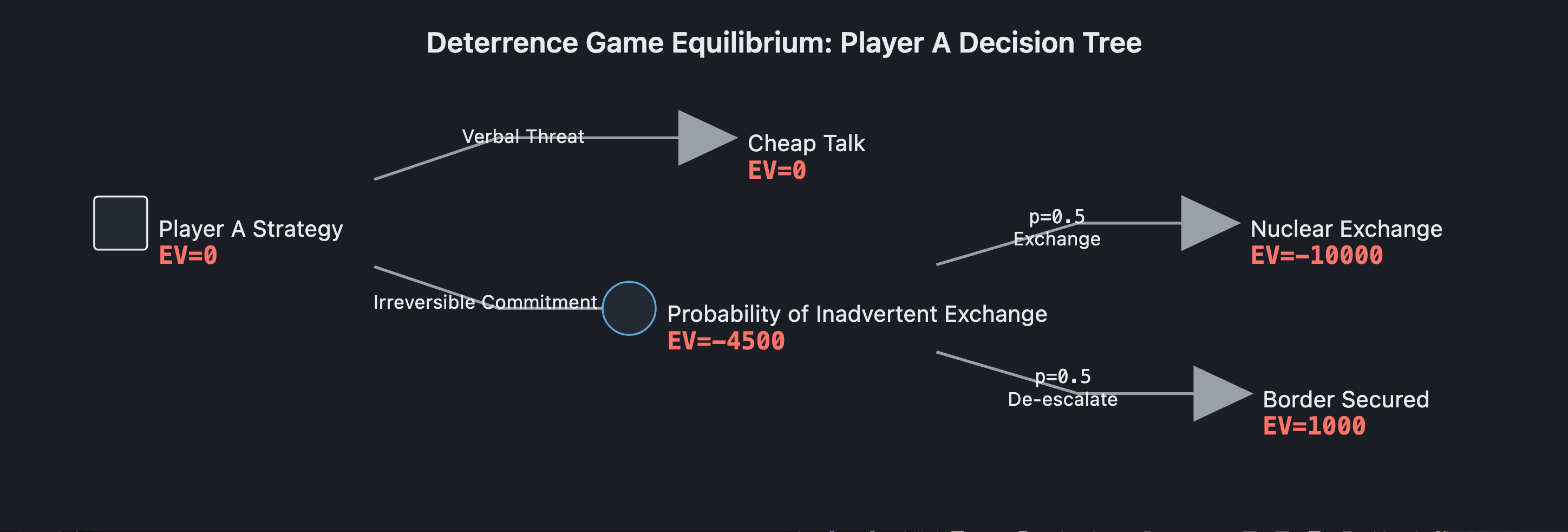
Brinkmanship is not threatening to push the button. It is deliberately creating a situation that might slip out of control — “the threat that leaves something to chance.” You stand on a slope above the abyss, holding your rival’s hand. You cannot credibly say “I will jump.” You can credibly say “I am inching us both toward the edge, the ground is loose, and I may not be able to stop us from sliding.”
The genius is that this converts an incredible threat (deliberate suicide) into a credible one (a rising probability of accidental catastrophe). You’re not choosing the disaster — you’re choosing the risk of it, and risk is something a rational actor genuinely might accept.
The Game Structure
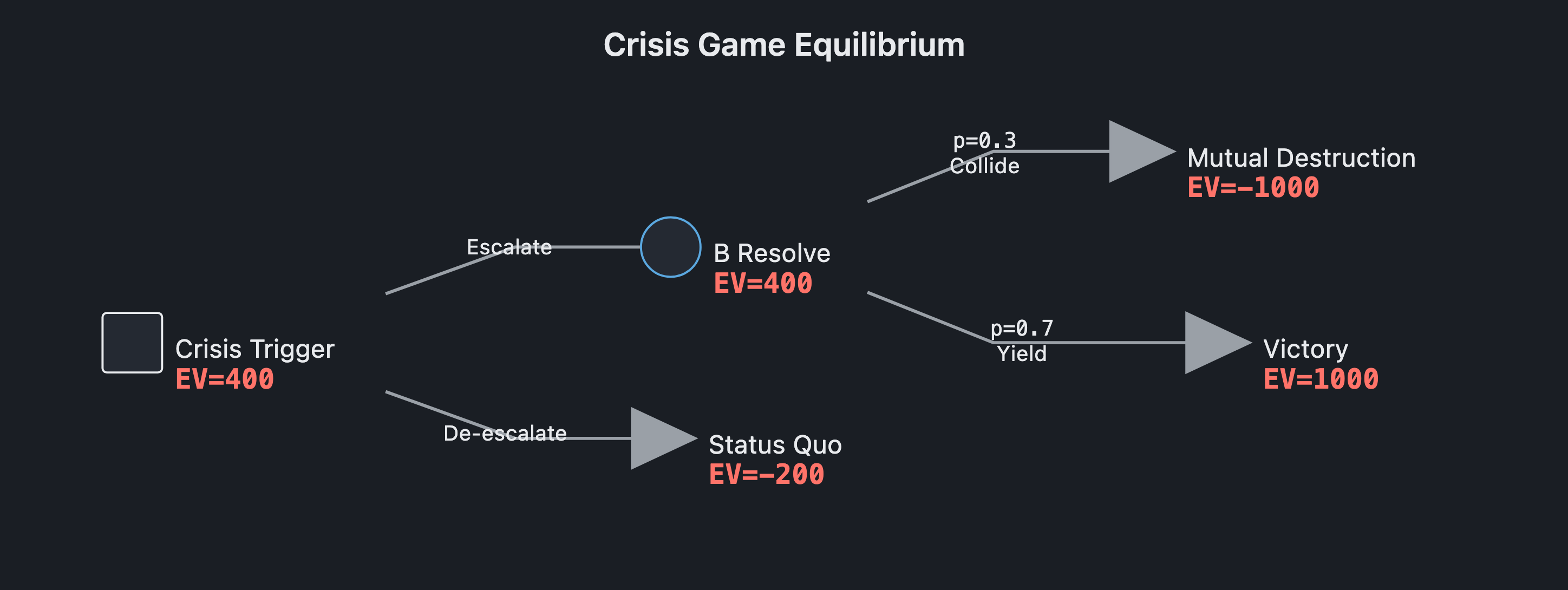
Model it as a war of attrition played in the currency of risk. At each moment, both sides choose: escalate (raise the shared probability of catastrophe) or concede. Let:
p = current probability the standoff tips into nuclear warV = value each side places on winning the dispute (prevailing on the border)C = cost of catastrophe (effectively unbounded, but finite in the actor’s utility)
A side is willing to keep escalating only while its expected payoff from holding firm exceeds the payoff from conceding:
Escalate while: V · (1−p) − C · p > −(cost of backing down)
Each side is asking: whose nerve breaks first? The standoff is a contest to convince the opponent that you will tolerate a higher p than they will. The “edge of catastrophe” is the region where p has climbed high enough that the expected cost is becoming intolerable — and the question is who flinches as it climbs.
What Each Side Expects the Other to Do
This is where it becomes a game of incomplete information about resolve. Neither side knows the other’s true C — how much catastrophe-risk they will actually stomach. So each forms beliefs and updates them:
-
Type signaling. Each side wants to appear to be a “high-resolve type” — one with much at stake (a vital interest, a domestic audience that punishes retreat, a leader who seems genuinely willing to risk it all). High-resolve types can climb higher up the slope.
-
Costly signals. Because talk is cheap, only actions that would be painful or hard to reverse for a low-resolve bluffer carry information: mobilizing forces, moving warheads to launch readiness, visible alerts. These are credible precisely because they’re costly — a bluffer would be reluctant to pay them.
-
The commitment move. The strongest play is to remove your own option to back down, making the threat self-enforcing. Schelling’s paradox: power often comes from constrained options. Examples:
- Tying hands — staking public/domestic reputation so visibly that retreating becomes politically fatal (audience costs).
- Burning bridges — delegating launch authority, deploying tripwire forces, automating response so that no human discretion can later relent.
- The doomsday-device logic — a fully automated retaliation removes the credibility problem entirely… but only if the other side knows about it. (Hence Dr. Strangelove’s joke: a secret doomsday machine deters nothing.)
A side that visibly destroys its own ability to back down wins the game of chicken — because the other now knows that to avoid disaster, they must be the one to yield. This is the deep counterintuition: handcuffing yourself is a source of bargaining power.
So in equilibrium each side expects the other to: bluff if low-resolve, commit if high-resolve, and — crucially — to be watching for the same signals from me. The standoff becomes a mutual reading of nerve, hardware, and politics.
Where It Tips Into Disaster
The horror of brinkmanship is that the catastrophe arrives not by anyone choosing it, but through the very mechanism that made the threat credible. The risk p is real, autonomous, and not fully steerable. Disaster comes from:
-
Genuine loss of control. The “left to chance” element is not theater. Alert forces, hair-trigger postures, and decentralized launch authority create real accident pathways — false radar warnings, a misidentified flock of geese, a training tape loaded into a live system (all historical near-misses). The slope really is slippery.
-
Both sides being high-resolve. If both have committed, neither can back down, and the war of attrition has no peaceful equilibrium — p ratchets upward with nothing to arrest it. Two players who both “throw the steering wheel out the window” in a game of chicken crash with certainty.
-
Misperception and the fog of signaling. Costly signals are noisy. A defensive mobilization reads as preparation for a first strike. Under crisis instability — where striking first is much better than striking second (use-it-or-lose-it forces) — even a side that wants peace may launch preemptively, fearing the other is about to. The structure rewards the itchy trigger finger.
-
The commitment trap. The same hand-tying that wins the bargaining game destroys the off-ramp. If reality drifts past the line you’ve committed to, your own credibility-engineering forces the catastrophe you built it to prevent.
The Synthesis
Brinkmanship works by a paradox stacked on a paradox:
- An incredible threat (rational suicide) is made credible by converting it into a probabilistic, partly-uncontrolled risk.
- Weakness becomes strength: the side that most convincingly gives up its ability to choose gains the power to make the other choose.
- And the mechanism that generates deterrent credibility — real, autonomous risk that no one fully governs — is the same mechanism that produces catastrophe.
Deterrence is therefore not a stable plateau but a knife-edge. It holds when one side reads the balance of resolve correctly and yields before p runs away. It fails when both commit, when signals are misread, or when the chance the threat “left to itself” simply comes due. The edge that makes the threat believable is the same edge people fall off.
The grim corollary: a deterrence posture optimized purely for credibility — maximally committed, maximally automated, maximally hair-trigger — is also the posture most likely to tip into the disaster it was built to prevent. Stability comes not from standing closest to the edge, but from preserving — on both sides — the ability to step back, and the time to realize you should.
Want me to push this further in any direction — formalize the war-of-attrition equilibrium, work through the chicken/Cuban-Missile-Crisis mapping, or examine how second-strike survivability (MAD) changes the game by collapsing the first-mover advantage?
In game theory, the phenomenon of nuclear brinkmanship is best modeled not by the Prisoner’s Dilemma, but by the game of Chicken (also known as Hawk-Dove or the Crazy Man Game).
In Chicken, two drivers speed toward each other on a narrow road. The first to swerve loses face (the “bastard” strategy), but the one who stays straight wins (the “cow” strategy). However, if neither swerves, both crash and die. The pure Prisoner’s Dilemma suggests mutual defection is rational, whereas Chicken suggests the rational equilibrium is to swerve (yield) to avoid catastrophe, provided the rival is more likely to yield first.
Here is an analysis of how nuclear brinkmanship functions under this framework, focusing on credibility, expectations, and the tipping point.
1. Making the Threat Credible: The Cost of Retaliation
In Game Theory, a strategy (or threat) is only credible if the opponent believes you will execute it upon deviation. In a pure nuclear standoff, a nuclear threat is theoretically logical, but in game-theoretic equilibrium, threats are often non-credible because “Mutually Assured Destruction” (MAD) makes the cost of war infinite for both sides.
If Country A threatens Country B with “If you invade, we strike first with our nukes,” Country B knows A is rational. Why? Because A risking nuclear annihilation to win a conventional border war is suicide. It is a dominated strategy—it offers negative payoffs for A regardless of B’s choice.
How Brinkmanship creates Credibility:
Schelling argued that credibility comes from changing the structure of the game to make retreat appear impossible or too costly.
- Belated Commitment: By “going to the edge,” Country A moves the game state closer to the Disaster cell in the matrix. They deploy tactical nuclear weapons near the border or issue public ultimatums with severe consequences attached.
- The Sunk Cost Trap: Escalation acts as a signal. As A escalates, B calculates whether backing down saves their political life or leads to defeat. As crisis deepens, A likely makes the cost of backing down higher than the cost of fighting. This is known as an “in-betweener” move.
- Bluffing vs. Reality: A bluff works only if the cost of calling the bluff is high for B, or if the cost of staying in the brink is high enough that A doesn’t have to be “rational.” However, true deterrence relies on A being incapable of backing down even as they are physically moving toward catastrophe.
The Credible Threat Paradox:
To make a threat credible, A must be willing to lose more than the crisis is worth. If A is only willing to lose the fight, the threat is cheap. If A is willing to trigger the crash (which kills A too), the threat is credible, otherwise, A dies for free. Therefore, true brinkmanship is a premeditated appraisal of death.
2. Mutual Expectations: The “Rationality Discount”
In the Chicken game, the equilibrium relies on determining who values life more than reputation. However, sovereign states are often driven by mixed motives (reputation, domestic political survival, historical insecurity).
What Country A expects Country B to do:
- The Calculation: Country A must estimate B’s “rationality discount factor.” Is B irrational? Is B held hostage by domestic extremists?
- Signaling Intentions: In the game, A assumes B will yield if A signals irrepressible aggression.
- The Fear of “Crazy” Betrayal: A exists in fear that B’s rationality is bounded by time. B might be willing to yield if the crisis ends in 1 hour. If A pushes for 24 hours, B loses.
What Country A does (to ensure they win):
- Strategic Uncertainty: To maintain the edge, A must ensure B cannot predict exactly how A will react.
- Schelling’s Point of Aggression: There is a threshold value where yielding becomes “unwinnable” for B not because the weapon will definitely hit, but because yielding it implies A is rational enough to be trusted. If A moves too far, the equilibrium breaks and the game moves from Chicken to Prisoner’s Dilemma.
The “First-Mover” Paradox:
Usually, the rational mover is the one who commits to the rival’s logic. If A signals “I am willing to burn the house down even if the house is mine,” B will not have the rational option to burn the house down too. B must wait for A to commit.
3. The Tipping Point: Disaster Point
In a nuclear game, the Tipping Point is not necessarily where the mutual destruction is complete, but the point where the ability to pick up a lever is uncertain. It is the moment the cost of pulling the trigger exceeds the cost of risk averse behavior.
The Escalation Ladder:
- Phase 1 (Hot Peace): Rhetoric increases. A signals readiness to fight.
- Phase 2 (Creds): Military movements occur. A moves missiles forward. The threat becomes more physical.
- Phase 3 (The Shift): The game moves from Deterrence to Disincentive. B now assumes A will fight if B yields.
- Phase 4 (The Catastrophe): The tipping point is reached when the “Yellow Line” (No-Nuclear Line) is breached. At this point, the crisis is no longer about winning the war, it is about winning the right to survive.
Where it tips:
The tipping into disaster occurs through Failure of Communication or Miscalculation.
If A calculates that B will yield before A crosses the threshold, A is rational.
If A forces B to step over the threshold (e.g., B executes a limited retaliatory strike), A faces a crisis of political survival. If A yields a nuclear attack, they lose national prestige.
However, at the brink, A must act as if A will rationalize irrationally. For example:
- If A provides a “No-Second Strike” guarantee, the threat collapses.
- If A issues a “Launch on Warning” policy, the cost of hesitation increases.
- If A activates the “Dead Hand” (automated retaliation systems), the game inevitably moves to Disaster, as the other side cannot control the trigger.
Game Specification Summary: The Nuke-Stranglehold Matrix
| B Yields (De-escalates) | B Escalates (Attacks) |
|---|
| A Yields | Status Quo (Low Payoff for A) | A Survives (High Reward for A) |
| A Escalates | A Survives (High Reward for A) | Mutual Death (Catastrophic Cost) |
The Equilibrium Problem:
If both A and B play the matrix above, the rational outcome is if one side is willing to sacrifice themselves to survive (yielding to the Escalate).
- However, A will never know if B will yield.
- Thus, A escalates. B sees A escalate.
- To avoid losing face (or domestic war), B escalates.
- Result: The Game breaks.
Conclusion
Brinkmanship relies on the mathematical logic of Game Theory, but it requires the psychological tolerance of irrationality. The threat to destroy the world is credible only when the model assumes both sides value political survival over material security more than the survival of the population.
The tipping point to disaster occurs not when the weapons are fired, but when strategic ambiguity collapses into binary choice. Once both sides perceive that the other is willing to press the button, the game transitions from Chicken to the “Tragedy of the Cleanse,” and the previous options of yielding or deterred withdrawal disappear.
In short: Going to the edge is necessary because it breaks the “safe” equilibrium. By making the cost of yielding higher than the cost of risking nuclear war, the brink creates the conditions where peace is a function of mutual survival, and the tipping point is simply the failure to understand who is actually willing to die for it.
Players and payoffs
| Player | Actual value terms (not claimed-to-want) | How these were inferred | Note where actual diverges from claimed |
|---|
| Power A | Regime survival (highest); territorial integrity (high but finite); civilian welfare (high but fungible, as elites are sheltered); prestige/credibility (medium, as lost prestige is recoverable but lost regime is not). Ordinal payoffs: Win ($+W$), Concede ($-c$), Disaster ($-D$), with $D \gg W > 0 > c$. | Revealed-by-behaviour: sustained second-strike investment prioritizes regime survival over territorial maximalism or civilian welfare. | Public rhetoric frames the choice as Win-vs-Disaster (“resolve to the end”); actual revealed preference recognizes that conceding ($-c$) is strictly preferable to mutual death ($-D$). |
| Power B | Regime survival (highest); territorial integrity (high but finite); civilian welfare (high but fungible); prestige/credibility (medium). Ordinal payoffs: Win ($+W$), Concede ($-c$), Disaster ($-D$), with $D \gg W > 0 > c$. | Revealed-by-behaviour: symmetric to Power A, reflecting MAD parity in a border standoff. | Public rhetoric frames the choice as Win-vs-Disaster; actual revealed preference recognizes that conceding ($-c$) is preferable to death ($-D$). |
Audience-entrapment payoff distortion: For a leader facing imminent coup or revolution, the payoff for conceding shifts from $-c$ to regime-death $-R$. Where $-R < -D$, the leader is rationally compelled to risk nuclear war, since regime survival is the only metric that binds. External analysts routinely misjudge the opponent’s $-c$ by missing this.
Missing-player flag: Domestic audiences/political bases, military command structures, allied extended-deterrence beneficiaries, neutral mediators, international public opinion, and proxy/ambiguous-attribution actors are reactive third parties whose responses would shift the equilibrium. Their inclusion is recommended if their behaviour is observable; their absence is named here so the equilibrium below is read as bounded-to-the-current-inventory.
Game classification
Timing: Sequential / extensive-form. Moves alternate observably (mobilize → counter-mobilize → ultimatum); the opponent responds and the first player responds to the response. The simultaneous-move Chicken matrix is a reduced-form abstraction of this underlying sequential escalation.
Information: Incomplete and imperfect. Incomplete: neither side observes the other’s true cost-of-concession, resolve, or exact red line. Imperfect: neither observes the firmness of the other’s command-and-control or launch authority. Public statements are cheap talk; revealed commitment is the only informative signal.
Duration: Finite single standoff embedded in an indefinitely-repeated dyad. The immediate crisis terminates, but the two powers face each other across crises. The shadow of the future restrains the present move, which is the key to the Cold War equilibrium.
Sum: Contingent on escalation region. Positive-sum below escalation (negotiation is possible); zero-sum over the territorial dispute ($+W, -W$); negative-sum in the catastrophe region (worse for both than the status quo). A single-sum label would be classification-lock; the effective sum changes with the escalation level reached.
Reasoning per classification: The sequential structure reflects real-world escalation ladders. Incomplete and imperfect information necessitate signaling models rather than simple complete-information trees. The indefinite repetition allows for reputation-building and Folk Theorem equilibria, preventing the one-shot mixed-strategy catastrophe tail from dominating. The variable sum accurately reflects that crises begin with potential mutual gain (avoiding war) but degenerate into negative-sum territory if control is lost.
Equilibrium analysis
Equilibrium method: Backward induction (subgame-perfect equilibrium), mixed-strategy Nash (for reduced-form), and Perfect Bayesian equilibrium (for formal signaling with incomplete information), alongside Folk Theorem (for repeated games).
Derivation:
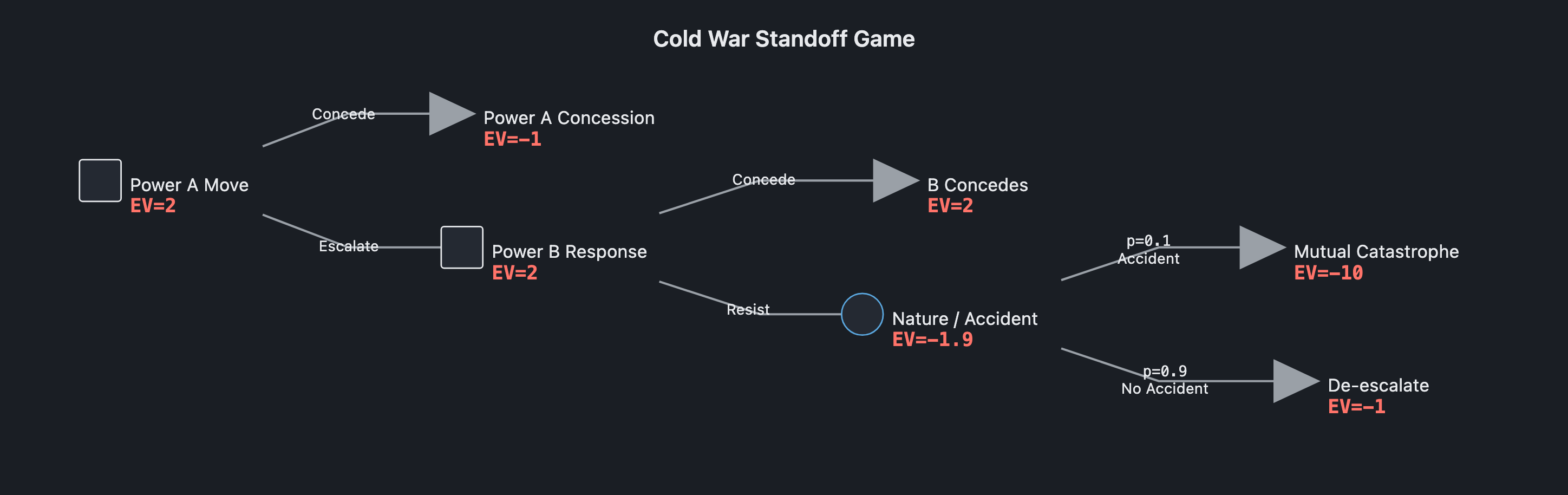
- Reduced-form Chicken (Mixed-Strategy Nash): With a symmetric corrected matrix (mutual concession $= 0$; unilateral outcomes $= +2, -1$; mutual catastrophe $= -10, -10$), A’s payoff from Concede is $-q$; from Escalate is $2(1-q) - 10q = 2 - 12q$. Indifference condition yields $11q = 2$, so $p = q = 2/11 \approx 18.2%$. The probability of mutual catastrophe is $p \cdot q \approx 3.3%$, representing the non-zero disaster tail intrinsic to brinkmanship.
- Sequential Game (Backward Induction): At the final node, if A escalates, B chooses between Concede ($-1$) and Escalate ($-10$). B concedes. Anticipating this, A at the first node chooses between Concede ($-1$) and Escalate ($+2$). A escalates. SPE outcome: (A Escalate, B Concede).
- Formal Signaling (Perfect Bayesian): A escalates (decision node). B chooses Concede $\to (W, -c)$ or Resist. If B resists, B assesses A’s type: “Rational” ($-c > -D$) or “Committed” ($-R < -D$, audience-cost-bound), holding prior belief $\mu$ that A is Committed. Chance node (Nature): if A is Committed or successfully mimics it, Nature introduces an exogenous accident probability $p_e$ leading to $-D$; with probability $1-p_e$, A may still rationally de-escalate to $-c’$. B’s expected utility $EU(\text{Resist}) = \mu[p_e(-D) + (1-p_e)(-c’)] + (1-\mu)(W)$. B resists only if $EU(\text{Resist}) > -c$. A forces concession not by threatening to choose $-D$, but by raising $p_e$ (chance exploitation) or by updating $\mu$ toward 1 (audience-cost entrapment), calibrated to make B indifferent/inclined to concede while keeping A’s own expected utility above $-D$.
- Repeated Game (Folk Theorem): Cooperation is supportable as SPE when the discount factor $\delta$ is high enough. A live-and-let-live pattern holds provided defection is punished (Tit-for-Tat / Grim Trigger).
Stability: The deterministic threat of mutual suicide is unstable because $-D < -c$ at the final node, making it incredible. The mixed-strategy Nash provides a stable but suboptimal non-zero catastrophe tail. The repeated-game Folk Theorem equilibrium is stable only as long as the shadow of the future remains long.
Reader-reproducibility check: A reader can reconstruct this equilibrium from the players, the ordinal payoffs ($D \gg W > 0 > c$), the sequential tree where B compares $-1$ vs $-10$, the indifference equation $11q = 2$, and the Perfect Bayesian expected utility formula for B’s resistance. Note: Probability discipline is strictly enforced; no decision-node edge carries a probability. The accident probability $p_e$ is attached strictly to the Nature/chance node, and $p, q$ are player mixing probabilities in the mixed-strategy equilibrium, not tree-edge probabilities on choices.
Tipping point into irreversible disaster: The system tips when three conditions converge: (1) The Math: actions push objective $p_e$ past the threshold where $EU(\text{Resist}) < EU(\text{Concede})$ for the defender. (2) The Binding: commitment devices built for credibility eliminate the human off-ramp, locking the system onto the chance-node trajectory. (3) The Fog: a precipitating exogenous shock (e.g., radar glitch) acts on the fragile system. The tipping point is a discontinuous phase transition (pre-brinkmanship $\to$ mid-escalation $\to$ brink $\to$ tipping point $\to$ disaster), occurring when communication is degraded enough that no face-saving concession is constructible, audience costs make domestic backing-down worse than war, and loss of control has overshot the point of unilateral de-escalation.
Bounded-rationality note: The equilibrium above assumes perfect rationality. Real-actor deviations (cognitive bias, political constraint, incomplete preference orderings) shift expected play toward escalation past the rational stopping point. Specific deviations include: overconfidence/mirror-modeling (underestimating objective $p_e$); prospect-theory loss aversion (overweighting avoiding the certain immediate loss $-c$ relative to probabilistic $-D$); underestimation of catastrophe severity; hot-cognition/groupthink narrowing the option set; audience-cost lock-in; and communication failure. The most common historical path to disaster is not rational bluff-calling, but communication failure plus commitment-driven inflexibility. The recommendations below account for these deviations.
Credibility assessment
credibility: “We will strike if our red line is crossed” (relying solely on a rational actor’s promise) — cheap talk. Why dismissible: No commitment device, sunk cost, or future-shadow exists. Backward induction shows $-D < -c$ at the final node, so a rational actor will take the de-escalation off-ramp. Mutual-suicide-by-choice is mathematically incredible.credibility: “We will strike if our red line is crossed” (augmented by a partly-irreversible step) — credible. Commitment device or future-shadow: Mobilized reserves, DEFCON-equivalent alert, hair-trigger posture, or a published ultimatum with a non-revisable deadline. Walking it back imposes domestic (audience) and operational (de-mobilization) costs; the threatener has visibly reduced its own freedom to retreat.credibility: Exogenous chance exploitation (posture raising accident risk) — credible. Commitment device: A posture that objectively raises $p_e$ (hair-trigger alert, forward-deployed tactical weapons). Relies on command-and-control fragility. It is reversible (de-alerting is possible).credibility: Audience-cost entrapment — credible. Commitment device: Altering the domestic payoff so the leader’s concession cost becomes $-R$ (regime death) $< -D$, via irreversible public commitments that eliminate face-saving exits and shift the opponent’s belief $\mu$ toward “Committed.”credibility: “No-first-use” — credible in some doctrines, cheap talk in others. Credible if enforced by physical deployment (e.g., submarine-based second-strike only, no forward-deployed tactical weapons). Cheap talk if contradicted by capability or prior behavior. The signal is the deployment pattern, not the statement.credibility: “We will stop escalating if you stop” — credible under repetition. Future-shadow: Grounded in the fact that defecting from a deal destroys future-deal value. It remains cheap talk in a one-shot final confrontation.credibility: “We cannot stop the launch sequence; it is pre-delegated to a doomsday machine” — credible (maximally). Commitment device: The threatener has removed its own control, so the threat becomes a fact about the world. The trade-off is maximum credibility for zero flexibility.
Alternative structures
- Alternative classification: Asymmetric payoffs (varying concession cost while holding catastrophe symmetric at $-D$). What changes: If A concedes at $-2$ and B concedes at $-8$ (B is more exposed on the specific issue), B’s higher concession cost raises B’s threshold for backing down. Consequently, B escalates more, and A, with the cheaper exit, is forced to back down. Implication for the dominant analysis: The dominant symmetric equilibrium is contingent. This reveals Schelling’s “paradox of weakness”: over-commitment to a winnable issue (making one’s own exit more costly) is itself the credibility-collapse mechanism. Vulnerability to the issue, not vulnerability to catastrophe, dictates the outcome.
- Alternative classification: Incomplete information about resolve (Harsanyi types {High, Low}). What changes: Perfect Bayesian equilibrium yields a separating equilibrium: high-resolve types escalate past the brink; low-resolve types concede at earlier stages; the opponent updates beliefs based on observed late escalation. Implication for the dominant analysis: Brinkmanship functions as a revealing mechanism. Pre-brinkmanship announcements are uninformative (pooling), whereas post-brinkmanship behavior is informative (separating). Escalation is signaling about hidden resolve, not merely applying pressure.
- Alternative classification: One-shot vs. repeated (Folk Theorem / Axelrod). What changes: In a one-shot game, the mixed Nash equilibrium dictates a non-zero catastrophe tail with no stable non-catastrophe equilibrium. Under indefinite repetition with a high discount factor $\delta$, cooperative equilibrium becomes supportable; reputation becomes an asset, and defection triggers next-period punishment (Tit-for-Tat / Grim Trigger). Implication for the dominant analysis: The brinkmanship equilibrium is unstable under repetition. The expected utility of triggering a crisis becomes vastly negative, shifting equilibrium to mutual early de-escalation. The most destabilizing real-world development is anything that shortens the shadow of the future (e.g., a short-tenure leader, coup-prone regime, or a regime not expecting to survive to the next crisis).
Strategic recommendations
- Provide a verifiable face-saving off-ramp — mechanism: payoff-structure alteration (lowering the opponent’s concession payoff $c$). Expected equilibrium shift: Allows withdrawal to be framed as “tactical realignment” or “joint de-escalation,” reducing the incentive to escalate. Moral-hazard trade-off: Repeatedly offering this updates the opponent’s belief $\mu$ downward, teaching them your threats are bluffs and inviting future probes that raise the equilibrium catastrophe probability.
- Cap the chance-node probability $p_e$ — mechanism: chance-node cap / off-ramp construction. Expected equilibrium shift: Maintains the threat of escalation but explicitly decouples it from automated systems. Establishing protected, direct channels (hotlines) guaranteeing human override proves rational intent (you will not choose $-D$) while retaining ambiguity over the opponent’s control of their own forces.
- Avoid sunk-cost / audience entrapment — mechanism: payoff-structure alteration. Expected equilibrium shift: By not tying regime legitimacy to the specific border outcome, you guarantee concession cost does not exceed disaster ($-R \nless -D$), preventing the opponent from being rationally compelled to play the disaster card. Stakes must be reframed as issue-based, not existential.
- Make red lines narrow, not broad — mechanism: classification-dimension alteration (shrinking the zero-sum territory region). Expected equilibrium shift: Fewer issues are fought over, but escalation on those specific issues is more credible, avoiding a state of permanent, unsustainable near-brinkmanship.
- Invest in second-strike survivability — mechanism: payoff-structure alteration (MAD stabilization). Expected equilibrium shift: Makes a first strike less attractive, stabilizing the no-first-strike equilibrium and removing the temptation to use brinkmanship to mask first-strike preparation.
- Preserve redundant, secure communication channels — mechanism: off-ramp construction. Expected equilibrium shift: Directly mitigates the communication failure that is the most frequent historical cause of MAD-equilibrium collapse, allowing coordination before The Math, The Binding, and The Fog converge at the tipping point.
- Pre-commit to a limited / proportional-retaliation doctrine — mechanism: credibility shift. Expected equilibrium shift: Reduces the gap between the threat and revealed preference. A promise to “retaliate proportionally to a first use” is more credible than “destroy the world over a border incident,” making the threat believable without requiring doomsday-machine loss of control.
- Cultivate a public reputation for keeping commitments — mechanism: repeated-game payoff alteration. Expected equilibrium shift: Raises the cost of defection. A state whose deals are genuinely believed faces lower audience costs on concession, facilitating cooperative Folk Theorem equilibria.
- Avoid short-tenure or lame-duck leadership in crises — mechanism: future-shadow preservation. Expected equilibrium shift: Ensures the leader remains responsive to long-shadow constraints, stabilizing the repeated-game equilibrium against premature crisis triggering driven by truncated time horizons.
- Use third-party mediators early — mechanism: off-ramp construction via an outside option. Expected equilibrium shift: Mediators supply interpretations of concession that let domestic audiences read capitulation as something else, directly breaking the audience-cost lock-in that prevents rational de-escalation.
- Build attribution capability for proxy attacks — mechanism: information-structure improvement. Expected equilibrium shift: Restores clean retaliation, eliminating the proxy-attack ambiguity failure mode that defeats clean MAD-style deterrence and allows ambiguous actors to probe red lines without triggering a response.
(visual rendered — see artifact)
Players and Payoffs
Player A / Player B — two nuclear-armed states in a border standoff (the symmetric baseline). Actual value terms (not claimed-to-want): claimed payoff is “defending territorial integrity / vital national interest,” but the revealed ordering, best to worst, is (4) opponent backs down → win the disputed stake and bank a reputation for resolve; (3) mutual de-escalation with face saved (status quo, stake frozen/split); (2) back down visibly (lose face); (1) nuclear exchange (catastrophic, ranked dead last by both). How these were inferred: revealed-by-behaviour. Note where actual diverges from claimed: neither side actually ranks exchange anywhere but last — survival dominates the stake — yet both claim the stake is worth annihilation. The game is the management of that gap; brinkmanship is the technology for making a claim you don’t mean look like a payoff you’d accept.
Domestic political / regime survival — a third, usually-unstated revealed payoff. Actual value terms: for many real leaders “back down visibly” ranks below “limited military clash,” because the operative utility is regime survival, not national survival. How these were inferred: revealed-by-behaviour. Note where actual diverges from claimed: this reordering is where the abstract model and real crises diverge; it is what audience-cost commitments exploit and what can invert a leader’s ordering mid-crisis.
Asymmetric stakes / balance of resolve — the operative case; the symmetric row above is only the baseline. Actual value terms: real standoffs are rarely symmetric, and the asymmetry is frequently decisive. Where one side holds the disputed ground as a core interest and the other as peripheral, the core-stake side’s inversion point (where backing down becomes worse than gambling on escalation) sits further out, so it can rationally endure more risk before yielding. How these were inferred: structural-position. Note where actual diverges from claimed: this does not change the ordinal form of the game (still Chicken) but tilts which equilibrium is selected and tilts the prior over who is the resolute type.
The stated-vs-actual divergence is itself the analytic object: both claim the stake is the issue; the revealed ordering shows the operative competition is over not being the one who blinked (a domestic-audience/reputational good), while mutual exchange is the common worst outcome — which is what makes the game mixed-motive rather than zero-sum.
Missing-player flag: alliance patrons, domestic audiences, and military command echelons / individual operators are reactive players whose responses would shift the equilibrium. Their full treatment is below in Additional players whose inclusion shifts the equilibrium; their absence from the core two-principal derivation is named here so the equilibrium below is read as bounded-to-the-current-inventory (the two principals plus the autonomous-risk node).
Game Classification
Timing: sequential / extensive-form, played in rounds. Escalation proceeds up a ladder (alert postures, mobilization, forward deployment, demonstration); each rung is observed before the next is chosen — move order and observability are the whole game. Refinement: within any single rung the commitment choices are effectively simultaneous (neither sees the other’s current decision before making its own), so it is best modeled as a sequence of simultaneous-move stage games — an extensive-form game with imperfect information at each stage.
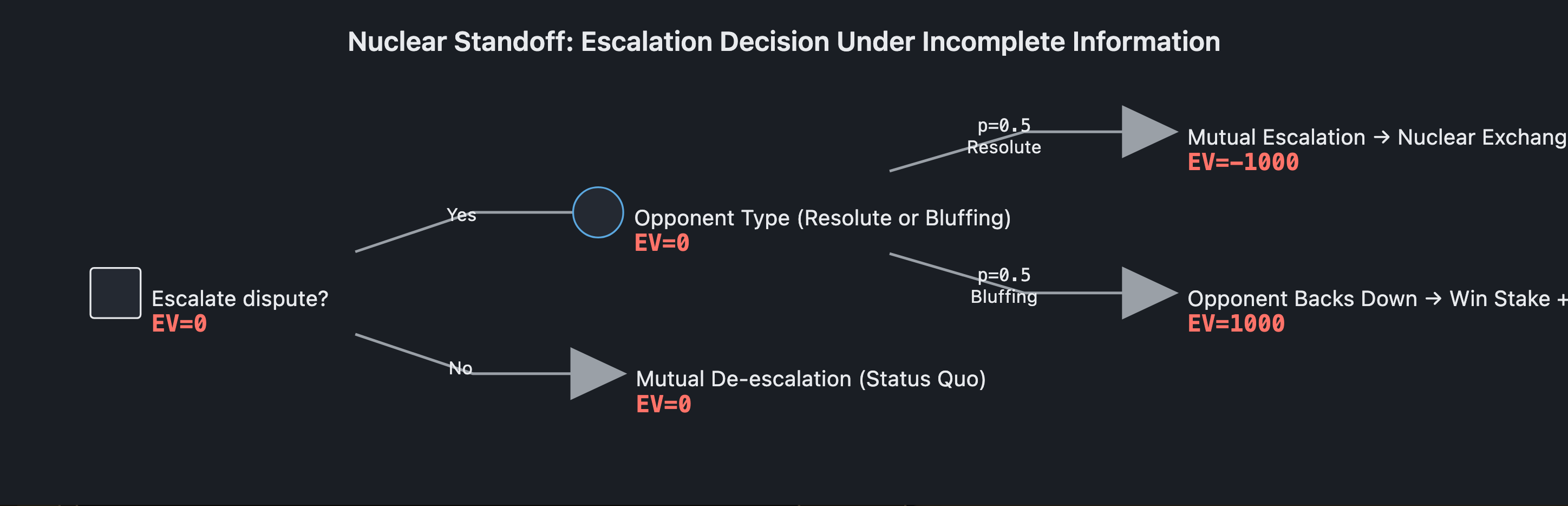
Information: incomplete AND imperfect (both present, doing different work). Incomplete: each side is uncertain of the other’s type — genuinely Resolute (would accept ruin over yielding) vs. Bluffing/irresolute; payoff orderings are private. Incompleteness drives signaling. Imperfect: fog of crisis — moves, intentions, and even one’s own forces’ actions are observed with noise and delay, and a side cannot perfectly tell whether an action was ordered or accidental. Imperfectness drives the autonomous-risk mechanism.
Duration: mixed — an indefinite-horizon repeated relationship with a one-shot, absorbing terminal node. The two powers coexist across many crises (repeated/infinite-horizon → reputation and reciprocity operate), but the catastrophe node — actual exchange — is one-shot and absorbing: no “next round” after it, and the threshold-crossing (weapon use) is terminal and unrepeatable. So the game is repeated everywhere except at the one node whose threat disciplines the whole structure. The danger lives in the gap between these two framings.
Sum: mixed-motive (non-zero-sum). Strong common interest (both rank exchange last → positive-sum cooperation to avoid it) layered over a distributive, zero-sum conflict over the stake. Pure-zero-sum framing erases the shared interest that makes de-escalation possible.
Reasoning per classification — the crisis is Chicken / Hawk-Dove, not Prisoner’s Dilemma. The defining feature of Chicken: the worst outcome is mutual aggression (mutual escalation/crash), worse than unilateral concession, so there is no dominant strategy to defect. In a one-shot PD, defection dominates and mutual defection is the unique equilibrium — if the standoff were really a PD we would expect war as the equilibrium; we don’t, which tells us the structure is Chicken. This single inversion drives everything that follows.
Equilibrium Analysis
Equilibrium method: a sequence of named methods — backward induction / subgame-perfect equilibrium (to kill the flat threat), Nash (complete-information Chicken stage), Schelling’s “threat that leaves something to chance” (to restore credibility), and Perfect Bayesian Equilibrium (the signaling game under private types).
Derivation:
Step A — the flat deterrent threat is not subgame-perfect (backward induction / subgame-perfect equilibrium). Take “if you cross my red line, I will deliberately launch.” Fold back: if B crosses, A’s terminal node offers launch (payoff 1, catastrophe) vs. acquiesce (payoff 2, lose face); since 2 > 1, A’s best response is not to launch. B, reasoning backward, crosses. The threat of deliberate all-out use against a comparable nuclear power is therefore an incredible/empty threat — executing it is worse for the threatener than swallowing the loss. This is the central result the rest of the analysis routes around. Empirical signature: red lines repeatedly crossed without nuclear response (Crimea, the Black Sea Fleet, the Kursk incursion) are cheap-talk threats being correctly called.
Step B — complete-information Chicken (Nash). One simultaneous stage with complete information yields two pure-strategy Nash equilibria (A-firm/B-yields and B-firm/A-yields) and one mixed-strategy equilibrium in which each holds firm with some probability. The mixed equilibrium places positive probability on the (hold, hold) catastrophe cell and is the dangerous one. Pure-equilibrium selection is the strategic prize — each side wants its preferred equilibrium (the one where the other yields) to be focal; selection is achieved by commitment, not preference.
Step C — brinkmanship: “the threat that leaves something to chance” (Schelling), credible by changing the game tree. Because deliberate launch is incredible, the credible move substitutes a threat the threatener can rationally carry out: not “I will launch,” but “I am taking partly-irreversible steps that raise an autonomous probability of an exchange neither of us fully controls, and will keep raising it until you yield.” This introduces a genuine nature/chance node of inadvertent catastrophe (accident, miscalculation, unauthorized/delegated action). It is credible because no one has to choose ruin — they only choose to tolerate risk. The credibility comes from the loss of control, not the resolve: you become more persuasive by becoming less able to choose (cutting your steering wheel in Chicken and letting the other driver see it).
Step D — incomplete information: Perfect Bayesian Equilibrium (signaling), with reproducible separation condition. Add private types (Resolute vs. Bluffing); the crisis is a signaling game solved by PBE in which each side updates beliefs about the other’s type from observed escalation. Costly, hard-to-fake, hard-to-reverse moves (mobilization expensive to reverse, public commitments staking domestic survival, mating warheads, raising alert) are separating signals; cheap/reversible moves (mere announcements) are pooling signals that update beliefs little. The signal separates types because it hurts to send (Spence cost-asymmetry logic): generating real autonomous risk is cheaper for a type that genuinely values the stake than for one that doesn’t.
The single-crossing / cost-threshold condition that makes separation reproducible: with signal cost k, resolute willingness-to-pay W_R, irresolute W_I, and W_R > W_I, the signal separates only when W_I < k < W_R. Below W_I both types send it (pooling, uninformative); above W_R neither does.
The Bayesian belief-update trace (reproducible): B holds prior p = P(A is Resolute). A sends costly move m; the Resolute type sends m with probability ≈ 1, the Bluffing type with probability q < 1. Likelihood ratio P(m|Resolute)/P(m|Bluffing) = 1/q > 1. Bayes update: p′ = p / [p + (1−p)q] > p. B has a threshold posterior p* (defined by indifference between standing firm — risking the crash if A is Resolute — and conceding the stake); A escalates precisely to drive p′ past p*, at which B’s best response flips from “stand firm” to “concede.” When q is large (cheap/mild move), p′ − p is small and p* is rarely crossed — the pooling/cheap-talk case formalized. Expectations are thus manufactured in real time by the sequence of costly moves.
Semi-separating / hybrid equilibrium (the dangerous middle). The separating/pooling binary is the clean limit; the realistic regime sits between. When cost asymmetry is only moderate, the Bluffing type escalates with positive probability — it mixes into the dangerous rungs rather than dropping out. Residual posterior uncertainty then persists even at high rungs (p′ falls short of certainty at the brink). A clean separating world would be safe (bluffers always exit before the brink); it is the mixing bluffer that makes the brink lethal — this is the formal bridge to the misperception tipping point.
Stability: the flat-threat path is unstable (B profitably deviates by crossing, since A won’t execute). In complete-information Chicken, the two asymmetric pure equilibria are stable (neither party profitably deviates once roles are set), while the mixed equilibrium is the knife-edge that places weight on catastrophe. Under PBE, A’s profitable move is to escalate exactly to the cost that drives p′ past p*; B’s best response flips at that threshold. The equilibrium is stable only if exactly one side expects to yield — the (hold, hold) catastrophe cell is realized under mutual optimism, where both simultaneously expect the other to yield, so neither does. Incompatible expectations are the structural fault line, not a bug to be smoothed over.
Reader-reproducibility check: a reader can reconstruct this from the players + payoffs above — fold back the terminal node to see launch is dominated (Step A), enumerate the Chicken stage’s three equilibria (Step B), substitute the chance-node threat to restore an executable commitment (Step C), and run the stated likelihood-ratio Bayes update against the p* threshold (Step D). PBE traces are schematic-symbolic: indifference conditions are stated in form, not solved for specific numbers, per the no-numerical-matrix posture.
Bounded-rationality note: the equilibria above assume hyperrational, unitary, common-knowledge-rational Bayesian players; every serious near-miss came from the failure of that assumption, and every deviation lowers the tipping threshold. Misperception and motivated reasoning corrupt the belief-updating PBE requires (Jervis); leaders see what their priors expect. Organizational/bureaucratic, not unitary, actors (Allison’s organizational-process and governmental-politics models, Essence of Decision): “the state” is a committee under standard operating procedures; routine reconnaissance flights or scheduled missile tests inject moves no leader intended into the signaling stream. Stress, fatigue, and compressed decision timelines degrade backward induction exactly when stakes peak — and modern automation/AI in early-warning and decision-support, plus hypersonic delivery, compress timelines further, shrinking the window to catch a false signal (a live contemporary doctrine concern). Incomplete/unstable preference orderings and sunk-cost escalation of commitment: leaders under existential stress do not hold clean payoff orderings; domestic-survival utility can reorder the ranking mid-crisis, and leaders throw good resolve after bad to justify prior moves. The reading does not overturn the rational model — it explains why the autonomous-risk node carries a higher probability than any rational actor would choose, and why real crises have come closer to the brink than equilibrium logic predicts. The residual catastrophe probability is the bounded-rationality term. This shifts expected play toward the brink relative to the rational baseline, which the recommendations in the final section account for.
Credibility Assessment
-
credibility: “If you cross the line, I will deliberately initiate a full nuclear exchange.” — cheap talk. Why dismissible: no commitment device, no sunk cost, no automaticity; executing it is self-destructive (payoff 1 < payoff 2); it fails subgame-perfection. An announcement without a commitment is not a threat; B should call it.
-
credibility: “I am raising the risk of an exchange neither of us controls, and will keep raising it until you yield” (the something-to-chance threat). — credible. Commitment device = the autonomous risk itself plus the sunk costs of escalation; the threatener never chooses ruin, only endures risk. This is the threat that actually deters.
-
credibility: tied-hands commitments — alliance/forward-stationed “tripwire” forces, automated/launch-on-warning postures, public red lines that stake domestic reputation (audience costs). — credible when hands are visibly and irreversibly tied. The device removes the threatener’s own option to back down, transferring the burden of avoiding catastrophe onto the adversary (Schelling’s “burning bridges”).
-
credibility: sunk-cost/mobilization commitments — mass deployment, fleet sortie, missile fueling, mating warheads. — credible as type-signal, but double-edged. Costly and hard to fake → separating in the PBE (satisfies the Step D threshold) — but they simultaneously raise the autonomous-risk floor (the danger in the tipping-point items below).
-
credibility: relinquishing control — delegating launch authority to field commanders, “dead-hand” systems. — credible and especially potent — and most dangerous. The purest form of “leaving it to chance” because the outcome is genuinely no longer the leader’s decision; also the hardest to reverse.
-
credibility: cheap, reversible “saber-rattling” — rhetorical, low-cost deployments, no real risk generated. — pooling-equilibrium noise → ignore. Both types can send it, so it conveys nothing; the receiver’s correct response is to ignore it, which is what a battle-hardened adversary does.
-
credibility: the assurance/promise side — “If you yield/withdraw, I will not press the advantage.” — cheap talk by default, credible only with a device or future-shadow (Schelling’s reassurance problem). Why dismissible by default: once B withdraws, A’s dominant incentive is to exploit the now-defenceless concession; B foresees this and the assurance fails subgame-perfection exactly as the flat threat did. It becomes credible only via (a) a commitment device — verification regime, reciprocal simultaneous concession (e.g. the tacit Jupiter/Italy withdrawal traded against the Cuban withdrawal), or third-party guarantor — or (b) the shadow of the future making reputation for reciprocity valuable (Axelrod). Deterrence requires both a credible threat and a credible assurance; an incredible assurance closes the off-ramp as surely as an over-credible threat does, because B will not take an exit it expects A to renege on. Analyses routinely audit the threat and forget the promise.
Mutual Expectations and Alternative Structures
How expectations form. Expectations are the PBE beliefs, continuously updated; the goal is to manufacture a belief. Each side enters with a prior over the other’s type and wants the other to expect it to hold firm so the other selects the yield-equilibrium. The stable expectation each tries to install: “My opponent believes I cannot or will not back down, therefore expects to have to back down itself.” Commitment devices are the technology for installing that belief; escalation moves are read as type-revealing signals (costly/irreversible → posterior shifts toward Resolute; cheap/reversible → barely moves beliefs).
The prior is not flat — it is tilted by observable stake asymmetry. Before any signal, the side whose local stake is visibly core (not peripheral) is presumed more likely Resolute because its inversion point visibly sits further out; it therefore pays less in costly signaling to clear the separation threshold (the structure does credibility work for free), while the peripheral-stake side must over-signal to compensate, which is itself escalatory.
The off-ramp / focal-point structure (the coordination side of mixed-motive): because the game is mixed-motive, both sides also hunt a mutually recognizable place to stop. Schelling focal points (a river, a recognized line of control, status-quo-ante, a round number) let convergence happen without either “losing”; convergence there is the cooperative equilibrium of the Chicken game. Each side expects the other to be hunting the same salient stopping point — but a focal point only works if paired with a credible assurance.
The reputational/repeated layer: because the powers expect to meet again, each forms expectations about the other’s future behavior; a state may hold firm harder than the present stake justifies to build a reputation for resolve that pays off later (a repeated-game, not static, incentive) — which is why conceding ranks lower than the present stake alone would imply.
The stability–instability paradox (canonical India–Pakistan lens): robust strategic-level stability (mutual second-strike survivability) can lower the threshold for sub-nuclear and conventional aggression, precisely because both sides believe the confrontation will not go nuclear. The same survivability that holds the game in Chicken thereby licenses probing and salami tactics below the nuclear line; strategic stability and tactical/conventional instability are two faces of one structure.
Expectations become combustible when incompatible. The equilibrium is stable only if exactly one side expects to yield. The (hold, hold) catastrophe cell is realized under mutual optimism — both simultaneously expect the other to yield, so neither does. Incompatible expectations are the structural fault line, not a bug to be smoothed over.
The alternative classifications that stress-test the dominant analysis:
-
Alternative classification: one-shot vs. repeated framing (duration dimension — the most consequential). What changes: under one-shot Chicken, the mixed-strategy Nash stands, there is positive probability on catastrophe, no reputational discipline, and de-escalation promises are cheap talk. Under repeated/indefinite-horizon (the realistic frame), the folk theorem makes cooperative restraint sustainable via reputation and reciprocity (Axelrod’s tit-for-tat); assurances become credible because exploiting a yield today is punished by lost cooperation tomorrow. Implication for the dominant analysis: but the terminal absorbing node (actual exchange) has no tomorrow, so repeated-game discipline cannot reach the one outcome it most needs to. Treating the crisis as one-shot overstates hopelessness and understates reputation incentives; treating it as fully repeated understates the terminal node’s incredibility-of-restraint. Sub-result: under repetition the live danger is noise — an accidental “defection” triggers retaliatory spirals; the correction is a more forgiving strategy (Tit-for-Two-Tats) plus communication redundancy.
-
Alternative classification: sum/dominant-strategy re-classification under first-strike instability (Chicken → PD). What changes: if a disarming first strike could succeed (eliminate the other’s second-strike capability), the structure mutates from Chicken to PD — “strike first” becomes dominant and preemptive war becomes the equilibrium. Implication for the dominant analysis: this is the single most dangerous structural shift in the analysis. MAD is the deliberate engineering of the game away from this — secure second-strike capability (submarines, hardened silos, road-mobile launchers) guarantees retaliation survives a first strike, collapsing the temptation payoff and restoring Chicken’s stability. Sharp policy implication: survivable retaliation is stabilizing; missile defense and counterforce accuracy that threaten the opponent’s second strike are destabilizing. This is a rational-actor result, qualified by the bounded-rationality note (necessary but not sufficient). The same stabilizer activates the stability–instability paradox at the conventional level.
-
Alternative classification: war of attrition (the structure that best fits the mechanism). What changes: the “competition in who endures the chance node longer” is not strictly the static Chicken stage game but a war of attrition (all-pay/dynamic-attrition), which changes the equilibrium object from a single mixed probability to a distribution of quitting times. Setup: each side chooses how long to persist at the brink; each period at the brink incurs an expected cost = (per-period probability the autonomous-risk node fires) × (catastrophe disutility) — a genuine chance node, so probability attaches there legitimately, while choosing when to concede is a strategy (a randomization over concession times is a mixed strategy, not a probability on a decision edge). Equilibrium: with complete information there is no symmetric pure equilibrium; the symmetric equilibrium is in mixed strategies over stopping times and must be memoryless (each player held exactly indifferent between conceding now and persisting), so concession time is exponentially distributed; the hazard rate is pinned by the indifference condition (calibrated so the opponent’s expected gain from persisting one more increment equals its expected risk-cost). A higher-value (core-stake) side has a lower concession hazard and persists longer. The all-pay feature competes away the contested rent — the war of nerves dissipates much of the value even for the eventual “winner.” Implication for the dominant analysis: (i) it makes the asymmetric-stakes result quantitative (resolve → slower concession hazard); (ii) it locates catastrophe not in a single (hold, hold) draw but in the chance node firing before either stopping time arrives — a cumulative hazard rising with duration, matching the empirical texture that danger grows with crisis length; (iii) it shows the contest is value-destroying even when won, sharpening the case for off-ramps.
-
Alternative classification: asymmetric-stake collapse of symmetric Chicken (payoff/expectations variant). What changes: if catastrophe/stakes are not symmetric, the equilibrium tips toward the higher-stake, lower-fear side. Payoff trace: for a side fighting a core survival interest, “back down” drops below “limited clash” (surrender on a survival stake is regime-ending), so its threshold p* rises — it requires near-certainty of catastrophe before yielding; for the peripheral-stake side “back down” stays above “limited clash,” so its p* is low and it yields on modest evidence of the opponent’s resolve. Implication for the dominant analysis: the lower-stakes side’s brinkmanship is therefore less credible and its bluff gets called — the recurring lesson of the 2022–25 record (a nuclear-armed side’s threats over a peripheral stake discounted by an opponent fighting for survival). There is a real positioning tension here, retained rather than resolved: the asymmetric-stakes reading is positioned two ways — as a payoff/expectations refinement that tilts equilibrium selection without changing the ordinal form, and as a standalone alternative structure (“asymmetric-stake collapse”). Both readings are kept: the form-preserving refinement and the equilibrium-tipping alternative are compatible descriptions at different grains.
Where It Tips Into Disaster
Probability discipline (load-bearing framing). Escalation decisions are choices and carry no probabilities on their edges; the autonomous-risk node is a genuine nature/chance node and is the only place probability legitimately attaches — and tuning that probability upward is Schelling’s mechanism. The crisp threshold: brinkmanship tips into disaster when, for at least one player, the cost of backing down comes to exceed the expected cost of escalation in their actual ordering (a decision failure — preferences pushed past the inversion point), or when the autonomous-risk chance node fires independently of anyone’s choice (a chance failure — the leashed risk slips). Both are built into the mechanism that makes deterrence work, which is why brinkmanship is intrinsically, not accidentally, dangerous.
To keep the two crash-probability sources distinct (they must not be blended): (a) the mixed-strategy equilibrium of Chicken (rational randomization, crash in the both-commit joint outcome) and (b) the autonomous chance-node of “leaving something to chance” (loss of control, not a strategic choice). The narrowed inseparability claim: each of mechanism (b) and equilibrium (a) is inseparable from a positive crash probability — you cannot draw the deterrent benefit without it — but the pure-strategy asymmetric equilibria (one side certainly yields) carry zero crash risk; those risk-free equilibria are exactly the ones where you have already lost the contest of nerve. Honest formulation: every equilibrium in which deterrence is actively contested carries crash risk. Decision-node edges carry no probabilities — escalation and concession are choices. Probability attaches only to chance/nature nodes: the autonomous-risk node, the per-period attrition hazard, the accident/false-warning node, and the mixed-strategy equilibrium randomization weights.
Tip 1 — mixed-equilibrium realization. In the incomplete-information game there is positive probability of the (hold, hold) cell — two Resolute types, or two mutually optimistic types, both declining to yield. Rational play does not exclude catastrophe; it only makes it improbable per round, and iterated crises make cumulative probability non-trivial.
Tip 2 — autonomous risk / loss-of-control overshoot. The device works by generating autonomous risk, but loss of control is non-linear and not finely tunable; hair-trigger alert, delegated authority, and automated warning can generate more catastrophe probability than intended. Tipping is when the apparatus crosses from “instrument I am wielding” to “process now driving us.” Canonical near-misses: the 1962 Soviet B-59 submarine near-launch (out of contact under depth-charge stress; unusually, unanimity of three senior officers was required because flotilla chief of staff Vasili Arkhipov was aboard; two favored firing, Arkhipov refused and cast the deciding dissent) and the 1983 Petrov incident (a Soviet officer correctly judged a false launch warning). No leader chose those brinks; the autonomous machinery nearly fired on its own.
Tip 3 — colliding commitment devices. The same tied-hands move that makes your threat credible removes your ability to yield; if both sides burn their bridges, neither can climb down (two cars in Chicken both throwing out the steering wheel). Individually rational commitment becomes jointly suicidal — the dark side of the most “credible” devices.
Tip 4 — information failure / misperception cascade. Imperfect information means a defensive move can be misread as offensive (security-dilemma spiral) or a bluff misread as resolve (or vice versa); PBE assumes correct Bayesian updating, but real updating is noisy and one misread signal can flip a side from “expect to yield” to “must hold.” Mechanically downstream of the semi-separating equilibrium: because the bluffer mixes into high rungs, residual uncertainty never resolves, so a Resolute move can be misread as a bluffer’s overreach or the reverse, and both sides can coordinate onto the crash equilibrium while each believes it is signaling restraint.
Tip 5 — first-strike instability / static-frame collapse (the classification itself shifts). If either side believes its retaliatory forces are vulnerable, “wait and see” collapses and striking first dominates being disarmed; the game degrades from Chicken (waiting safe) toward a one-shot PD with a dominant strategy to strike — and that structural shift is the tipping point. Equivalently, a decision-maker who collapses the infinite-horizon relationship into a one-shot “this is the final move” frame destroys the shadow-of-the-future term that restrained both sides; “use it or lose it” is exactly this collapse. One-shot reasoning applied to what is actually a repeated relationship is itself a tipping mechanism: collapsing the infinite-horizon game into “this is the final move” evaporates the cooperative equilibria sustained by the shadow of the future. The repeated framing is the realistic one for the relationship as a whole; the one-shot framing holds only at the absorbing terminal node — and conflating the two in either direction misprices both danger and assurance credibility.
Tip 6 — audience-cost lock-in / off-ramp closure (bridge to bounded rationality). The public commitments that generate credibility also raise the domestic cost of backing down; when the reputational/political cost of yielding is driven below the expected cost of gambling on escalation, the leader’s actual ordering inverts and the off-ramp closes. This includes assurance-credibility failure: even an open, salient off-ramp closes if B disbelieves A’s promise not to exploit the concession. Public maximalist commitments are dangerous because they burn the bridge both sides need.
Additional Players Whose Inclusion Shifts the Equilibrium
The analysis is bounded to the two principals plus the autonomous-risk node; the players below are named (the alliance case sketched) but not fully modeled. Including them converts the 2-player game into an n-player game with coalition structure and changes the credibility calculus.
Allies / alliance patrons (extended deterrence). A third nuclear power backing one side changes both the stake and the second-strike calculus (NATO in a Russia crisis; US–Pakistan and China–Pakistan in the India–Pakistan dyad). Three-player sketch: because a patron’s payoff for defending-the-ally sits below its payoff for defending itself, the extended-deterrent threat reverts toward cheap talk under backward induction — the ally cannot rationally expect the patron to trade its own cities. Credibility is re-imported only by a tied-hands device that removes the patron’s option to stand aside — forward-stationed “tripwire” forces coupling the patron’s fate to the ally’s (Cold-War Berlin-garrison logic), connecting back to the commitment taxonomy. Extended deterrence is thus structurally harder than direct deterrence and depends on manufacturing automaticity.
Domestic audiences and political oppositions. “Audience costs” (Fearon): public commitment raises the domestic cost of backing down — precisely what makes commitment credible, but also what closes the off-ramp and can invert a leader’s ordering mid-crisis. An embedded second mover inside each state, deliberately invoked to lock in commitment, rather than a true third party.
Military command echelons and individual operators (the Arkhipov/Petrov node). Sub-state and accidental actors — submarine commander, radar officer, local field commander with delegated authority — are, in the imperfect-control structure, players with their own decision nodes, and they have twice nearly ended the world; they are the locus of autonomous risk and the dominant historical near-miss mechanism.
Other nuclear powers / international institutions whose intervention or mediation can supply face-saving off-ramps.
Strategic Recommendations
-
Preserve the adversary’s off-ramp + make the assurance credible, not just the point salient — mechanism it leverages: keep the opponent’s yield-cell ordering intact and solve the reassurance problem (commitment device on the promise). Offer a face-saving focal point (third-party mediation, ambiguous interpretation, reciprocal partial concession) so payoff-2 stays above the gamble-on-escalation expected value, and back the “I won’t exploit your withdrawal” promise with a commitment device (verification, simultaneous reciprocal concession, guarantor). The war-of-attrition reading makes this doubly worth engineering (the contest destroys value even for the winner). Expected equilibrium shift: keeps B’s best response at “concede” rather than forcing it onto the contested-crash path; reference — the quiet Jupiter/Italy concession that let the Cuban crisis resolve.
-
Commit first, visibly and irreversibly — but only unilaterally — mechanism it leverages: equilibrium selection via a tied-hands/burned-bridge commitment device. The first credible commitment selects the favorable pure equilibrium. Expected equilibrium shift: moves play from the mixed (dangerous) equilibrium to the asymmetric pure equilibrium in which the other side yields. Caveat: safe only if the other side has not also committed; simultaneous mutual commitment is the colliding-devices catastrophe — the lever is sharp on both edges.
-
Invest in communication redundancy to lower the autonomous-risk floor — mechanism it leverages: shift the information structure from imperfect toward perfect and reduce probability mass on the nature node. Hotlines, de-confliction channels, de-alerting, pre-agreed signaling vocabularies attack the autonomous-risk and misperception tips directly, and lower the per-period attrition hazard, flattening the cumulative-catastrophe curve. Expected equilibrium shift: shrinks the firing probability of the chance node and the odds of a misperception cascade. Most MAD-equilibrium failures were communication failures, not capability failures; reference — the Moscow–Washington hotline directly prompted by the Cuban crisis (established 1963).
-
Invest in second-strike survivability to hold the game in Chicken — mechanism it leverages: block the sum/dominant-strategy degradation from Chicken to PD. Secure retaliatory forces remove use-it-or-lose-it pressure; restrain counterforce accuracy and leak-proof missile defense that threaten the adversary’s second strike (destabilizing even though they look defensive). Expected equilibrium shift: collapses the first-strike temptation payoff, keeping “strike first” non-dominant and the game in stable Chicken. Trade-off: this enables the stability–instability paradox, so it must be paired with conventional/sub-nuclear crisis management.
-
Calibrate — don’t maximize — loss of control — mechanism it leverages: keep the autonomous-risk commitment device tunable. Circuit-breakers, human-in-the-loop requirements, delay mechanisms, de-alerting. Expected equilibrium shift: preserves enough autonomous risk to keep the threat credible while capping the overshoot probability. Resist delegating launch authority and AI in the launch loop — both raise credibility and raise uncontrollable-overshoot probability, and the second effect dominates near the brink.
-
Lengthen the shadow of the future — mechanism it leverages: one-shot → repeated-game conversion via folk-theorem reputation enforcement. Arms-control regimes, confidence-building measures, visible reciprocity make cooperative equilibria reachable, upgrade de-escalation promises from cheap talk to credible, and make the “final move” collapse less psychologically available. Expected equilibrium shift: brings the cooperative restraint equilibria into reach and raises assurance credibility.
-
Define red lines as sharp focal points, not gradients; discount cheap-talk red lines and price costly signals — mechanism it leverages: Schelling focal-point clarity + separating/pooling/semi-separating discipline. Ambiguous lines invite salami-tactic probing (the conventional-level probing the stability–instability paradox predicts) that erodes the equilibrium without any single triggering move; treat reversible/costless threats as pooling noise and update type-estimates only on genuinely costly, hard-to-reverse commitments. Expected equilibrium shift: sharpens the separating signal so beliefs track real resolve — while recognizing that in the realistic semi-separating regime a bluffer still escalates with positive probability, so high rungs never fully resolve ambiguity (and your own reversible threats teach the adversary only that you bluff).
The through-line: brinkmanship is the rational response to a specific failure — the threat of deliberate nuclear use is not credible (not subgame-perfect), so states substitute a threat they can execute: the deliberate generation of shared, partly-uncontrolled risk. Credibility is bought not with resolve but with the visible, partly-irreversible surrender of one’s own control; the confrontation becomes a war of attrition over who tolerates the manufactured chance node longer, with resolve and asymmetric stakes mapping onto how long each can rationally persist. Deterrence stability requires pairing the credible threat with a credible assurance. The same mechanism that makes the threat work is what makes catastrophe possible — whether by the chance node firing (Arkhipov/Petrov), by colliding commitments leaving neither side able to yield, by incompatible mutual-optimism expectations, by misperception in the semi-separating regime, or by a leader’s payoffs inverting past the off-ramp. The deterrent benefit and the catastrophe risk are not separable; they are the identical mechanism viewed from two ends. The danger is not a defect in brinkmanship — it is the price of its credibility.
This is a generic two-state model per the clarified scope; patron states and domestic audiences are named but not fully modeled; historical cases (Cuban Missile Crisis 1962, B-59/Arkhipov, Petrov 1983, India–Pakistan Kargil 1999 / 2001–02 / 2019, and the 2022–25 red-line record) are used illustratively, with the B-59/Arkhipov three-officer-unanimity detail, the secret Jupiter/Italy withdrawal, the 1963 hotline’s catalysis by the crisis, and the Allison/Axelrod attributions web-verified during revision; PBE traces are schematic-symbolic (indifference conditions stated in form, not solved for specific numbers, per the no-numerical-matrix posture).
(visual rendered — see artifact)