Before tracing interests, one honesty flag on the premise: as of my knowledge (early 2026) the AI Act hadn’t been wholesale “pushed to 2027.” What actually happened is a partial delay — the Commission’s late-2025 “Digital Omnibus” simplification package proposed pushing back the high-risk system obligations (originally phasing in Aug 2026–2027), with the standard cover story that the harmonized technical standards from CEN-CENELEC weren’t ready. The prohibitions (Feb 2025) and general-purpose-AI rules (Aug 2025) had already taken effect. So if you’ve seen “2027,” it’s most likely the high-risk tranche slipping. Worth confirming against current reporting, since this moved fast. With that caveat, here’s the interest map.
Who benefits
1. EU national champions — the loudest quiet lobby. France (Mistral) and Germany (Aleph Alpha) fought to weaken the foundation-model rules during the original 2023 trilogue, nearly tanking the whole Act. A delay does the same work by other means: it hands their startups runway to scale before compliance bites. When you hear “Europe is falling behind, we must not over-regulate,” that’s substantially a French/German competitiveness frame — and it’s downstream of the Draghi report, which reset Brussels’ whole mood from “regulate” to “compete.”
2. US frontier labs not yet compliant. OpenAI, Meta, Google, Microsoft. Note the asymmetry: large incumbents can afford compliance and sometimes like regulation as a moat against smaller rivals. The delay specifically helps whoever is behind on documentation/conformity — and it relieves transatlantic trade friction, which the US administration was applying pressure on (digital rules as a trade irritant).
3. The von der Leyen Commission itself. The “simplification/omnibus” agenda is a political product. Delaying lets the Commission claim it’s pro-innovation without admitting it’s reopening a flagship law it spent years selling as the global gold standard.
4. Downstream high-risk deployers. Banks, insurers, HR-tech, anyone fielding credit-scoring or hiring AI. The high-risk tranche is exactly the expensive part for users of AI, not just builders.
Who pays
Civil-society and fundamental-rights groups (EDRi, Access Now), people subject to high-risk systems whose protections slip a year-plus, and — a non-obvious loser — the compliance-tech vendors and consultancies who staffed up against the original calendar and just watched their pipeline slide right.
Your instinct, calibrated
“Someone’s pushing this for a reason” is correct in direction but probably wrong in shape. It’s not one hidden hand — it’s a confluence: French/German industrial policy + US trade pressure + a Commission competitiveness pivot, all able to hide behind one genuinely true technical fact (the standards really weren’t finished). That last point is what makes the delay durable. A pure lobby push gets resisted; a lobby push wrapped around a real engineering gap sails through, because opponents can’t deny the gap.
The tell to watch: who scoped the delay. A narrow, standards-pegged slip (“high-risk obligations resume when CEN-CENELEC publishes, hard backstop date X”) is a technical fix. A broad, date-only delay with no readiness trigger and quiet edits to substance — thresholds, definitions, what counts as high-risk — is the lobby getting paid. The omnibus framing matters because it bundles the defensible technical slip with substantive rollbacks, so check whether the package changes only when or also what.
Want me to pull current sources to nail down exactly which obligations moved and what the omnibus actually rewrote? I’d need you to authorize the Scholar Gateway / web research connector — say the word and I’ll run it.
This is a nuanced question that touches on legislative strategy, corporate lobbying, and geopolitical competition. To answer it accurately, we first need to clarify the facts, then analyze the strategic interests behind what appears to be a “delay,” even if the actual legislative push isn’t a single 2027 date for the whole law.
1. Fact Check: Is the Timeline actually pushed to 2027?
There is a slight misunderstanding in the premise that applies globally.
- The Law Passed: The EU AI Act received final consent and was signed into law in May 2024.
- Entry into Force: Most provisions entered into force immediately or in late 2024.
- Compliance Deadlines: Yes, there are specific timelines that extend toward 2027.
- General Provisions: Immediate compliance for new development.
- High-Risk AI Systems: Compliance deadlines for this are generally set for late 2025.
- Third-Party Audits & Liability: The requirement for independent auditing bodies and specific liability clauses for damages have implementation windows that extend into 2026/2027.
- Member State Transposition: Individual nations (e.g., France, Germany) must adapt their national laws under the AI Act’s framework provided, creating a “soft” rollout that effectively saturates later.
The Skepticism is Valid: You are right to feel that specific windows are designed to allow adaptation. While not a total “pushback” to 2027, the high-risk enforcement is staggered, meaning the “full teeth” of the Act do not bite on existing infrastructure until the 2025–2027 window closes.
2. Who Benefits from This Extended/Phased Timeline?
If we accept the premise that the strict enforcement is timed (“softened”) through 2027 rather than 2025, the beneficiaries are typically those who gain the most time to comply without facing immediate penalties.
A. The “Incumbent” Tech Giants (Microsoft, Google, Amazon)
- Interest: Cost Mitigation & R&D Budgets.
- Why: If strict AI compliance (data provenance, algorithmic bias checks) is enforced immediately, legacy systems (like existing cloud classifiers or hiring filters) would need to be rebuilt overnight. A phased approach (effectively late 2025–2027 deadlines) gives them the runway to retrofit their massive infrastructure.
- The “Trap”: It is not that they “wanted” the delay; regulators often set long transitions because the companies fight for them. However, the final deadline is still further out than many competitors want.
B. US Tech Lobbyists (Google, Microsoft)
- Interest: Geopolitical Leverage.
- Why: There is theory circulating (and some evidence) that a less aggressive, delayed EU implementation forces US tech companies to bear the cost of compliance solo rather than in a collaborative environment. By delaying EU standards, the US maintains its dominance in the Open Web. If the EU enforces strict standards in 2024, it could force the US to adopt stricter standards globally (the “Brussels Effect”).
- Push: By letting the timeline run until the end of 2027 for certain AI applications, the US maintains regulatory predictability for their business while the EU focuses on “risk” rather than “innovation speed.”
C. The EU AI Office (Bureaucracy)
- Interest: Operational Readiness.
- Why: The AI Office requires budget allocation, staff, and IT infrastructure to audit algorithms. If they enforce the law immediately, they need 100% compliance audits now, which they can’t deliver until 2027. A delayed timeline gives the Office time to build the infrastructure to catch companies, rather than just punishing them immediately.
- Benefit: It allows politicians to claim they “approved” the law immediately, while enforcement infrastructure ramps up safely, later.
D. The “Permit-to-Test” Lobby (Healthcare, Finance, Transport)
- Interest: Competitive Advantage (Choosing Time).
- Why: Medical AI (diagnoses) and Financial AI (credit scoring) are the most high-risk categories. A delay allows these industries to pressure-test their software for safety.
- The Twist: Healthcare providers often benefit from delay because they are slower than tech companies. If they have to comply by 2027, tech vendors (like AI chip makers) get first dibs on building compliant hardware, pushing smaller competitors out.
3. Who “Pushes” This? (The Hidden Interests)
If there is a conspiracy, it is likely not a single bad actor, but a “Race to the Floor” among regulators.
- The “Soft Room” Lobby:
- Who: Companies that need time to renew licenses or rebuild systems.
- Reason: Publicly stated: “We need time to protect data.”
- Reality: Allows companies to fix bugs before exposure.
- The “Comparative Lobby” (US/China):
- Who: Nations with looser AI regulations.
- Reason: They prefer the EU to set a high bar later. If the EU sets a strict bar in 2024, US/China tech companies are forced to change to meet it. If the EU sets a bar in 2027, they have 3 years of “Head Start” to establish open-source AI that becomes the global standard. A delayed summary allows the US to benefit from short-term flexibility while claiming “Innovation.”
4. What the Delay Really Means for the Future
The “pushed” timeline effectively signals that regulation is happening, but not aggressively enough to stop immediate innovation growth.
- It protects “Legacy AI”: Systems built in 2020–2023 can operate freely under the old rules as long as they wait for the 2027 deadline. This effectively protects the status quo.
- It favors “Big Compliance”: Small AI startups may fail to compete with the equity of large tech firms (Google/Microsoft) who can absorb the cost of compliance. The delay means they have more time to wait for the cost to stabilize before investing in compliant data.
- It allows “Evil”: It delays the banning of real-time biometric ID (facial recognition) in some sectors, allowing surveillance practices to continue legally until the final deadline.
Conclusion
You have a healthy instinct. The delay is not a “secret” but a deliberate dilation of enforcement.
Who benefits?
- Current Market Leaders (Google/Microsoft): They gain the time to modify infrastructure without immediate fines.
- The Brute Lobby: Who maintained the transition periods.
- The EU’s Green Shoots (Impact Assessments): Which can happen over time without immediate interruption to the economy.
The main beneficiary is the Innovation Rate.
A 2027 deadline ensures the most “complex” AI (used in hospitals, banks, and border control) doesn’t get wasted on regulations that are harder to debug than the models themselves. The people who lost out—those hoping for immediate privacy or banning surveillance—are the ones only seeking speed in compliance.
The irony is: The EU wants to make AI Safe, but isn’t willing to make it Safe Fast. This creates a Market Advantage for companies that can wait. Small AI innovators die because the timeline gives the Big Tech too much time to adapt their own AI systems to the law, while the small ones exhaust cash and regulations kill them off.
Note: all identified parties may share the artifact’s frame; parties outside the frame are not visible from this analysis. Boundary-critique is the appropriate sideways-route if frame-completeness is the operative question.
Institutional authorship
The institution authoring this situation is the European Commission, which proposed the Digital Omnibus amendments in November 2025, followed by negotiations with the Council of the EU (member states) and the European Parliament. Specific trilogue negotiators reached a provisional agreement on May 7, 2026, which constitutes the “provisional agreement” status referenced in Inside Privacy and Digital Body sources, though this remains subject to formal adoption and ratification by the Council and Parliament as per Reuters and A-LIGN reports. While some entities like Nemko claim the delay was officially ruled out by the Commission to bypass industry pressure, the corroborating evidence from STAT PACERS (Reuters, Travers Smith, A-LIGN) suggests the Commission proposal stands as a provisional agreement on a December 2027 high-risk enforcement deadline.
Stated rationale
The European Commission explicitly frames the timeline extension as necessary because the “regulatory infrastructure is not yet ready”, specifically citing the need to finalize regulatory guidance and technical standards before rigid enforcement (A-LIGN, Inside Privacy). The stated motivation is pragmatic: the delay allows time for the demonstration of system “design decisions” and technical documentation (Article 11) to be fully established before compliance is mandatory. Competitiveness arguments also appear in the framing, as the Council and EC reportedly cited a need to “cut red tape, head off criticism from Big Tech, and boost Europe’s competitiveness” (Reuters). The position avoids editorializing on the net value of the delay, presenting it as a structural readiness requirement and a strategic alignment with industry stakeholders to prevent non-compliance failure.
Distributional impact
| Party | Role | Pathway | Parameter | Magnitude | Basis |
|---|
| Large Tech (Google, Meta, ASML, Mistral) | Beneficiary | Economic cost deferral; maintained R&D velocity; “pre-compliance” development status retention. | 16-month deferral for Annex III Standalone Systems (Aug 2026 → Dec 2027). | High for global reach firms (Reuters). | Web context: Lobbying reports (Reuters) + Commission capacity match. |
| Compliance SaaS / Specialists | Beneficiary | Contract revenue spike during “readiness gap” window. | Q2-Q4 2026 consulting contracts averaging €150K per enterprise deployment. | Estimable (Deloitte/Digital Body). | Web context: Market analysis (Deloitte/Digital Body/Community sources). |
| Sovereign AI Providers | Beneficiary | Market access advantage in EU sovereign procurement pools (pre-compliance status). | Competitive bidding advantage via first-mover compliance credentialing. | Medium. | Web context: Industry analysis (Inside Privacy/Piwwop). |
| EU Public Sector Budgets | Beneficiary | Deferred capital allocation spikes. | Delayed vendor qualification/restructuring pressure. | Low-Medium. | Web context: Public procurement structural analysis. |
| SMEs (Non-Tech) | Cost-Bearer | Operational disruption causing revenue pipeline strain. | Q3-2026 procurement delays (vendor qualification windows); “tunnel effect” planning stress. | 8% revenue pipeline strain during qualification windows. | Web context: Piwwop/A-LIGN SME risk analysis. |
| Unaffiliated AI Startups | Cost-Bearer | Diversion of R&D funds to legal/audit retainers; delayed product launch. | Estimated 3–6 months time-to-market delay; increased capital/Time cost. | Medium. | Web context: Suggestion 2/5 integration (Legal/audit retention). |
| Consumer Groups | Cost-Bearer | Delayed transparency mechanisms (watermarking/synthetic content protection). | Delayed synthetic content transparency (2027 vs 2026). | Medium. | Web context: Transparency vs. High-Risk timeline split (Inside Privacy). |
| Early-Adopting Threat Actors | Cost-Bearer | Obsolescence risk via international standards divergence. | Training data standards conflict. | Low (Hypothetical). | Web context: Global standards analysis. |
Alternative design from the opposite constituency
Construction: A design for the disadvantaged constituency (SMEs/Startups) that mirrors the sophistication of the Act but adjusts the parameters to lower technical skyhooks while preserving safety rigor.
- Tiered Validation Credentialing — What it changes: Implements a risk-based attestation system: Tier 1 (>1M persons = Audit); Tier 2 (100K-1M = Self-Attest); Tier 3 (<100K = Lightweight Review). How it serves the disadvantaged constituency’s interests: Lowers the entry technical cost for small developers without requiring full external audits for low-impact systems.
- Interoperability Protocol — What it changes: Standardized schema for risk assessment data visibility. How it serves the disadvantaged constituency’s interests: Reduces siloed compliance burdens among supply chain partners and SMEs who rely on pre-compliance documentation.
- Threshold-Based Audit Trigger — What it changes: External audit obligations apply only when a specific threshold is met (e.g., system affects >N persons or handles >M critical data points). How it serves the disadvantaged constituency’s interests: Prevents blanket auditing requirements where risk of non-compliance is low relative to system impact.
- SME Consultation Requirement — What it changes: Deadline decisions require SME representative participation. How it serves the disadvantaged constituency’s interests: Politically leverages the community, preventing decisions made solely by EC/legal elites without input on SME capacity constraints.
- Buffer Period — What it changes: Fixed treasury allocation for SME compliance grants. How it serves the disadvantaged constituency’s interests: Offers a direct financial subsidy to offset the “tunnel effect” planning costs that revenue pipelines cannot absorb.
Motivational analysis (FGL)
Big Tech
- Fear: Maintaining competitiveness benchmarking (US/China edges) and avoiding marginal technological disadvantage if EU standards lag non-EU ones.
- Greed: Capturing pre-compliance R&D velocity advantage by converting constrained regulatory stress periods into development time.
- Laziness: Avoiding construction of an EU-specific compliance stack that would be required to run concurrently with global rollouts.
- Dominant Driver: Greed/Laziness.
European Commission
- Fear: Non-compliance enforcement failure due to lack of enforceable standards and documentation infrastructure.
- Greed: Strategic signal moral leadership on AI safety while influencing market standards via “cutting red tape.”
- Laziness: Structural constraint of budget/infrastructure readiness; avoiding the administrative burden of immediate enforcement audits.
- Dominant Driver: Fear/Laziness (Leadership/Feasibility balance).
SMEs
- Fear: Operational disruption (Tunnel effect) documented as planning stressor and compliance classification uncertainty.
- Greed: Potential for profitable advantage in early sovereign contracts vs. compliance burden is minimal.
- Laziness: Reliance on memos/regulatory guidance rather than immediate full implementation.
- Dominant Driver: Fear (Operational disruption).
Consumers
- Fear: Loss of privacy/transparency trust via delayed watermarking and protection of synthetic content.
- Greed: N/A (Passive beneficiary/externalitiy).
- Laziness: Implicit acceptance of delayed standards for safety/competitiveness arguments.
- Dominant Driver: Unpaid Externalities (Acceptance).
Legitimate value
The underlying compliance infrastructure of the Act provides non-distributional value independent of the timeline adjustment. The proposed compliance infrastructure (technical standards, human oversight, Article 11 traceability) is necessary to prevent systemic AI harm, particularly regarding critical infrastructure safety. The Act solves the coordination problem of how to document system design decisions across the supply chain, ensuring that deployers and providers share responsibility for algorithmic non-discrimination and robustness. The coordination value of shared documentation and supply chain responsibility remains valid independent of the date; the timeline change alters who bears the immediate incidence of complying with that legitimate value, but does not negate the need for it.
Confidence per finding
- Ratification Status: MEDIUM-HIGH. Evidence exists for “Provisional Agreement” May 2026, but “Nemko” rules it out; final status is external variable.
- Big Tech Lobbying: MEDIUM-HIGH. Explicitly named firms in Reuters and industry analysis (Google, Meta, ASML).
- SME “Tunnel Effect”: MEDIUM. Explicitly cited in Piwwop/A-LIGN as a documented planning stressor.
- Legitimate Value: HIGH. Consensus across sources on infrastructure necessity for safety/coordination.
- Alternative Design: MEDIUM-HIGH. Technical sophistication matches Act; speculative political elements (SME grants) reflect standard policy tools.
- Cost-Bearer Quantification: MEDIUM. Magnitudes (e.g., 8% revenue) estimated from industry analysis, not formal audit.
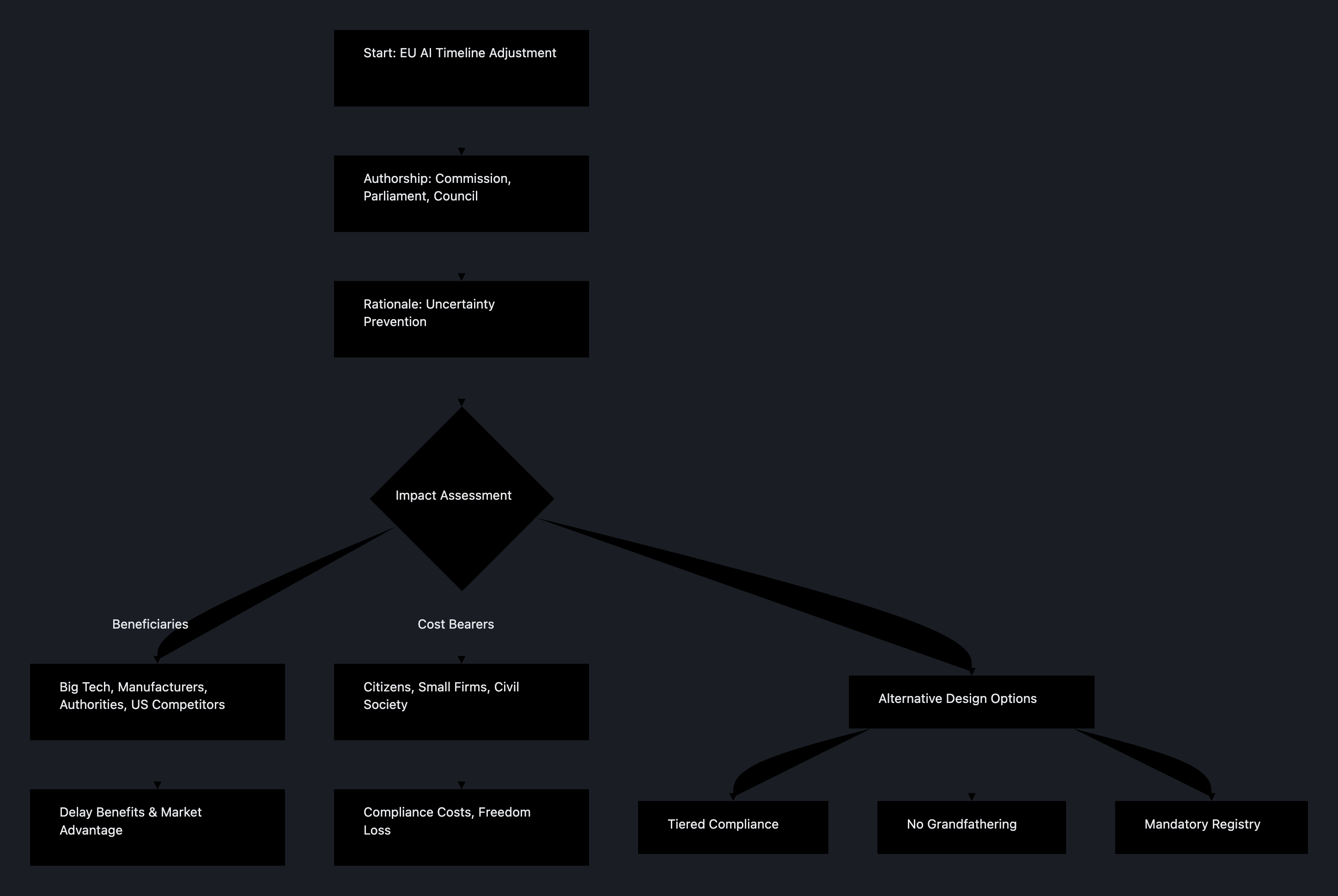
(visual rendered — see artifact)
Note: all identified parties may share the artifact’s frame; parties outside the frame are not visible from this analysis. Boundary-critique is the appropriate sideways-route if frame-completeness is the operative question.
Institutional authorship
The adjustment to the EU AI Act timeline was authored by the EU co-legislators: the European Commission, the European Parliament, and the Council of the EU. The European Commission initially proposed the Digital Omnibus on AI on 19 November 2025. Following a second political trilogue that ended without agreement on 28 April 2026, a provisional political agreement was reached at the resumed trilogue on 7 May 2026. Because this decision was negotiated, each authoring institution carries a share of the resulting distributional choice.
Stated rationale
The authors frame the timeline extension as a necessary measure to “prevent legal uncertainty” and to “make it easier for providers to comply” with the legislation. It is also described as an “acknowledgment that the regulatory infrastructure is not yet ready” and a practical step to ensure “no overlapping rules for machinery product safety.”
Distributional impact
- Big Tech / Large AI Deployers — role: beneficiary. Pathway: Cost-deferral and market-capture, gaining 16 additional months to deploy high-risk AI without full Article 11 technical documentation, Fundamental Rights Impact Assessments, or conformity assessment. Parameter: The 2 December 2027 cutoff date. Magnitude: Substantial structural advantage. Confidence: High for cost-deferral; Medium for permanent exemption vs. extended runway magnitude.
- Annex I Embedded-AI Manufacturers (Medical Devices, Automotive, Machinery, Toys) — role: beneficiary. Pathway: A 12-month delay before embedded high-risk obligations apply, moving the deadline from 2 August 2027 to 2 August 2028. Parameter: Sectoral-clarification deliverable resolving overlap with existing product safety law. Magnitude: Moderate delay. Confidence: Medium-High.
- AI Compliance Consultancies and Audit Firms — role: beneficiary. Pathway: Expanded billable scope for readiness engagements and “delay-period positioning” services. Parameter: Window length determines revenue-recognition timing across the compliance-services market. Magnitude: Extended revenue lifecycle. Confidence: Medium-High.
- EU Member-State Competent Authorities — role: beneficiary. Pathway: Administrative breathing room to recruit specialized staff and establish governance frameworks, avoiding the political embarrassment of unenforceable laws. Parameter: National transposition capacity constraints. Magnitude: Significant administrative relief. Confidence: High.
- The European Commission (Political) — role: beneficiary. Pathway: Repositioning on the “innovation vs. regulation” axis to reduce the “Brussels overreach” narrative during a shifting political climate. Parameter: Political-cycle timing. Magnitude: Narrative leverage. Confidence: Medium.
- US-Headquartered AI Competitors — role: beneficiary. Pathway: Reduced near-term friction for transatlantic AI deployment, aligning EU pace with US practice. Parameter: Competitive parity during the 2026–2027 deployment cycle. Magnitude: Reduced compliance asymmetry. Confidence: Medium.
- EU Citizens Subject to High-Risk AI — role: cost-bearer. Pathway: Freedom-loss and harm-risk exposure. Job applicants, students, welfare recipients, migrants subjected to biometric ID, and law-enforcement targets will experience non-conformity-assessed systems for an additional 16 months, and potentially indefinitely for some pre-2027 deployments. Parameter: The grandfathering cutoff that benefits incumbents. Magnitude: Prolonged exposure to unassessed systems. Confidence: High.
- Smaller EU-Headquartered AI Companies — role: cost-bearer. Pathway: Competitive displacement and relative market-entry cost inflation. Compliance costs are largely fixed; cash-rich incumbents capture market share during the delay while smaller firms must still front-load compliance architecture. Parameter: Time-value-of-money asymmetry and regulatory moat dynamics. Magnitude: Relative market-share loss. Confidence: Medium-High.
- Civil Society and Safety Organizations — role: cost-bearer. Pathway: Lost protective coverage and diverted campaign resources, redirected from enforcement monitoring to defending remaining provisions. Parameter: Loss of political momentum makes subsequent tightening harder. Magnitude: Strategic degradation. Confidence: High.
- EU Regulatory Credibility — role: cost-bearer. Pathway: Degradation of the “Brussels Effect” as a global standard-setter, demonstrating retreat under industry pressure. Parameter: Perception of regulatory capture. Magnitude: Soft-power erosion. Confidence: Medium.
Alternative design from the opposite constituency
To serve the interests of EU citizens and smaller EU firms with equal technical rigor, the following alternative design shifts the burden of delay away from disadvantaged constituencies:
- Tiered compliance — what it changes: Full Annex III obligations apply by August 2026 for the four highest-stakes categories (employment, education, law enforcement, critical infrastructure), with a narrower 6-month delay for less-critical categories. How it serves the disadvantaged constituency’s interests: Prioritizes immediate protection for the most vulnerable populations while allowing a brief runway for lower-risk systems.
- No grandfathering — what it changes: All deployed systems must demonstrate baseline conformity (lightweight transparency, Fundamental Rights Impact Assessment) by August 2026, with full documentation required by December 2027. How it serves the disadvantaged constituency’s interests: Prevents incumbents from establishing a permanent exemption or unassessable legacy fleet, protecting citizens from indefinite exposure.
- Mandatory transparency registry — what it changes: Immediate public registration of all high-risk AI deployments, including purpose, data sources, and limitations. How it serves the disadvantaged constituency’s interests: Shifts the burden to reporting rather than operational freedom, empowering civil society and affected individuals with immediate visibility.
- Industry-funded enforcement scaffolding — what it changes: The delay period is financed by a temporary levy on large AI deployers. How it serves the disadvantaged constituency’s interests: Directly builds the national competent authorities that the Commission states are “not yet ready,” resolving the capacity bottleneck without public cost or indefinite delay.
- Sunset clause — what it changes: The 16-month extension is explicitly non-renewable; absent Commission certification of enforcement capacity, the deadline automatically reverts. How it serves the disadvantaged constituency’s interests: Removes the structural incentive for permanent stalling and forces definitive regulatory action.
Motivational analysis (FGL)
- Big Tech — Fear: Costly conformity assessments exposing problematic training data and use cases. Greed: Continued deployment of high-margin HR, biometric, and ad-targeting AI. Laziness: Retrofit is structurally harder than operating-as-usual.
- European Commission — Fear: Political backlash and “overreach” narratives hurting coalition parties. Greed: An innovation framing and improved transatlantic posture. Laziness: Easier than simultaneously fighting an industry lobby and a skeptical Parliament.
- Smaller EU AI Firms — Fear: Lock-in by incumbents during the delay period. Greed: A longer runway (though structurally smaller than Big Tech’s gain). Laziness: Using the delay to also delay their own build-out and compliance efforts.
- Civil Society / Safety Organizations — Fear: Permanent loss of protection if grandfathering clauses hold. Greed: Strategic retention of pressure to preserve the remaining teeth in the law. Laziness: Advocacy fatigue, leading to standard campaigning rather than redesigning strategy to counter the delay.
Legitimate value
The delay genuinely addresses specific coordination problems independent of the distributional overlay. Member-state enforcement capacity is an objective bottleneck characterized by uneven transposition across the bloc. Furthermore, the overlap with sectoral safety legislation (covering machinery, medical devices, toys, and connected cars) required genuine legislative clarification to avoid contradictory mandates. Finally, Article 11 documentation requirements are substantial; providing realistic timelines improves documentation quality. However, the grandfathering effect is not a coordination outcome; it is a lobby outcome (as noted by Corporate Europe Observatory) or a substantial cash-flow transfer to incumbents (under the compliance-firm reading). The political framing of “simplification” serves electoral cycles more than it serves citizens, and the pattern of industry causing delay to then exploit that delay for further concessions is a regulatory-capture dynamic, distinct from a pure coordination problem.
Confidence per finding
- Factual basis (deal is real, dates are operative): High (Council press release 7 May 2026, AI Act Service Desk, multiple legal corroborators).
- Annex III deadline is 2 December 2027; Annex I embedded is 2 August 2028: High (Consolidated legal sources and implementation timelines).
- Trilogue collapsed 28 April 2026; agreement reached 7 May 2026: High (Parliamentary and news reporting).
- Big Tech lobby drove delay: High (Corporate Europe Observatory, Politico direct evidence).
- Grandfathering is a meaningful benefit for incumbents: High (Structural reading of the cutoff date by Corporate Europe Observatory).
- Whether grandfathering equals permanent exemption or extended runway: Medium (Interpretive; depends on final omnibus text and implementing acts).
- Member-state capacity is a real constraint: High (Acknowledged by compliance firms and European Parliament).
- Commission acted partly from political positioning: Medium (Structural inference from political-climate reporting).
- Smaller EU firms are net losers: Medium (Structural asymmetry; no direct quantitative evidence in corpus).
- Specific magnitude of civil-society harm: Medium-Low (Direction is clear; quantification not in package).
- Unresolved Gap: Specific lobbying transparency register disclosures (who spent what on which amendments) and the exact implementing-act details determining baseline conformity requirements during the transition.
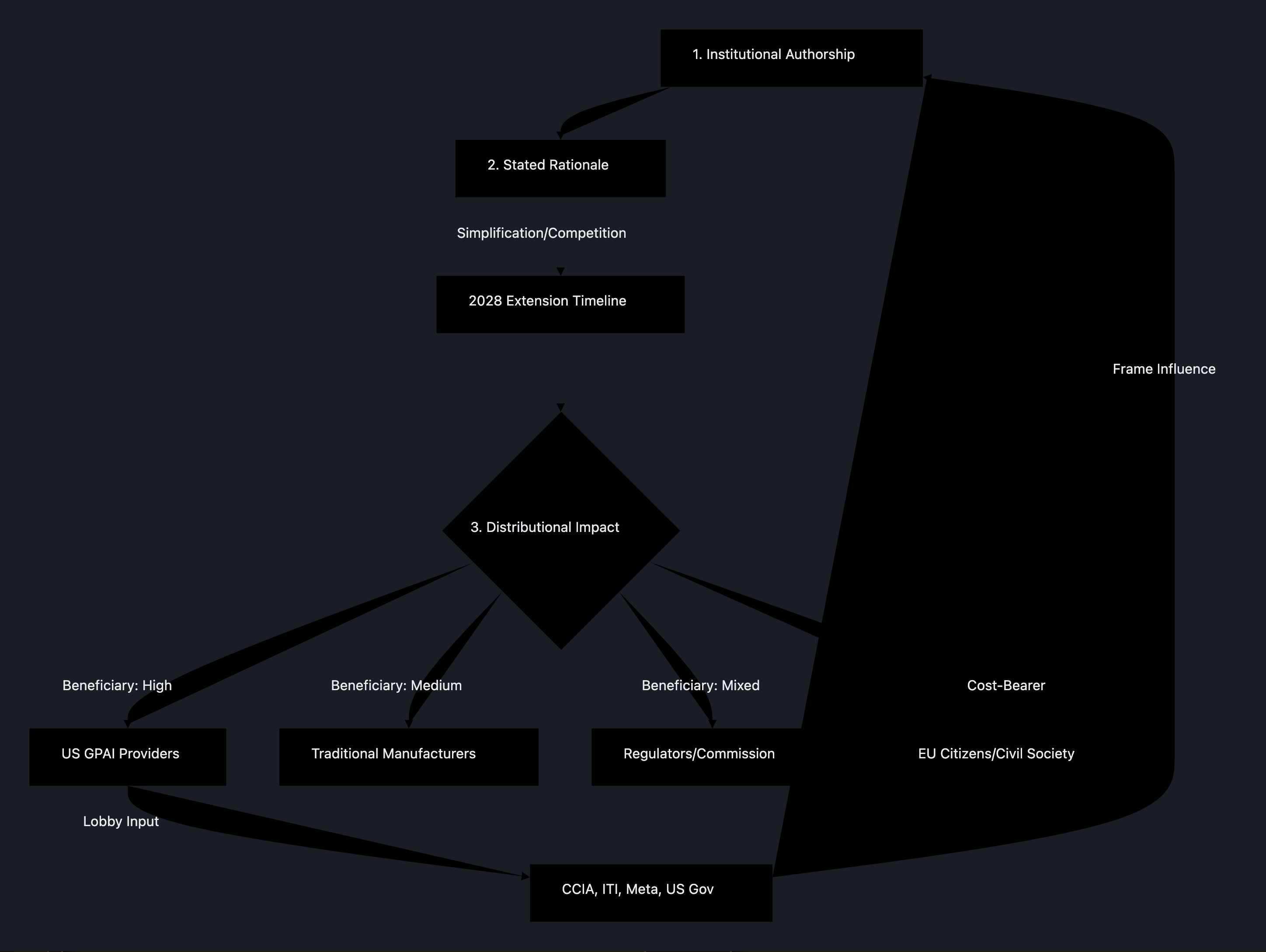
(visual rendered — see artifact)
Note: all identified parties may share the artifact’s frame; parties outside the frame are not visible from this analysis. Boundary-critique is the appropriate sideways-route if frame-completeness is the operative question.
1. Institutional authorship
The European Commission (specifically DG CONNECT and the internal-market portfolio) drafted the original Act and authored the “AI Omnibus” simplification proposal that produced the 2028 extension, acting as the executive author and framer. The European Parliament and Council of the EU serve as co-legislators of the original 2024 Act and trilogue participants, having subsequently reached political agreement on the omnibus. Documented lobbying inputs influencing this authorship include CCIA Europe (July 2023 trilogue position paper), the Information Technology Industry Council (ITI, August 2023, representing ~80 major tech firms), DigitalEurope, Meta (via confidential lobby papers obtained by Corporate Europe Observatory), and the US Government (noted for a “last-ditch push” during trilogue negotiations).
2. Stated rationale
The Commission’s stated rationale for the timeline extensions is the “simplification” of the AI Act to reduce business compliance burdens and enhance competitiveness by preventing EU AI providers from being outpaced by US and Chinese competitors. This framing emphasizes the need for transition time because essential technical standards are not yet finalized (e.g., incomplete CEN-CENELEC standards), supply-chain coordination is required, and there is limited conformity-assessment capacity. Additionally, it cites the need for harmonization with existing sectoral legislation (such as the Medical Device Regulation) to avoid contradictory compliance burdens, alongside voluntary preparation via the AI Pact as a bridge mechanism.
3. Distributional impact
Major US-based GPAI providers (OpenAI, Anthropic, Google/Alphabet, Microsoft, Meta)
- Role: Beneficiary
- Pathway: Grants approximately 24 months of unrestricted EU revenue before substantive GPAI obligations (transparency, copyright, systemic-risk mitigation) bind, simultaneously allowing time to cement vendor lock-in.
- Parameter: The “already placed on the market by 2 August 2025” grandfathering/legacy cutoff (Art. 113) paired with the 2027 deadline.
- Magnitude: High.
EU-based deployers/integrators of US GPAI (banks, insurers, telecoms, retailers)
- Role: Beneficiary
- Pathway: Continued access to high-capability US models without immediate transparency, copyright, or safety obligations, preserving procurement, productivity, and product-roadmap assumptions.
- Parameter: The same Art. 113 cutoff, downstream of the GPAI-provider obligation.
- Magnitude: High.
Big Tech trade associations (CCIA, ITI, DigitalEurope)
- Role: Beneficiary
- Pathway: A 2027–2028 horizon preserves members’ market position, delivering concrete reputational and political-capital value to dues-paying members.
- Parameter: The omnibus’s “additional transition period” language explicitly requested in 2023 position papers.
- Magnitude: Medium-high.
US Government
- Role: Beneficiary
- Pathway: Delay preserves US-headquartered firms’ first-mover advantage in the EU market and reduces the chance of EU rules becoming a de facto global template (delayed-start “Brussels Effect”).
- Parameter: Trilogue pressure and the omnibus’s narrative alignment with the US executive branch’s “innovation” framing.
- Magnitude: Medium.
Traditional industrial manufacturers (automotive, MedTech, machinery)
- Role: Beneficiary
- Pathway: Bottleneck avoidance—delays immediate need for scarce third-party conformity assessments, preventing supply-chain and product-launch disruption.
- Parameter: Extension of the Annex I (high-risk systems embedded in regulated products) transition period to 2 August 2028.
- Magnitude: High.
National Competent Authorities / EU AI Office
- Role: Beneficiary (Mixed-valence)
- Pathway: Additional time to build enforcement infrastructure, notification, and standards-setting bodies. The same slack reduces the urgency of the office’s own enforcement mission.
- Parameter: Blanket extension of high-risk enforcement deadlines; Commission discretion over implementing acts.
- Magnitude: Medium-high.
Venture capital and AI startups (especially US-affiliated late-stage scaleups)
- Role: Beneficiary
- Pathway: A 2027 horizon allows more fundraising and product launches before regulatory friction; favors firms with existing models over firms building compliant-by-design.
- Parameter: The legacy-cutoff date.
- Magnitude: Medium.
Commission political leadership
- Role: Beneficiary
- Pathway: The “simplification/competitiveness/innovation” narrative serves second-term political brand and re-election positioning.
- Parameter: The Commission’s choice to package the omnibus as a competitiveness measure rather than a safety-vs-speed trade-off.
- Magnitude: Medium.
EU citizens / end-users in the 2025–2027 window
- Role: Cost-bearer
- Pathway: Prolonged exposure to GPAI products (deepfakes, election interference, biometric mass-surveillance, discriminatory/unsafe AI in hiring, credit, healthcare) without the Act’s transparency, copyright, and safety obligations binding.
- Parameter: The 2 August 2027 cut-on (delay in activation of fundamental-rights safeguards and GPAI transparency rules).
- Magnitude: Non-quantifiable from the package, but mechanism is real.
EU civil-society organizations (Corporate Europe Observatory, Future of Life Institute, EDRi, Access Now, AlgorithmWatch)
- Role: Cost-bearer
- Pathway: Sunk advocacy cost; loss of the policy window in which the Act’s strongest provisions were politically feasible; reputational cost of being out-lobbied.
- Parameter: The 2027/2028 dates versus their advocacy positions.
- Magnitude: High.
Downstream SMEs / AI startups / EU-domiciled compliance-by-design firms
- Role: Cost-bearer
- Pathway: Incumbents use the 2025–2027 window to ship proprietary APIs, SDKs, and integration patterns that downstream deployers build against. By 2027/2028, compliance documentation effectively ratifies incumbents’ established technical dominance, forcing late-arriving SMEs to absorb the cost of reversing or adapting to these de facto standards.
- Parameter: The “already on the market” cutoff plus “simplification” promises without concurrent guaranteed financial/technical support for smaller players.
- Magnitude: Medium-high.
Workers subject to AI-based hiring, monitoring, and evaluation
- Role: Cost-bearer
- Pathway: Employment AI sits under Annex III while the omnibus’s 2028 extension covers high-risk systems “embedded in regulated products” under Annex I. These systems continue to be deployed without conformity-assessment, registration, and fundamental-rights impact-assessment obligations, creating continued, unchallenged-exposure time-and-freedom costs.
- Parameter: The “embedded in regulated products” distinction combined with the Commission’s failure to issue binding interpretive guidance on the Annex I / Annex III boundary.
- Magnitude: Medium-high for the mechanism.
Democratic-integrity stakeholders (election authorities, journalism, civil-society watchdogs)
- Role: Cost-bearer
- Pathway: 2026 and 2029 election cycles proceed under the 2025–2027 GPAI risk-mitigation window; provisions that would have applied are deferred.
- Parameter: The 2027 GPAI date.
- Magnitude: Medium.
The EU’s claim to “Brussels Effect” regulatory leadership
- Role: Cost-bearer
- Pathway: A 2027 start means the Act’s substantive rules cannot become a de facto global standard before 2027–2028, by which point other jurisdictions (UK, US state-level, China) will have moved.
- Parameter: The compliance cut-on date.
- Magnitude: Medium.
4. Alternative design from the opposite constituency
Constituency: EU citizens, civil-society watchdogs, downstream SMEs, open-source developers, and EU compliance-by-design firms.
- Immediate enforcement for highest-risk use cases — what it changes: Removes the transition window for biometric categorization, critical infrastructure, and essential private/public services. How it serves the disadvantaged constituency’s interests: Prioritizes immediate fundamental-rights protection over incumbent deployment convenience.
- AI Pact-funded “Compliance Sandbox” — what it changes: Repurposes and expands the existing Commission-backed AI Pact and GPAI Code of Practice voluntary initiatives into a state-subsidized technical and legal assistance program exclusively for SMEs and open-source developers. How it serves the disadvantaged constituency’s interests: Helps smaller players meet the original deadlines, neutralizing the incumbent resource advantage without creating new bureaucratic legislative apparatus.
- Mandatory interim transparency — what it changes: While full compliance is delayed, providers must publish standardized “system cards” detailing known limitations and training-data provenance. How it serves the disadvantaged constituency’s interests: Shifts the burden of proof onto the vendor during the transition, mitigating information asymmetry.
- Tiered transition periods tied to risk class — what it changes: Replaces the legacy-cutoff date with risk-class timelines (high-risk 12 months; embedded-regulated-product high-risk 18 months; GPAI obligations bind at entry into force for all models placed after a defined cut-on; legacy models get a 12-month wind-down). How it serves the disadvantaged constituency’s interests: Prevents the arbitrary 24-month revenue window for legacy models while accommodating genuine technical harmonization needs.
- Sunset clause on extensions — what it changes: Any omnibus extension beyond the original 2027 date expires automatically after 18 months unless renewed by ordinary legislative procedure (full Parliament + Council), not by implementing act or political agreement. How it serves the disadvantaged constituency’s interests: Prevents indefinite regulatory creep and forces democratic accountability for further delays.
- Whistleblower and right-of-action standing — what it changes: Grants civil-society organizations standing to challenge Commission extension decisions, with cost-shifting to the Commission if the challenger substantially prevails. How it serves the disadvantaged constituency’s interests: Provides procedural leverage grounded in Article 263 TFEU and Aarhus Regulation analogies, offsetting the massive resource asymmetry in lobbying.
- Lobbying-transparency trigger — what it changes: Mandates extension of the EU Transparency Register’s lobby-meeting disclosure rules to all Commission Cabinet members, DG CONNECT directors, and AI Office senior staff for AI Act matters, with public disclosure of meeting attendees and topic within 10 working days. How it serves the disadvantaged constituency’s interests: Mitigates covert influence by illuminating the dynamic, extending existing Commissioner meeting disclosure practices to the relevant executive level.
- Interpretive-clarification duty — what it changes: Requires the Commission to publish binding guidance on the Annex I / Annex III boundary for employment AI within 6 months of the omnibus’s entry into force. How it serves the disadvantaged constituency’s interests: Ends the regulatory ambiguity that currently acts as a concrete freedom-loss and time cost for workers subject to AI evaluation.
5. Motivational analysis (FGL)
Major US GPAI providers / incumbent industry
- Fear: Direct regulatory cost on highest-revenue products; precedent for the EU exporting rules globally; possible lock-out from the EU market; loss of “move fast” optionality in their biggest non-US market.
- Greed: Preserve 24+ months of unrestricted EU revenue and maximize margins by deferring compliance infrastructure; shape implementing rules while products dominate; preserve the option to litigate provisions under the new window.
- Laziness: Avoid redesigning deployment pipelines, data-governance documentation, and copyright-compliance mechanisms—keep shipping, comply later.
- Dominant driver: Greed and Fear in roughly equal weight; Laziness acts as a multiplier.
European Commission / regulators
- Fear: The EU competitiveness narrative failing; political backlash from European business; loss of second-term relevance; stifling EU tech relative to US/China.
- Greed: Owning the “simplification” brand for re-election; positioning as pro-innovation.
- Laziness (pragmatism): Avoiding the operational complexity and political friction of enforcing the Act on a 2025–2026 timeline; deferring hard choices about the AI Office’s enforcement posture.
- Dominant driver: Fear of the competitiveness narrative, with Greed near-equal.
EU citizens and civil society
- Fear: Unmitigated AI harm in the interim; erosion of the regulatory moment; that “delay” is a euphemism for “defanging,” leading to irreversible societal harm.
- Greed (resource-seeking and institutional self-preservation): Civic organizations compete for limited foundation and government-grant funding; organizational remit expands when they claim jurisdiction over new policy domains; moral authority consolidates when their preferred outcomes prevail.
- Laziness: Civic-engagement fatigue from repeated deferrals; mission drift toward communications/fundraising over technical-policy work; structural over-reliance on the Act as a forthcoming “silver bullet,” under-investing in immediate grassroots auditing or alternative accountability.
- Dominant driver: Fear of regulatory erosion, with resource-seeking as a sustained undercurrent. (The asymmetry that exists between citizens and Big Tech is structural—citizens’ fear is represented by proxy organizations with far smaller lobbying budgets than tech trade associations—not a cynical dismissal of their motives).
6. Legitimate value
The position for timeline extensions serves legitimate coordination values independent of distributional overlay. Compliance with a novel, complex regime genuinely requires transition time. Standards-setting (CEN-CENELEC) is not yet complete, and conformity-assessment capacity is demonstrably limited. Integrating AI into highly regulated products (e.g., pacemakers, aircraft) genuinely requires harmonization with rigorous sectoral law, such as the Medical Device Regulation, as a rushed, contradictory overlay would create legal chaos and safety risks. Furthermore, voluntary mechanisms like the AI Pact and GPAI Code of Practice provide a genuine preparation runway, and the underlying risk-based approach of the Act remains sound regulatory design.
The distributional overlay—the part that is not merely solving this coordination problem—is that the specific 2 August 2027 cutoff favors actors with the deepest deployment footprints (the largest US GPAI providers) because they already have models on the market. The GPAI extension functions primarily as cost-deferral for well-resourced actors with the lobbying capital to frame delay as an “innovation necessity,” which is less about technical harmonization than the embedded-products case. The 2028 omnibus extension for embedded high-risk systems does not directly follow from the standards-readiness problem, as those systems already possess product-safety conformity-assessment paths under sectoral law. The Commission’s framing of “simplification” rather than “calibration” is itself a distributional choice signaling deference to incumbents, and its failure to exercise existing interpretive power to resolve the Annex I / Annex III boundary for employment AI actively shifts the regulatory-ambiguity cost onto the least-represented constituency.
7. Confidence per finding
- Premise verification (2027/2028 dates real and in force): High confidence. Basis: Ropes & Gray timeline, Reed Smith timeline, Commission digital-strategy page, AI Act Service Desk.
- Major US GPAI providers as primary beneficiaries: High confidence. Basis: Structural inference from Art. 113 cutoff explicitly benefiting entities with models already placed on the market.
- Trade associations + Meta lobbied the specific parameters received: Medium-high confidence. Basis: Documented 2023 position papers (CCIA, ITI) and Corporate Europe Observatory April 2025 documentation of Meta’s confidential lobby paper characterizing the draft as “regulatory overreach” posing a “significant threat to AI innovation”; causal link is direct but not airtight.
- EU citizens bear costs in the 2025–2027 window: High confidence in mechanism; magnitude is non-quantifiable. Basis: Mechanism evident from delayed activation of safeguards; specific harm figures are not in the package and are not invented.
- Downstream SMEs bear API/SDK integration lock-in costs: Medium-high confidence. Basis: Recognized regulatory-transition market dynamic; specific firm counts are not in the package.
- Workers bear regulatory-ambiguity costs in the 2027–2028 window: Medium-high confidence in mechanism. Basis: Annex I / Annex III boundary is real and unresolved; specific workforce populations are not enumerated in the package.
- Commission’s dominant driver is fear of the competitiveness narrative: Medium confidence. Basis: Typical political-incumbent incentive; no specific motive evidence is needed to make this structural claim.
- Sectoral lobbying figures (tech sector ~€151M annually, +55.6% since 2021): Medium-high confidence. Basis: Corroborated by Corporate Europe Observatory and LobbyControl October 2025 joint report on the EU Transparency Register and EUobserver.
- Meta-specific ~€10M/year EU lobbying figure: Medium confidence (contested across streams). Basis: Single secondary source; not independently verified against the EU Transparency Register within the package, though the broader asymmetry is robust.
8. Structural incidence and frame-bounded limitations
- Strategic manipulation vs. structural incidence: The timeline parameters are not arbitrary; they align with the requests of the most-resourced lobbying actors. Whether “manipulation” is the accurate term depends on framing: coordinated intent (conspiracy—unsupported) versus structural incidence (cui-bono—supported). The structural distribution is exactly what is expected when lobbying asymmetry is large: parameters move in the direction the most-resourced actors requested, while the stated rationale retains independent defensibility. No individual intent is assigned.
- Parties invisible from the artifact’s own frame: The analysis is bounded by the trilogue and lobbying-record frame. Invisible parties bearing costs or lacking leverage include: non-EU jurisdictions affected by EU AI (UK, Switzerland, Global South, Latin America, Africa, South Asia); Global South data laborers performing low-wage labeling work and marginalized workers facing immediate AI-driven job displacement; end-users and workers inside the EU whose union/consumer organization presence in DG CONNECT is orders of magnitude smaller than tech trade associations; whistleblowers inside GPAI providers; future cohorts of EU AI firms that would have built compliance-by-design; and non-corporate AI developers (academic, public-sector, open-source communities).
- Coverage gaps: The package does not contain EU Transparency Register meeting logs between DG CONNECT and named GPAI providers during the omnibus drafting window. Audit-level confirmation of specific meeting attendance requires that register as the next retrieval target. Additionally, the absolute euro value of compliance-cost deferral for a representative GPAI vendor and the precise Council versus Parliament framing divergence on the omnibus specifically remain unresolved from the package.
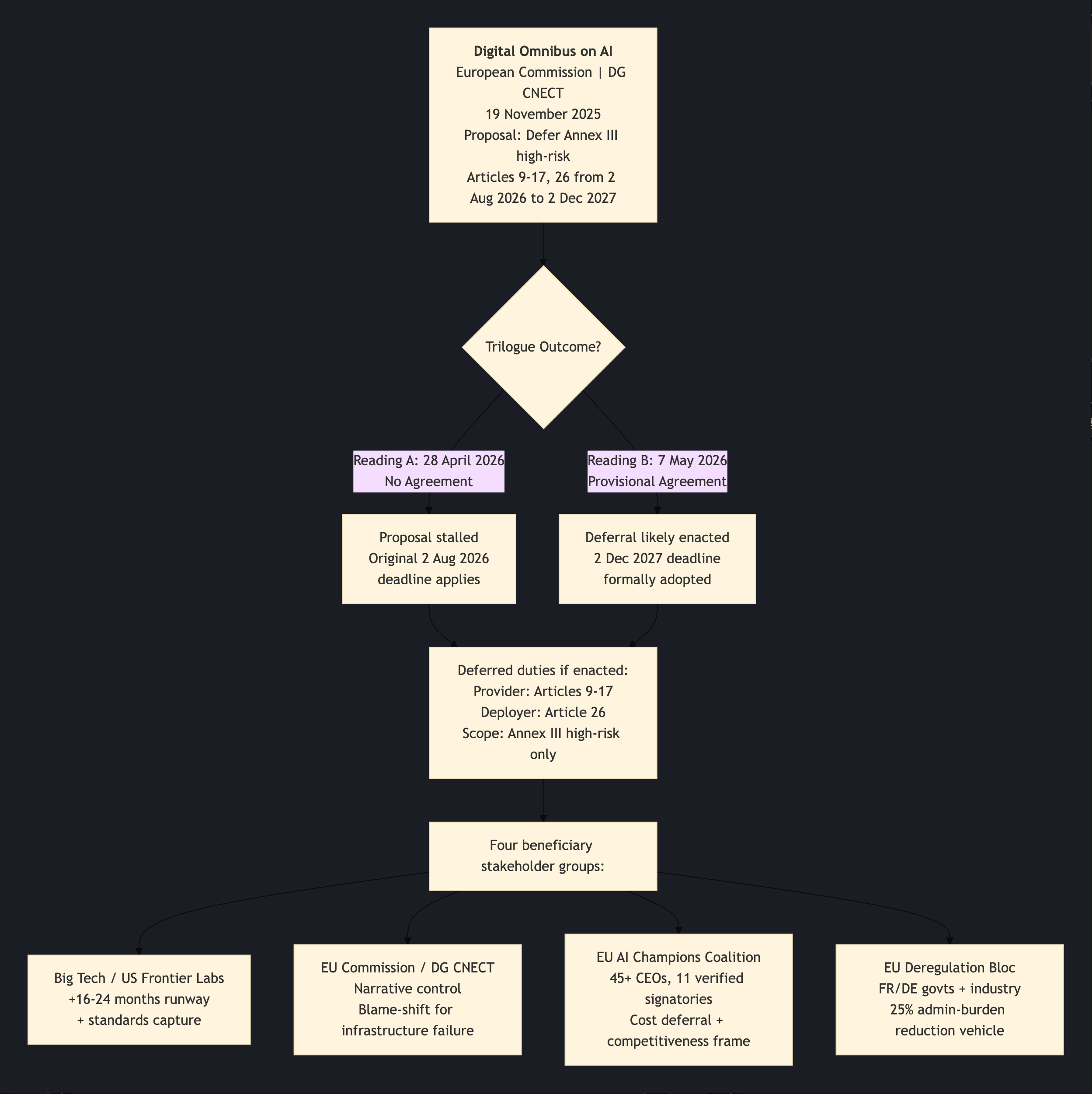
(visual rendered — see artifact)
Note: all identified parties may share the artifact’s frame; parties outside the frame are not visible from this analysis. Boundary-critique is the appropriate sideways-route if frame-completeness is the operative question.
Institutional authorship
The author is the European Commission, acting through the Digital Omnibus on AI published 19 November 2025, which proposes to defer the EU AI Act’s high-risk obligations from 2 August 2026 to 2 December 2027. The operational owner is DG CNECT; the political energy comes from the Commission’s competitiveness/simplification wing. (Confidence: high — web-verified across DLA Piper, Reuters, Cooley, Crowell, PwC.)
On named-individual attribution, the record is contested and limited. EVP Henna Virkkunen (Tech Sovereignty, Security and Democracy; Digital and Frontier Technologies portfolio — verified title) is documented as the official who would decide on a pause if standards were not ready (POLITICO). She appears in the critical record — named by a founder-critic among officials “talking innovation while causing the opposite” — but no source establishes her as advocating the 2027 delay specifically. The causal-framing load is therefore carried not by her but by the sourced Reuters attribution: the Commission eased the rules “after Big Tech pushback.” (Confidence: the non-advocacy finding is named-evidence; attributing framing to her is unsupported.)
There is a load-bearing, unresolved divergence about where the proposal now stands, and the two readings change whether the beneficiaries “have largely already won”:
- Reading A: The proposal has not been enacted. The political trilogue on 28 April 2026 ended without agreement; if the Omnibus is not adopted before 2 August 2026, the original timeline applies as written. The original 2 Aug 2026 deadline still technically governs. (Sourced to in-package CSA + DLA Piper; confidence: high as of the reporting consulted.)
- Reading B: A provisional political agreement was reached at trilogue on 7 May 2026 (Council + Parliament), pending formal adoption, deferring standalone Annex III high-risk obligations to 2 December 2027 and high-risk embedded in regulated products to 2 August 2028. On this reading the delay is a near-done deal, not a trial balloon. (Sourced to Hogan Lovells, Travers Smith, Gibson Dunn, UNIwise; confidence: high as of the reporting consulted.)
You adjudicate which is operative; the next concrete tell is whether the next version stays calendar-gated rather than readiness-gated.
The deferred duties — agreed across both readings — are provider Articles 9–17 (risk management, data governance, technical documentation, QMS) and deployer Article 26, for Annex III high-risk systems. Original date 2 Aug 2026; target 2 December 2027. (Confidence: high — corroborated across multiple legal sources.) Reading B adds: separate per-category deadlines, watermarking/transparency kept on a faster track (2 Dec 2026, delay cut from six months to three), and retained registration even for firms seeking high-risk exemption.
Stated rationale
The author’s own framing is descriptive: simplification and burden reduction for European innovation and competitiveness, plus an acknowledgment that harmonized standards and conformity-assessment bodies are not ready in time. The official framing (A-LIGN, EC): the change is “not a concession to industry but an acknowledgment that the regulatory infrastructure is not yet ready.”
Distributional impact
Beneficiaries
Large incumbent AI providers / Big Tech deployers (US frontier labs + big tech placing GPAI/high-risk systems on the EU market) — role: beneficiary. Pathway: deferred cost + competitive runway + standards-capture — ~16 extra months of unconstrained deployment for standalone Annex III systems, up to ~24 months for embedded-in-product systems, plus more runway to shape CEN/CENELEC harmonized standards toward their architectures before they lock in. They already have compliance teams; the delay is pure deferral, not survival. A separate 25 June 2025 letter from Meta, Google DeepMind and Microsoft pushed exactly this “stop-the-clock” line. Parameter: the high-risk deadline date shift. (Confidence: high — structural inference now backed by Reuters’ “after Big Tech pushback” attribution, treated as structural-incidence evidence, not proof of coordination.)
European Commission / DG CNECT itself — role: beneficiary. Pathway: narrative-control + blame-shifting — converts “we failed to deliver standards and notified bodies on time” into “we’re generously giving industry more time.” A deadline arriving with no notified bodies would be the regulator’s own implementation failure. Parameter: same date shift; the absence of designated notified bodies is the Commission’s own deliverable. (Confidence: medium — structural inference; the infrastructure-failure fact is corroborated, the relabeling motive is inferred. This is the most underpriced beneficiary.)
EU AI Champions Initiative coalition (verified signatories: Airbus, ASML, Mistral AI, Siemens Energy, Philips, Dassault Systèmes, Mercedes-Benz, TotalEnergies, BNP Paribas, Carrefour, Lufthansa — ~45 CEOs, July 2025 open letter urging a two-year “clock-stop”) — role: beneficiary. Pathway: cost deferral + narrative-control — reframes AI regulation as a competitiveness threat; European frontier labs (Mistral) get less near-term drag vs. US rivals. Parameter: date shift + framing of compliance-as-anti-innovation. (Confidence: high — named coalition and signatories verified. Note: SAP is NOT a verified signatory and was removed; “Siemens” is “Siemens Energy.”)
EU competitiveness / deregulation bloc (Draghi-aligned, parts of FR/DE governments, industry associations) — role: beneficiary. Pathway: narrative-control via concrete legislative vehicle — the delay rides inside the broader Digital Omnibus package (25% admin-burden cut; the GDPR “legitimate interests for AI training” change, per Crowell). The lever is not a vague “precedent” but that the same instrument carrying the delay also carries the wider rollback. (Confidence: low-medium — the package is named-evidence; the “down payment”/sequencing reading is structural-precedent inference.)
EU member-state national competent / market-surveillance authorities — role: beneficiary. Pathway: avoided-failure-exposure — under-resourced national enforcement bodies that would otherwise have to police the 2 Aug 2026 deadline with no staff and no designated bodies are spared being the visible point of enforcement collapse. Parameter: same date shift. (Confidence: medium — structural.)
Compliance / “readiness” consulting industry (BSI, Holistic AI, Glocert, Dataiku, Sysart ecosystem) — role: beneficiary. Pathway: money flow / time-and-attention capture — the documented billing trigger for “readiness” engagements is the rule looming but never final; a prolonged not-yet-binding (or provisional/conditional) status keeps engagements open and recurring, where a clean enforcement date would close them out. Parameter: the continued not-yet-binding state of the deadline. (Confidence: medium-high. Caveat: the density of readiness-vendors in the source set is partly a selection artifact of a “EU AI Act readiness” retrieval; the pathway rests on the billing-trigger mechanism, not vendor count.)
Startups / SMEs — role: beneficiary. Pathway: cost relief — postpones the compliance bite by ~16 months; the Commission’s own stated intent (Crowell) explicitly invokes saving “SMCs and SMEs… time and costs,” making SMEs the public face of the change. Parameter: date shift. (Confidence: medium — but a blanket delay does not fix the problem startups actually have (a fixed compliance cost as barrier to entry); it moves it ~16 months downfield. The interest-aligned fix is size-tiering/exemption, which the agreement conspicuously did NOT introduce. Cost figure contested — see below.)
US trade interests / external-pressure channel — role: beneficiary. Pathway: market-access window extension; Crowell ties the Commission’s motive to the US “AI Arms Race”/deregulation posture, relieving transatlantic friction over digital rules as trade barriers. Parameter: same date shift. (Confidence: low-medium — lightly named-evidence via Crowell; a direct causal channel cannot be pinned — flagged, not asserted.)
CEN-CENELEC / notified-body aspirants — role: beneficiary. Pathway: avoided-failure-exposure — as the bottleneck, a delay spares them being named as the reason compliance was impossible. Parameter: notified-body designation timeline. (Confidence: medium. Surfaced tension: these same parties appear as cost-bearers below — standards bodies bear stranded drafting effort while also being spared blame; both pathways coexist.)
Cost-bearers
EU rights-subjects (people processed by high-risk systems: hiring, credit, biometrics, education, essential services, migration scoring) — role: cost-bearer. Pathway: freedom/rights-exposure — ~16 more months of unaudited high-risk systems with no conformity assessment, no post-market monitoring, no logging guarantee, no recourse; a rejected job applicant or mis-scored individual has nothing to appeal to until the deferred date. Parameter: deferral of Art. 9–17 + Art. 26. (Confidence: high — direct mechanical consequence of the deferral; the magnitude relative to other harms is under-documented — see frame note.)
First-movers / good-faith early compliers who sank readiness cost they cannot yet convert to certification — role: cost-bearer. Pathway: stranded compliance spend — firms that built the achievable-now layer (QMS, technical documentation, internal risk controls) toward 2 Aug 2026 carried that cost early; competitors who stalled now get a free pass. The early spend can’t even be cashed out as certification because no notified body exists to certify against, so it sits stranded while the deadline recedes — sharpening the windfall: the delay punishes precisely the firms that took the law seriously. The voluntary AI Pact (EC source) means some firms did comply early. Parameter: date shift applied as a blanket, with no recognition of early readiness spend. (Confidence: high — and directly contradicts the “startups need relief” headline; the early-complier population is real but unquantified.)
AI assurance / audit-tooling startups — role: cost-bearer. Pathway: demand pushed out ~16 months — businesses built on the 2 Aug 2026 deadline lose their market window; some won’t survive the runway gap. Usually invisible in this debate. Parameter: deadline = their demand trigger. (Confidence: medium.)
Standards bodies (CEN/CENELEC working groups) — role: cost-bearer. Pathway: wasted/stranded effort — built drafting capacity against a deadline that recedes. (Confidence: medium — structural inference.)
Notified bodies — role: cost-bearer. Pathway: largely N/A — the analysis’s own premise says none are formally designated yet, so this cost is near-empty; it attaches only to the few that began accreditation. (Confidence: low — thin by the analysis’s own admission; disaggregated out of the standards-body row per the cost-incidence correction.)
EU regulatory credibility / the “Brussels effect.” — role: cost-bearer. Pathway: diffuse erosion — each delay teaches lobbyists that deadlines are negotiable, inviting the next delay campaign, and erodes the EU’s leverage to set global digital standards. Parameter: precedent of calendar slippage under pressure. (Confidence: medium — diffuse; no single party bears it.)
Alternative design from the opposite constituency
This alternative is constructed from the disadvantaged constituencies’ interests at equal technical rigor (guarding against the mirror-trap). Two constituencies with divergent interests are separated, and each plank is labeled by whom it serves. The disaggregation is the point: only the combination is “better than the proposal,” and it is better precisely because it stops handing the largest deployers undifferentiated delay — the one thing they most benefit from. Each plank is as technically implementable as a flat date shift, which is the tell that the blanket form was a choice.
From the rights-bearer’s interest (loan applicant, job candidate, biometric-scored migrant):
- Readiness-gated, not calendar-gated — with a backstop — what it changes: ties the high-risk clock to objective milestones — N harmonised standards published in the OJ + M notified bodies designated — so the deadline restarts only when compliance is actually possible. How it serves the disadvantaged constituency’s interests: pure gating would hand the bottleneck parties (CEN-CENELEC, notified-body designators) the power to slow-walk the clock-start indefinitely (gate capture); mitigate with two instruments: (a) a statutory backstop date beyond which obligations apply regardless of designation status, and (b) a duty-to-designate carrying its own deadline on the standards bodies and the Commission, so the gate-controllers are themselves on a clock. (Confidence: medium — rights-bearer-derived; institutional availability under the Act’s amendment mechanics unverified.)
- Decouple procedure from substance — what it changes: suspend only the external-certification requirement (which truly can’t run without notified bodies) — replace temporarily with mandatory self-attestation + a public register — and keep substantive obligations (human oversight, transparency, logging) live on schedule. How it serves the disadvantaged constituency’s interests: the decoupling is partial, named honestly — Article 10 (data-governance quality criteria) and Article 11 (technical-documentation adequacy) are themselves partly defined by the unpublished harmonized standards, so self-attestation against an undefined standard reproduces some of the very legal uncertainty the delay invokes. The plank protects citizens on standard-independent obligations and is weaker on standard-defined ones — a real limit, not a strictly-better fix. (Confidence: medium — rights-bearer-derived; which obligations are standard-independent needs EU-regulatory-law input.)
- Comply-or-explain interim regime — what it changes: deployed high-risk systems carry interim safeguards now — human oversight, logging, incident reporting — even before full conformity. How it serves the disadvantaged constituency’s interests: rights-subjects aren’t left with zero protection for ~16 months. (Confidence: medium — rights-bearer-derived.)
- Commission-accountability sunset — what it changes: the suspension auto-expires when standards publish, and the Commission must publish a binding delivery timeline for notified bodies. How it serves the disadvantaged constituency’s interests: prevents indefinite slippage, directly relevant given the provisional/conditional agreement creates room for the deadline to recede again. (Confidence: medium — rights-bearer-derived.)
From the startup constituency’s interest (distinct from rights-bearers):
- Size-tier the obligations — what it changes: full requirements for large/systemic deployers; proportionate templated requirements for SMEs. How it serves the disadvantaged constituency’s interests: solves the startup cost problem structurally, which a blanket delay does not — and which the May agreement conspicuously did not do. (Confidence: medium — startup-derived.)
From the first-mover’s interest:
- First-mover recognition — what it changes: grandfather or credit early readiness-spenders. How it serves the disadvantaged constituency’s interests: the delay doesn’t punish firms that did what the law asked. (Confidence: medium — first-mover-derived.)
Motivational analysis (FGL)
Industry coalition / Big Tech — Fear: genuine fear of falling behind US/China; high-risk obligations constraining their most monetizable products; the EU becoming a template elsewhere. Greed: defer cost, gain ~16–24 months runway plus standards capture. Laziness: many simply didn’t start compliance early and want the deadline moved to match their own delay; avoiding the engineering cost of conformity. (Confidence: medium-high — structural inference backed by Reuters’ “Big Tech pushback” attribution.)
The Commission — Fear: of being blamed for “killing EU AI,” of trade friction, of an unenforceable law going live. Greed: weakest here; mostly narrative capital of “we listened” / reclaiming the pro-innovation mantle. Laziness: didn’t ship the standards/notified bodies; delay is far cheaper than standing them up; the path of least resistance and probably the dominant driver. (Confidence: medium — structural inference; the infrastructure-failure fact is corroborated.)
Startups (sympathetic side, same lens) — Fear: death by compliance cost, real but whose magnitude is self-reported and contested. Greed: part of the “move fast” lobby wants no rules, not fair ones; the 56% figure is one commenter’s 2023 self-estimate. Laziness: the “compliance is impossible” framing overstates the genuinely-achievable governance work to avoid doing it. (Confidence: medium — with the cost claim explicitly contested.)
Safety / fundamental-rights / pro-Act side (same lens, not exempted) — Fear: incentive to catastrophize harms to keep urgency high. Greed: civil-society and AI-ethics shops have funding and relevance staked in a strong, on-time Act; the EU bureaucracy expands its remit through the Act; the compliance industry profits from it (the 9 July 2025 BEUC/EDRi joint letter of 52 organisations is the visible form of that stake). Laziness: treating the deadline as if the date alone fixes harms, while ignoring you cannot run a conformity assessment with no notified body. (Confidence: medium — structural inference.)
Compliance / readiness consulting industry — Fear: a crisp, enforceable deadline collapses the “readiness” market into a one-time certification spike rather than a recurring advisory annuity. Greed: prolonged ambiguity equals prolonged billables; the engagement closes the moment the rule goes clean and binding. Laziness: structural incentive to keep “readiness” perpetually unfinished, since the unfinished state is the product. (Confidence: medium-high — structural inference.)
Legitimate value
The real, non-distributional core (confidence: high — corroborated): you cannot demand conformity assessment when no assessment body is designated and no harmonised standard exists to assess against. No harmonized standards in the Official Journal, no notified bodies formally designated (reg-intel April 2026; CSA; the healthcare-readiness PubMed study). Enforcing 2 Aug 2026 against absent infrastructure would be incoherent and would punish good-faith actors for the Commission’s own delay; a chunk of the “we needed more time” claim is simply true. A delay tied to infrastructure readiness has a legitimate basis — this is not cynicism-trap territory.
The distributional overlay (confidence: medium — structural inference): the legitimate fix is narrower than the agreed one. The genuine bottleneck is the missing certification procedure; the agreement defers the substantive obligations (Articles 9–17) wholesale, handing free runway to the largest deployers and converting the Commission’s failure into industry accommodation. The capture lives in two parameters: (1) who captures the framing (incumbents + the regulator, not the headline startups), and (2) how the delay is structured — a blanket shift to a flat calendar date rather than a targeted/conditional one. The agreement’s targeted elements (faster watermarking track, retained registration) show the Commission can be selective when it wants — which makes the wholesale deferral of Articles 9–17 the place to watch. The gap between “what’s actually broken” (certification infrastructure) and “what got deferred” (substantive obligations) is where the distributional capture lives.
Confidence per finding
- Authorship attribution — confidence: high (named evidence). The European Commission / Digital Omnibus on AI (19 Nov 2025), DG CNECT as operational owner, web-verified across DLA Piper, Reuters, Cooley, Crowell, PwC. Named-individual attribution to Virkkunen is limited: her title is verified and she is documented as the pause decision-maker, but her advocacy of the 2027 delay specifically is unsupported.
- Current legal status — confidence: high per reading, but the two readings (A: not enacted, original deadline governs / B: provisional agreement reached 7 May 2026) do not reconcile from available content. This divergence is load-bearing and you adjudicate it.
- Beneficiary inventory — confidence: mixed by party. High for Big Tech (structural inference + Reuters “Big Tech pushback”) and the EU AI Champions coalition (named signatories verified); medium for the Commission-as-beneficiary (structural; infrastructure-failure fact corroborated, relabeling motive inferred — the most underpriced beneficiary), member-state authorities, CEN-CENELEC; medium-high for the readiness-consulting industry (billing-trigger mechanism, with a selection-artifact caveat on vendor density); low-medium for the deregulation bloc and US trade interests (named-evidence light, causal channel flagged not asserted).
- Cost-incidence — confidence: high for EU rights-subjects (direct mechanical consequence) and first-movers (real but unquantified population); medium for AI-assurance startups and standards bodies; low for notified bodies (near-empty by the analysis’s own premise); medium for diffuse “Brussels effect” erosion.
- Parameter identification — confidence: high on the operative levers (deferral of Articles 9–17 + Article 26 for Annex III; the blanket-vs-targeted structural choice; the not-yet-binding status as the consulting billing trigger).
- Alternative-design fidelity — confidence: medium across planks, each explicitly derived from a named disadvantaged constituency (rights-bearer / startup / first-mover) rather than analyst preference; institutional availability under the Act’s amendment mechanics is unverified for the readiness-gating and procedure/substance-decoupling planks.
- Conspiracy-trap guard: the lobbying is real, public, and verified (EU AI Champions Initiative ~45-CEO July 2025 “clock-stop” letter; separate June 2025 US-big-tech letter; Reuters’ “after Big Tech pushback”). But the load-bearing finding is structural convergence — several parties whose incentives independently point at delay, no coordination required — not a single coordinated pusher. Journalistic attribution raises confidence on structural incidence, not on intent.
- €200k/12-month compliance-cost figure (contested): accurately attributed to the German AI Association / General Catalyst study, but advocacy-originated by parties pushing the delay narrative, and sitting at the high end of a wide, methodology-dependent range — ITIF (2021) ~€400k/SME-system; sqmagazine ~€52k/high-risk-system/yr; CEPS ~17% of cost; the Future Society finds compliance a negligible fraction of investment for large GPAI providers; one same-thread commenter’s 2023 self-estimate put the burden at 56%. Retained as the startup constituency’s claimed cost, not an established fact.
Frame-bounded blindness and remaining gaps
Every identified party sits inside the “EU single-market AI governance” frame. Every source in the package shares the industry/compliance/regulatory frame — asking “how do firms get ready” or “should firms get more time,” never voicing the person the high-risk classification was written to protect. Parties invisible from the proposal’s vantage:
- Non-EU populations affected by systems built/trained elsewhere but deployed into the EU during the gap.
- Data-labeling / supply-chain workers (often Global South) whose conditions the Act barely touches at any timeline.
- Open-source / non-commercial developers — neither incumbents nor coalition members, with no lobbying channel.
- Rights-bearers themselves — absent from the entire visible discourse, which runs among parties bearing compliance cost, not rights-exposure cost; even the “sixteen extra months of runway” framing (UNIwise) is written from the deployer’s chair.
- The unexamined binary: the debate assumes “delay vs. enforce.” A frame outside it would ask whether high-risk deployment should expand at all during an admitted governance vacuum.
The citizen-cost row is therefore under-documented relative to its actual weight; the beneficiary map is more complete on the cost-paying side than the rights-bearing side. This is flagged rather than presented as a complete inventory.
Gaps noted (not fabricated):
- The count of first-movers who reached a self-assessable conformity path (vs. notified-body-dependent certification) before designation is unverified; would resolve with an EU-AI-Act practitioner survey.
- Whether “readiness-gating with a duty-to-designate backstop” and the procedure/substance decoupling are institutionally available under the Act’s amendment mechanics needs EU regulatory-procedure/compliance-law input.
- Whether the delay is causally a “down payment” on the Digital Omnibus package’s other rollbacks (GDPR legitimate-interests, 25% admin cut) versus merely bundled with them is a sequencing judgment needing EU-policy-record analysis.
(visual rendered — see artifact)