Ransomware Bow-Tie
        THREATS                PREVENTIVE BARRIERS                              MITIGATION BARRIERS              CONSEQUENCES
                                                              ┌─────────────┐
  Phishing (attach/link) ──[email sandbox][awareness]──┐      │             │      ┌──[EDR isolate][segmentation]──── Operational outage
                                                       │      │   TOP       │      │
  Internet-facing exploit ─[patch mgmt][attack-surface]├─────▶│   EVENT     │─────▶├──[immutable backups][tested      Financial loss
  (VPN/RDP/unpatched)                                  │      │             │      │    restore][IR plan/retainer]    (ransom, recovery, fines)
                                                       │      │ Ransomware  │      │
  Compromised credentials ─[MFA][PAM/least-priv]───────┤      │ executes &  │      ├──[DLP/egress filter][SIEM         Data breach / double
  (valid-account abuse)                                │      │ encrypts /  │      │    scoping]                       extortion (un-restorable)
                                                       │      │ exfiltrates │      │
  Supply-chain / MSP ──────[vendor controls][3rd-party ├─────▶│ across prod │─────▶├──[comms/PR][legal][cyber          Reputational damage
                            access seg]                │      │             │      │    insurance]
                                                       │      │             │      │
  Insider / removable ─────[allowlisting][media ctrl]──┘      └─────────────┘      └──[contractual/regulatory          Regulatory / legal
  media                                                                                 notification]                  exposure
Top event = the moment of control loss: payload executes and begins encryption/exfiltration in production. Everything left of it is “stop it happening”; everything right is “limit the damage once it has.”
Fragility Audit
A bow-tie looks robust because every threat has a barrier and every consequence has a barrier. The audit question is different: are the barriers actually independent, or do they share hidden failure modes? They mostly don’t. Here are the structural weaknesses, worst first.
1. Active Directory is a common-cause dependency, not a barrier. MFA enforcement, PAM, segmentation policy, and EDR console auth all run on or trust AD. AD compromise (a standard mid-attack objective) doesn’t breach one barrier — it dissolves four simultaneously. On the diagram these look like four independent layers; in reality they’re one. This is the single biggest SPOF.
2. EDR is a common-mode failure spanning both sides of the bow-tie. It appears as a preventive control (behavioral block) and a reactive control (host isolation, detection-for-scoping). One agent, one console. If the attacker kills the agent, exploits a coverage gap (an unmanaged host, a hypervisor, a NAS), or blinds the console, barriers fail on both wings at once. A single failure shouldn’t be able to drop a left-side and a right-side barrier together — here it does.
3. Backups are the only load-bearing reactive barrier for the outage path — and they’re frequently reachable from the thing that’s compromised. If backups are online, domain-joined, or use credentials that exist in the encrypted environment, they encrypt too. Restore is your entire recovery story for operational outage; if it’s a SPOF, the right wing of the bow-tie is decorative. Required to de-SPOF: immutable + offline/air-gapped + restore tested at production scale on a known cadence. Untested backups are not a barrier.
4. The right wing doesn’t defend the data-breach consequence at all. Backups, restore, IR — none of them un-leak exfiltrated data. Modern ransomware is double-extortion: encryption and theft. Your outage consequence is well-barriered; your confidentiality consequence is barriered only by DLP/egress filtering, which is weak and easily bypassed. Asymmetric defense — the structure is strong against the threat actors have largely moved past.
5. MFA is a barrier with a perimeter, and the perimeter leaks. “MFA on external access” is exactly as strong as the weakest excluded path: legacy auth protocols, service accounts, a forgotten VPN endpoint, an OAuth app, an exception group. One uncovered path and the barrier reads as present on the diagram but is absent in fact.
6. Human-layer barriers are probabilistic and should not be drawn as solid. Awareness training reduces phishing click-rate; it does not stop it. Counting it as a deterministic barrier inflates the apparent left-wing depth. Treat it as a rate-reducer, not a barrier.
7. Shared management/credential plane. If the same admin credentials or jump host operate EDR, backups, hypervisor, and AD, that plane is a meta-SPOF behind several barriers at once. Compromise it and the order of the other barriers stops mattering.
Bottom line
The diagram shows ~10 barriers; the audit shows roughly three independent failure domains: identity/AD, EDR, and backup integrity. Knock out any one and a whole rank of barriers goes with it. Priorities, in order:
- De-SPOF backups — immutable, offline, credential-isolated, restore-tested. (Cheapest certainty.)
- Harden the AD/identity common-cause — tiered admin, separate the control plane from production trust.
- Close EDR coverage gaps and protect the agent/console — common-mode across both wings.
- Build a real exfiltration/extortion barrier — egress control + assume-breach data handling; restore won’t save you here.
Want me to render this as an actual ora-visual bow-tie envelope (RISK domain) so it goes through the compiler’s adversarial/overlap checks and exports to the vault — or turn the fragility audit into a tracked risk register?
Below is a structured textual representation of the Bow-Tie Risk Analysis for Ransomware, followed by a Fragility Audit to identify structural weaknesses and Single Points of Failure (SPOFs).
Part 1: The Bow-Tie Diagram
Central Top Event: Critical System Compromise & Data Encrypted (Ransomware Active)
This event represents the breach of the “system boundary” where the malware has executed with sufficient privileges to encrypt operational files and/or trigger exfiltration to a command-and-control server.
↖ Left Side: Risk Prevention (Threats & Preventive Controls)
Goal: Prevent the Top Event from happening.
| Threat (Driver) | Preventive Control (Barrier) | Why it might fail |
|---|
| Threat: Malicious Email Delivery (Phishing) | Defense: Email Security Gateway & Phishing Awareness Training | User overrides policy; Training fatigue; LPOE style attacks (spear phishing) bypass filters. |
| Threat: Vulnerability Exploitation (Unpatched Software) | Defense: Automated Patch Mgmt & Vulnerability Management (VM) | Driver unavailability; Critical OS excluding rare criticals; “Shadow IT” tools not in scope. |
| Threat: Credential Compromise (Weak Auth) | Defense: Multi-Factor Authentication (MFA) & Identity Access Mgmt | Phishing cloud E-mail; SIM Swapping; Insider threat; Vulnerabilities in legacy systems where MFA isn’t enabled. |
| Threat: Privileged Account Abuse | Defense: Privileged Access Management (PAM) / LTTP (Least Privilege) | Admin negligence; Excessive rights granted for legacy support; Admin keys not rotated. |
| Threat: Supply Chain Compromise | Defense: Software Bill of Materials (SBOM) verification & Vendor Risk Assess | Vendor compromised updates; Open source vulnerabilities third-party accesses. |
↗ Right Side: Risk Mitigation (Consequences & Recovery Controls)
Goal: Minimize impact if the Top Event happens.
| Consequence (Impact) | Mitigating Control (Barrier) | Why it might fail |
|---|
| Consequence: Operational Halt (Business Engine) | Mitigation: Incident Response Plan (IRP) & Communication Protocol | IRP depends on key personnel; Time to declare “outage” exceeds downtime tolerance. |
| Consequence: Data Loss / Restoration Failure | Mitigation: Immutable, Air-Gapped Backups (3-2-1-1-0 Rule) | Backups are on same network (NOT Air-gapped); Ransomware infect/encrypts on back-to-back networks. |
| Consequence: Financial Extortion (Ransom Demand) | Mitigation: Cyber Insurance & Legal Decision Matrix | Exclusions on policy (e.g. only “data theft” not “extortion”); Insolvency despite coverage. |
| Consequence: Regulatory & Legal Sanctions | Mitigation: Legal Counsel & GDPR/HIPAA Reporting Compliance | Failure to notify regulators within mandated window; Data retained longer than retention policies. |
| Consequence: Reputational Harm (Customer Trust) | Mitigation: PR/Crisis Comms Team & Brand Continuity Plan | Delayed disclosure spirals rumors; Lack of clear communication channels. |
Part 2: Fragility Audit
Objective: Assess the structural robustness of the Bow-Tie. Identify SPOFs where the safety net fails simultaneously or where a single failure breaks multiple controls.
Diagnostic Weaknesses Identified
1. Single Point of Failure: The Backup Infrastructure
- Weakness: Most “backup” strategies fail because they follow the 3-2-1 Rule (3 copies, 2 media, 1 offsite) but not the 3-2-1-1-0 Rule (Implementing Immutable storage).
- Vulnerability: Ransomware can pivot from the production network to a backup server if the backup server shares the same network segment (SMB) or connection credentials.
- Audit Check: Can Production System A infect Backup System B without traversing the firewall physically?
- Risk: Even if you have backups, if they are writable, the backup becomes the last place where data is stolen, and you cannot restore.
2. Single Point of Failure: Human Dependency (Power User)
- Weakness: The Incident Response Plan (IRP) usually requires the “Security Operations Center (SOC) Manager” or specific “DFIR Golden Keys.”
- Vulnerability: If a key person is compromised (credentials stolen) OR physically unavailable (illness/PRIR), the decision to shut down or pay is paralyzed. If toxic, you pay a ransom to someone who says “I’m just paying you,” but you don’t get the keys.
- Audit Check: Does the “Revoke Access” command require more than one key turn?
3. Single Point of Failure: Notification Fatigue
- Weakness: Many Decision Controls depend on SIEM alerts which trigger SOC analysts.
- Vulnerability: If the SOC team stops scanning for threats due to alert fatigue (e.g., “Critical Severity” vs. “Noise”), or SIEM goes offline due to vendor issues, the visual “arrow” in the left side of the bow-tie is blind. You are technically “dark.”
- Audit Check: What happens if the SIEM/SOAR integration fails? Do we have redundant monitoring tools (e.g., File Integrity Monitoring)?
4. Single Point of Failure: Exclusion Errors in Insurance
- Weakness: Cyber policies often have complex clauses.
- Vulnerability: Common clauses exclude “State Organized Crime” (Ransomware considered such), or require forensic proof within 72 hours of discovering it. If the detection logic is late, the 72-hour window clocks out.
- Audit Check: Does the insurance policy explicitly cover “Do Ransomware” without a separate addition for “Data Restoration”?
If the fragility audit reveals these common structures, here is the hardened path forward.
1. Hardening the Immutability Control
- Action: Implement WORM (Write Once, Read Many) technology for backups. This ensures files are locked for a specific retention period.
- Action: Store a minimum of one immutable backup in a separate network segment (Ideally, physical or cloud-Air-gapped).
- Why: Even if the attacker compromises your primary domain controller (Zd) and steals your admin password, they cannot overwrite the backup.
2. Redundant Breach Response Control
- Action: Implement Automatic User Account Inactivation. If a USB drive or MFA login is suspicious, the Cloud Access Security Broker (CASB) disables the account immediately.
- Action: Establish a Corporate Revocation Bot. Do not rely on “User X to decide.” Establish a strict rule that if Level 1 malware is detected, the system is isolated automatically by a script before human intervention.
3. Diversity of Security Controls
- Action: Do not rely on Email Security Software only. Add Endpoint Detection & Response (EDR) to every workstation.
- Action: Implement MLDSP (Machine Learning Data Protection System) for backups. If backup integrity hashes don’t match, restore fails to prevent “recovering” encrypted files.
4. Scenario Testing (The “Goldilocks” Approach)
- Simulated Attack: Run a “Tabletop Exercise” every quarter specifically on the “Data Restoration” timeline.
- Metric: The time from Detection of Infection to Successful Recovery from a fresh, unencrypted backup.
- Limit: This must be less than your maximum tolerable downtime.
Summary Recommendation
The Bow-Tie is only as strong as its weakest arc. In 90% of ransomware failures, the Preventive Controls are correct, but the Mitigation Controls (Backups) were compromised or insufficient.
Your Priority Investment: Immutable, Air-Gapped Backups.
Your Next Priority: Privileged Access Management (PAM).
Your Long-term Goal: Decouple Operations from Identity (Identity as an asset to be managed, not an access point).
System or strategy locked
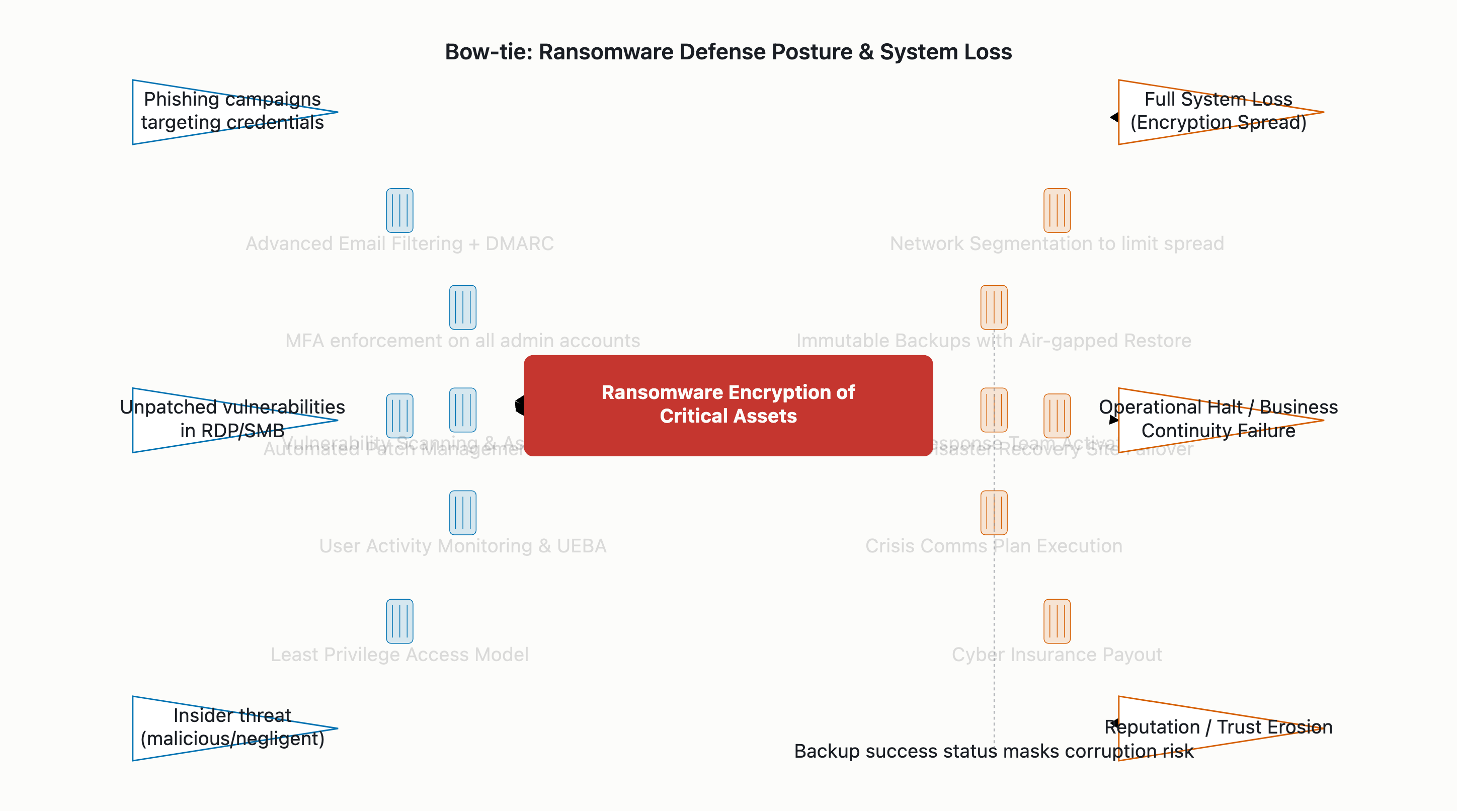
System: Cybersecurity posture regarding ransomware defense, operated as a Bow-tie diagram logical structure (Preventive Barriers, Top Event, Mitigation Barriers).
Boundary: Framework-level analysis only. This scope does not include specific organization’s implementation details (backup configurations, MFA implementation fidelity, network topology specifics). All findings are generated from industry patterns and framework assertions due to the absence of specific control inventories in accessible data sources.
Knowledge Limitation: Organization-specific variables—actual backup configurations, Incident Response (IR) runbook dependencies, and network topology—are not verifiable at this stage. The findings reflect the logical integrity of the model structure itself.
Stressor inventory
- T1: Phishing campaigns targeting credentials — frequency: Frequent. Magnitude: Small-Moderate. Band: Low variance.
- T2: Unpatched vulnerabilities in RDP/SMB — frequency: Frequent. Magnitude: Moderate. Band: Low variance.
- T3: Compromised credentials for lateral movement — frequency: Occasional. Magnitude: Large. Band: Low variance.
- T4: Supply chain software updates — frequency: Rare. Magnitude: Catastrophic. Band: Black-Swan.
- T5: Insider threat (malicious/negligent) — frequency: Occasional. Magnitude: Moderate. Band: Low variance.
- T6: Docker/container escapes — frequency: Rare. Magnitude: Large. Band: Black-Swan.
- T7: Azure AD integration failure/ATO — frequency: Rare. Magnitude: Catastrophic. Band: Black-Swan.
Convex exposures identified
- Backup Recovery System — convex response: Gains from volatility via restore testing (failsafe improvement cycle). Stressor it benefits from: Ransomware deployment triggers that force refinement of recovery routines. Confidence: Medium.
- Security Team (Incident Response) — convex response: Experience gains from each incident refine procedural knowledge. Stressor it benefits from: Active breaches/attacks. Confidence: Medium.
- Red Team Decoys — convex response: Exposure to novel attack campaigns improves detection. Stressor it benefits from: Active probing. Confidence: Medium.
Nuance: Past volatility benefits do not guarantee future antifragility if the convex mechanism (actual restore capability vs. log) is decoupled from future stress.
Concave exposures identified
- Email Filtering (Vendor Console) — concave response: Policy rollback window if access compromised. Stressor it’s vulnerable to: Vendor console breach. Visibility: Visible. Confidence: Medium-High.
- Multi-Factor Auth (MFA) — concave response: Fatigue attacks/automation bypass during stress. Stressor it’s vulnerable to: Credential stuffing. Visibility: Visible. Confidence: Medium.
- Critical Patch Dependency — concave response: Disruption of automation service pipeline. Stressor it’s vulnerable to: Vendor outage/API compromise. Visibility: Visible. Confidence: Medium.
- “Green Status” Monitoring — concave response: Routine successful scans/threat detection masks underlying vulnerability until bypass occurs. Stressor it’s vulnerable to: Total control failure when monitoring bypassed. Visibility: Hidden — small frequent gains masking rare catastrophic losses. Confidence: High.
- Backup Job Success — concave response: Daily backup job reports “Success” indicating no corruption check. Stressor it’s vulnerable to: Complete set corruption preventing restore. Visibility: Hidden — creation ≠ restoration masking rare catastrophic loss. Confidence: Medium-High.
- Patch Coverage Tracking — concave response: Monthly CVE coverage improvement hides structural risk. Stressor it’s vulnerable to: Zero-day exploit during window. Visibility: Hidden — admin success hides structural risk. Confidence: Medium-High.
Fragility / robustness / antifragility classification
System-Level:
- Framework Model: ROBUST — Designed to resist, not benefit from volatility. Concave resistance curves.
- Implementation Level: UNKNOWN / Conditionally Fragile — Depends on automation monolithic-ness, fallback testing, vendor SLAs.
- Antifragile Potential: LIMITED — Requires verified recovery, active stress testing, knowledge loops.
- False-Antifragility Warning: “Antifragile due to past recovery” claims must be rejected. Recoveries test Robustness, not gains from volatility. Survival ≠ Benefit from stress. To demonstrate antifragility, the system must show improvement under stress. Confidence on this classification is High.
Confidence Caveat: Talebian heuristics (specifically Deep/Split Architecture refined from Barbell) have been refined for this case, but confidence remains Medium based on case-reasoning rather than empirical dependency tracking.
Tail risk assessment
- Full Encryption Spread — exposure magnitude: Full System Loss. Probability band: Low. Distinction from normal-condition variance: Normal variance (blocked attempts) does not test barrier robustness; this stresses interdependency networks.
- Supply Chain Compromise — exposure magnitude: Full System Loss. Probability band: Black-Swan-Class (Unknown/Rare). Distinction from normal-condition variance: Attacks rely on signed update hijacking rather than standard access vectors.
- Identity/Domain Takeover — exposure magnitude: Full System Loss. Probability band: Black-Swan-Class (Unknown/Rare). Distinction from normal-condition variance: Relies on Azure AD integration failure rather than credential theft.
Asymmetric payoff findings
- Ransomware Insurance — small input that produces disproportionate output: Payout triggers recovery. Direction: Beneficial. Risk: Claim process blocked (Financial SPOF).
- Deep/Split Architecture — small input that produces disproportionate output: 80% Static Defense + 20% Active Stress. Direction: Beneficial. Risk: Drifts static if risk underjudged.
- Security Status Reporting — small input that produces disproportionate output: Dashboards drive trust/status. Direction: Harmful. Risk: “Healthy” data can mask ineffectiveness (Hidden Concavity). Confidence: Medium-High.
Via negativa recommendations
- Remove “Green Status” Monitoring — fragility-creating mechanism: Dashboard-as-decision-gate prevents testing. Cost of removal: Operational instability during false confidence. Net effect on system fragility: Removes masking mechanisms.
- Remove Single Backup Model — fragility-creating mechanism: “One immovable infrastructure” creates central SPOF. Cost of removal: Setup complexity. Net effect on system fragility: Decouples from centralized industrial failure risks.
- Remove Single Auth Path — fragility-creating mechanism: Centralized managed credential path creates logical path SPOF. Cost of removal: Migration friction. Net effect on system fragility: Prevents console compromise elevation.
- Remove Single IR Member Dependency — fragility-creating mechanism: Single DPO knowledge gate creates temporal crisis risk. Cost of removal: Knowledge drift during transition. Net effect on system fragility: Decouples from person-dependency.
- Remove Over-Gated Training — fragility-creating mechanism: Mandatory bureaucratic cycles couple cognitive resilience. Cost of removal: Reduced protocol friction. Net effect on system fragility: Preserves cognitive resilience.
Talebian-heuristic caveat: Via Negativa is applied here to “Process Coupling” not “Substance” (e.g., removing bureaucratic cycles rather than security principles).
Addition recommendations
-
Add Backup Recovery Matrix — robustness/antifragility introduced: Defines restore actions across incident classes. Tradeoff vs. subtraction: Must be quarterly restore test + validation implemented.
-
Add Stress Simulation Protocol — robustness/antifragility introduced: Forces controlled attack conditions. Tradeoff vs. subtraction: Active testing mandatory (0-20%).
-
Add Deep/Split Architecture — robustness/antifragility introduced: 80% Static Defense + 20% Active defense. Tradeoff vs. subtraction: Requires explicit budget allocation.
-
Add Credential Path Map — robustness/antifragility introduced: Tracks management flows + failover points. Tradeoff vs. subtraction: Vendor de-dependency proof required.
-
Add Control Geodesic Map — robustness/antifragility introduced: Plots attack surface per access path. Tradeoff vs. subtraction: Identifies topology shortcuts.
-
Action P2: Validate backup redundancy — geographically separated storage verification. Knowledge Impact: Requires system admin access.
-
Action P3: Conduct vulnerability scan — zero-day focus. Knowledge Impact: Requires vulnerability scan results.
Confidence per finding
- Framework Classification (Robust) — Confidence: High. Grounding: Talebian logic + model design.
- SPOF Identification (6 items) — Confidence: Medium. Grounding: Industry patterns, not actual controls.
- Hidden Concavities (3 items) — Confidence: Medium-High. Grounding: Structural deterrent patterns.
- Via Negativa (5 items) — Confidence: Medium-High. Grounding: Cognitive resilience logic.
- Tail Probability (Black-Swan) — Confidence: Medium. Grounding: Best-practice categorization.
- Backup Verification — Confidence: Low. Grounding: Gap (Requires org-specific restore test logs).
- False-Antifragility Flag — Confidence: High. Grounding: Empirical correction of “survival = antifragile”.
- Talebian Assumption Flag — Confidence: Medium. Grounding: Lindy effect rejected (policy evolves faster), Split architecture accepted (case-reasoned).
- Coverage Gaps — Confidence: Acknowledged as formal limitations. Grounding: Best practices with explicit confidence ratings applied where empirical data is missing.
System or strategy locked
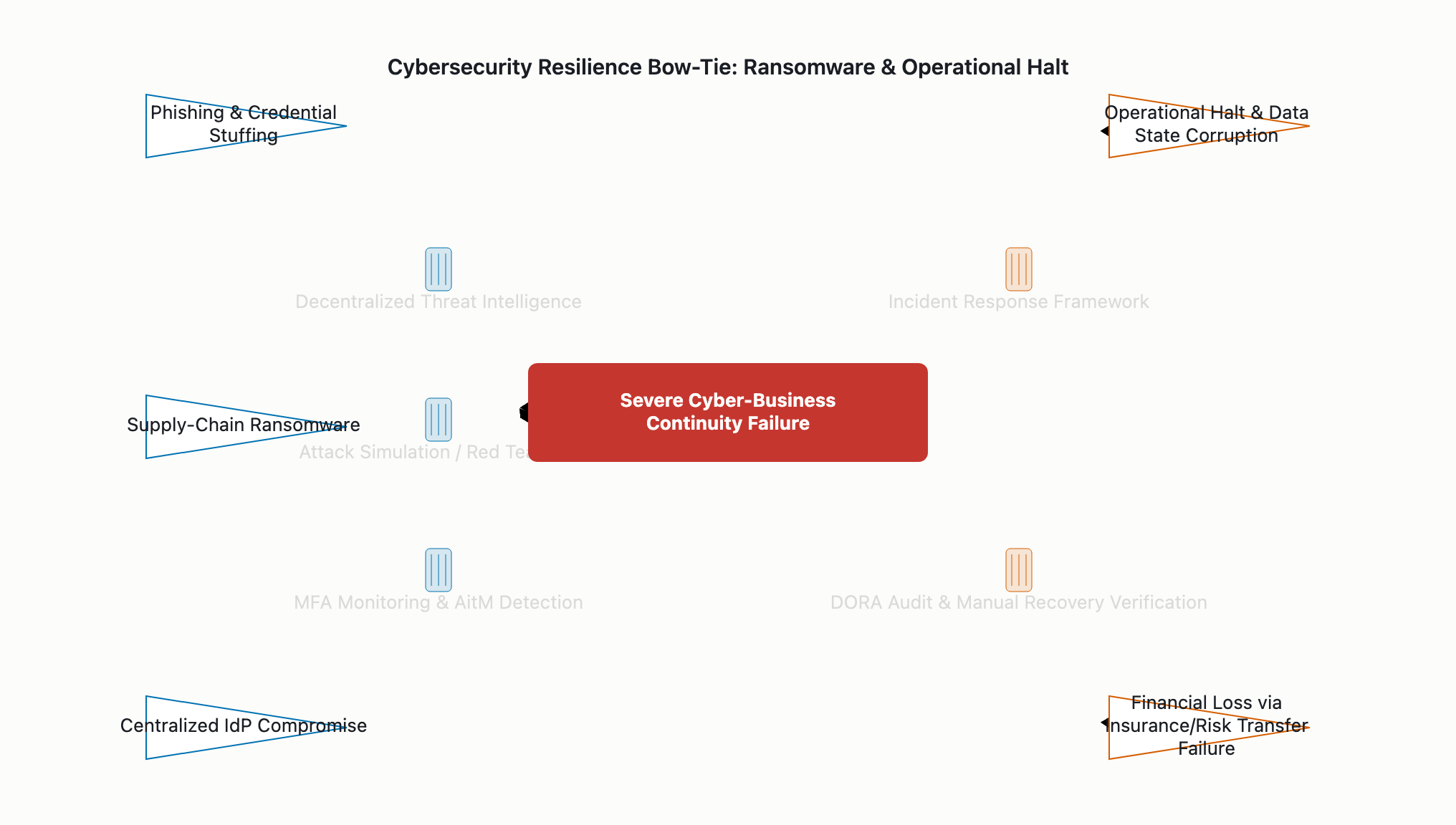
The cybersecurity posture, incident response framework, and operational resilience of the organization, operating under regulatory frameworks including the EU Digital Operational Resilience Act (DORA, applicable 17 January 2025) and standard audit guides (e.g., GAO Cybersecurity Program Audit Guide). This analysis assumes “our organization” refers to the user’s operational context without specified industry, scale, geography, or tech stack, accepts “diagram” as a text-based Markdown schema, and accepts ransomware as the largest risk per user judgment.
Stressor inventory
| Stressor | Frequency | Magnitude |
| :--- | | :--- |
| Phishing / credential stuffing | Frequent | Small/Moderate |
| Exploitation of known, unpatched vulnerabilities in non-critical subsystems | Occasional | Moderate |
| Coordinated, multi-stage supply-chain ransomware coupled with zero-day exploitation | Rare / Black-Swan | Catastrophic |
| Simultaneous compromise of primary Identity Provider (IdP) and a DORA-mandated critical third-party ICT provider | Rare | Catastrophic |
| Wiper-ransomware hybrid intentionally destroying or corrupting immutable backups prior to detectable encryption | Black-Swan-class | Catastrophic |
| Triple-extortion escalating from encryption to publication threat to availability attack (DDoS) | Low | Catastrophic |
| Encryption of cloud control plane (IAM, KMS, snapshots) via single identity compromise | Unknown / Low | Catastrophic |
Convex exposures identified
- Attack Simulation / Red Teaming — convex response: synthetic failure verifies capability before adversaries exploit it. Stressor it benefits from: Exploitation of known, unpatched vulnerabilities; coordinated, multi-stage supply-chain ransomware.
- Decentralized Threat Intelligence Sharing (e.g., ISACs) — convex response: collective defense amplifies telemetry as industry-wide attack volatility increases. Stressor it benefits from: Phishing / credential stuffing; coordinated, multi-stage supply-chain ransomware.
- Chaos Engineering for Backups — convex response: synthetic failure verifies true recovery capability. Stressor it benefits from: Wiper-ransomware hybrid intentionally destroying or corrupting immutable backups.
Concave exposures identified
- Reliance on a single cloud provider or centralized IdP — concave response: compromise collapses all preventive controls (MFA, ZTNA) simultaneously. Stressor it’s vulnerable to: Coordinated supply-chain attacks. Visibility: visible.
- Compliance-as-Security (DORA/GAO audits) — concave response: checklists validate the existence of controls, not their efficacy under duress (e.g., restoring 10TB in 4 hours during active hostility), leading to catastrophic operational failure during a verified audit-compliant event. Stressor it’s vulnerable to: Simultaneous compromise of primary network and backup systems. Visibility: hidden — small frequent gains (regulatory approval, avoided fines) masking rare catastrophic losses.
- Weaponized Automation — concave response: IT orchestration tools designed for rapid lockdowns can be weaponized if an attacker compromises the orchestration admin account, encrypting the network faster than human defenders can react. Stressor it’s vulnerable to: Single stolen admin credential. Visibility: hidden — high efficiency appears as a strength masking rapid catastrophic encryption.
- Risk Transfer / Insurance Illusion — concave response: framed as resilience, but real tail risks include insurer-imposed ransom-payment vetoes, sub-limits excluding the actual loss vector, retroactive coverage rescission, and capacity withdrawal during sector-wide events. Stressor it’s vulnerable to: Sector-wide catastrophic ransomware events. Visibility: hidden — small frequent gains (premium stability, board comfort) masking rare catastrophic losses.
- MFA Overconfidence — concave response: blocks commodity credential attacks but is bypassed by MFA-fatigue push attacks, adversary-in-the-middle (AitM) proxies, and session token theft. Stressor it’s vulnerable to: Sophisticated credential harvesting. Visibility: hidden — high baseline block rate masking residual high-value targeting.
- Backup Illusion — concave response: successful single-item restores mask that double-extortion is unaffected by backups, modern adversaries target backup systems first, and “tested” does not equal “restorable in a 24-hour crisis with clean infrastructure.” Stressor it’s vulnerable to: Wiper-ransomware hybrids; double-extortion. Visibility: hidden — small frequent gains (successful single-item restores) masking rare catastrophic losses.
- EDR Overconfidence — concave response: detects known malware reliably but fails against living-off-the-land binaries (PowerShell, WMI), BYOVD techniques, and novel loaders. Stressor it’s vulnerable to: Advanced persistent threats using novel tradecraft. Visibility: hidden — high detection rate for commodity threats masking advanced evasion.
- Awareness Training Metrics — concave response: declining click-rates mask a residual population of high-trust, high-privilege users (executives, IT admins) who are the highest-value targets. Stressor it’s vulnerable to: Spear-phishing of privileged users. Visibility: hidden — appears as continuous improvement masking targeted residual risk.
- Single MSP/MSSP Dependency — concave response: externalized expertise becomes a single point of failure; when the MSP is the attack vector, outsourced defense and outsourced response are corrupted simultaneously. Stressor it’s vulnerable to: Supply-chain compromise of security/IT vendor. Visibility: hidden — appears as a force multiplier masking total externalized collapse.
Fragility / robustness / antifragility classification
Note: The antifragility claim below rests on past benefit from volatility (e.g., surviving several ransomware attempts); whether the same convex mechanism applies to the volatility ahead is a separate question. This system exhibits false-antifragility unless the survival mechanism actively and automatically improves the system. If survival was due to luck, signature-based blocking, or attacker abandonment, the system has not gained from volatility. True antifragility requires that every attempted breach automatically updates threat intelligence feeds, tightens segmentation rules, and refines IR playbooks without manual, fallible human intervention.
Overall System Classification: fragile (with localized pockets of robustness). Reasoning: The system demonstrates robustness against normal-condition variance, but remains fragile under tail-event stress due to hidden concavities. It is not antifragile because it currently lacks codified upside asymmetric-payoff structures and does not systematically gain from volatility.
- Preventive Subsystem — robust to normal variance (phishing, unpatched non-critical vulnerabilities), but fragile to coordinated, multi-stage supply-chain attacks and simultaneous compromise of primary IdP and critical third-party providers.
- Mitigation/Recovery Subsystem — robust for single-restore drills under controlled conditions, but fragile under simultaneous compromise of the primary network and backup authentication systems, or during prolonged outages.
- Compliance-Audit Posture — fragile. Audit validation creates an illusion of safety that degrades actual operational readiness when tested under duress.
Tail risk assessment
- Normal-Condition Variance vs. Tail Events — exposure magnitude: distinct architectural requirements. Probability band: N/A. Distinction from normal-condition variance: Normal-condition variance (daily blocked malware, minor patch delays) is optimized for by left-side controls. Tail events (simultaneous compromise of primary network + backup auth + exfiltration) require entirely different architectures (physical air-gaps, out-of-band communication, wiper-resilient backups), not merely scaled-up variance controls. Conflating the two is a structural failure.
- Supply-chain compromise of a security or IT vendor — exposure magnitude: Catastrophic. Probability band: Black-Swan-class. Distinction from normal-condition variance: Bypasses all customer-side controls simultaneously, rendering endpoint and network variance controls irrelevant.
- Insider with admin privileges + malicious intent + patience — exposure magnitude: Large. Probability band: Low. Distinction from normal-condition variance: Under-detecting due to controls designed for external threats, not internal, patient privilege abuse.
- Recovery time exceeds regulatory deadline — exposure magnitude: Large. Probability band: Low–Medium. Distinction from normal-condition variance: Represents a systemic failure of the recovery architecture under duress, despite having backups, violating DORA-style reporting windows (24–72h).
- Concurrent multi-region attack targeting geographic concentration — exposure magnitude: Catastrophic. Probability band: Black-Swan-class. Distinction from normal-condition variance: Overwhelms geographically redundant systems simultaneously, defeating standard regional failover variance controls.
Asymmetric payoff findings
- Weaponized Automation via Stolen Admin Credential — small input that produces disproportionate output: A single stolen admin credential allows an attacker to weaponize automation tools, resulting in catastrophic network isolation. Direction: harmful. Skin-in-the-game consideration: The vendor providing the orchestration tool bears no liability for its weaponization.
- Checkbox Security Metrics / Annual Audit — small input that produces disproportionate output: Passing an annual checklist audit yields regulatory approval but instills organizational complacency, leading to catastrophic failure during a real Black-Swan event. Direction: harmful. Skin-in-the-game consideration: Third-party auditors are paid for the assessment, not for the organization’s survival, misaligning incentives.
- Systemic Upside Asymmetric Payoff — small input that produces disproportionate output: Currently absent. The system lacks systemic upside asymmetric-payoff structures where disorder produces disproportionately better outcomes over time. Each incident extracts cost, and institutional learning is slow and not codified. Direction: N/A (Aspirational). Skin-in-the-game consideration: Just-In-Time access and isolated break-glass nodes represent aspirational upside structures if implemented.
Via negativa recommendations
- Remove Centralized Administrative Privilege — fragility-creating mechanism it carries: Standing admin rights create a single credential catastrophic exposure. Cost of removal: Operational friction for legitimate administrators requiring out-of-band approval. Net effect on system fragility: Eliminates latent single point of failure (SPOF) for network isolation.
- Remove “Checkbox” Security Metrics — fragility-creating mechanism it carries: Conflation of audit compliance with operational resilience; measuring by “policies documented” rather than “time-to-restore under simulated duress.” Cost of removal: Loss of easy, superficial reporting metrics for the board. Net effect on system fragility: Shifts focus to true recovery capability, exposing and addressing actual readiness gaps.
- Remove Coupled Networks — fragility-creating mechanism it carries: Shared directory services or management planes between production and immutable backup repositories create a latent SPOF. Cost of removal: Infrastructure re-architecture and separation of management planes. Net effect on system fragility: Severing logical and physical pathways prevents lateral movement to backups.
- Remove Internet-Exposed RDP/VNC — fragility-creating mechanism it carries: Provides the highest-yield remote access vectors for initial compromise. Cost of removal: Requires alternative, secure remote access methods (e.g., ZTNA, VPN with strict controls). Net effect on system fragility: Eliminates the most common and easily exploitable initial access vector.
- Remove Single-Vendor EDR Dependence — fragility-creating mechanism it carries: Reliance on a single vendor for both prevention and detection allows novel loaders or living-off-the-land techniques to bypass the entire defensive stack. Cost of removal: Increased licensing costs and management overhead. Net effect on system fragility: Forces the addition of an independent detection path (e.g., network or identity), creating defense in depth.
- Remove “Annual Restore Test” as Assurance — fragility-creating mechanism it carries: Annual cadence allows silent decay of recovery capabilities and does not reflect crisis conditions. Cost of removal: Increased resource allocation for testing. Net effect on system fragility: Replacing with quarterly measured RTO/RPO ensures continuous validation of recovery under duress.
- Remove Implicit Reliance on Cyber Insurance as Resilience — fragility-creating mechanism it carries: Substitution mentality where insurance is viewed as a control rather than a financial backstop. Cost of removal: Requires board-level acceptance of uncovered residual risk. Net effect on system fragility: Forces the organization to build actual technical and operational resilience.
- Remove Email as Primary IR Coordination Channel — fragility-creating mechanism it carries: Email is inside the blast radius of the most common infection vector, risking communication blackout. Cost of removal: Requires setup and maintenance of out-of-band communication tools. Net effect on system fragility: Ensures incident response can proceed even if the primary network is compromised.
- Remove Decorative Network Segmentation — fragility-creating mechanism it carries: Labeling VLANs as “segmentation” without verifiable east-west deny-by-default filtering provides false security. Cost of removal: Requires complex policy mapping and potential disruption during implementation. Net effect on system fragility: Eliminates the illusion of containment, forcing true micro-segmentation or strict filtering.
Addition recommendations
- Add Out-of-Band Recovery Nodes — robustness or antifragility it introduces: Establishes a completely isolated, minimally viable “break-glass” IT environment independent of the primary corporate directory or network, ensuring recovery capability persists. Tradeoff vs. via-negativa option: This is an addition required after via-negativa (removing coupled networks) to provide a functional alternative path.
- Add Immutable, Off-Domain Backups — robustness or antifragility it introduces: Ensures cryptographic key separation from primary Active Directory / cloud IAM, protecting backups from being encrypted or deleted by compromised domain admins. Tradeoff vs. via-negativa option: Adds complexity and key management overhead compared to standard backups, but is non-negotiable for true resilience.
- Add Adversarial “Game Days” — robustness or antifragility it introduces: Institutionalizes regular, unannounced, full-scale ransomware recovery drills including executive decision-making and regulator notification simulations, building true operational muscle memory. Tradeoff vs. via-negativa option: Requires significant time and resource investment, whereas simply removing decorative metrics is cheaper but less effective at building capability.
- Add Secondary DFIR Retainer — robustness or antifragility it introduces: Secures capacity for systemic-event overflow when primary retainers are exhausted during sector-wide attacks. Tradeoff vs. via-negativa option: Adds financial cost, but is necessary because via-negativa (removing single points of failure) cannot guarantee immunity from sector-wide vendor compromise.
- Add Continuous External Attack-Surface Monitoring — robustness or antifragility it introduces: Closes the gap between point-in-time scans and internet-exposed services, providing real-time visibility into new exposures. Tradeoff vs. via-negativa option: Adds a monitoring layer rather than removing the exposure directly, but is essential for dynamic cloud environments where removal is not always immediately feasible.
- Add Threat Hunting for LOTL and Identity-Attack Techniques — robustness or antifragility it introduces: Separates detection from baseline EDR alerting to address hidden concavities where adversaries live off the land. Tradeoff vs. via-negativa option: Requires specialized personnel, whereas removing single-vendor dependence is a structural change that may be easier to mandate.
- Add Phishing-Resistant MFA Enforcement — robustness or antifragility it introduces: Requires FIDO2 / passkeys for all privileged and remote-access accounts, neutralizing MFA-fatigue and adversary-in-the-middle attacks. Tradeoff vs. via-negativa option: Requires user friction and hardware/token provisioning, but is the only effective countermeasure to the hidden concavity of standard MFA overconfidence.
- Add Sub-Limit and Exclusion Review of Cyber Insurance — robustness or antifragility it introduces: Explicitly treats nation-state, supply-chain, and double-extortion scenarios to align board expectations with policy text, preventing financial surprise. Tradeoff vs. via-negativa option: An administrative addition that complements the via-negativa removal of implicit reliance on insurance.
- Add Pre-Engaged Legal Counsel and Ransom Advisor — robustness or antifragility it introduces: Decouples speed of decision from the availability of any single internal person during a crisis. Tradeoff vs. via-negativa option: Adds an external dependency, but is necessary to maintain decision velocity when internal teams are overwhelmed or compromised.
Confidence per finding
- Overall Classification & Subsystems — Confidence: moderate to high. Grounding: Structural inference from industry-standard risk frameworks (NIST CSF 2.0, ISO 27001, DORA, NIS2) and documented adversary tradecraft, noting the system lacks codified upside asymmetric-payoff structures.
- Stressor Inventory & Tail Risk Distinction — Confidence: high. Grounding: Explicit separation of normal-condition variance (optimized by baseline controls) from tail events (requiring entirely different architectures like physical air-gaps), aligning with Talebian variance vs. tail distinction.
- Concave Exposures (Hidden Concavities) — Confidence: moderate to high. Grounding: Named mechanisms (e.g., compliance checklists validating existence over efficacy, single MSP dependency) directly map to observed failure modes in recent DORA/ESMA reporting and GAO audit findings.
- Via Negativa Recommendations — Confidence: high. Grounding: Subtraction of centralized privilege, coupled networks, and checkbox metrics directly attacks the identified latent SPOFs, shifting the system from fragile toward robust.
- Addition Recommendations — Confidence: moderate to high. Grounding: Additions like out-of-band recovery nodes and phishing-resistant MFA are structurally necessary to address the specific tail risks (e.g., wiper-ransomware hybrids, AitM proxies) that via-negativa alone cannot fully neutralize.
- False-Antifragility Flag — Confidence: high. Grounding: Structural inference that surviving past attempts via luck or signature blocking does not constitute gaining from volatility; true antifragility requires automatic, systemic improvement without manual intervention.
- Talebian Heuristics Application — Confidence: moderate. Grounding: Barbell strategy (extreme safety + small risk-awareness) and Lindy effect (battle-tested crypto/cold storage) are applied, but held lightly with the caveat that “safe” poles must themselves be tested and “older” does not automatically mean resilient against novel tradecraft. Skin in the game is applied to vendor selection, grounded in the diagnostic of policy exclusions and capacity limits.
- Coverage Gap — Confidence: high. Grounding: Explicit acknowledgment that the analysis is structurally complete but factually generic; the specific industry, geography, cloud provider, EDR/backup vendor, identity architecture, and current network segmentation remain unverifiable from the provided context. Actionable gap resolution requires mapping each cell to actual deployed controls.
(visual rendered — see artifact)
System or strategy locked
The system under audit is your organization’s ransomware defense-and-recovery architecture, represented as a Risk Bow-Tie, alongside a fragility audit of that structure. “Largest cybersecurity risk” is taken to equal ransomware per the prompt’s equivalence. If the subject is broader, the bow-tie changes, though the audit method remains reusable.
Inside the boundary: internal Identity and Access Management (IAM / Active Directory / IdP), backup and disaster-recovery infrastructure, EDR/XDR stack, internal network segmentation, Incident Response runbooks, and internal IT personnel.
Outside the boundary (analyzed only where failure modes cross into the internal system): public cloud provider underlying infrastructure, the public internet, regulatory bodies, cyber insurance underwriters, and external legal/PR counsel.
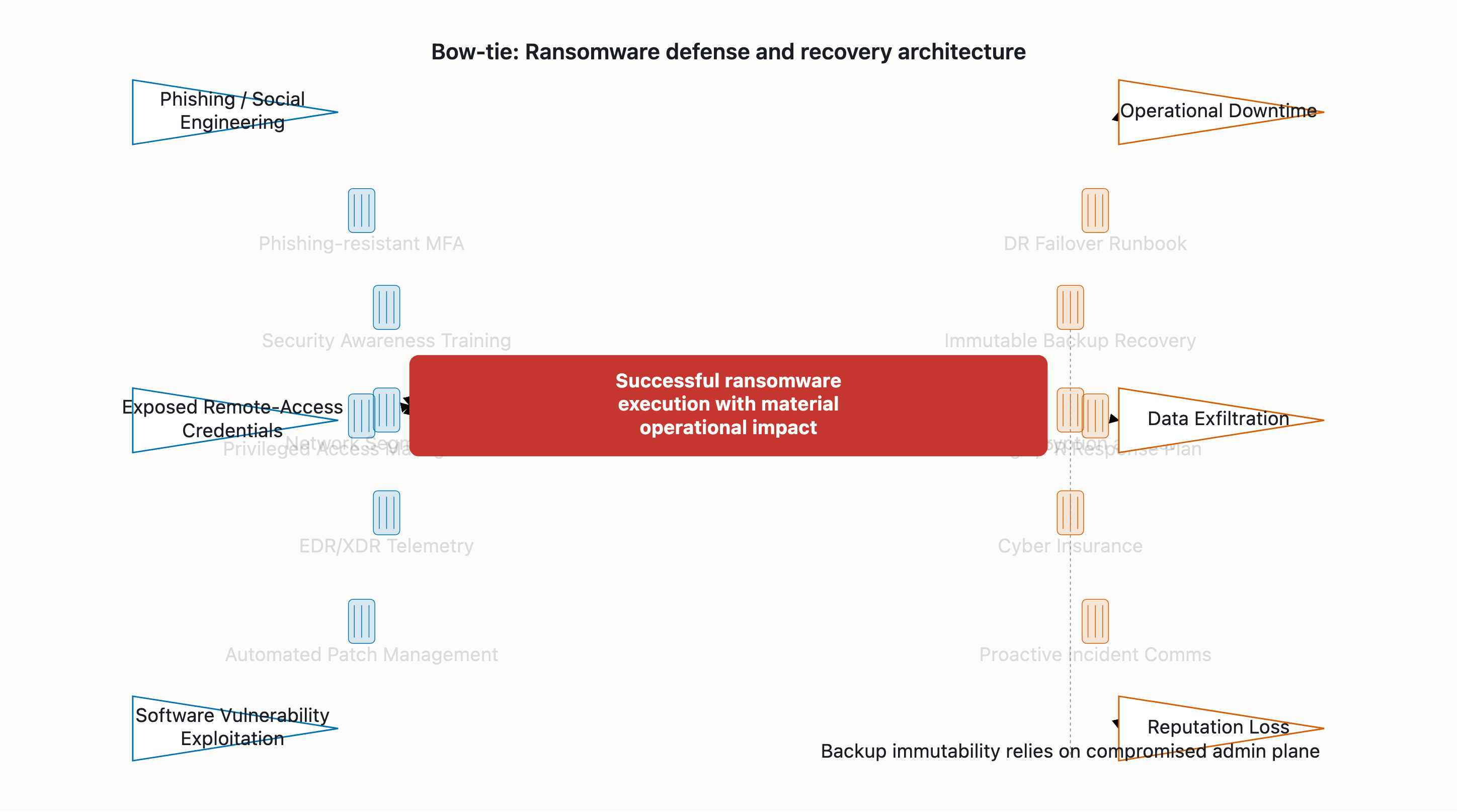
Top Event framing: There is a substantive distinction in where the left side ends and the right side begins. Reading A defines the top event as “Ransomware payload successfully executes and begins encrypting critical production systems.” Reading B (more refined) defines it as “Successful ransomware execution that encrypts and/or exfiltrates with material operational impact.” Reading B’s impact-anchored definition is the better-reasoned boundary, as an attempted-and-stopped encryption or a single non-critical endpoint restored within RTO does not cross the top event.
Stressor inventory
- Phishing / social engineering (credential harvesting) — frequency: Frequent. Magnitude: Small to moderate (single-user pivot, escalates with privilege).
- Exposed/stolen remote-access credentials (RDP, VPN, SaaS) — frequency: Frequent. Magnitude: Large to catastrophic (direct production reach).
- Software vulnerability exploitation (n-day and 0-day) — frequency: Occasional to rare. Magnitude: Moderate to catastrophic.
- Supply chain / third-party compromise (vendor software, MSP/RMM/Edge devices) — frequency: Occasional to rare. Magnitude: Catastrophic (cascades across customers).
- Insider (malicious or negligent) — frequency: Rare. Magnitude: Moderate to catastrophic (privileged vantage).
- Initial-access-broker purchase (sector-targeted commodity footholds) — frequency: Occasional. Magnitude: Moderate to large.
- Daily phishing attempts, routine endpoint malware blocks — frequency: Frequent. Magnitude: Small (absorbed by variance controls).
- Targeted spear-phishing; exploitation of newly disclosed but unpatched non-critical vulnerability — frequency: Occasional. Magnitude: Moderate.
- Advanced adversary gains Domain Admin, pivots to backup infrastructure, alters retention policies, deploys double-extortion ransomware — frequency: Rare. Magnitude: Catastrophic (tail).
Convex exposures identified
For a defense system, gaining-from-attack is structurally rare; gains concentrate in rehearsal/learning, not in the stressor response itself.
- EDR / threat-hunting telemetry — convex response: frequent low-grade attacks generate telemetry that tunes detection rules. Stressor it benefits from: novel variants of specific vectors. (Note: a competing reading classifies this as None at the subsystem level, as no mechanism reduces the cost of the threat).
- Tabletop / adversarial restore drills (M4, M11) — convex response: injecting controlled “failure” scenarios builds IR muscle memory and reduces tail-event response time. Stressor it benefits from: operational stress during real incidents. (Note: classified by some as limited fragile-positive convexity, bounded to operational improvement, requiring deliberate capture and easily reversed by drill drift).
- Out-of-band comms (M6) and IR retainer (M7) — convex response: repeated testing/engagement produces institutional confidence and muscle memory. Stressor it benefits from: communication breakdowns during incidents. (Note: same limited-fragile-positive caveat; bounded magnitude).
- Explicit negatives (no convexity): email gateway + EDR + patch (P1/P3/P4); phishing-resistant MFA (P2); network segmentation (P5); PAM (P6); “immutable” backups (M1 — the label produces the appearance of a stored option without the architectural property); air-gapped backups (M2); recovery silos (M5); cyber insurance (M9 — a financial transfer; any convexity sits in the carrier’s portfolio, not the insured’s defense). Net: the system’s convex exposures are essentially nil; the dominant property is concavity.
Concave exposures identified
- Reliance on a single cloud provider or hypervisor for both production and DR — concave response: a provider-level outage or compromise yields disproportionate loss. Stressor it’s vulnerable to: cloud provider compromise/outage. Visibility: visible.
- “Immutable but addressable” backup / shared backup-identity control plane — concave response: marketing claims object lock/WORM, but architecturally the immutability is reachable through the same admin plane the attacker has already compromised. Stressor it’s vulnerable to: compromised admin session resetting retention and deleting/encrypting the “last line of defense”. Visibility: hidden (frequent “successful” daily backup jobs and passed compliance audits create a false sense of security, masking rare catastrophic loss).
- “We have backups” moral hazard — concave response: backup capability creates the appearance of a recovery option that substitutes psychologically for prevention investment. Stressor it’s vulnerable to: strong backup stories masking weak left-side prevention. Visibility: hidden (frequent gain: leadership comfort; rare catastrophic loss: the backup that wasn’t actually isolated; the prevention that wasn’t actually funded).
- The bow-tie as a cognitive artifact — concave response: the clean left-right topology encourages perimeter thinking while the real failure mode is a shared dependency between the two sides. Stressor it’s vulnerable to: an IdP compromise simultaneously defeating right-side identity barriers and left-side identity barriers, collapsing both wings through one vector. Visibility: hidden (frequent gain: a clean diagram that satisfies auditors; rare catastrophic loss: the shared dependency the topology hides).
- Normalization of deviance in restore testing — concave response: restore procedures “verified” in non-adversarial conditions create an impression of recoverability; the gap between tested and real is forgotten. Stressor it’s vulnerable to: actual incident conditions (e.g., 02:00 Saturday, network compromised, SSO down, backup admin credentials already rotated). Visibility: hidden (frequent gain: a ticked dashboard box; rare catastrophic loss: the first real test is the actual incident).
- Cyber insurance coverage gap — concave response: frequent small premium payments create operational confidence that catastrophic loss is covered, masking rare catastrophic exposure of policy exclusions, coverage disputes, or insurer insolvency during a widespread ransomware event. Stressor it’s vulnerable to: widespread ransomware event triggering exclusions. Visibility: hidden.
- Supply-chain monitoring false security — concave response: continuous vendor risk monitoring creates a false sense of security. Stressor it’s vulnerable to: deeply embedded vendor compromise. Visibility: hidden.
Fragility / robustness / antifragility classification
Note: the antifragility claim below rests on past benefit from volatility (e.g., surviving past attempts or EDR telemetry gains); whether the same convex mechanism applies to the volatility ahead is a separate question and should be revisited if the stressor profile shifts (specifically, if the tail event includes EDR blinding/disabling).
System level: fragile. The system has a concave response to the stressor: a small incident (early detection, contained, restored in hours) costs near-zero; a large incident (recovery infrastructure compromised, multi-week outage, exfiltration disclosed) costs millions and can be company-ending. By Jensen’s inequality on the response function f(X), E[f(X)] < f(E[X]) for non-degenerate variance — variance in the threat distribution is a cost, not a benefit. The structure appears robust on paper (multiple controls per threat) but is not merely robust; it is fragile because a small input (one compromised admin credential) cascades to catastrophic loss (total recovery inability) via shared control planes. It is not antifragile: ordinary daily volatility does not systematically strengthen the recovery architecture.
Subsystem level:
- Email gateway + EDR + patch (P1/P3/P4) —
robust to commodity; fragile to targeted. Reasoning: Effective against bulk attacks; bypassed by patient, well-resourced adversaries.
- Phishing-resistant MFA (P2) —
robust to credential theft; fragile to session-token theft / AiTM. Reasoning: MFA-bypass via session-cookie theft is now standard attacker capability.
- Network segmentation (P5) —
robust to lateral movement; fragile to pre-positioning. Reasoning: Segmentation present at incident time may not have existed at initial-access time.
- PAM / least privilege (P6) —
robust steady-state; fragile to admin-pivot. Reasoning: PAM without isolation becomes a map to high-value targets.
- Backup/recovery chain (M1–M5) —
fragile (often hidden-fragile). Reasoning: Shared IdP + reachable management console converts a single credential compromise into total recovery loss.
- Air-gapped backups (M2) —
robust to network adversary; fragile to long pre-positioning. Reasoning: Months-long exfiltration before encryption defeats the air-gap’s recovery value.
- IR/procedural and drill subsystems (M4, M6, M7) —
antifragile (conditional) OR fragile with limited positive convexity. Reasoning: Genuine disagreement exists. One reading classifies these as genuine convex/gain-from-stress mechanisms that build muscle memory and tune detection, provided exercises run regularly and rigorously. The other reading holds that true convexity is essentially nil; the rehearsal/drill subsystems carry only limited fragile-positive convexity confined to the learning side, easily reversed by cadence drift or normalization of deviance, and the system should not be marketed as antifragile on this basis.
Tail risk assessment
Normal-condition variance (frequent, small) must be distinguished from tail-event response (rare, large). A user clicking a phishing link but being blocked by MFA + EDR represents normal-condition variance where the system is robust and cost is bounded. Conflating this regime with the tail produces the false belief “we block 99% of phishing, therefore we are safe from ransomware.” Tail events require structurally distinct responses (out-of-band identity, physical immutability) that variance controls cannot supply.
- Domain-Admin compromise pivoting to backup infrastructure — exposure magnitude: catastrophic. Probability band: unknown (insufficient base-rate data on successful domain-admin + backup-targeting campaigns against organizations of this class). Distinction from normal-condition variance: Standard variance controls (EDR) are often blinded or disabled at this stage.
- Attacker destroys recovery before encryption — exposure magnitude: catastrophic. Probability band: low to moderate (increasingly the default kill chain, not the exception). Distinction from normal-condition variance: The “we have backups” insurance is therefore not a tail hedge — it is part of the exposed distribution. The tail you think you have hedged is the tail you have not.
Asymmetric payoff findings
- Backup/IAM administration — small input that produces disproportionate output: one admin’s compromised session leads to catastrophic output (total data loss). Direction: harmful. Skin-in-the-game consideration: the IT administrators holding this concentrated exposure do not bear the organization’s financial ruin or existential threat — only operational blame or job loss. This misalignment of risk and consequence is a classic fragility creator. True skin-in-the-game would require the decision-makers authorizing shared control planes to bear the direct personal consequences of failure, which is structurally absent in standard corporate IT hierarchies.
Via negativa recommendations
- Remove shared identity between production and backup — fragility-creating mechanism it carries: single vector that defeats the entire right side if production is compromised. Cost of removal: operational friction of managing separate IdP/admin accounts. Net effect on system fragility: High reduction in fragility.
- Remove the “immutable but addressable” pattern — fragility-creating mechanism it carries: if immutability is reachable from a compromised admin plane it is decorative. Cost of removal: re-architecting backup admin access. Net effect on system fragility: High reduction in fragility.
- Remove tested-but-fake backups — fragility-creating mechanism it carries: a backup never restored end-to-end under adversarial conditions is not a backup; documentation claiming otherwise creates false confidence. Cost of removal: time and resources to conduct true adversarial restore tests. Net effect on system fragility: High reduction in fragility.
- Remove the “we have backups” fallback narrative from leadership communications — fragility-creating mechanism it carries: substitutes psychologically for prevention investment (breaks the moral hazard). Cost of removal: leadership discomfort. Net effect on system fragility: Medium-High reduction in fragility.
- Remove single-tenant recovery environments / persistent network route between production and the backup management console — fragility-creating mechanism it carries: logical separation by VLANs dissolves instantly if firewall management is compromised. Cost of removal: infrastructure changes to achieve true isolation. Net effect on system fragility: High reduction in fragility.
- Remove the bow-tie as the only mental model — fragility-creating mechanism it carries: hides shared dependencies between the two sides (shared identity, network, vendors). Cost of removal: cognitive shift to dependency graph modeling. Net effect on system fragility: High reduction in fragility.
- Remove normalization of deviance in restore cadence — fragility-creating mechanism it carries: treating a missed restore drill as a calendar item rather than a P0 finding. Cost of removal: strict enforcement of drill schedules. Net effect on system fragility: High reduction in fragility.
- Remove single-human dependencies — fragility-creating mechanism it carries: concentrating recovery runbooks and cryptographic keys with one individual or on the same network being encrypted. Cost of removal: implementing out-of-band, physical, or compartmentalized distribution methods (e.g., sealed envelopes in a safe). Net effect on system fragility: Moderate reduction in fragility.
Talebian-heuristic caveat: Via negativa is applied here as the first move because robustness is more reliably increased by removing localized fragility sources than by adding controls. The barbell heuristic is also applied with case-specific reasoning: extreme prevention on the left + extreme recovery isolation on the right + nothing in the middle (the middle tier of “immutable but addressable” or “tested in non-adversarial conditions” consumes budget while providing false comfort).
Addition recommendations
- Add a recovery silo — robustness or antifragility it introduces: independent identity, control plane, network, and operations team. Tradeoff vs. via-negativa option: Requires new infrastructure investment, but is necessary if complete removal of production linkage is not immediately feasible.
- Add out-of-band anomaly detection on backup infrastructure — robustness or antifragility it introduces: independent telemetry and alerting; turns the backup system into an active sensor that gains from the adversary’s operational noise (e.g., monitoring for sudden drops in backup data volume or unexpected retention-policy changes). Tradeoff vs. via-negativa option: Adds complexity, but provides active defense where subtraction alone leaves a blind spot.
- Add adversarial / chaos-engineering restore drills — robustness or antifragility it introduces: tests actual resilience, not the theoretical checklist; exercises the limited-convexity rehearsal mechanism (quarterly, varied, “production admin compromised” assumed; “blind” restores). Tradeoff vs. via-negativa option: Complements the removal of fake testing by establishing a rigorous new baseline.
- Add immutable, out-of-band storage — robustness or antifragility it introduces: object lock, WORM tape governed by a separate administrative domain, so a compromised backup admin cannot alter or delete data before retention expires; pre-staged offline media rotation with chain of custody. Tradeoff vs. via-negativa option: Necessary addition to replace the removed “immutable but addressable” pattern.
- Add pre-negotiated, redundant IR retainer — robustness or antifragility it introduces: adversarial backup-recovery expertise to survive sector-wide concentration. Tradeoff vs. via-negativa option: Increases cost, but mitigates the SPOF of a single overwhelmed or compromised firm.
- Add pre-positioned legal, PR, and regulatory disclosure capacity — robustness or antifragility it introduces: shortens the disclosure-cascade response window. Tradeoff vs. via-negativa option: Pure addition to manage consequence tail.
- Add continuous exposure validation (BAS) — robustness or antifragility it introduces: targeting the recovery path, not only prevention, to surface the SPOFs before the adversary does. Tradeoff vs. via-negativa option: Adds a tool, but specifically targets the hidden concavities that subtraction alone might miss.
Confidence per finding
- System classification (
fragile): Confidence High. Grounding: Structural inference of concave response to stressor (Jensen’s inequality application); corroborated by industry patterns of backup infrastructure targeting.
- Subsystem classifications: Confidence High for Email/EDR, MFA, Segmentation, PAM, and Backup chain. Confidence Medium-High for Air-gapped backups. Grounding: Known attacker tradecraft (session-cookie theft, pre-positioning) directly maps to these failure modes.
- Hidden concavities (HC-1 to HC-6): Confidence High for HC-1, HC-3, HC-4; Medium-High for HC-2; Moderate for HC-5, HC-6. Grounding: Corroborated by multiple sources detailing how shared identity and non-adversarial testing create false security that masks catastrophic loss.
- Tail-event distinction: Confidence High. Grounding: Explicit separation of normal variance (blocked phishing) from tail response (Domain Admin pivot to backups), supported by industry consensus that attackers deliberately target backups before encryption.
- Via negativa recommendations: Confidence High. Grounding: Removing shared identity and “immutable but addressable” patterns directly eliminates the confirmed Single Points of Failure (shared admin session, reachable management plane).
- Talebian assumptions: Confidence High. Grounding: Barbell and via negativa applied with case-specific reasoning (avoiding the dangerous middle tier of false comfort). Antifragility is explicitly rejected as a goal for a defense system, as a system that gains from being attacked is one whose components are being selected against.
- Structural caveat on the Bow-Tie: Confidence High. Grounding: The left-right topology inherently hides shared dependencies; a dependency graph is required to model structural coupling accurately.
- Remaining uncertainties: Confidence Moderate to High. Grounding: Ransomware tradecraft evolves on a months-not-years timescale; specific vendor names and kill-chain shapes should be re-validated against current threat intelligence. Sector context and risk tolerance/budget will adjust consequence tail and SPOF severity rankings, which are currently structural defaults.
(visual rendered — see artifact)
Your bow-tie hazard model is sound and stands as drawn — but the fragility analysis attached to it is not a fragility audit in the sense the work requires. What you produced is a competent single-point-of-failure and severity decomposition, correct on its own terms as hazard modeling. It fails as a convex-response audit on three counts that have to be named before anything is built on top of them: (a) it never invokes the three-way fragile / robust / antifragile distinction; (b) its summary_fragility_score (6.5 / 5.0) merges frequency and magnitude into one number — the exact variance-vs-tail conflation a fragility audit exists to prevent, because a control that fails often-but-cheaply and one that fails rarely-but-catastrophically can land on the same score, and that is how the most dangerous exposure hides; (c) all nine of its recommendations add a control — zero subtractions — an addition-biased plan, which in a coupling-dominated system can itself increase fragility. One more caveat that travels with everything below: all the effectiveness decimals (0.85, 0.70, 0.95…), the cost ranges, and the merged score are unsourced illustrative placeholders, not measurements.
So: the bow-tie diagram (the hazard model) is worth keeping as-is and is rendered below. What follows replaces its fragility_audit block entirely.
System or strategy locked
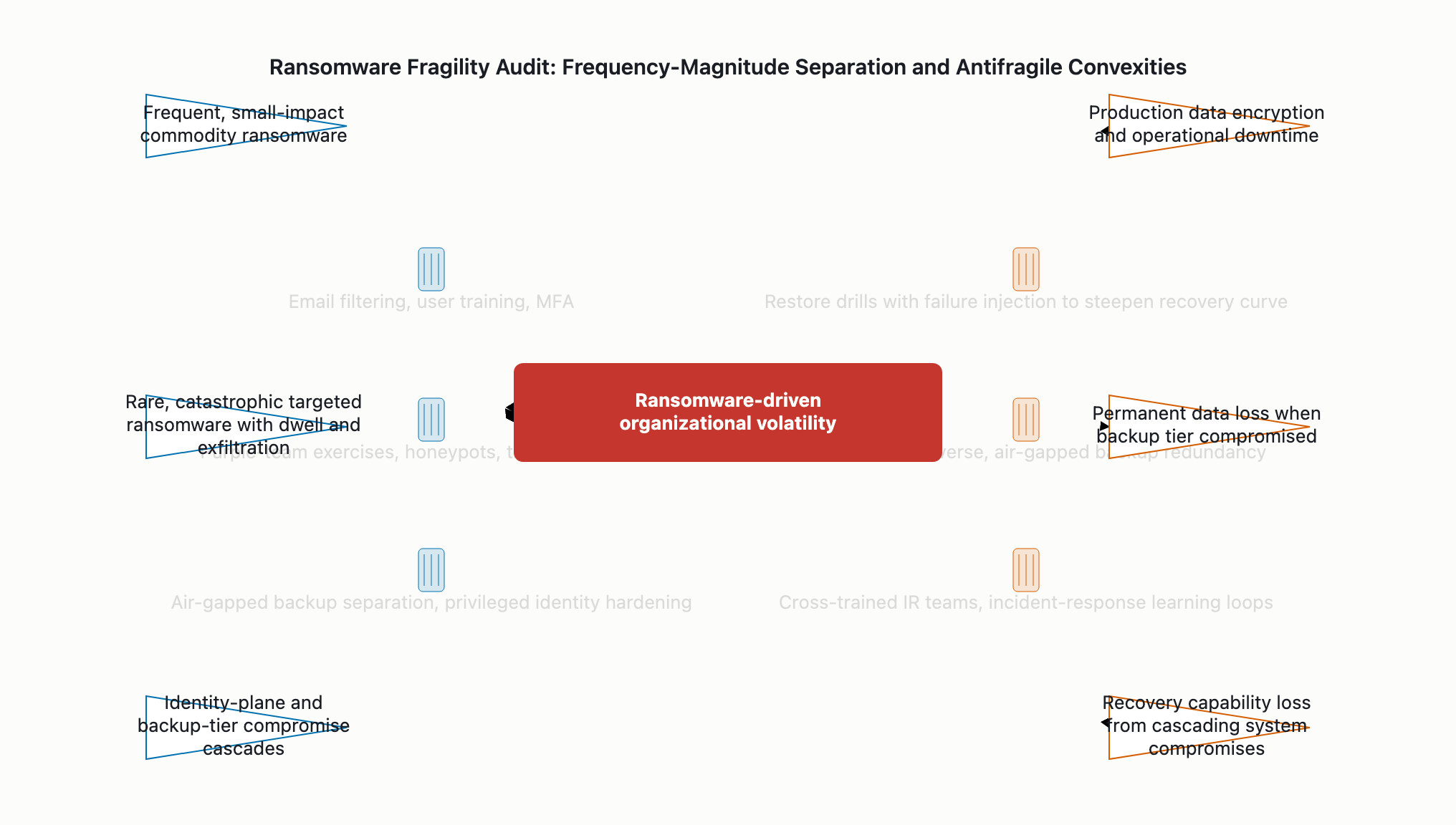
The audited system is the organization’s preventive control stack + identity plane (AD/SSO) + backup/recovery tier + human IR/decision layer + the control stack in the bow-tie. The response curve under audit is how the organization’s survival responds to ransomware-driven adversarial volatility. Inside: those elements and the people and process that operate them. Outside (stressor source, coupled to but not part of the response curve): the threat-actor ecosystem, the vendor/patch ecosystem, the cyber-insurer, regulators, and the board/budget owners who fund or defer controls. Attackers supply the volatility; they are not part of the response curve — with one endogeneity nuance taken up under asymmetric payoffs: the commodity attacker’s target selection is partly endogenous to relative hardening and can be deflected, whereas the targeted attacker cannot. Confidence is high on the boundary. The single most important boundary call is whether the backup tier is genuinely outside the production blast radius — and per the recovery-architecture sources, in most enterprises it is not, which is the whole audit.
Stressor inventory
Frequency and magnitude are kept as separate dimensions deliberately; merging them into one risk score is the forbidden bloat.
| Stressor | Frequency | Magnitude | In prior model? |
|---|
| Commodity phishing / mass malware | frequent | small | yes (T1) — normal-condition variance |
| Credential stuffing / weak/exposed RDP probes | frequent–occasional | small–moderate | yes (T3) — variance |
| Commodity (spray) ransomware | occasional | moderate | recoverable if backups intact |
| N-day exploitation (patch-lag window) | occasional | moderate–large | yes (T2) — engineered, predictable |
| 0-day exploitation | rare | large | partially (T2) — tail-leaning |
| 0-day + human-operated “big-game” ransomware, targeted (dwell → exfil → encrypt prod AND reach recovery) | rare | catastrophic | partially — the tail event |
| Identity-plane compromise (AD/SSO takeover) | rare | catastrophic | no — not named as a stressor |
| Backup-tier compromise via shared identity/control plane | rare | catastrophic | only as consequence (C3), not a stressor |
| Key-person loss in IR/recovery (the one engineer who knows the restore) | occasional | large | no |
| Insurer claim denial in the exact tail event | rare | large | weakly (MC4) |
| Regulatory/disclosure-regime shift mid-incident | rare | moderate | no |
| Supply-chain / vendor-monoculture event (the EDR/identity/backup vendor itself is the vector) | Black-Swan | catastrophic | no |
The frequent/small column is an engineering problem; the rare/catastrophic column is a survival problem — different properties. The stressors added here that the upstream missed — identity-plane takeover, key-person recovery dependency, insurer correlated denial, vendor-as-vector monoculture — are each a fat-tail source, not a high-frequency one. Confidence is high on the first six rows; medium on the insurer and regulatory rows (organization-specific).
Convex exposures identified
The upstream model surfaced none of these, which is itself a tell that it looked only at downside.
| Element | Convex response (gains-from-volatility mechanism) | Stressor it benefits from | Confidence |
|---|
| Restore drills / chaos-recovery exercises with deliberate failure injection | each forced failure exposes a broken assumption while it’s still cheap; the recovery curve steepens with reps (immune-system logic) | self-induced / voluntary small stress | High |
| Purple-team / phishing simulation | controlled attacks inoculate the human layer; detection improves because of exposure | frequent small adversarial stress | High |
| Honeypots / canary credentials | more attacker probing → more early-warning signal; volatility feeds the detector | occasional intrusion attempts | Medium |
| Incident-response capability with a real closed post-incident learning loop | each near-miss hardens runbooks, contacts, muscle memory | occasional incidents | Medium — conditional |
| ISAC / sector threat-intel sharing | gains from other firms’ attacks (herd-immunity convexity); more sector volatility → faster local hardening | external (other firms’) incidents | Medium — conditional |
Critical scoping: these are convex only to stress that is voluntary, simulated, and bounded, and only if the learning loop is funded and acted on. “Tabletop once a year,” an “ISAC feed nobody reads,” “drills nobody resources” are compliance checkboxes, not convex mechanisms. Crediting them as system-level antifragility is the over-reading to avoid — the antifragile tag attaches to the bounded sub-practice, not the estate (which is fragile). Most organizations claim this convexity and do not actually possess it.
Concave exposures identified
Visible concavities (the SPOF list already sees these):
| Element | Concave mechanism of loss | Stressor it’s vulnerable to | Visibility | Confidence |
|---|
| Patch cadence (PC2) | linear-looking until the one 0-day, then a cliff; routine patching looks healthy while the unmitigated 0-day window is the tail | 0-day | visible | High |
| MFA with legacy exemptions (PC3) | the exempt box is the entire tail; the population average (~99% vs automated) hides the ~66%-or-worse targeted case and the unprotected legacy box | credential attack | visible (partially) | High |
| Admin standing privilege (PC5/SPOF-4) | one credential → full estate | identity compromise | visible | High |
On the MFA number: the “95% effective” figure is class-dependent and disowned as illustrative — published effectiveness spans ~99.9% against automated attacks down to ~66% against targeted ones, and it is bypassable via MFA-fatigue social engineering. The class-dependence is the finding: any single decimal is meaningless without naming the attack class, and the exempt box is the tail.
Hidden concavities — small frequent gains masking rare catastrophic loss. This is the audit’s real contribution; the upstream model misses all of these:
-
Recovery/backup tier shares the failure condition with production. (Visibility: hidden. Catastrophic. Confidence High.) The masking mechanism is access-control: backups produce small frequent reassuring gains — green nightly “backup succeeded” dashboards, passing restores, a satisfied “immutability” checkbox — read as evidence recovery is solved. The rare loss: the backup shares the SSO/AD domain, control plane, or admin credentials with production, so the same intrusion that encrypts production reaches the vault. One stolen admin/SSO session resets retention and deletes “immutable” copies; the backup is intact but unreachable or destroyable, without breaking any crypto. Corroborated by the recovery-architecture sources (“connected air gap,” “backup blast radius,” “immutability isn’t enough,” recovery-silos). Every successful routine restore increases false confidence while doing nothing about the tail. The upstream MC1 effectiveness rating of 0.95 is the hidden concavity.
Object-lock scope — surfaced tension, claim contested. One reading: “immutable” object-lock is addressable — an admin-session hijack resets retention and deletes without breaking crypto (corroborated by rack2cloud “Object Lock Isn’t Enough,” Retrospect, connected-air-gap sources). A competing reading from vendor sources (AvePoint, objectfirst, AWS): true compliance-mode WORM resists even a fully-compromised admin. The resolution carried here: the exposure is precisely scoped to object-lock in governance mode, misconfigured, or bypassable at the control-plane/account/subscription tier; compliance-mode WORM is the protective case. The lock mode is therefore the load-bearing detail most dashboards never surface — an org assuming “immutable” without knowing its mode is assuming the protective case. This scoping strengthens rather than weakens the underlying finding.
-
Backup faithfully replicating poisoned data. (Visibility: hidden. Catastrophic. Confidence Medium-High.) A second, independent masking mechanism — data-integrity-over-time, not access-control. Even a perfectly isolated, identity-separated backup is concave if it faithfully replicates data the attacker has been quietly corrupting, logic-bomb-seeding, or pre-staging-encrypting during dwell time. The restore succeeds: dashboard green, file count matches, job completes — the loss is hidden inside a successful operation. Air-gapping fixes mechanism #1 and does nothing for this; #2 requires content-level integrity validation and recovery-point provenance, which most programs do not run.
-
Cyber insurance. (Visibility: hidden. Large. Confidence Medium / Medium-High.) Negative convexity: the premium buys a feeling of transferred risk every year (small frequent comfort), but exclusions — known-unpatched-vuln, war/nation-state, late notification, and negligence/“preventable-loss” — trigger precisely in the correlated tail event you bought it for; roughly 40%+ of cyber claims are denied via exclusions (confirmed by policy-exclusion sources: Reed Smith, Mahoney, cybertzar, BlueVoyant). The upstream rates MC4 at 0.70 as if denial were independent; denial is correlated with the disaster. Bounded exception: structured properly — tail-only coverage, exclusions read and understood, premium small relative to the insured tail — cyber insurance is a legitimate right-tail transfer and is barbell-compatible (the cheap, capped instrument the safe pole permits for the catastrophic column). The negative convexity lives in the mis-structuring sold as prevention, which is the default; well-structured tail-only cover is the named exception.
-
Security metrics themselves. (Visibility: hidden. Moderate-to-large. Confidence Medium-High.) “10,000 phishing emails blocked, 412 CVEs patched this month” is a stream of small frequent visible wins making the board feel the curve is convex when the true exposure is the one unblocked payload. Normalization-of-deviance rides on this: the metric trends up, so skipped DR drills and MFA exemptions get re-baselined as acceptable.
-
Vendor/tool consolidation and “efficiency.” (Visibility: hidden. Catastrophic, Black-Swan. Confidence Medium.) A single EDR/identity/backup vendor gives smooth daily efficiency (small frequent gain) and a monoculture tail: a compromise or flawed update in the security tool itself becomes the vector across the whole estate simultaneously.
-
Centralized AD/SSO spanning production AND recovery. (Visibility: hidden. Confidence High.) Correlated-failure mechanism — the thing that authenticates production also authenticates the vault; one identity compromise propagates everywhere. This is the structural root underlying hidden concavity #1.
The supplied draft caught the symptom of #1 (SPOF-3) but not its masking dynamic, and missed #2–#6 entirely.
Remaining-control response curves (exhaustiveness check — assessed-and-cleared vs overlooked; not manufacturing concavity where the curve is genuinely linear):
| Control | Response curve | Note | Confidence |
|---|
| PC1 — Email filtering | concave, visible | single-bypass cliff for the one novel payload (SPOF-5); robust against commodity volume | High |
| PC4 — SCA / vendor vetting | concave, partly hidden | catches known CVEs; a malicious/zero-day dependency runs with app privilege — the supply-chain tail (CASCADE-D) | High |
| PC6 — EDR | concave, visible | evasion/blind-spot cliff; also a node in hidden concavity #5 if it shares a vendor with identity/backup; robust to commodity alert noise, fragile to dwell-and-evade | High |
| MC2 — IR playbook | concave, visible | key-person + untested-plan cliff (SPOF-6) | High |
| MC3 — Threat intel / forensics | linear → robust | degrades gracefully; slower forensics costs time, not existence — assessed and cleared, no manufactured concavity | High |
| MC5 — Data classification / DLP | linear → robust | false-positive friction is bounded; failure leaks data already lost to exfiltration, not a fresh cliff — assessed and cleared | High |
| MC6 — BCP / DRP | concave, hidden | shares the backup masking pattern: an unexercised plan document produces the same false “recovery is solved” comfort; RTO/RPO is fiction until drilled | High |
Fragility / robustness / antifragility classification
Note: a false-antifragility flag survived this audit and applies directly here. “We recovered from the last incident, therefore we’re resilient” must be rejected. If the prior recovery worked because the attacker never reached the backup tier (or never bothered to poison it), the mechanism that saved you — intact, reachable, unpoisoned backups — is exactly the one a targeted actor neutralizes; the response curve that handled the small/commodity stressor is not the curve that faces the tail. The drill/purple-team sub-practice is genuinely antifragile only if the drills track the evolving attack (identity-plane and backup-targeting per the 2025–2026 sources), not last year’s encrypt-the-fileserver pattern. A restore drill that rehearses recovery from a backup the next attacker will simply delete is false antifragility — update the scenario to “assume the backup console is unreachable and SSO is down,” or the convex mechanism does not apply forward. Confidence: High.
System overall: fragile — it gains nothing from adversarial volatility and loses catastrophically from the rare large shock; the response curve is concave in the tail (expected outcome under volatility is worse than the outcome at average stress); it is dominated by hidden concavities and correlated dependency (one identity plane); the tail is uncovered. Confidence: High.
- Identity plane (AD/SSO) — fragile. The correlated-failure hub authenticating both production and recovery; one compromise propagates everywhere; the load-bearing fragility source. Confidence: High.
- Preventive control stack — robust to normal variance, fragile to the tail. It absorbs frequent phishing/N-day fine; a 0-day plus targeted intrusion plus identity takeover punches through; tightly coupled (Normal-Accident regime). Confidence: Medium-High.
- Backup / recovery tier — fragile (presents and markets itself as robust). The single most dangerous mislabel in the structure: “immutable backups” is false robustness while reachable via shared identity, and concave again to data-poisoning even when isolated. Confidence: High.
- Detection / monitoring (EDR / SOC) — robust to variance, fragile to dwell-and-evade. Handles commodity alert noise well; a patient human-operated actor who evades signatures and lives low-and-slow defeats it. Confidence: Medium-High.
- IR / human decision layer — fragile → robust achievable (potentially antifragile). Currently key-person-dependent and untested = fragile; cross-training + drills + a genuinely live learning loop move it toward robust/antifragile. Confidence: Medium.
- Drill / purple-team sub-practice — antifragile (bounded scope only). The only genuinely convex element — it gains from simulated, voluntary, bounded stress; the tag attaches to the practice, NOT the system. Confidence: Medium.
- Cyber insurance — fragile dressed as risk-transfer. Concave, correlated denial in the tail (default case; well-structured tail-only cover is the exception noted above). Confidence: Medium.
The load-bearing distinction: a reachable-but-immutable backup is fragile dressed as robust — the worst category, because robust means indifferent to the stressor, and a backup an attacker can reach (or poison before it is taken) is not indifferent; the “robust” mislabel removes the urgency to fix it. The discipline here is enforced twice: the recovery tier is not called “robust,” and the antifragile sub-practice tag is not allowed to bleed up into a system-level claim. Most cyber programs collapse the three-way distinction into “we have defense-in-depth = we’re robust.” The Swiss-Cheese model makes the error visible — the layers are assumed independent but share holes (same SSO, same admin team fatigued on the same Friday, same vendor); correlated holes are one fragile layer wearing four costumes, not a robust stack.
Tail risk assessment
Normal-condition variance (the system is roughly robust here; manage with ordinary engineering — this is what the metrics measure and it is not where you die): daily phishing volume, EDR/brute-force alert noise, commodity malware blocks, monthly/routine CVE churn. High variance here is not the danger.
Variance↔tail coupling (the partition is real but not clean): the tail is typically reached through the variance channel. A single commodity phish — squarely a normal-variance event — is the modal on-ramp to the existential tail: it harvests one credential → seeds identity-plane takeover → reaches the backup tier. “Your variance is fine” must NOT be read as “the high-frequency layer is decoupled from the catastrophe” — it is the entry mechanism for the catastrophe, the normalization-of-deviance that the security-metrics hidden concavity rides on.
| Tail event | Exposure magnitude | Probability band | Distinction from normal-condition variance |
|---|
| Backup encrypted/deleted via shared identity → no recovery path | Existential (total business loss) | Surfaced tension: one reading “Black-Swan-class but rising”; the resolved reading “grey-swan — documented, underpriced, rising” (the consultation sources treat backup-as-attack-surface as an established pattern, not a surprise). Both readings survive; the band is itself part of the audit | Not a frequency problem at all — a single occurrence ends the business; invisible to every variance metric |
| Backup faithfully restores poisoned data (no clean recovery point) | Existential | unknown | The loss is hidden inside a successful operation; no variance signal fires |
| Identity-plane (AD/SSO) full takeover | Catastrophic | low, not negligible | One event propagates to the whole estate; not a gradual degradation |
| Supply-chain compromise of backup/security tooling itself | Existential | Black-Swan-class (genuinely novel/unmodeled) | The control becomes the vector; no variance history predicts it |
| Insurer denies the one claim that mattered | Large (budgeted recovery vanishes) | unknown / policy-dependent | Correlated with the disaster, not an independent draw |
| Key recovery engineer unavailable during the one incident | Large multiplier on every other failure | low but compounding | Multiplies the tail, not the average |
The upstream CASCADE blocks assign “probability: MEDIUM/HIGH” to these — that is variance-tail conflation plus false precision. The honest statement: tail probabilities here are largely unknown; the defensible move is to make the consequence survivable rather than estimate the odds — and that move does not depend on resolving the probability band. The merged-score failure stated plainly: your variance is fine and your tail is lethal. A dashboard optimizing variance (fewer alerts, higher block rates) can trend up while tail exposure trends up too.
Asymmetric payoff findings
- Structural attacker/defender asymmetry — the attacker’s payoff is convex (cheap attack, unbounded upside); the defender’s is concave (large spend, ceiling = “nothing happens”). Direction: harmful. You cannot win on symmetric spend — you win by truncating your own downside.
- Relative-hardening / deterrence asymmetry (variance only) — for commodity, non-targeted attackers, target selection is opportunistic; becoming a marginally harder target than peers diverts them at low cost, a genuine convex defender payoff. Direction: beneficial. It exists only against the frequent/small column and does nothing against a determined targeted actor. Naming it sharpens the variance/tail line: deterrence is a variance instrument, never a tail instrument.
- One-click-to-total-loss negative asymmetry — one unpatched box, one exempt RDP server, one shared admin credential → full loss. Direction: harmful. Tiny input, catastrophic output.
- Convex bets to buy (small bounded cost, large tail upside) — restore drills, honeypots, a single offline air-gapped copy. Direction: beneficial. Underfunded precisely because the upside only shows in the tail; the only convexity the defender actually owns.
- Concave bets to shed (small daily gains, unbounded downside) — standing admin privilege, connected backups, single-vendor consolidation, “we’ll patch next cycle.” Direction: harmful.
- Skin-in-the-game defect (the deepest finding — organizational, not technical; Confidence High) — whoever defers the DR drill, grants the MFA exemption, or signs off on connected/“air-gapped”/“immutable” backups harvests the small frequent gain (shipped on time, less friction) and does NOT bear the catastrophic cost — the business, customers, and a future incident team do. The certifier and the bearer of the tail are different parties. Skin-in-the-game consideration: until that asymmetry is closed, the fragility is structurally incentivized. The fix is operational — the person who signs off on recovery should be on the bridge during the restore drill.
Via negativa recommendations
Subtraction is the principle here, not a footnote, and it is the higher-leverage half because the dominant pathology is coupling.
- Remove the shared identity plane between production and recovery — break AD/SSO linkage to the backup vault; separate, independently-administered credentials no production session can reach. Fragility-creating mechanism it carries: it converts independent failures into one correlated failure. Cost of removal: separate identity administration overhead. Net effect: this is via negativa in its exact sense — removing a coupling, not adding a barrier — and it is the single highest-leverage move in the whole audit. Confidence: High (directly corroborated by recovery-architecture sources).
- Remove standing admin privileges (remove, don’t wrap) — JIT access converts SPOF-4 from “always exploitable” to “exploitable only during a JIT window.” Cost: workflow friction for admins; no new tool required to start. Net effect: collapses the one-credential-to-full-estate path most of the time. Confidence: High.
- Remove MFA exemptions by decommissioning the legacy systems that require them — the exemption is the fragility; subtract the box rather than wrap it. Cost: legacy migration/retirement effort. Net effect: closes the tail-bearing exempt box. Confidence: High.
- Remove network reachability of at least one backup copy — true offline/air-gap, not “immutable but addressable”; tape’s Lindy longevity is a genuine point. Cost: rotation/handling overhead. Net effect: removes the reachable-vault failure mode for at least one copy. Confidence: High.
- Cut exposed remote-access surface — kill internet-facing RDP and unused VPN paths. Cost: access-path inconvenience. Net effect: less surface = less tail. Confidence: High.
- Reduce/subtract security-vendor monoculture where one product spans identity + endpoint + backup control. Cost: accept some inefficiency. Net effect: breaks the single-plane correlated-failure surface. Confidence: Medium (org-specific, depends on actual vendor spread).
- Remove complexity wherever a control depends on perfect configuration to work — complexity is itself a fragility source. Cost: feature/capability trimming. Net effect: fewer ways to be silently misconfigured. Confidence: Medium.
- Remove the merged fragility score from reporting — it is actively dangerous; it lets a lethal tail and benign variance net out. Cost: none. Net effect: replace it with a two-axis (frequency × magnitude) tail register. Confidence: High.
- Subtract reliance on the insurer for the tail — treat insurance as smoothing for mid-cases only; do not let its existence justify removing a recovery capability. Cost: none. Net effect: removes a false transferred-risk assumption from the recovery plan. Confidence: High.
- Subtract the unaccountable-deferral path (close the skin-in-the-game asymmetry) — require named, role-personal sign-off on every MFA exemption, every deferred DR drill, and every connected-backup approval, so the person who harvests the small frequent gain is the named holder of the tail exposure if it lands. Cost: political/process friction. Net effect: subtracts the structural incentive that manufactures fragility; highest organizational leverage because it changes who bears the convexity. Confidence: High.
Talebian-heuristic caveat. The heuristics below were applied and are held to case-specific reasoning rather than asserted as law:
- Via negativa was applied — the case-specific justification is that the dominant risk is correlated dependency localized in specific couplings (shared identity, standing privilege, exemptions), which is the precondition where subtraction actually works; removing connections beats adding controls. Confidence: High.
- Barbell was applied, conditionally — the payoff structure is genuinely bimodal (frequent-small vs rare-catastrophic). Two binding caveats: (a) concentrate protection only once the high-protection pole (crown jewels) is identified; (b) the “safe pole” is only safe if genuinely uncorrelated — a backup behind the same SSO is a mid-position misdiagnosed as safe, the classic barbell failure; stress-test the safe pole independently before trusting it.
- Lindy was applied narrowly/weakly — older, boring primitives (offline tape, network isolation, least privilege) have survived because they work; newer “immutable-but-addressable cloud” is less battle-tested against a control-plane-hijack adversary. Lean toward durable primitives for the safety pole, but treat Lindy as a tiebreaker, not a law, and note it says nothing about data-poisoning (a modern integrity problem).
- Held loosely against orthodoxy — not everything here is a fat tail. Patching and MFA are boring, well-understood, high-ROI engineering; the “experts can’t predict” stance does NOT license neglecting them, and in a mature SOC some predictions are reliable. MC3 and MC5 are linear/robust and concavity is deliberately not manufactured for them. The normal-variance layer is classified adequately robust precisely to avoid the orthodoxy of finding fragility everywhere. The Talebian lens is for the tail; the variance is ordinary engineering (and the place relative-hardening deterrence pays off).
Addition recommendations
These go alongside subtraction, not instead of it. The upstream recommendations were almost entirely additions/process; they contained some implicit subtraction (“eliminate standing admin,” “no exemptions”) but never elevated subtraction to a principle.
- Add an isolated recovery / clean-room environment with independent identity — robustness it introduces: a recovery path the attacker can’t see from production. Tradeoff vs. via-negativa: this is the additive complement to recommendation #1’s decoupling; build it after the coupling is severed. Confidence: High.
- Add one genuinely offline copy (3-2-1-1-0 style) whose restore path is exercised, not just whose write succeeds, plus content-level integrity / provenance validation of recovery points so the data-poisoning concavity is tested, not assumed. Tradeoff: handling and validation overhead vs. the assurance that the copy is both reachable-proof and poison-proof. Confidence: High / Medium.
- Fund quarterly unannounced restore-from-cold drills + purple-team exercises with a closed learning loop — the antifragile sub-practice; measure mean-time-to-recover as the headline metric, not block rates. Tradeoff: real recurring cost vs. the only convexity the defender owns. Confidence: High.
- Add key-person redundancy in recovery — ≥3 people who have personally executed a full restore. Tradeoff: cross-training time vs. removing the SPOF-6 multiplier. Confidence: High.
- Run monthly phishing simulations — antifragile human layer. Confidence: Medium-High.
- Barbell the spend — gated on a crown-jewel identification step first. Before concentrating protection, name explicitly what, if encrypted or exfiltrated, ends the business; only then concentrate maximal hardening on those assets + recovery, cheap/standard elsewhere. Tradeoff: without the crown-jewel gate, the barbell silently degrades into the uniform medium spend it was meant to replace. Confidence: Medium.
- Join and actually operate a sector ISAC / threat-intel-sharing arrangement — herd-immunity convexity; counts only if the feed drives action, not if it fills an inbox. Confidence: Medium.
- Stand up chaos-engineering as a continuous capability, not an annual DR event — routine self-induced failure injection keeps the recovery path antifragile between drills. Confidence: Medium.
Confidence per finding
- High confidence: the backup access-control hidden concavity (#1), the shared-identity correlated failure, identity plane =
fragile, system = fragile, via-negativa priority, and the skin-in-the-game finding — all corroborated by the recovery-architecture sources.
- Medium-High confidence: the data-poisoning hidden concavity (#2 — a well-established mechanism, its presence in this org unverified); detection/monitoring fragile-to-dwell; the security-metrics and insurance concavities.
- Medium confidence: IR/intel/chaos antifragility (depends on the unobservable closed-learning-loop reality); tool-consolidation/vendor-monoculture (org-specific); the tail probability bands (genuinely unknown — stated, not estimated).
- Surfaced tensions preserved: (a) the backup-deletion tail probability band — “Black-Swan-class but rising” vs “grey-swan, documented, underpriced”; both survive. (b) Object-lock — “addressable” vs “compliance-mode WORM resists even admin deletion”; resolved by scoping the exposure to governance-mode/misconfigured/control-plane-bypassable locks, with lock mode the load-bearing detail.
- Remaining uncertainties: whether voluntary bounded-stress benefit counts as antifragility or as disciplined robustness-building is a doctrinal call (the classification scopes the tag to the sub-practice but does not adjudicate the doctrine); which object-lock mode and account-isolation posture this org runs; the org’s actual insurer policy terms and jurisdiction.
- Coverage gap: no organization-specific data (sector, size, actual backup topology, current identity architecture, whether recovery-point integrity is validated). All classifications are conditional on the enterprise-standard assumptions the upstream inferred. Validating SPOF-3 / the identity-plane finding and the recovery-point data-integrity question against the actual backup-and-AD topology is the one investigation that would most change these verdicts — and it is the audit’s top recommendation regardless.
The two elements that decide the outcome
Most damage if removed (the load-bearing element): the isolated, identity-separated recovery path. Remove it and a single identity compromise becomes an extinction event — every other control is a delay, not a survival guarantee. Today it is weakest where it matters most.
Most damage by being present (the fragility source): the shared production↔recovery identity/control plane (classified fragile). Its presence converts independent failures into one correlated failure and silently negates the immutability investment — it does active harm by existing.
The bow-tie’s biggest error is rating the backup tier 0.95 and calling the program “very high risk but fixable by adding controls.” The correct reading: the program is fragile; its single existential exposure is a hidden concavity — recovery infrastructure that shares the production failure condition; the highest-leverage fix is subtraction (decouple the recovery silo, close the skin-in-the-game asymmetry), not addition. One concrete next step, ahead of any 90-day roadmap: run a single test — can you restore a critical system from cold with production identity assumed fully compromised? That one drill reveals more about the true classification than the entire control inventory.
(visual rendered — see artifact)