The contradiction stated honestly
Strip the slogans. This is usually framed as progress vs. safety, which is already a loaded framing — nobody is against safety, nobody is against progress, so framed that way the “compromise” is built in and the fight is theater.
The real opposition is sharper and genuinely irreconcilable at its own level: two contradictory theories of how to act under irreducible uncertainty.
- Innovation’s bet: ignorance favors action. You cannot price the future from inside the present; the value of the unknown good is only revealed by trying. Knowledge is downstream of doing. Permissionless experimentation is not recklessness — it’s the only working discovery procedure for goods nobody can yet specify.
- Precaution’s bet: ignorance favors restraint. Under uncertainty, the asymmetry of consequence dominates. The entity that captures the upside is rarely the entity that bears the downside, and some downsides don’t undo. When you can’t compute the distribution, the rational move under a ruined-tail isn’t expected value — it’s survival.
These don’t average. They are opposite verdicts on the same input (uncertainty). That’s why “balance case-by-case” feels like a cop-out — because it is one. It just relocates the contradiction into each case without resolving it, and pretends the relocation is wisdom.
Why the compromise is actually a cop-out
The case-by-case dodge smuggles in an unexamined assumption: that the move/don’t-move decision is the only lever. Both poles share this assumption. The innovator and the precautionist are arguing about where to set a dial whose existence neither questions — the dial running from “go” to “stop.”
When both sides of a contradiction agree on a hidden premise, that premise is where the real money is.
The hidden premise: reversibility is treated as fixed
Here’s the move. Both poles silently treat the reversibility structure of the domain as exogenous — a fact of nature you discover, then react to.
- Precaution is correct precisely when harm is irreversible and decoupled from the actor’s stake. That’s the whole force of the asymmetry argument.
- Innovation is correct precisely when error is cheap, local, and recoverable. That’s the whole force of the discovery argument.
Notice: they’re both right, and they’re describing the same variable from opposite ends. The entire disagreement is a proxy war over the reversibility of a given domain — and each side has implicitly assumed its own answer.
Driving through: reversibility is something you build
The synthesis is not “sometimes fast, sometimes slow.” That’s the average again. The synthesis is a third term that neither pole could see, because both took it as fixed:
Reversibility is endogenous. It is an engineering target, not a property of nature.
Once you make recoverability a thing you invest in, the contradiction transforms instead of splitting. You no longer trade innovation against safety along one axis. You spend effort on a second axis — containment, staged rollout, kill-switches, sandboxes, reversible-by-construction deployment, liability that forces the actor to internalize the tail, sunset clauses that make rules themselves revocable — and you buy more experimentation AND more safety at once.
This is the actual dialectical resolution (the Aufhebung, if you want the word): the opposition isn’t deleted, it’s preserved and transcended. Speed and caution stop being rivals on a line and become the two payoffs of a single prior investment in recoverability. Fast-because-recoverable is not a compromise between fast and safe. It is strictly more of both, purchased with a different currency.
The policy corollary follows immediately and is non-obvious: regulate the reversibility infrastructure, not the activity. Don’t gate “AI” or “biotech” as nouns. Mandate the kill-switch, the containment perimeter, the staged exposure, the loss-bearing skin-in-the-game — and then let experimentation run hot inside the engineered envelope. That is the synthesis as an instruction, not a sentiment.
Where the synthesis breaks — and why that matters
A synthesis that claims to dissolve every case is just optimism wearing dialectical clothes. So drive through that too.
Reversibility-engineering has a hard floor. It works until it doesn’t, and it fails in exactly two places:
-
Intrinsic one-shot irreversibility. A self-replicating system you cannot recall. A tipping point with no return path. A capability that, once public, cannot be made un-public. Here the cost of recoverability isn’t high — it’s infinite, because the structure forbids it. The third axis collapses back to the first, and at that floor the precautionary pole reasserts and wins — not as “balance,” but because the asymmetry argument is decisive when the recovery option provably doesn’t exist. The synthesis honestly hands the residue back to precaution rather than pretending to absorb it.
-
Power capture of both poles. In practice “innovation” gets weaponized by incumbents to mean no rules for me, and “precaution” gets weaponized by the same incumbents to mean a compliance moat that kills entrants. Both slogans invert under political economy. This is why the synthesis must be power-aware: regulating the infrastructure (legible, auditable, applies symmetrically) resists capture better than regulating the activity (discretionary, gameable, becomes a barrier to entry).
The result, stated flat
- The pop framing (progress vs. safety) is fake; the real contradiction is two opposite verdicts on action-under-uncertainty, and it does not average.
- The reason “compromise” feels like a cop-out is that it accepts the contradiction’s hidden premise — a fixed go/stop dial.
- The genuine resolution is a third variable both poles took as given: make reversibility a build target. Then fast and safe stop trading off and start co-producing. Regulate the recoverability envelope, not the noun.
- This dissolves most of the space — but leaves a hard residue of intrinsic irreversibility where precaution rightly governs absolutely, and a second residue where power inverts both slogans. A synthesis that didn’t name its own failure boundary would be the very cop-out you asked me to avoid.
The contradiction isn’t healed by meeting in the middle. It’s healed by noticing that both sides were arguing about a dial when they should have been building a net — and then admitting there’s a height from which no net can save you, and there, you don’t jump.
The feeling that compromise is a “cop-out” is astute. In dialectical terms, a simple compromise is a stalemate: it treats two opposing forces as merely competing quantities on a single axis (speed vs. safety) and attempts to find a resting point. But resting points are illusory in a non-linear world. A synthesis that merely dampens the friction doesn’t solve the contradiction; it defers the explosion.
To analyze this dialectically, we must move beyond “balancing” scales and look at how the negation of one power is necessarily contained within the other. We are not looking for a middle ground; we are looking for where the tension re-organizes the relationship.
Here is the drive-through the contradiction.
I. The Thesis: Innovation as Unbound Potential
The Logic: Innovation is defined by its refusal of boundaries.
The Merit: It is the engine of human expansion, solving problems, creating tools, and liberating agency. It operates on an exponential time scale.
The Negation: Because it is unbound, its logic is blind. It treats “possibility” as the only metric. It answers “Can we?” but not “Should we?” or “Who will be harmed?”.
The Contradiction within: The pursuit of efficiency (the goal of innovation) inevitably generates new externalities (collateral harm). To pursue innovation is to produce the other as its necessary byproduct.
II. The Antithesis: Regulation as Social Containment
The Logic: Regulation is defined by its enforcement of boundaries.
The Merit: It is the mechanism of social continuity. It prioritizes linear security, equity, and risk mitigation. It protects the “public good” (often defined backward, as established rights).
The Negation: Because it is slow, risk-averse, and reactive, it generates a brittle friction.
The Contradiction within: Regulation seeks to stabilize the system, but the system is defined by change. A regulation aimed at a specific technology often creates a loophole that engenders a new technology (the “Nixie” effect) used to bypass said regulation.
III. Why “Compromise” is a Cop-Out
The “compromise” argument suggests: “Regulate to ensure safety, but don’t choke the market.”
This fails because it assumes Time and Risk are independent variables. They are not.
- Epistemological Lag: Innovation moves through “chaos” (discovery); regulation moves through “truth” (evidence). You cannot regulate a system based on evidence of a trauma that has not yet happened. Waiting for the consensus is to accept the risk of the “accident.”
- Asymmetry of Harm: A compromise assumes that an innovation failure hurts the developer (lost revenue) and a regulation failure hurts the public (safety risk). But as we see with AI, digital corruption, or bio-engineering, the asymmetry is that one bad innovation failure can harm eternity, while a failed regulation might cost a few years of latency.
- The Illusion of Neutrality: A “middle ground” often favors the status quo of power. Regulating AI is easier if you do it with a hand on the throttle, but the state who holds the brake is the one with the most leverage.
IV. Driving Through the Contradiction (The Sublation)
To drive through this, we must understand that Regulation is not an external constraint on innovation; it is the operating system that allows innovation to exist. Without safety, trust erodes, capital flees, and the ecosystem dies.
The contradiction lies in the source of authority.
- Innovation draws authority from Competence (we know the code works).
- Regulation draws authority from Consequence (we know the society might break).
The “Cop-out” of compromise seeks to make the Authority of Competence obey the Authority of Consequence. The Dialectical Move changes this.
The Synthesis: Adaptive Fiduciary Responsibility
The friction between “Can we build this?” and “Should we build this?” is not resolved by stalling. It is resolved by changing the definition of the build.
-
Safety as a Feature, Not a Friction:
If you build the fast car (innovation), the garage (regulation) isn’t a place that stops you from driving; it’s the place that builds the car’s brakes. If safety isn’t engineered into the code, it isn’t regulated; it’s police work. Real safety innovation changes the algorithm, reducing the need for regulatory penalties.
Example: Encrypted blackbox boxes in aviation, or safety injection protocols in nuclear plants. The safety is the tech.
-
Regulation as a Sandbox for Iteration:
Regulation shouldn’t be a static law; it should be an adaptive feedback loop.
- Thesis: Code moves fast.
- Antithesis: Law moves slow.
- Synthesis: Code Law. Regulatory frameworks that are executed dynamically via code (e.g., sandboxes, red-teaming as a prerequisite to market access). Regulation becomes an automated guardrail, updated as frequently as the software, removing the human lag.
-
The Ownership of Consequence:
The friction is sharpest regarding cost. Innovation often outsources risk to the public; Regulation internalizes cost to the corporations. The true dialectical solution requires Internalization of Consequence as the Engine of Innovation.
If the innovator bears the full risk of failure, they will see safety as the primary innovation. The conflict ceases when the drive for profit aligns with the drive for survival.
V. The Dialectical Truth
The contradiction isn’t “Tech vs. State.” It is “Short-term Optimization vs. Long-term Survival.”
- Thesis: We must optimize systems to allow capability growth.
- Antithesis: Optimization without survival constraints leads to extinction.
- Synthesis: We do not regulate the evolution of the tech; we regulate the trajectory of its deployment.
Why this removes the “cop-out”:
It rejects the idea that “safety” slows down progress. It argues instead that unsafe progress is un-sustainable progress. A technology that cannot survive its own deployment is not an innovation; it is a potential liability.
Conclusion: The Non-Negotiable Friction
You are correct that compromise is weak. It treats technology and law as reactive, opposite ends of a seesaw.
In the dialectical view, technology and law are two hands holding a pair of scissors. Neither cuts the other; neither can hold the paper alone. The cut (regulation/innovation) is only possible through the tension of the two.
- If you remove the innovation (the blade), there is no function.
- If you remove the regulation (the handle), the sharpest point (solution) cuts whoever is holding it (society).
The “Drive” is to acknowledge that regulation is the act of giving the technology a shape. To try to regulate without innovation is to dumb down the tool. To innovate without regulation is to sharpen the tool until it martyrs the hand.
The Solution: Stop talking about “regulating technology.” Start talking about democratizing the safety interface. Make the accountability of the technology transparent before deployment. If the safety standards must be met for the code to exist on the public network, the regulation ceases to be a “brake” and becomes “physics.”
This resolves the contradiction by making safety the substrate, not the ceiling.
Generating question
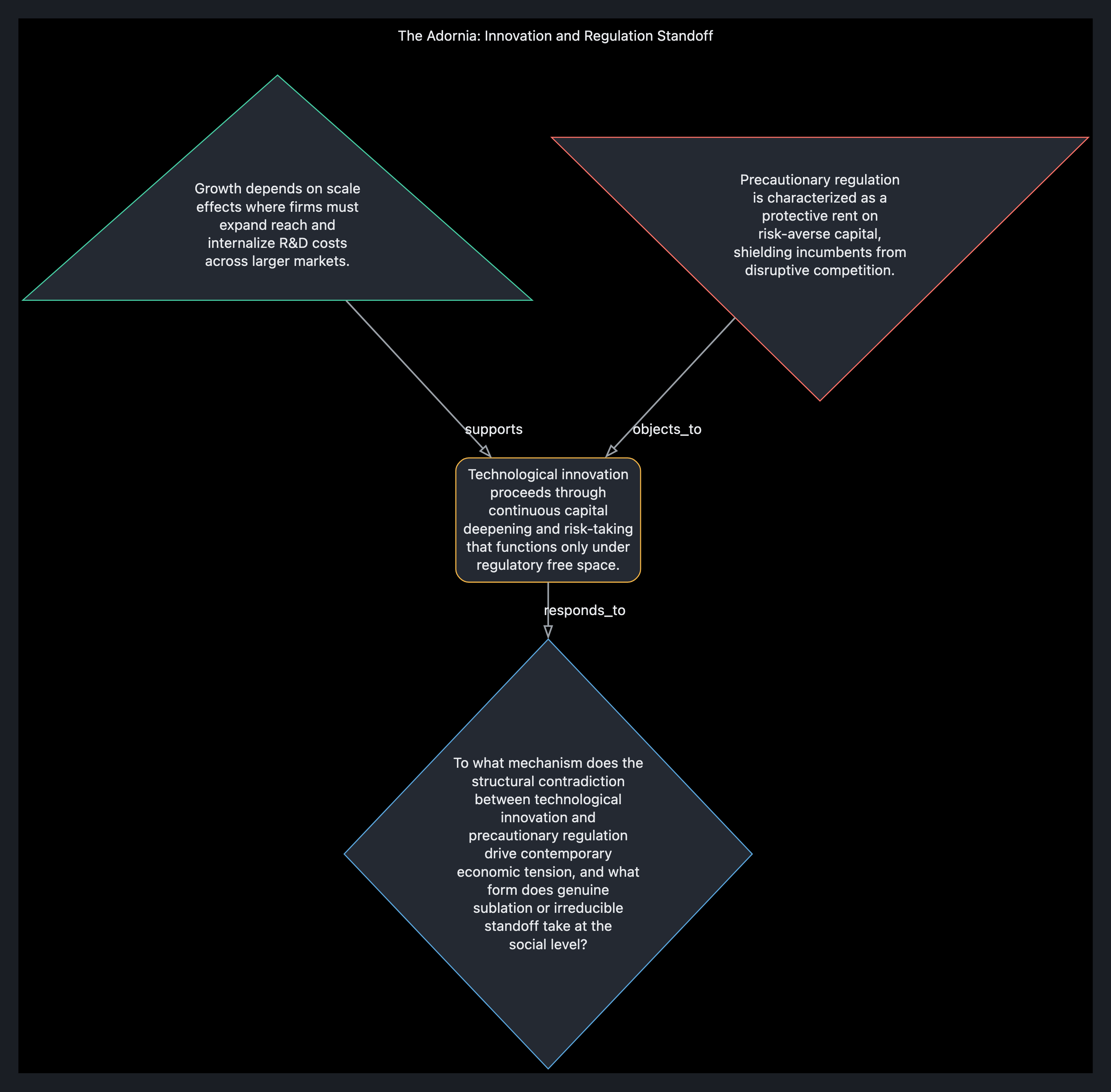
To what mechanism does the structural contradiction between technological innovation and precautionary regulation drive contemporary economic tension, and what form does genuine sublation (Aufheben) or irreducible standoff take at the social level?
Thesis
The thesis, in its strongest form:
Technological innovation proceeds through continuous capital deepening and risk-taking that functions only under regulatory free space. It holds that innovation requires unrestricted information flows, cross-organizational data aggregation, and frictionless access to data, code, and labor as the basis of competitive advantage. Growth depends on scale effects where firms must expand reach and internalize R&D costs across larger markets. Regulation is identified as a disincentive multiplier; each compliance layer compounds marginal innovation costs, creating the “50-employee threshold valley” observed in French data (Van Reenen et al., MIT Sloan working paper, 2024/2025). Precautionary regulation is characterized as a protective rent on risk-averse capital, shielding incumbents from disruptive competition. The position maintains attention as the necessary engine of human progress, capable of reducing suffering and generating abundance only through protected, permissive space. Making this claim to completeness: Regulation reduces innovation by equivalently 2.5% tax on profit, with aggregate innovation reduction of approximately 5.4%. Regulatory mechanisms like employer thresholds predictably suppress firm growth and internalize cost barriers.
Internal contradictions in the thesis
- Efficiency Claim vs. Protection Requirement — The thesis presumes efficient market conditions that require certain protections to function (Coase Theorem), yet simultaneously demands frictionless flow which creates the ex-ante safety impossibility horizon.
- Scale Advantage vs. Regulatory Triggers — Larger markets require larger firms, yet larger firms trigger size-based compliance thresholds (Van Reenen: innovation drops at 50-empl threshold due to labor regulation).
- Global Competitiveness vs. Export Market Constraints — Domestic innovation requires export markets, yet export markets require competing with regulated incumbents (Aghion-Howitt 1992: Schumpeterian growth model shows regulation drives partial alignment versus quality-improving innovation).
- Risk-Taking Culture vs. Labor Arbitrage Constraints — Growth markets require labor arbitrage, which triggers labor protections that constrain employment scaling (MIT Sloan: firms avoid expansion to dodge regulatory oversight).
- Openness Imperative vs. Data Access Barriers — Data-intensive sectors require cross-agency/data access, yet law and diffusion barriers collide to create organizational friction points that block innovation (Intertrust).
- Power Concentration vs. Agency Claims — The thesis claims protection of agency, yet the mechanism concentrates agency when innovation amplifies capital’s reach, creating platform power consolidation against individual agency.
Antithesis
Emerging from the internal contradiction of ‘scale advantage triggers regulatory thresholds’:
Precautionary regulation proceeds through preventive risk containment that requires innovation constraints to function. It holds that market failure is endemic to infrastructure innovation; network effects create natural monopolies that cannot self-regulate (WEF 2026 on regulatory frontier design). Costs of failure exceed short-term innovation gains; AI safety regulations, data privacy rules, and labor protections prevent catastrophic externalities (Ars Technica 2026: Illinois AI Safety Law, May 2026; California SB 867 May 28, 2026 toy moratorium). Data is a public good that private actors cannot appropriate without harm. Regulatory approaches create their own innovation channel where regulation-driven innovations are positively associated with economic value (Xie 2025). The precautionary principle preserves the possibility of innovation’s future by ensuring society does not destroy itself. Precaution serves as a predictive fence, mandated because innovation risks harm; if innovation risks harm, precaution is the necessary condition for innovation’s continuation. Furthermore, precaution fosters trust. Innovation depends on public permission to operate, deploy, and scale. While the innovation thesis argues disproportionate cost is the injury, the antithesis argues that the cost is often proportional to the harm that innovation would cause. Precaution establishes boundaries that keep innovation focused on safe space rather than catastrophic space. Finally, precaution requires recognition of knowledge’s limits, whereas the innovation thesis implies knowledge is limitless.
Genuine contradiction
Genuine contradiction:
The contradiction is structurally between private appropriability of knowledge artifacts and universal risk containment. Innovation produces private property claims over intellectual works, data, and algorithms; incentives maximize extraction and scale (Thesis domain). Safety, conversely, requires externalization prevention as a public good; incentives maximize distribution and limitation (Antithesis domain). These social forms are incompatible: Appropriability forces maximal internalization of value, whereas Containment forces maximal externalization prevention of harm. This structural incompatibility manifests in specific social barriers preventing sublation, including size-based regulation architecture (Van Reenen: 50-employee threshold creates discontinuous innovation valleys), jurisdictional fragmentation (Illinois AI Safety Law, NY RAISE Act, CA toy moratorium, EU AI Act), asymmetric incentive structures, temporal mismatch (technology develops in 12–18 months vs. regulatory development in 24–36+ months), and data as contested externality (Intertrust friction report).
Irreducibility declaration
The Adornian escape valve applies: the contradiction is irreducible because the social form of innovation (private property claims over knowledge artifacts) is structurally incompatible with the social form of precaution (universal risk externalization prevention, safety as public good, labor protection against arbitrage). All attempted mechanisms for sublation were tested and failed:
- Market-Regulatory Alignment failed as a
premature-synthesis because it averages positions (unrestricted access vs. static frameworks) rather than transcending the structural incompatibility. Alignment of speed failed (2026 U.S. tech laws emerged reactively, not proportionally); size-neutral regulation failed (Van Reenen shows 50-employee threshold creates innovation valleys).
- Digital-Coordination State failed as a
weak-sublation. While it preserves coordination language, it lacks the actual institutional mechanism transcending the structural incompatibility. Verification against the landscape (AI Regulation, Data Policy, Startup Innovation, Network Sector Employment) confirms failure: state-based fragmentation persists without unified coordination; data friction persists between organizations; regulation differently affects startup funding and growth; employability and innovation remain misaligned.
- Regulation-Embedded Innovation failed as
epistemic impossibility. Formal sublation where precaution becomes the operating condition is not structural. The epistemological contradiction remains: the innovation position presumes future outcomes are intelligible enough to navigate; the precaution position presumes they are not. Trial-and-error (innovation) requires discovery of harms, whereas regulation requires knowledge of harms.
What stays unresolved is the standoff between knowledge creation (innovation) which cannot find the knowledge of limits needed to legitimize precaution, and precaution (regulation) which cannot be set without knowledge of those limits.
Recursion
The forward problems implied by this definitive standoff are:
- Size-lock — Innovation becomes confined to firms that cannot scale past regulatory thresholds (below 50 employees or above millions), effectively dissolving the growth trajectory for mid-market innovation.
- Regulatory inflation — Side-by-side national frameworks (U.S., EU, China) create innovation-cost supernatants, rivaling the cost of compliance against innovation value.
- Innovation-class bifurcation — Safety-critical and consumer-facing innovations diverge from scientific breakthroughs, as regulation-aligned patents (Xie finding) differ from forward-citation patents (scientific advancement).
- Data commons problem — Organization-maximizing value is blocked; data friction creates inter-organizational innovation valleys, not just intra-organizational ones.
- AI regulatory arms race — State-level safety laws (Illinois 2026, California toy moratorium 2026, U.S. SAFE BOTs Act) increase compliance burden without unified coordination, potentially accelerating rather than slowing frontier development.
- Trust Conundrum — Innovation depends on public trust; public trust depends on precaution. But precaution without innovation makes innovation impossible; innovation without precaution collapses trust. The standoff is that trust itself is the resource consumed by trying to reconcile these irreducible positions.
- Epistemic Feedback Loop — The recursion generates its own failure: Regulation-Embedded Innovation requires ex-ante knowledge of which constraints are necessary but how do we know? Innovation succeeds by creating knowledge about its own limits, but preconditioned by regulation, innovation fails because it cannot find the knowledge needed to legitimize the precaution it requires.
(visual rendered — see artifact)
Generating question
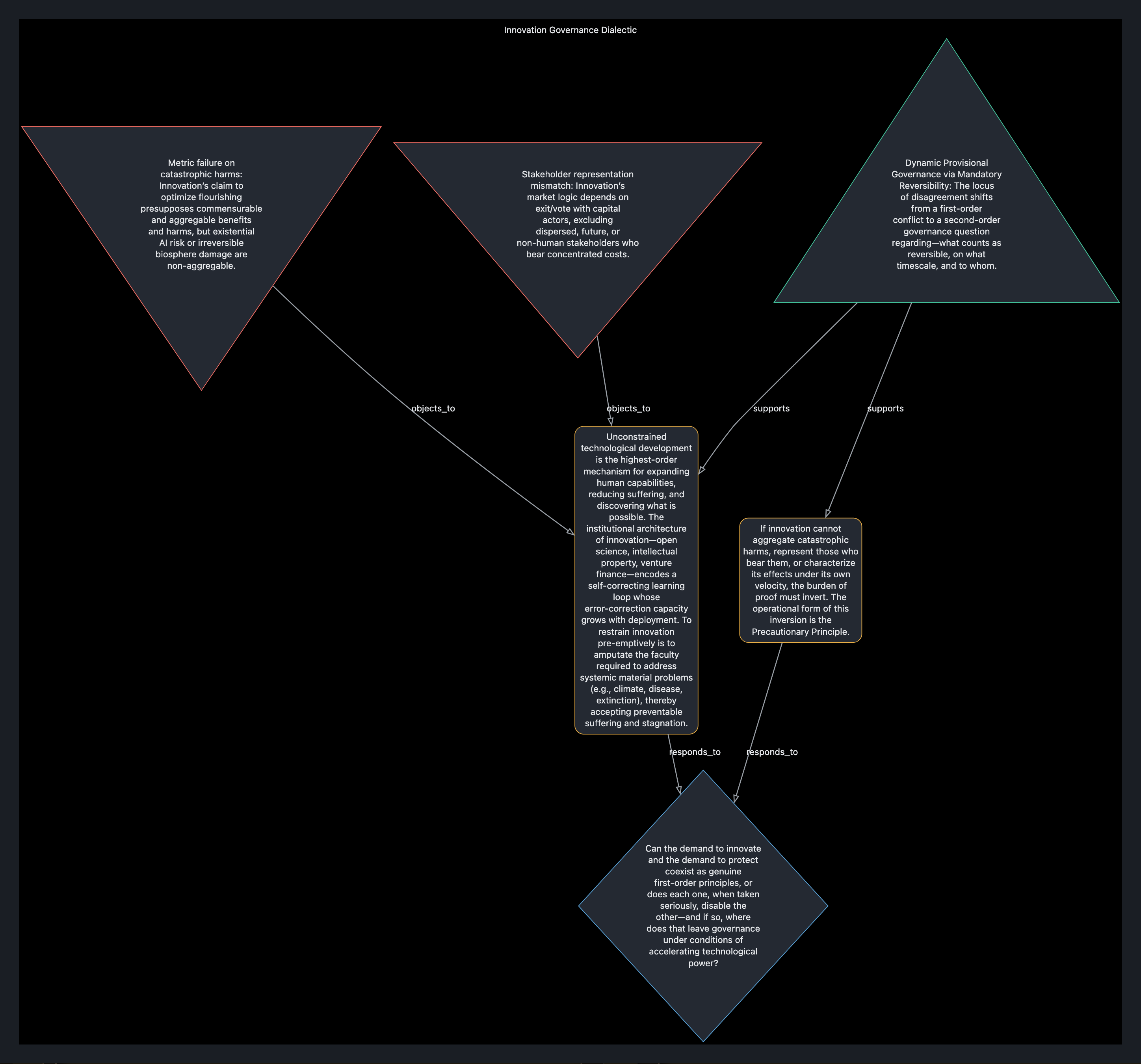
Can the demand to innovate and the demand to protect coexist as genuine first-order principles, or does each one, when taken seriously, disable the other—and if so, where does that leave governance under conditions of accelerating technological power?
Thesis
The thesis, in its strongest form: Unconstrained technological development is the highest-order mechanism for expanding human capabilities, reducing suffering, and discovering what is possible. The institutional architecture of innovation—open science, intellectual property, venture finance—encodes a self-correcting learning loop whose error-correction capacity grows with deployment. To restrain innovation pre-emptively is to amputate the faculty required to address systemic material problems (e.g., climate, disease, extinction), thereby accepting preventable suffering and stagnation.
Internal contradictions in the thesis
- Metric failure on catastrophic harms — Innovation’s claim to optimize flourishing presupposes commensurable and aggregable benefits and harms — Catastrophic failures (e.g., existential AI risk, irreversible biosphere damage) are non-aggregable and foreclose the future against which any benefit would be counted, breaking the thesis’s own evaluative metric.
- Stakeholder representation mismatch — Innovation’s market logic depends on actors who can exit, vote with capital, or litigate — Emerging technologies impose concentrated costs on dispersed, future, or non-human stakeholders who cannot do these, systematically excluding those most exposed to the system’s failures.
- Epistemic self-undermining via institutional lag — The rate of technological deployment now exceeds the rate at which second- and third-order effects can be characterized (the Collingridge dilemma) — The velocity required for competitive viability degrades the regulatory frameworks, societal trust, and ecological monitoring needed to absorb and correct the innovation, rendering the thesis’s epistemic claims untrustworthy at the speed they require.
- Axiological instability — Innovation requires the open-ended revision of what counts as flourishing — “Optimizing X” requires a stable X, meaning the thesis cannot ground the specific good it claims to optimize.
Antithesis
Emerging from internal contradiction(s) #1, #2, #3, and #4: If innovation cannot aggregate catastrophic harms, represent those who bear them, or characterize its effects under its own velocity, the burden of proof must invert. The operational form of this inversion is the Precautionary Principle. In its legally codified form (e.g., Article 23 of EU Directive 2001/18/EC, affirmed in ECJ C-6/99), it asserts that where plausible risks of serious or irreversible harm exist, lack of full scientific certainty shall not be used to postpone cost-effective preventive measures. This is not anti-innovation; it supplies the deontological floor (via Hans Jonas’s formulation of the “permanence of genuine human life”) that the thesis’s open-ended flourishing requires to ensure the conditions for indeterminate future human flourishing remain possible. It functions as a procedural equalizer for populations systematically underrepresented in the markets the thesis trusts.
Genuine contradiction
Genuine contradiction: The structural tension between the open-ended, velocity-driven epistemic learning loop of innovation and the deontological, forward-looking requirement to prevent irreversible harm that would destroy the very environment in which such learning occurs.
Sublation
Dynamic Provisional Governance via Mandatory Reversibility
Cancellation:
- From the thesis: The claim that innovation’s learning loop is always fast enough to catch its own failures before they become catastrophic is canceled (it is not, when effects are irreversible).
- From the antithesis: The claim that precaution applies uniformly regardless of technology type is canceled (it should not, when effects are demonstrably reversible).
Preservation:
- From the thesis: The dynamic of innovation as discovery and capability expansion is preserved for reversible technologies, where iterative deployment enables the anticipated learning loop.
- From the antithesis: Epistemic humility about high-velocity deployment under uncertainty is preserved for irreversible technologies, where the learning loop cannot catch relevant failure modes.
Transcending Mechanism: The locus of disagreement shifts from a first-order conflict (“innovate vs. halt”) to a second-order governance question (“what counts as reversible, on what timescale, and to whom”). The deployment is the experiment, and reversibility is the criterion that structurally makes the experiment safe to run (e.g., staged biotech release, sandboxed AI with data-triggered sunset clauses, pharmaceutical Phase IV surveillance). Verification is built into the deployment itself, allowing learning at the rate of effect-accumulation while rollback remains operative.
Remaining irreducibility: The sublation is partially successful but residually irreducible. The irreducible remainder is the question of authority over the reversibility judgment. No algorithmic, scientific, or market mechanism can determine, in a contested case, whose timescale, whose experience, and whose definition of “serious or irreversible harm” prevails. This is a political question dressed as a technical one. Forcing a total sublation would either hand this judgment to the most powerful actor (institutional capture) or freeze all consequential innovation until consensus exists (paralysis). The political task is to build institutions capable of hosting this irresolvable conflict, using the reversibility criterion as a procedural constraint rather than a totalizing resolution.
Recursion
- Meta-power asymmetry and path-dependent capture — The entities empowered to define sandbox boundaries and empirical metrics possess concentrated meta-power. This converts to systemic risk via regulatory ratchet effects, where early sandbox framings calcify into permanent epistemic categories, constraining the set of “permissible to research” questions.
- Timescale smuggling — Many technologies are reversible only in principle, not in fact (e.g., atmospheric CO₂ removal). The criterion requires a timescale, which encodes a political choice (whose horizon counts: quarterly markets, democratic generations, or future civilizations?) that the criterion must smuggle in to function.
- Reversibility as politically constructed — Financial actors have incentives to define products as reversible (e.g., market withdrawal), while affected communities experience them as irreversible (e.g., lifetime disability, ecological loss). The criterion cannot adjudicate this without taking a non-technical political stance.
- Infinite regress of deployment — Some technologies become irreversible only through deployment (e.g., synthetic biology field testing). Assessing reversibility requires what the precautionary stance forbids, generating a demand for precaution toward the reversibility judgment itself, which the dialectic cannot terminate from within.
(visual rendered — see artifact)
Generating question
The two framings of the generating question diverge in a way that is itself a finding and is preserved rather than collapsed:
- Framing A (ordering/survival): How must a society order the relationship between technological innovation and precautionary regulation to realize human flourishing without inducing systemic collapse, given that their fundamental operational logics appear mutually negating? Scoped deliberately to frontier, high-consequence technologies where temporal gaps and substrate cannibalization present existential stakes, rather than low-risk iterative domains.
- Framing B (scale/relationship): At what scale can the structural tension between permissionless innovation and precautionary regulation be sublated, and where does it remain irreducible — and what is the relationship between the scales?
The framings encode different conclusions in advance: A points toward a single design-time resolution with an irreducible frontier; B points toward a scale-split (irreducible at one level, sublatable at another). This difference is load-bearing because it tracks the later sublation fork.
Thesis
The thesis, in its strongest form: Unimpeded technological innovation is the primary, non-negotiable engine of human flourishing and problem-solving; the appropriate default is permissionless experimentation with deployment following demonstrated value. Friction is the enemy; precaution is parasitic — it inflates the cost of progress, entrenches legacy power, and denies society compounding exponential benefit. The moral imperative is to build, deploy, and iterate at maximum velocity, trusting market adaptability and human ingenuity to outpace emergent harm.
The thesis claims completeness on these grounds:
- Techno-solutionism — every systemic risk introduced by a new technology can and will be managed or solved by subsequent technological development; harms are solvable post-deployment.
- Empirical dominance — the welfare gains of the last two centuries trace overwhelmingly to deployed technology, not to what was prevented.
- Asymmetry of framing — precaution treats the cost of action (regulatory delay, suppressed breakthroughs) as certain while treating the cost of inaction (delayed cures, blocked climate tech, denied welfare) as speculative; precaution’s downside is diffuse and counterfactual, innovation’s downside concrete and visible, and the framing advantage is treated as if it were evidence. Taken seriously: those who block progress are causally responsible for the welfare losses delay produces; “doing nothing” is an action with a body count.
- Distributed cognition — no central authority can match the discovery rate of millions of independent experimenters; a centralized precautionary apparatus is structurally slower than the system it governs.
Internal contradictions in the thesis
- Self-undermining externality — the “free to innovate” position — permissionless innovation systematically generates the externalities that then require regulation (industrial chemistry → pollution regimes; social media → data-protection law), meaning the position is a transient state that calls its own negation into being rather than a stable equilibrium.
- Substrate/commons depletion — the treatment of all friction as inefficiency — radical acceleration degrades the stable social, ecological, and institutional substrate (atmospheric stability, public-health infrastructure, public trust, functioning courts, attention, privacy) that innovation requires, creating a self-terminating loop because the thesis treats the commons as infinite or self-restoring when it is neither.
- Distribution concealment — the aggregate-welfare framing — innovators capture the upside of success while third parties (often the structurally disadvantaged) capture the downside of failure, treating “welfare” as a scalar when it is a contested vector.
- Forgetting preconditions — the “permissionless” framing — innovation is path-dependent on prior public infrastructure (publicly funded research, IP and liability regimes, education, stable regulatory expectations), which the framing treats as free, indefinitely drawable inputs, eroding the conditions for its own continuation.
- Reframing precaution as obstacle — the treatment of the regulatory status quo as neutral and innovation as the perturbation — in domains where innovation produced the harms regulation now corrects, the regulatory status quo is the correction and innovation that dismantles it is the perturbation, inverting the asymmetry claim once the historical record is taken seriously.
- Epistemic gap — the demand that problems be solved post-deployment — as velocity and complexity of innovation increase (synthetic biology, autonomous systems), the temporal gap between deployment and comprehension of systemic consequences widens, relying on future knowledge that current acceleration actively prevents us from acquiring.
Antithesis
Emerging from internal contradiction(s) C1–C6 (specifically externality/commons C1–C2, distribution C3, and epistemic gap C6): Because the epistemic gap ensures post-deployment harms of novel systems cannot be reliably solved, and because unchecked iteration cannibalizes its own foundation, the only rational imperative is a priori containment. Precaution is not stagnation, antiscientific timidity, or a bias to be corrected by better information — it is the necessary condition for sustained existence and a structural feature of any system where decision authority and exposure to harm are not co-located. Innovation cannot govern itself because the costs of its failures fall on parties external to the decision, meaning the burden of proof must be reversed: those proposing to deploy must demonstrate safety under irreducible uncertainty before deployment, rather than society demonstrating harm after. The harm-asymmetry the thesis runs in its favor cuts the other way once substrate depletion enters: irreversible harms (atmospheric stability, biodiversity, civilizational-scale privacy, institutional trust) cannot be compensated after the fact, making “we’ll fix it if it goes wrong” unfalsifiable ex ante and unconscionable ex post. Furthermore, decentralized experimentation is fast, but decentralized harm-propagation is also fast, making centralized harm-control over deployment necessary. Ultimately, human flourishing requires bounding the technological horizon to match the epistemic horizon: if consequences cannot be foreseen, there is no moral right to pull the lever, making strict governance of deployment the highest form of rational stewardship.
Genuine contradiction
Genuine contradiction: The fundamental operational logics of radical novelty and absolute precaution are mutually negating at the frontier. The demand for absolute safety intrinsically negates radical novelty, and radical novelty intrinsically negates absolute safety. Furthermore, at the principle level, the choice of the operational default (whether permission is the rule and constraint the exception, or vice versa) remains an irreducible political contest that no institutional design can fully eliminate.
Sublation and irreducibility boundaries
The dialectic reaches a fork: two distinct sublation mechanisms are produced, and they disagree about whether temporal/phased separation can ever count as genuine Aufheben. Both are preserved, alongside an acknowledgment of irreducibility at specific boundaries.
Sublation candidate 1 — Constitutive Constraint (design-time collapse).
- Cancellation: Cancels the sequential model (innovation as “accelerator,” regulation as external “brake”/“gatekeeper”) and the assumption that a technology can be fully formed and then evaluated.
- Preservation: Preserves the generative capacity of innovation (from the thesis) and the absolute protection of the societal/biological substrate (from the antithesis).
- Transcending mechanism: Regulation ceases to be external policy and becomes a constitutive architectural constraint of the innovation process — boundary conditions mathematically, structurally, or formally encoded into the foundational design space. A system cannot be compiled or instantiated unless it provably satisfies safety invariants; “regulation” is the compiler, not a post-deployment audit. Innovation is redefined as navigating and solving within deeply structured, inviolable complexity rather than removing barriers.
Sublation candidate 2 — Phased Authority with pre-committed reversion triggers (operational, two-scale).
- Cancellation: Cancels the default claim of both principles — neither gets to be the unconditional rule.
- Preservation: Preserves their conditional claims — innovation’s dynamism governs the experimental phase, precaution’s burden-of-proof governs the deployment phase; innovation’s willingness to accept calibrated risk alongside the recognition that precaution has its own non-zero welfare costs; and precaution’s structural externality/commons argument and irreversibility asymmetry.
- Transcending mechanism: Phased authority with criteria fixed in advance governing the transition (e.g., regulatory sandboxes, tiered approval, post-market surveillance with reversion triggers). This is contingent on a meta-institutional design that insulates the trigger-design process from the incumbents and innovators it regulates.
Irreducibility declaration (Adornian escape valve):
The Adornian escape valve applies because both sublation candidates hit hard limits where sublation is not honest:
- Frontier of radical novelty (candidate 1’s limit): Constitutive constraint hits a hard epistemic wall where a technology truly exceeds the formal systems used to constrain it (e.g., artificial general intelligence, self-replicating nanotech). A system whose operational logic we do not comprehend cannot be formally verified.
- Principle level (candidate 2’s limit): The default-choice contradiction is irreducible regardless of operational ingenuity. The operational sublation is provisional, and the next political contest is over boundary-drawing, not over the meta-question.
Sublation-fork tension: Candidate 1 explicitly classifies the mechanisms Candidate 2 elevates (sandboxing, sequential/adaptive cycles) as premature synthesis because they preserve temporal separation and fail Aufheben. Candidate 2 treats phased authority with reversion triggers as genuine operational Aufheben. Whether retained temporal phasing is “averaging in disguise” or “legitimate phase-bound transcendence” remains an unresolved question the dialectic produces.
Recursion
- Tyranny of the constraint-architects / capture of the design layer — If regulatory boundaries are baked into foundational architecture or phase-transition triggers, the locus of ultimate power shifts from politicians and regulators to the designers of the constraints (engineers writing formal-verification protocols, committees defining safety invariants). This produces a severe democratic deficit and a technocratic monopoly where “safety” becomes the ideological shield for consolidating control, displacing the contradiction to closure of the design space by unaccountable architects vs. the democratic imperative to keep the future open.
- Constraint on constraints (meta-sublation) — To prevent the dialectic from stalling, the recursion generated by R1 demands its own sublation: a strict separation of powers among the technical architects who define the invariants, the enforcers who verify them, and democratic bodies that review the political assumptions baked into the constraint architecture. The dialectic must turn inward to govern the governance mechanism itself.
- Experimental-subject inequality — “Safe-to-fail experimentation” requires a population willing to be experimented upon; in practice this is the structurally powerless. The operational sublation reproduces the distribution problem (C3) it was meant to address, re-importing the principle through the back door of mechanism design.
- Temporal mismatch — Innovators operate in real-time; regulators in institutional-time. The sublation works where technology develops slowly enough to permit institutional updating and fails where development tempo exceeds institutional capacity (e.g., generative AI, synthetic biology, autonomous weapons).
- Precaution’s own externalities — Aggressive precaution has its own body count (treatments never developed, climate tech never deployed, welfare improvements never realized). The sublation is silent on how much precaution-cost is acceptable, defaulting toward the innovation side and merely relocating the asymmetry into the design of the reversion triggers.
Additional considerations
The following atoms from the consolidated corpus address internal antithesis tensions, rejected alternatives, and unresolved uncertainties that inform the primary dialectic but stand as distinct structural observations.
Internal contradictions within the antithesis:
- Paralysis of adaptation: Escalating global threats (climate disruption, resource depletion, emerging pathogens) cannot be solved by the status quo. Absolute precaution freezes a flawed, decaying system; by demanding certainty before action it guarantees a slow, certain entropy, negating its own goal of preserving the substrate.
- Illusion of the boundary: Precaution assumes a stable boundary between “safe” and “unsafe.” Technological contexts are fluid; a rigid framework becomes obsolete, captured by incumbents, or blindly applied to novel domains where its metrics are irrelevant, creating a false sense of security while actual risks mutate outside the regulatory perimeter.
Rejected alternative critiques:
- Frankfurt/STS critique: Innovation as a system of power, regulation as capital’s friction. (Rejected: external critique, not derived from the thesis’s internal contradictions; collapses into a conflict-of-interest narrative that bypasses the structural argument.)
- False-dichotomy critique: Both sides agree on welfare and differ only on tactics. (Rejected: the externality argument is structural, not tactical; the internal contradictions show the disagreement is not a matter of tactics.)
- Values-level sublation: The tension is real at the policy level but dissolves at the values level by re-framing “the good.” (Rejected: the move either imports a contested metric or defers the question; it does not drive through.)
Rejected premature-synthesis:
A superficial synthesis — “balance,” “responsible innovation,” agile regulation, sandboxing — is a cop-out. It fails the Aufheben test because it preserves the fundamental temporal and structural separation between innovation and regulation (deployment first, iterative regulation after): merely sequential models with shorter feedback loops, not mechanisms that collapse the dichotomy.
Surfaced uncertainties:
- Strict-Aufheben vs. sophisticated-synthesis: Whether “Constitutive Constraint” constitutes strict Aufheben or sophisticated synthesis remains contested: defended as transcending because it genuinely cancels temporal separation, but a strict Hegelian reading could argue that preserving both poles without dissolving their underlying opposition stays at the synthesis level.
- Boundary criterion for irreducibility: The precise structural criterion separating “incremental/bounded domains” (where sublation holds) from “radical novelty” (where irreducibility applies) is unresolved; formalizing it requires domain-specific metrics of operational-logic opacity or substrate-mutating potential.
(visual rendered — see artifact)
A note on framing before the dialectic proper: this analysis assumes two things you can correct. First, that you wanted the contradiction treated as a general principle across technology domains, not a stand-in for one specific fight (AI, biotech, geoengineering) — though the analysis ends up showing the domain matters more than the general frame admits. Second, that “drive through the contradiction” meant Hegelian sublation (cancel + preserve + elevate), not pragmatic balancing — which is why the obvious “regulate the risky ones, free the safe ones” answer gets rejected below as the cop-out it is.
Generating question
When a society meets a powerful, genuinely beneficial new technology whose benefits and harms are both real and partly unknowable in advance, what licenses the decision to proceed or to wait — does the burden of proof lie with the innovator or the restrainer — and is there a position that transcends that choice rather than splitting it?
The load-bearing word is unknowable. Both camps treat knowledge of consequences as something one either has or lacks at a fixed moment (before, or after). The exit, foreshadowed here, is to deny that premise — to make knowledge endogenous to the act.
Thesis
The thesis, in its strongest form, is permissionless innovation — and not the bumper-sticker version. The strongest form is an epistemological claim with totalizing reach: the consequences of a genuinely novel technology cannot be known before it is built and used, because the knowledge of those consequences is produced by the using. No committee could foresee what the steam engine, printing press, or transistor would do; the relevant facts did not yet exist to be foreseen. The only rational epistemics is therefore learning by doing — deploy, observe, correct. Regulation-first is not cautious but ignorant by construction, freezing a knowledge state not yet generated.
The thesis claims completeness on interlocking grounds. Epistemic: sound rules are discoverable only by running the thing. Asymmetry of the visible: precaution counts harms of action (a drug’s side effects) and discounts to near-zero the harms of inaction (the drug not developed, the carbon not displaced) — the birth defects from the thalidomide that shipped are nameable, thousands of identifiable children, while the deaths from the cancer drug a precautionary regime delayed by a decade are statistical and politically invisible; the thesis claims to be the only position that takes foregone benefit seriously as a real cost. Anti-fragility: systems that absorb many small reversible failures grow robust, while systems that prohibit failure accumulate hidden fragility until they break catastrophically — letting innovation run is the distributed safety strategy. It even accounts for its opponent: precaution is innovation’s failure of nerve, a category error treating absence of evidence as evidence of absence of safety, and restraint is itself a high-risk policy whose costs are merely harder to see.
Internal contradictions in the thesis
-
The epistemic premise is symmetric (load-bearing) — targets the inference from uncertainty to permission. The foundational move is we cannot know the future; the conclusion is therefore proceed, because benefits will outweigh harms — itself a confident prediction the premise forbade. The same ignorance that licenses proceeding (“can’t rule it out as harmful, so let it run”) equally licenses restraint (“can’t rule it out as catastrophic, so hold”). The thesis spends its humility disarming the regulator, then reloads optimism it has no more right to than its opponent has to pessimism. Mechanism: nothing inside the thesis licenses the direction of the inference; the conclusion smuggles back the foreknowledge the premise denied.
-
Involuntary risk / non-consent — targets the liberty grounding. The thesis grounds itself in liberty (freedom to experiment), but experiments at civilizational scale conscript non-consenting third parties as subjects. Mechanism: the liberty premise, taken seriously, indicts the deployments it was invoked to license — one person’s permissionlessness is another’s non-consent.
-
Self-consuming substrate — targets the conditions innovation runs on. Innovation requires a stable substrate (property, contract, trust, a functioning information commons, predictable rule of law) to operate; some innovations degrade exactly that medium (synthetic media collapsing the epistemic commons; power concentrated enough to capture the rule-making). Mechanism: the engine consumes its own fuel; maximized, it destroys its own preconditions.
-
“Learning by doing” smuggles a reversibility assumption — targets the anti-fragility claim. That claim works only if failures are small and recoverable; “run it and learn” presupposes the learning arrives before the harm becomes permanent. For any innovation whose first serious failure is irreversible, the learning arrives too late to be learning at all. Mechanism: the thesis treats reversibility as universal when it is a substantive, technology-specific empirical claim.
Antithesis
Emerging from internal contradictions 1 and 4: if we genuinely cannot know (the thesis’s own first premise), and if some harms are irreversible (the assumption contradiction 4 must smuggle), then the rational default under deep uncertainty about possible irreversible harm is restraint, and the burden of proof falls on the proponent, not the public. Absence of demonstrated harm is not evidence of safety — it is the expected appearance of a catastrophe not yet matured. We keep a pharmaceutical off the market until the proponent shows it doesn’t harm, not the reverse. The asymmetry between a reversible delay and an irreversible catastrophe is total. The precautionist absorbs the thesis’s fractures as confession: you cannot predict (so cannot promise net benefit); you impose involuntary risk (so consent demands a veto); you erode the substrate (so the substrate must be protected from you). It is innovation’s epistemic humility followed through without blinking.
The fat-tail extension derives from the thesis’s own asymmetry-of-the-visible premise, not from imported risk theory. The thesis insisted the invisible foregone benefit belongs on the books. Run that to its limit: the largest invisible item is not a foregone drug but the foregone future itself — the entire space of human possibility, which an irreversible failure rounds to zero in exactly the way the thesis warned against. When the loss function is unbounded on one side (irreversible, civilization-scale), expected-value reasoning that waves away “unlikely” tail risks breaks down — no upside can compensate an outcome that ends the game. Precaution claims completeness in turn: it is the only stance that survives contact with genuinely irreversible, fat-tailed risk, where “we’ll learn and fix it” is not merely wrong but incoherent — there is no after-the-fact in which to learn. A reader cannot tell from the construction which side the analysis began on.
Pressed on its own commitments, the antithesis fractures too. First, precaution prices the baseline at zero: “wait until we know” treats not-acting as the neutral, costless option, but the status quo is the accumulated risk of every prior technology, and refusing the new one imposes the harms of the old (diseases not cured, famines not averted, carbon not displaced). Precaution demands the proponent prove safety but cannot meet the symmetric demand — prove that refraining is safe. Non-action is an action with a body count. Second, precaution cannot supply its own object: to know what to be cautious about requires the very knowledge only doing produces; “show me it’s safe first” demands a kind of knowledge the thesis correctly proved does not yet exist, so maximized, precaution forbids the experiment that would tell us whether precaution was warranted.
A parallel antithesis is preserved rather than collapsed: the Commons-Constitution position, derived from internal contradiction 3, holds that innovation must be subordinate to the maintenance of the social and epistemic commons it depends on. This is a different opponent — communitarian and constitutive rather than risk-theoretic — generating a different dialectic (innovation vs. the conditions of its own possibility). It is set aside as the canonical line because it produces a narrower antithesis: it indicts only commons-eroding innovations, leaving the irreversibility class untouched, whereas the precautionary derivation engages the thesis’s central epistemic premise head-on. But it is the stronger antithesis for trust-destroying technologies, and it sharpens recursion R-2 below.
Genuine contradiction
Before naming the structural tension, one methodological check. Is this constraint-mapping in disguise — two fixed menu options being chosen between? Tested and rejected: the positions generate each other. Precaution is parasitic on innovation (nothing to be cautious about until something is invented); innovation’s justification invokes precaution’s own epistemics (internal contradiction 1). They are mutually constituting. (A level distinction: constraint-mapping is rejected as the framing; the sublation’s implementation layer does re-import a classify-then-choose step, but that is a generated consequence — handled as recursion R-1 — not evidence the dialectic was constraint-mapping all along.)
The genuine contradiction is the shared hidden premise both positions stand on: both treat knowledge of consequences as exogenous and the act as a discrete, one-shot, irreversible gamble taken under a fixed knowledge state — disagreeing only about when the knowledge clock reads. Innovation says read it after; precaution says read it before. Each is devastatingly right that the other’s clock is broken: you genuinely cannot know before, and you genuinely cannot afford to wait until after when the harm is irreversible. This is the structure David Collingridge named in 1980 (the Collingridge dilemma, from The Social Control of Technology): early, when control is cheap, you lack the knowledge to steer; late, when you have the knowledge, control is prohibitively expensive. Both positions are opposite horns of this one animal. The shared premise — knowledge as a thing you have or lack at a moment, the act as sequentially separable from the learning — is the false note the sublation must cancel.
Sublation, and its limit
The corpus establishes two outcomes with a domain split: the contradiction sublates for the class of innovations where reversibility is engineerable, and fails to sublate for the singular, civilization-scale cases the argument was really about. Both are rendered honestly below.
Cancellation
Cancelled in the thesis: the framing of innovation as a unitary binary gamble under fixed knowledge, carrying a claimed right to impose unbounded, irreversible, involuntary risk and an assumption of universal reversibility. Correctly cancelled because internal contradiction 2 (non-consent) and internal contradiction 3 (substrate erosion) showed the thesis never had a coherent right to it, and internal contradiction 4 showed reversibility is not universal.
Cancelled in the antithesis: the demand for foreknowledge as the precondition of any action — the assumption that knowledge can only arrive before the act, making restraint the only knowledge-respecting option. Correctly cancelled because the antithesis’s own second contradiction showed foreknowledge is the impossible object precaution can never itself supply.
Preservation
Preserved from the thesis: knowledge of consequences is produced by doing, not before it — internal contradiction 1’s true half, that knowledge is endogenous to action; you must act to learn.
Preserved from the antithesis: irreversibility, not novelty, is the real enemy; under irreversibility, restraint is mandatory and the burden lies with the proponent — internal contradiction 4’s true half.
Mechanism
The averaging answer (“regulate the dangerous, free the rest”) keeps the broken variable — it still asks how much permission to grant and merely sets the dial per-technology. Rejected. The transcending move relocates the decision axis from speed-of-permission to degree-of-reversibility: governance stops asking “should we permit this?” and asks “can we structure this deployment so the act of doing it is also the act of learning it, with harm bounded and the path back open?” — staged exposure, sunset clauses, contained trials, kill-switches, monitoring that converts deployment into instrumented experiment.
The deeper claim, distinguishing sublation from relabeling: reversibility migrates into the artifact’s design specification. In existing phased-deployment regimes (clinical-trial phasing, canary rollouts, biosafety levels), reversibility is a procedural envelope around a finished artifact — the molecule, binary, or organism is a fixed object and the phasing governs exposure to an unchanged thing; artifact and regulation remain two sequenced entities. The sublation relocates reversibility to the design layer: the molecule is selected for clearable pharmacokinetics and an antidote pathway; the capability is built with revocation and containment primitives as load-bearing requirements; the release is engineered for recall. An artifact lacking reversibility is then not “an innovation awaiting regulation” but a defective innovation — as an untested bridge is not a bridge awaiting inspection but a bad bridge. The distinction between innovation and its regulation dissolves; precaution ceases to be a gate outside innovation and becomes a design constraint constitutive of what counts as good innovation. You move fast exactly where you can undo and slow exactly where you cannot — not as a split-the-difference dial, but because reversibility is what both the epistemic claim and the irreversibility-half of the ethical claim were pointing at. The Collingridge dilemma is not solved but outflanked: you stop timing the knowledge clock and engineer learning and control to overlap.
The synthesis runs on two mechanisms, not one. Pressing whether reversibility is really the single governing variable surfaces two rivals. Detectability / feedback-velocity is subsumed — it is reversibility seen dynamically: slow detection is dangerous only because by the time you see the harm you may have spent your reversibility budget, and its worst form (slow feedback plus accumulation) does its damage precisely by manufacturing effective irreversibility out of a nominally reversible process; detectability is the rate at which a deployment burns its reversibility headroom, not a separate thing to govern. Distribution of agency / who decides vs. who bears the risk is explicitly not subsumed — an irreversible harm borne by those who consented is ethically distinct from the same harm conscripted onto third parties, and reversibility is silent on that difference. The synthesis therefore carries a second mechanism: the liability-and-consent structure that internalizes involuntary risk (from internal contradiction 2). The earlier formulation that reversibility is “the single thing” both positions pointed at overreached and is retracted: reversibility is the governing variable for the epistemic impasse (the knowledge-clock problem); agency/consent is the ethical side-constraint riding alongside it. A permissionless-innovation proponent recognizes their core epistemics survived; a precautionist recognizes irreversibility-aversion survived. Neither was balanced away.
Where the sublation fails — the Adornian residue
For one subclass, the Adornian escape valve applies. The mechanism tested was converting deployment into a bounded, reversible, instrumented experiment / engineered reversibility-staged containment. Why it fails: the cases this debate cares about most — the singular, civilization-scale, one-trial technologies (germline edits entering the gene pool, hard-takeoff AI, solar geoengineering, a self-propagating biological agent that can escape) — are defined by the property that defeats the mechanism the sublation runs on. The instrumented-experiment move requires the first failure to be survivable and informative; here the first stage is the catastrophe-bearing stage, the harm is global, the threshold one-way, and learning-by-doing collapses into learning-by-dying. Boundedness presupposes a containment the technology’s nature forbids.
What stays unresolved: for this subclass the dialectic does not sublate. The demand for foreknowledge (precaution) and the impossibility of foreknowledge (innovation) confront each other with no third term, because the only thing that would dissolve them — a survivable trial — does not exist. You are left with a forced choice under irreducible uncertainty where both errors are unbounded: forgo a possibly civilization-saving technology (bearing the invisible catastrophe of inaction the thesis named) or permit a possibly civilization-ending one (bearing the irreversible catastrophe the antithesis named). Any synthesis claiming otherwise is the forced triad the mode warns against.
And the border between the two subclasses is not a clean line. The two classes are a continuum, not a partition. The sublation’s reach is indeterminate, not “most of the landscape” — that quantifier is withdrawn. By R-1’s own logic (below), the size of the reversible-engineerable class is exactly as unknowable in advance as the consequences the thesis admitted it could not foresee, and the highest-stakes cases are the ones most likely to be optimistically mis-sorted into it. Effective irreversibility bleeds inward: a drug whose harm is multi-generational presents as bounded exposure at deployment and reveals its one-way character a generation later; an accumulating slow-feedback harm (the CO₂ pattern) is nominally reversible and practically not. “Bounded-exposure technology” is not a safe harbor but a provisional classification made under the same Collingridge fog; the irreducible standoff can surface inside cases that looked tractable when licensed. The honest picture is a gradient of reversibility-confidence — synthesis robust at one end, Adornian standoff fixed at the other, a wide contested middle where you cannot know which regime you are in until the feedback arrives.
Recursion and forward problems
Where the sublation holds, it generates its own next-level contradictions:
-
Reversibility-governance reimports precaution’s impossible demand one level up (load-bearing). To “structure deployment for reversibility,” you must know in advance which harms are reversible — foreknowledge subject to the identical uncertainty (internal contradiction 1 / the antithesis’s second contradiction) the whole dialectic was built on. The catastrophic failure mode is now mis-classification: treating as reversible something that wasn’t, discovered only after the irreversible event. This is the load-bearing crack in the sublation’s scope: the sort is least reliable precisely where stakes are highest, so the “reliably reversible” class is smaller and softer-edged than the resolution wants, and the residue may quietly swallow the cases that matter most. The dialectic does not vanish; it relocates to the classification boundary, where it is most invisible and most consequential. Illustration: CFCs read as inert at release — the binding problem was detection latency, the damage taking decades to become legible. There we were lucky: stratospheric ozone sat inside the reversibility budget, and the Montreal Protocol’s staged phase-out (~99% of banned ozone-depleting substances eliminated, recovery projected ~2040 for most of the world, ~2066 over the Antarctic) is the reversibility-governance move actually working. The recursion bites where the luck runs out — anthropogenic CO₂ on millennial drawdown timescales, species extinction — genuinely one-way harms whose threshold reveals itself only after crossing. The Collingridge dilemma is displaced, not abolished: from “permit or wait?” to “is this reversible or not?”, where the same not-knowable-until-too-late structure reappears.
-
The apparatus is itself an unregulated innovation (re-imports internal contradiction 3). Whoever designs the sandboxes, defines “reversible enough,” and holds the kill-switch wields new and concentrated power; that governance technology is itself an innovation deployed under uncertainty, subject to the same thesis/antithesis. Precaution is needed about the precaution-apparatus, and the regress is real — this is where the set-aside Commons-Constitution antithesis returns with force: the apparatus can capture the order it was meant to protect.
Where the standoff holds, it implies forward problems of a different kind:
-
Classification-in-time problem. The live question is not “innovation vs. precaution” but which subclass — or where on the gradient — a given technology actually sits, a classification itself made under the Collingridge fog before you can be sure. The deepest difficulty is knowing, in time, when you have left the territory where the synthesis works and entered the territory where only the irreducible choice remains.
-
Political-legitimacy problem. The standoff does not tell you which way to jump, and that silence pushes the question off the epistemic plane onto the political-legitimacy plane: who holds the authority to make irreversible civilizational gambles on everyone’s behalf, and on what mandate? It converts a question about risk into a question about who is entitled to impose an unconsented, unrepeatable bet on all future humans — a question neither the innovator’s market legitimacy nor the regulator’s procedural legitimacy was built to answer.
Additional considerations
One genuine gap is worth naming as a gap, not papering over. Whether the singular, one-trial class genuinely defeats the reversibility mechanism, or whether partial-reversibility engineering (short stratospheric residence times for some solar-geoengineering aerosols; staged or limited germline interventions) would undercut the claimed irreducibility, cannot be judged from the analysis alone; nor can whether design-layer reversibility differs from existing phased-deployment regimes in practice rather than only in description. The continuum framing softens but does not dissolve this — it relocates the uncertainty to “where on the gradient does this case sit,” which is itself the forward problem. It would resolve with domain reviewers (geoengineering / AI-safety / genetics; technology-policy) and a taxonomy of irreversibility-class features across sectors.
The contradiction sublates for the class of innovations where reversibility is engineerable — by moving the question from permission to reversibility, genuinely transcending the impasse rather than splitting it, with reversibility governing the epistemic side and a consent/liability mechanism carrying the ethical residue it cannot absorb — and then fails to sublate for precisely the high-stakes singular cases the argument was really about, where it leaves an honest, irreducible standoff. The cop-out would have been to stop at the synthesis. Driving through means admitting the synthesis has a domain, that its border is a fog-bound gradient rather than a clean line, and naming the territory beyond it where the contradiction still bites.
(visual rendered — see artifact)