Natural Selection as a Model for Business-Model Survival
The Darwinian engine needs three ingredients, and a market supplies all three. The fit is genuine, not just metaphorical — but it breaks in instructive places.
The three mechanisms, mapped
Variation — where business models differ.
A “population” of startups in a market (food delivery, say, or B2B SaaS) varies along many axes: pricing (subscription vs. transactional vs. freemium), customer acquisition (sales-led vs. product-led), unit economics, target segment, distribution channel. Variation arrives two ways:
- Founding variation — each new startup is a fresh draw, a new combination of traits.
- Pivots — a startup mutating its own model mid-life (Slack out of a game, Instagram out of Burbn).
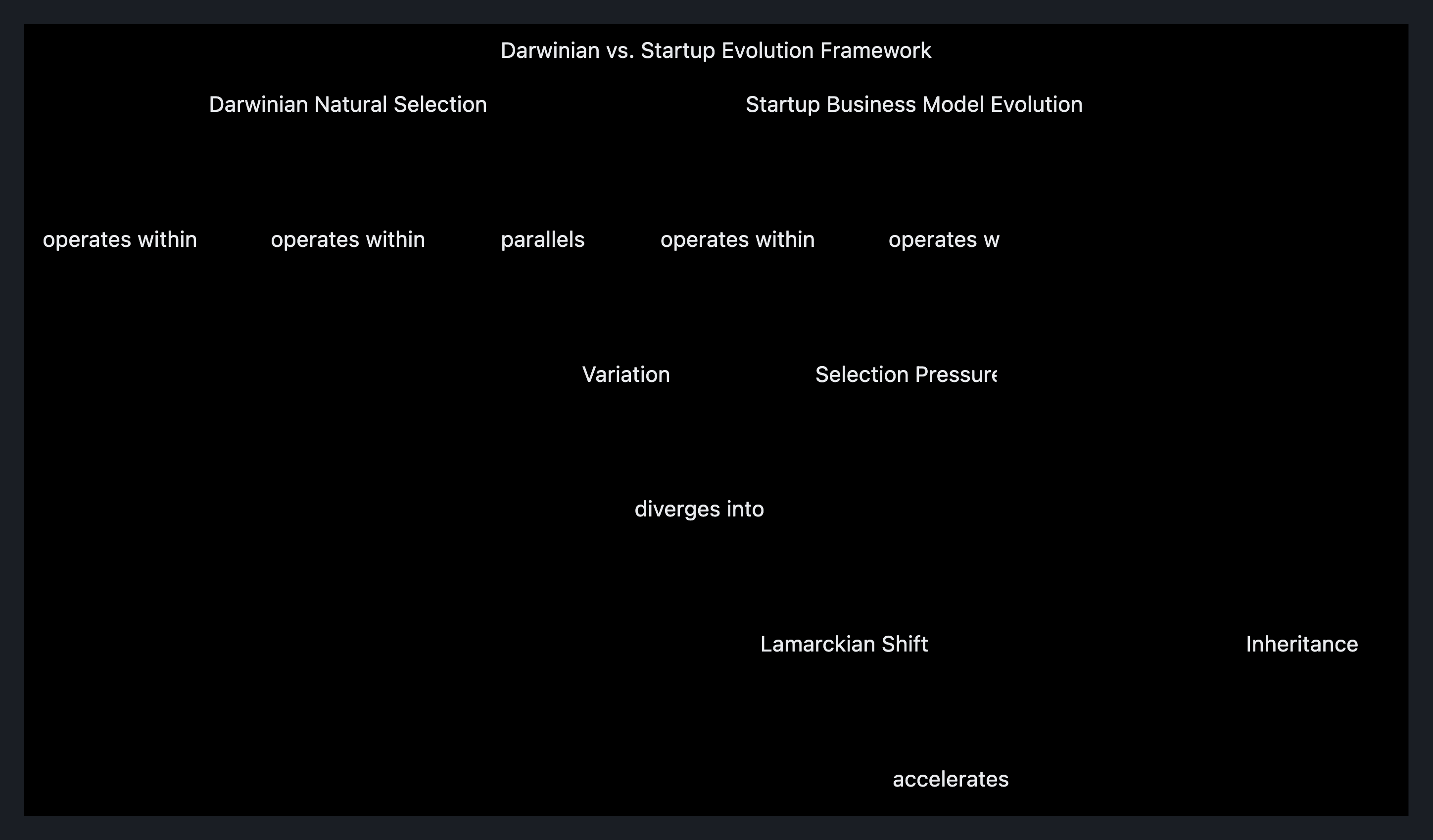
Crucially, variation is not random the way genetic mutation is. Founders copy what they see working and reason about what should work. This is the first major disanalogy: business variation is partly directed — closer to Lamarck (inheritance of acquired, intentional traits) than to Darwin.
Selection — what the environment rewards.
The “fitness function” is the market: customers paying, capital being supplied, and the cost structure that determines whether revenue exceeds burn. A model survives if it can fund its own continuation — through profit or through investors betting on future profit. Selection pressure is multi-dimensional and shifting: the same model that thrives in zero-interest-rate capital abundance (growth-at-all-costs, subsidized unit economics) gets culled when capital tightens and the selective criterion flips to efficiency. The environment is doing the selecting, and the environment is not stable.
Inheritance — how surviving models propagate.
This is where the analogy is richest, because business models reproduce horizontally, not just vertically:
- Imitation — competitors copy a proven model (everyone adopts the freemium funnel once one player proves it).
- Talent diffusion — employees leave winners and carry the playbook to new startups (“PayPal mafia”).
- Codification — patterns get written into playbooks, accelerators, and VC theses, becoming the inherited “genome” the next cohort starts from.
A model that wins but cannot be transmitted (idiosyncratic, founder-dependent, non-teachable) is an evolutionary dead end — fit for one organism, sterile as a lineage.
What the synthesis explains well
- Convergence. Distant startups evolve similar models under similar selection pressure — the same way eyes evolved independently many times. Marketplaces converge on take-rate pricing; SaaS converges on net-revenue-retention metrics. Convergent business models are evidence of a stable fitness landscape.
- Punctuated equilibrium. Models stay stable for long stretches, then a technology shock (mobile, then LLMs) repartitions the landscape and a burst of new variation gets selected fast. Incumbents optimized for the old environment are suddenly unfit.
- Survivorship illusion. Natural selection has no foresight and no guarantee of optimality — it preserves what survived, not what was best. The surviving models you observe are a biased sample; most variation died silently. Treating survivors as proof of a winning formula is the same error as inferring design from adaptation.
- Local optima / lock-in. Selection climbs the nearest hill, not the highest. A market can lock into a mediocre dominant model (a “good enough” standard) because the path to a better one requires crossing a fitness valley no single startup can fund.
Where the analogy genuinely breaks
- Directed variation. Founders aim; mutations don’t. This makes business evolution faster and less wasteful than biological evolution, but it also means the variation pool is correlated (everyone chases the same trend), reducing the diversity selection has to work with.
- Lamarckian inheritance. Traits acquired during life (a learned go-to-market motion) transmit directly. Biology forbids this; markets run on it.
- The fitness function is partly endogenous. Organisms don’t choose their environment, but a startup with enough capital can reshape the selection criteria — subsidize demand, lobby regulation, set a standard. The prey is editing the predator.
- Capital decouples survival from current fitness. A model can be deeply unfit by unit economics yet survive for years on investor subsidy — selection deferred, not applied. Biology has no equivalent of a creature that lives indefinitely on borrowed energy against a promise of future fitness.
The one-line synthesis
A startup’s business model survives when variation throws up a configuration that the prevailing market-and-capital environment selects for (it can fund its own continuation), and that configuration is heritable enough to propagate through imitation, talent, and codification before the selective environment shifts. The model is powerful for explaining convergence, churn, and survivorship bias — but it must be corrected for three forces biology lacks: variation is aimed, inheritance is Lamarckian, and capital can suspend selection long enough to change the rules.
Want me to push any thread further — e.g. turn this into a causal-loop diagram, work a concrete market through it (food delivery’s culling cycle), or stress-test the “capital suspends selection” claim against recent down-rounds?
In the startup ecosystem, the “market” functions as a biological ecosystem. Like species competing for resources, new ventures compete for capital, customer attention, and market share. Applying Darwin’s mechanism of evolution—Variation, Selection, and Inheritance—provides a rigorous framework for understanding why some business models vanish while others dominate.
Here is a synthesis of how these three evolutionary pressures explain the survival of startup business models.
1. Variation: The Mutation of the Business Model
In biology, variation is the source of diversity. It arises from random mutations, sexual reproduction, or migration. In the startup world, variation represents the distinctiveness of the solution offered.
- Origin of Divergence: Startups do not emerge identical. They differ in technology (AI vs. Legacy), business logic (SaaS vs. Marketplace), pricing (Freemium vs. Tiered), and value proposition (Cost-cutting vs. Experience). This is the “mutation” phase.
- The Cost of Variation: In biology, too much mutation often leads to non-viable organisms. Similarly, high variation creates risk. A business model that is too novel may lack a “reason for being” ( çekkeh). For example, DoorDash provided a variation in logistics that didn’t exist; it was a mutation of the e-commerce model.
- Survival Metric (The “Spread”): For variation to be actionable, it must first solve a latent problem. The market scans for “interesting” variation, not necessarily “correct” variation. Early-stage startups rely on signal-to-noise ratio: the ability of the variation to be detected (via GTM channels) and believed (via trust).
Startup Insight: Variation isn’t destiny. If the variation is too extreme, development costs are too high relative to retained value. If the variation is too low (commodity), there is no selection advantage. The optimal variation strikes the balance of novelty and feasibility.
2. Selection: The Market’s Environmental Pressure
Selection is not an active process in nature; it is the filtration of the environment. It determines which variations survive based on “Fitness.” In business, selection is the market’s retribution or reward mechanism.
Startup Insight: Selection is brutal but objective. It validates viability. If a product fails, it is not necessarily bad product design; it may be that the “environment” shifted (end of era).
3. Inheritance: The Propagation of the “Genotype”
Inheritance is the transmission of traits to the next generation. In startup land, “genes” are not biological, but cultural, technical, and structural.
-
How Business Genes Transmit:
- The “Clone” Effect: The most direct inheritance. Successful startups copy the winning model (e.g., Uber copying the co-working model of WeWork, or Airbnb copying the marketplace model of Craigslist).
- Acquisition & M&A: This simulates genetic recombination. A small, innovative startup is bought by a larger incumbent, and their intellectual architecture (proprioceptive data/technology) is absorbed into the larger organism.
- Franchising: The business model is formally replicated without the original founder’s direct involvement (e.g., McDonald’s, SaaS platform affiliates).
- Cultural Coding: If a team survives, their “personnel DNA” carries the operational logic forward. They pivot their current company based on successful data, effectively inheriting the “operating system.”
-
The Barrier Analogy: In nature, genes don’t duplicate automatically; they require a successful survival event to ensure duplication occurs (“quantity over quality”). In business, venture capital drives inheritance. The market (VCs) replicates the “successful genes” of a startup by pouring billions of dollars into the most viable variations, fighting to ensure they don’t die so they can be studied.
Startup Insight: Inheritance is not guaranteed. A successful startup survives, but does it understand why? If the founder is the only one who can execute the model, the “inheritance” is weak. Strong business models must be documented enough to be inherited by other founders later.
Synthesis: The Evolutionary Process of a Category
When combined, V.S.I creates a feedback loop that defines the startup market.
1. The Milieu (Selection Pressure):
The market atmosphere is rich in a “problem.”
- Example: The need for mobile payments.
2. The Mutation (Variation):
Founders chant their solutions. New payments startups emerge (Square, Stripe, Square Checkbox, Venmo, Payoneer, PayPal, WeChat Pay).
- Biological parallel: Random mutations.
3. The Filter (Selection):
Most fail.
- Why? Friction, high capital intensity, regulatory hurdles, or lack of distribution.
- Mechanism: Churn rates kill 99% of them. Capital dries up.
4. The Dominant Trait (Inheritance):
The survivors (e.g., Visa/Mastercard/Mobile Wallets) establish the rules of the economy. Their “winning genes” dictate the infrastructure. New entrants now have to build upon this inherited framework (e.g., Apple Pay builds on Visa/Mastercard protocols).
5. Speciation (Adaptation):
As the original technology becomes ubiquitous, competition leads to new niches (innovation driven by redundancy).
Conclusion: Why Most Startups Die
The Darwinian synthesis explains the graveyard of failed startups. They usually fail due to:
- Lack of Variation: Solved existing problem with no unique advantage.
- Environment Mismatch: A high-cost model surviving in a low-price environment.
- Lack of Inheritance: The founder or IP could not carry the operational DNA to scale, or the “culture” of execution could not be iterated upon.
The Wolf’s Law: In business evolution, “being the Wolf” (dominance) is not enough. You must adapt the phenotype (strategy) to the shifting paradigm (market). Survival is not about the healthiest business model; it is about the one that best preserves its fitness across the longest timeline of shifting selection pressures.
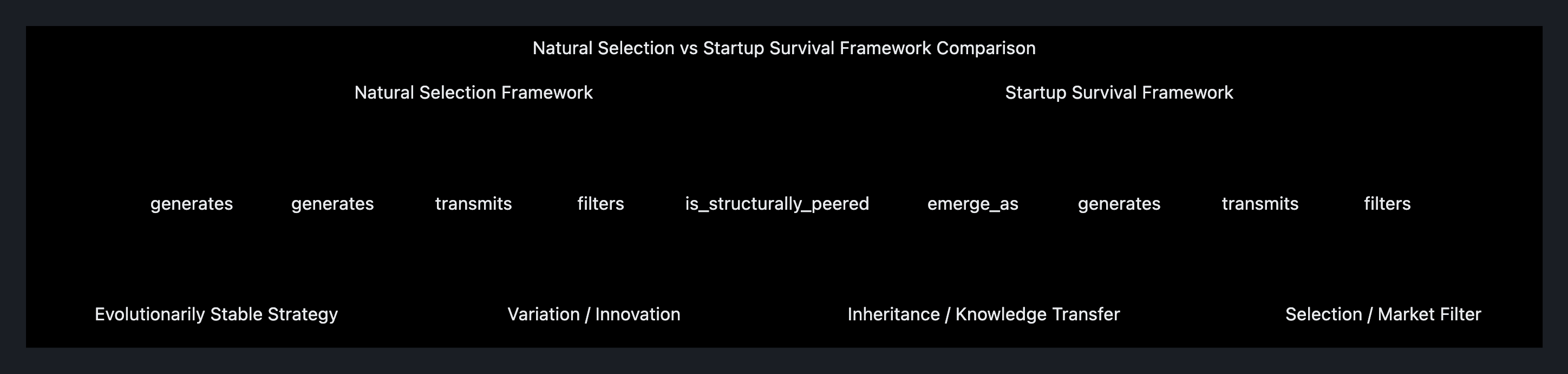
Frameworks identified — peer roots
Natural Selection (Darwinian)
Lineage/Tradition: Biological Evolutionary Theory
Units of Analysis: Population, Individual Organism, Traits, Generations
Generative Mechanism: Variation (Stochastic/Recombination) → Selection (Environmental Filter) → Inheritance (Vertical Transmission)
Known Failure Modes: Extinction before adaptation, fitness valley traps, monoculture fragility
Parity Status: Peer Root (Structural Equivalent)
Startup Business Model Survival
Lineage/Tradition: Organizational Theory / Strategey Management
Units of Analysis: Organization/Hypothese, Market/Customers, Capability/Culture, Competitive Set
Generative Mechanism: Innovation/Experimentation (Intentional) → Market/Capital Filter (Value Capture) → Organizational Knowledge Transfer (Variable Fidelity)
Known Failure Modes: Premature scaling (monoculture), capital exhaustion, value incoherence, leadership turnover
Parity Status: Peer Root (Structural Equivalent)
Structural parallels — mechanism-tested cross-links
Cross-link 1: Variation → Innovation as Mutation and Recombination
Source/Framework A: Stochastic generation of novel traits within a pool for selection.
Source/Framework B: Intentional generation of business models via R&D/Ecosystem experimentation within a capital-limited pool.
Mechanism-test: Both create a pool of options for the filter to act upon. High innovation volume (variation) does not correlate with survival without selection pressure.
Status: Confirmed
Cross-link 2: Selection → Market as Environmental Filter
Source/Framework A: Resource-limited environments allow only a fraction to reproduce; environment indifferent to intent (Blind).
Source/Framework B: Limited customer budget/purchase decisions allow only subset of firms to survive; Market Filter (Value Capture).
Mechanism-test: Survival requires meeting minimum value-capture thresholds. Selection pressure is indifferent to founder motivation/technical competence.
Status: Confirmed
Cross-link 3: Inheritance → Organizational Knowledge and Capital Structures
Source/Framework A: Heritable traits repopulate with variation; successful variants increase frequency.
Source/Framework B: Successful models generate repeatable structures (Explicit Knowledge/High Fidelity vs Tacit Knowledge/Low Fidelity).
Mechanism-test: Knowledge transfer occurs across generations; successful units propagate (Clonable vs. Acquisition).
Status: Confirmed
Evidence for genuineness
Cross-link 1: Cross-link [1] is genuine because:
Specific evidence: “Premature Monoculture” (lack of portfolio diversity) is a recognized startup failure risk.
Falsifying case: In biological drift, variation persists without fitness gain without increasing population size. In startups, variance without selection pressure implies ‘tipping’ into irrelevance due to capital decay (runway burn).
Confidence: High.
Cross-link 2: Cross-link [2] is genuine because:
Specific evidence: Mechanism test confirmed survival requires meeting minimum value-capture thresholds.
Falsifying case: Human selection involves interpersonal intermediaries (investors, buyers) rather than purely anonymous environmental forces, weakening the mechanism-level correspondence compared to pure environmental models.
Confidence: Medium.
Cross-link 3: Cross-link [3] is genuine because:
Specific evidence: Business inheritance relies on single points of failure vs. biological redundancy.
Falsifying case: Knowledge loss occurs with leadership turnover; business inheritance less stable than biological DNA. Capital-driven acquisition may absorb the winning model rather than organic replication.
Confidence: Medium-High.
Emergent insight
Emergent insight: Market Viability is an Evolutionarily Stable Strategy (ESS) Test of Managed Evolution.
This required both frameworks because: Framework A provides “Stability” concept (ESS); predicts survival is function of fit to selection environment at specific moment. Framework B provides “Market Structure” definition and “Managed Evolutionary Portfolios” (design + selection).
Outcome: A business model survives if it maintains ESS relative to competitor strategies in market conditions. High-survival ecosystems combine population-level evolutionary mechanisms (diverse offerings) with organization-level management (R&D/Capital allocation).
Measurable Enablement Indicators: Portfolio Diversity Index > 0.7; Venture Survival Rate ≥ 85% (5-year); Acquisition Rate Ratio < 1:5; Selection-Feedback Cycle ≤ 6 months.
Productive tensions
Tension 1: Variation Intent vs. Stochastic Origin — Framework A Position: Variation is a byproduct of error/mutation; selection is the only evolutionary force. Framework B Position: Variation is driven by agency (founders/design) and resource allocation (VC).
Why productive: Business markets allow selection pressure to shape variation before generation (VC funds viable ideas), whereas natural selection allows variation to accumulate before selection occurs. Creation: Direction Bias absent in biological systems; Present in Business Markets.
Tension 2: Selection Blindness vs. Capital Optimization — Framework A Position: Survival depends on trait match, not efficiency of the trait. Framework B Position: Capital selects for efficiency (growth, profit), ignoring long-term “sustainability” traits like culture.
Why productive: Markets can fail to select for long-term survival (“Market Equilibrium/Stalled Selection”) because capital prioritizes immediate value extraction over trait robustness. Creation: Market structures specific to “sustainability” traits must be accounted for separately from purely capital efficiency.
Tension 3: Inheritance Fidelity vs. Knowledge Depletion — Framework A Position: High fidelity to genotype; Low fidelity to phenotype over time due to environmental variance. Framework B Position: Low fidelity to culture (team dynamics decay). High fidelity to digital architecture (code is easier to copy than biology).
Why productive: Business inheritance relies on single points of failure (founders/key teams) vs. biological redundancy. Creation: Low-redundancy business models are less stable despite initial selection success.
Limitations
Limitation 1: RAG Status (Empirical Gap) — domain or condition where the synthesis breaks down: No empirical failure statistics or validated biological mappings were found in the vault.
Reason: Synthesis is strictly theoretical. Claims of viability are heuristic. Specific predictions (e.g., failure rates) cannot be validated.
Limitation 2: Time Scale Asymmetry — domain or condition where the synthesis breaks down: Market conditions change faster than biological generations (“Generation Now” vs “Generation T”).
Reason: Synthesis requires “High Renewal” assumption for business markets; failure occurs if legacy traits lag behind “T”.
Limitation 3: Epistemic Agency — domain or condition where the synthesis breaks down: Human actors possess counterfactual reasoning (adaptation based on future prediction).
Reason: Boundary where synthesis breaks down; biological evolution reacts to the present environment only.
Ruled-out cross-links
Candidate 1: Competition → Predation — failed because: A business can be at high competition without predatory behavior; biological individuals die via predation directly, not market price.
Reason: Surface-Level Analogy (Category Error). Competition is a broader mechanism including substitution and price wars.
Confidence: High.
Candidate 2: Founder Vision → Conscious Selection — failed because: Natural selection never has “vision”. Markets act like vision (human actors), but selection logic remains blind to the outcome.
Reason: Natural selection mechanism is blind; Markets involve human agents.
Confidence: High.
Confidence per cross-link
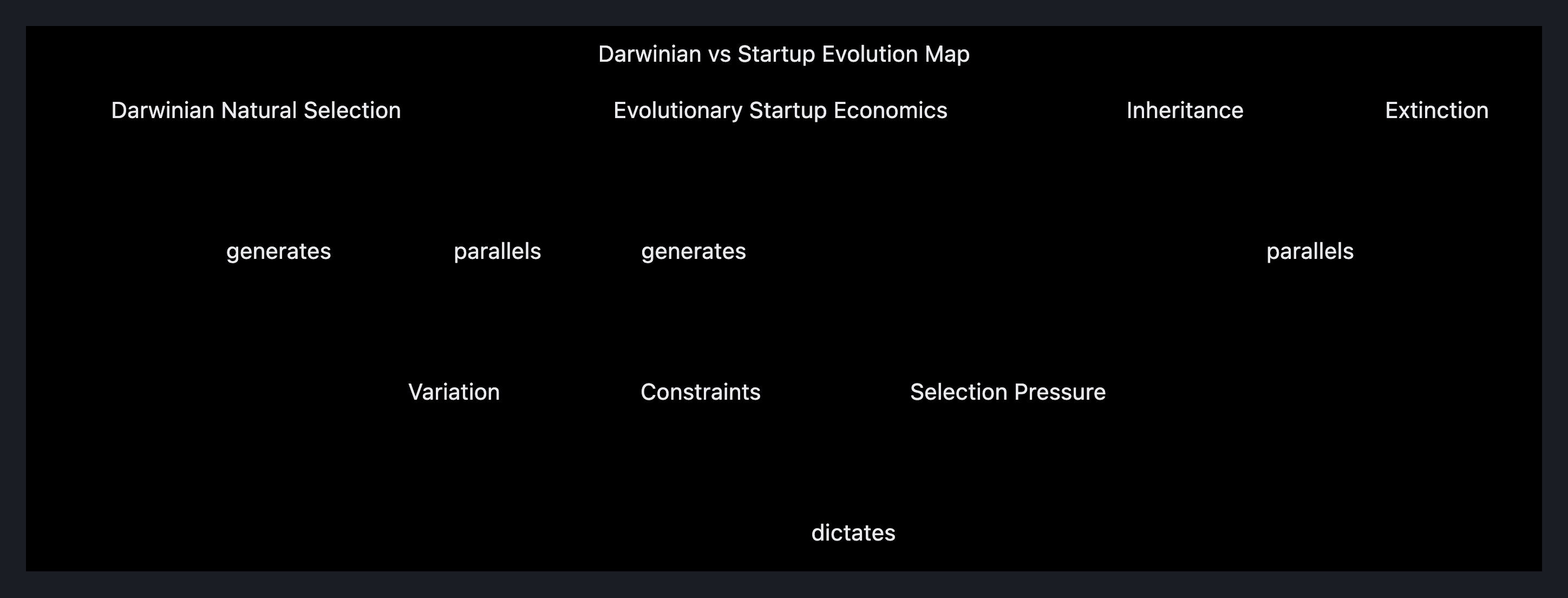
Selection Pressure: Medium (Human intermediaries weaken correspondence).
Variation: High (Structural logic holds).
Inheritance: Medium-High (Mechanism divergence significant but structural).
Nature of Synthesis: Theoretical (No empirical retrieval).
(visual rendered — see artifact)
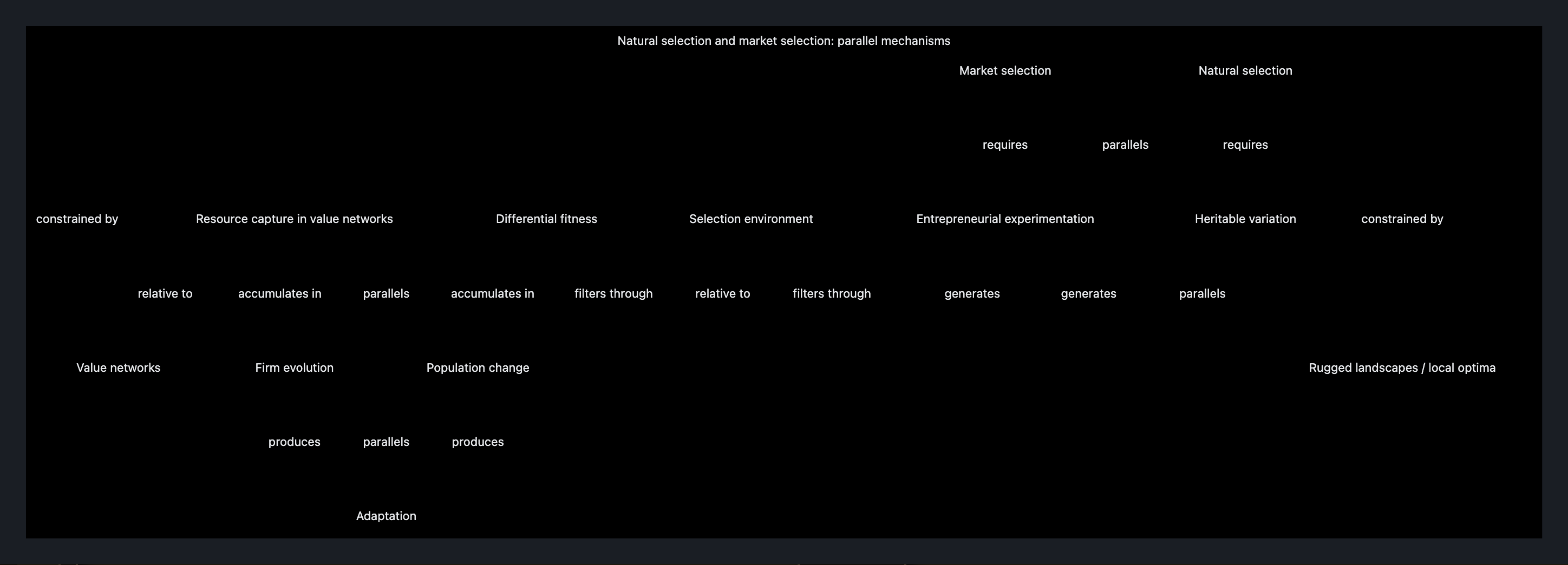
Frameworks identified — peer roots
Evolution by natural selection
Framework A — Evolution by natural selection. Lineage / tradition: evolutionary biology — Darwin–Wallace; Lewontin’s 1970 formalization (“The Units of Selection,” Annual Review of Ecology and Systematics 1(1)) reducing Darwin to three jointly sufficient conditions: phenotypic variation, differential fitness, and heritability of fitness (“heritable variation in fitness”); replicator/vehicle distinction (Dawkins); population-dynamics framing (Dennett, Holland). The Godfrey-Smith refinement (strictly, the trait need be heritable, not fitness) is a known nuance that does not unseat the standard formulation.
Units of analysis: genes, organisms, populations — the level itself contested (replicator vs. vehicle).
Generative mechanism: heritable variation that is blind with respect to fitness, filtered by differential reproductive success, accumulated across generations → change in trait frequency. Population mean fitness rises over time, but fitness is always relative to the present environment; Wright’s adaptive landscape adds that landscapes are rugged (local optima separated by valleys), so adaptation produces local optima and fragility under environmental shift.
Known internal failure modes: the tautology charge (“fittest” defined by survival); neglect of genetic drift; adaptationism (Gould–Lewontin spandrels — not every trait is selected); unresolved levels-of-selection disputes; evolution-as-fatalism (treating every loss as inevitable); wrong selection criterion (optimizing a proxy); premature monoculture.
Market selection of business models
Framework B — Market selection of business models. Lineage / tradition: industrial organization and evolutionary economics — Nelson & Winter, An Evolutionary Theory of Economic Change (Harvard/Belknap, 1982), treating firms as collections of heterogeneous routines that function as the evolutionary-economic equivalent of genes; Christensen’s disruption theory; ecosystem-level disruption-process literature (Snihur, Thomas & Burgelman, “An Ecosystem-Level Process Model of Business Model Disruption: The Disruptor’s Gambit,” Journal of Management Studies 55(7), 2018, 1278–1316).
Units of analysis: firms, business-model archetypes, organizational routines — embedded in value networks (the cost structures, customers, and partners a model is rational within).
Generative mechanism: entrepreneurial experimentation generates a diversity of models; the market (customers + capital + unit economics) confers differential access to the resources a model needs to persist; incumbents make locally rational choices inside their current value network, making low-margin/new-market footholds unattractive to them; entrants with asymmetric economics colonize the overlooked foothold and move upmarket; successful routines are replicated by imitation, hiring, funding, and codified playbooks.
Known internal failure modes: survivorship/hindsight bias; conflation of luck with skill; the false assumption of a single fitness criterion; calling everything “disruption”; over-attributing outcomes to strategy when luck or capital dominated; managerial agency that can deliberately reshape the selection environment.
Peer-root status: neither reduces to the other. Biology supplies populational machinery and rugged-landscape structure; business theory supplies a concrete, observable selection mechanism (resource capture inside value networks) and an account of intentional agency that biology expresses through a different mechanism (niche construction — CL6) rather than lacking entirely.
Structural parallels — mechanism-tested cross-links
Cross-link 1: Biological variation ↔ business-model heterogeneity. [CONTESTED mechanism-test judgment — both judgments preserved] Proposed correspondence: the diversity of founder approaches is the raw material market selection acts on, as genetic variance is the material biological selection acts on.
- Judgment α (survives, confidence high): falsification condition — if markets reliably produced winners with no prior diversity of attempts (a single mandated model winning by fiat), the parallel breaks; they don’t, the survivor is drawn from a mostly-invisible pool of variants. Survives with the caveat that market variation is partly directed (carried to Tension 1).
- Judgment β (declined as a standalone cross-link): the biologically interesting fact about entrepreneurial variation is not that it exists — recombinant bricolage (new models as recombinations of existing components) trivially mirrors genetic recombination — but that it is directed. A bare variation↔recombination link would restate the surface analogy RO1 is built to reject; the divergence (directedness), not the correspondence, is the finding, so variation is handled as Tension 1, not a cross-link.
Status: downstream must resolve whether variation survives as a passing cross-link or migrates to Tension 1; both judgments stand.
Cross-link 2: Selection = differential resource capture inside a value network ↔ market fitness function. Proposed correspondence: the structural claim is not “the strong win” but: a unit reproduces only if it captures the specific resources its reproduction requires, and that capture is relative to an environment. Differential survival by environmental fit maps onto differential survival by profitability / product-market fit / access to capital. Christensen’s evidence is mechanism-direct: incumbents fail at low-end footholds not from incompetence but because rational resource allocation inside their existing value network makes the disruptive niche unattractive — selection operates through resource flows, not deliberate choice, mirroring fitness-relative-to-environment. Mechanism-test (falsification condition): a case where business-model survival is uncorrelated with differential resource capture — survival random with respect to a model’s resource-acquisition traits. (Drift, Cross-link 5, shows this partly occurs.) Mechanism-level corroboration (relaxed selection): sustained zero-cost capital (ZIRP-style conditions) subsidizes unfit models and transiently suspends selection — but this is not a market-only exception. Biology has the same phenomenon as relaxed selection: resource abundance, predator release, or a vacated niche lets low-fitness variants persist that a tight regime would cull. The off-switch behaves the same way in both frameworks, so “selection can be switched off by resource glut” survives the mechanism test as correspondence rather than disanalogy. (The tightness of the relaxed-selection↔capital-glut match is flagged as a domain uncertainty in limitations.) Status: confirmed.
Cross-link 3: Inheritance = replication of routines. Proposed correspondence: cumulative selection is impossible without a transmission channel; business models are transmitted — SaaS and marketplace playbooks propagate through employees who move, VCs who pattern-match and fund clones, accelerator curricula, and franchising. Nelson & Winter’s “routines as genes” is the structural claim. Mechanism-test (falsification condition): if each firm had to reinvent its model from scratch with no transmissible template, no cumulative adaptation could occur and the parallel collapses. It does not collapse — but how it transmits diverges (see Tension 2). Status: confirmed (with a tension).
Cross-link 4: Adaptive-landscape local optima / fragility ↔ the incumbent’s value-network trap. [non-obvious; load-bearing] Proposed correspondence: on Wright’s rugged landscape, an organism on a local peak cannot reach a higher peak without first crossing a fitness valley — descending in fitness en route. The incumbent occupying the sustaining-innovation peak cannot move to the disruptor’s peak without abandoning the margins and customers that constitute its current fitness. The firm most rationally optimized to its current value network is the one least able to pursue the disruptive foothold; tight local optimization causes the vulnerability. Both frameworks make the same mechanism-level statement: fitness is defined relative to a specific environment. Mechanism-test (falsification condition): if incumbents could costlessly occupy both peaks simultaneously (run disruptive and sustaining models at once with no loss), landscape structure would not bind; if incumbents lost for reasons unrelated to prior environmental fit (fraud, random shock, one bad CEO bet), the parallel wouldn’t apply. The empirical record — incumbents needing autonomous spin-outs with different economics and governance — shows it binds, and yields the sharper testable prediction: the better-adapted the incumbent to the old environment, the more vulnerable to the shift (Christensen’s empirical claim). The non-obviousness: links a spatial biological construct (landscape topology) to a financial one (margin/value-network economics) at the level of the constraint, not the vocabulary. Status: confirmed.
Cross-link 5: Drift ↔ stochastic survival in small populations. Proposed correspondence: genetic drift dominates selection when populations are small — alleles fix or vanish by chance, not fitness. Startup niches contain few firms, so timing, a single funding decision, or a founder’s network can fix or extinguish a model independent of its traits. Survivorship-bias literature is the symptom. Mechanism-test (falsification condition): if startup outcomes were fully determined by model traits (no stochastic fixation), the drift parallel would be inert. The persistent gap between model quality and outcome shows it is not. This cross-link also functions as a limitation on Cross-link 2. Status: confirmed.
Cross-link 6: Niche construction ↔ agency reshaping the selection environment. Proposed correspondence: niche construction theory (Odling-Smee, Laland & Feldman) establishes that selected units modify their own selective environments (beavers build dams, earthworms alter soil chemistry), and those modifications persist as ecological inheritance, changing selection pressures borne by later generations. Business correspondence: a firm engineering network effects, setting a de facto standard, or securing favorable regulation reshapes the value-network selection environment, and the modification persists (installed base, standard, statute) to raise the selection bar for subsequent entrants. Mechanism-test (falsification condition): if firms could only adapt to a fixed selection environment and never durably alter the environment that selects later entrants, the parallel collapses. Empirically they do alter it — switching costs and standards built by an incumbent are inherited by the niche and select against later models. Residual divergence (ties to Tension 1): beaver dam-building is itself a blindly selected behaviour; founder niche construction is foresighted and strategic. The mechanism corresponds (a unit feeds back on its own selective environment, and the change is inherited); the directedness does not — which is why confidence is medium, and why this cross-link narrows but does not fully dissolve the agency limitation. Status: confirmed.
Evidence for genuineness
Cross-link 1 is genuine because: market winners are observably drawn from a mostly-invisible pool of prior variants rather than appointed by fiat — no case shows a single mandated model winning with zero diversity of attempts upstream. Falsifying case: markets reliably producing winners with no prior diversity of attempts (a single mandated model winning by fiat). The contestation (judgment β) turns precisely on whether the genuine finding is the correspondence or the divergence in directedness.
Cross-link 2 is genuine because: Christensen’s evidence is mechanism-direct — incumbents fail at low-end footholds not from incompetence but because rational resource allocation inside their existing value network makes the disruptive niche unattractive, so selection operates through resource flows rather than deliberate choice. The relaxed-selection corroboration adds a shared off-switch: resource glut suspends selection identically in both frameworks. Falsifying case: business-model survival uncorrelated with differential resource capture — survival random with respect to a model’s resource-acquisition traits.
Cross-link 3 is genuine because: business models demonstrably transmit through specific channels — employees who move, VCs who pattern-match and fund clones, accelerator curricula, franchising — and Nelson & Winter’s “routines as genes” names the structural claim that surface analogy would not predict. Falsifying case: each firm having to reinvent its model from scratch with no transmissible template, which would make cumulative adaptation impossible and collapse the parallel.
Cross-link 4 is genuine because: the empirical record shows incumbents needing autonomous spin-outs with different economics and governance to pursue the disruptive foothold — the prediction that the better-adapted the incumbent to the old environment, the more vulnerable to the shift, which surface vocabulary would not generate. Falsifying case: incumbents able to costlessly occupy both peaks simultaneously (run disruptive and sustaining models at once with no loss), or incumbents losing for reasons unrelated to prior environmental fit (fraud, random shock, one bad CEO bet).
Cross-link 5 is genuine because: the persistent gap between model quality and outcome shows survival is not fully trait-determined — timing, a single funding decision, or a founder’s network can fix or extinguish a model independent of its traits, exactly as drift dominates in small biological populations. Falsifying case: startup outcomes fully determined by model traits with no stochastic fixation, which would render the drift parallel inert.
Cross-link 6 is genuine because: firms empirically alter the environment that selects later entrants — switching costs and standards built by an incumbent are inherited by the niche and select against later models, paralleling ecological inheritance (the beaver dam persisting to change pressures on later generations). Falsifying case: firms able only to adapt to a fixed selection environment, never durably altering the environment that selects later entrants.
Emergent insight
Emergent insight: The synthesis produces a claim neither framework generates alone, with two coupled facets, stated in both lexicons so neither narrates the other.
Facet 1 — Pre-adaptation to a moving environment. Survival favors not the model with the best present-tense fitness, but the model whose economics are aligned with where the environment is heading — in the biology root’s terms, a non-stationary fitness landscape whose peak is moving; in the business root’s terms, a value network whose cost structure, customer set, and foothold economics are shifting. Because market variation is generated by agents who forecast that shift, the surviving variant is often one that looks inferior on today’s scoring (Christensen’s “inferior-looking foothold”) yet is pre-positioned for tomorrow’s.
Facet 2 — Niche collapse / Red-Queen acceleration. When variation is foresighted and successful routines transmit horizontally within months, imitators saturate a profitable niche before the original occupant stabilizes on its adaptive peak. The resource-capture advantage that constituted fitness at entry (Cross-link 2) is competed away by inheritance (Cross-link 3) operating at Lamarckian speed (Tension 2). In biology’s terms this is niche collapse around the adaptive peak; in the business framework’s own terms it is imitation-driven margin erosion exhausting the value-network niche — the same dynamic named from each root rather than translated into one. Survival becomes a moving target: a model can be selected-for at entry and selected-against by the time its copies proliferate.
Red-Queen label earned, not borrowed: Van Valen’s mechanism is that each unit’s fitness declines as its co-competitors improve, forcing constant adaptation merely to hold relative position — falsifiable by a case where a model, once selected, retains its resource-capture advantage indefinitely with no re-variation. The niche-collapse dynamic is precisely the failure of that condition.
Pre-empting the biology-foresight objection: biology is not as foresight-free as a clean contrast suggests — it produces future-robust phenotypes without forecasting via bet-hedging, phenotypic plasticity, exaptation, and the evolution of evolvability. The genuine difference is not the existence of anticipatory structure but its source and direction: biological anticipation is selected-in across past generations and biological valley-crossing is undirected and post-hoc, whereas a founder’s anticipatory variant is designed within a single generation by an agent forecasting the next environment and crosses valleys by directed first-principles leap.
Practical implication: business-model survival depends less on a model’s absolute quality than on (a) the fit between its resource-capture profile and an available value-network niche, and (b) the transmissibility of its routines — which is double-edged: transmissibility is what lets a model spread and what lets imitators destroy its niche. Present-tense fitness scoring is the wrong selection criterion when the landscape is moving; persistence requires continuous re-variation rather than arrival at a stable peak.
This required both frameworks because: biology contributes the formal variation–selection–inheritance machinery, drift, the rugged-landscape structure that explains why distributions of models persist and why incumbents are trapped on local peaks (Cross-link 4), and — via niche construction (Cross-link 6) — the mechanism by which a selected unit modifies its own selective environment, plus the anti-monoculture discipline of keeping variation alive even when one model wins. Disruption/evolutionary-economics theory contributes the concrete selection mechanism (resource capture in value networks), the directedness of variation (Tension 1), the Lamarckian transmission channel (Tension 2), the internal structure of the selection environment (value networks) determining which incumbents are trapped, and the foresighted strategic form niche construction takes among firms. Only together do they predict the acceleration-driven niche-collapse dynamic and the selection of pre-adapted variants — a Red-Queen regime running faster than biological selection because both the variation and the inheritance steps are sped up by agency.
Productive tensions
-
Blind/stochastic vs. directed/foresighted variation and valley-crossing (Tension 1, a major tension) — Framework A’s position: mutation is undirected with respect to fitness; selection in biology has no foresight. Biology does not forbid valley-crossing — populations can cross adaptive valleys via genetic drift in small populations, neutral networks, and recombination (Wright’s shifting-balance theory; the strongest version, species-wide spread from a single deme, is contested per Coyne et al. 1997) — but biological crossing is stochastic, slow, and undirected. Framework B’s position: founders deliberately design models toward perceived fitness and revise mid-flight (pivots); the varying unit anticipates the selector, so the variation distribution is already pre-filtered by founder cognition before the market sees it, and founders cross valleys by directed first-principles redesign aimed at an anticipated peak. Why productive: the genuine distinction is therefore mechanism, not possibility. This does not break Cross-links 2–4 (variation is still generated upstream of market exposure) but changes the tempo, and bounds Cross-link 6 (niche construction supplies the structural parallel for agency; Tension 1 marks where its directedness departs from biology’s).
-
Lamarckian/horizontal vs. Mendelian/vertical inheritance (Tension 2, a major tension) — Framework A’s position: biological inheritance is vertical, blind, high-fidelity — traits pass parent→offspring, variation is generated without foresight, offspring resemble parents closely. Framework B’s position: business-model inheritance is horizontal, directed, lossy — a successful model propagates by competitors copying it, talent diffusing between firms, acquirers absorbing it; the variation feeding it is often intentional. Nelson & Winter already flag this by treating organizational routines as Lamarckian “genes” acquired and modified within a firm’s lifetime. Why productive: this is the same function (heritability) via a categorically faster channel, and it breaks two evolution-root assumptions: (a) the “many generations” requirement collapses — horizontal copying lets a winning model saturate a market in a single “generation”; (b) the “variation is blind to the future” premise is violated. The tension is not resolvable by translation.
-
Unit-of-selection / replicator ambiguity in both (Tension 3) — Framework A’s position: biology’s levels-of-selection dispute (gene/organism/group). Framework B’s position: a direct counterpart — is the market selecting the archetype (SaaS, marketplace, freemium), the firm, the routine, or the founder carrying learnings across ventures? The frameworks pull apart on what survives. Why productive: it yields a discriminating test that turns assertion into testable claim — do archetypes propagate across firms independent of any single firm’s survival? If an archetype keeps spreading — copied into new ventures, taught in accelerators, demanded by investors — while the startups that pioneered it die at the usual base rate, the replicator is the archetype, not the firm, and selection operates one level above the entity we instinctively watch. Falsification condition: if archetypes only ever propagated through the continued survival of their originating firms (archetype death tracking firm death), the replicator collapses back onto the firm. Observed pattern: archetypes outlive their instances — which is why the synthesis is strong at archetype scale and weak at single-firm scale. (Note: the scale-strength judgment is itself contested — see the contested limitation below.)
Limitations
-
Drift and survivorship bias may explain more variance than the V-S-I story admits (Cross-link 5) — domain or condition where the synthesis breaks down: in small-population niches, luck and timing can dominate trait-based selection; we observe only survivors, and selection cannot legitimately be read from winners alone — the one population biology insists you cannot infer selection from. Reason: the synthesis is a tendency, not a determinism.
-
The fitness criterion is endogenous and gameable — domain or condition: capital can subsidize unfit models (the relaxed-selection case, Cross-link 2); metrics chosen as fitness proxies drift from real viability (Goodhart / map-is-not-territory). Reason: market “fitness” is not the relatively fixed energetic constraint biology works with.
-
Weak heritability/fidelity — domain or condition: business models mutate heavily on copy. Reason: there is no high-fidelity replicator, and the discreteness the gene gives biology has no clean market analog (Tension 2).
-
Agency’s reach exceeds even niche construction — domain or condition: Cross-link 6 supplies a real biological parallel for firms reshaping their selection environment, so “biology has no equivalent” is too strong. But a residual gap remains: founders can rewrite the formal, codified selection criteria themselves — lobbying for regulation, capturing standard-setting bodies — which goes beyond niche construction’s typically ecological/physical modification of pressures. Reason: where a selected unit edits the rules of selection (not just the environment), the biological analogy genuinely thins out, the divergence being one of foresight and tempo as much as of kind (Tension 1, Cross-link 6 residual).
-
Increasing returns can lock in inferior models — domain or condition: network effects and switching costs — the QWERTY/path-dependence case (canonically Paul David 1985, “Clio and the Economics of QWERTY,” AER) and increasing-returns lock-in (Brian Arthur 1989, “Competing Technologies, Increasing Returns, and Lock-In by Historical Events”) — let a worse model fix and exclude better entrants. Reason: biology has “good enough” outcomes too, but increasing returns of this strength are largely absent from it, so market selection can be anti-optimal in a way natural selection rarely is.
-
The fatalism trap (inherited from the evolution root’s own warnings) — domain or condition: the frame must not be used to declare any given incumbent’s loss “inevitable.” Reason: structural disruption and preventable strategic error are distinct; the lens explicitly flags evolution-as-fatalism as misuse.
-
Contested limitation — scale at which the synthesis is strong vs. weak — domain or condition: the streams disagree and the disagreement is itself a finding. One position: the synthesis is strongest at the routine and firm scales, weaker at the archetype scale (because no reproductive isolation softens archetype-population claims — RO2), and weakest of all at the single-instance scale where idiosyncratic factors dominate. Competing position: the synthesis is robust at archetype level (archetypes propagate independent of any single firm’s survival — Tension 3) and noisy at the individual-firm/instance level where idiosyncratic death dominates. Both agree the single-instance scale is weakest; they diverge on whether the archetype scale is a strength (archetype-as-replicator) or a weakness (no reproductive isolation). Reason: downstream use should pause on the archetype-scale claim accordingly.
Ruled-out cross-links
-
“Survival of the fittest” ↔ “only strong startups survive” / “the best product wins” (RO1) — failed because: it rests on shared vocabulary and is circular in both domains — “fittest” is defined post hoc by survival in each, and no independent mechanism is specified, so nothing could falsify it. Why surface, not structural: it fails the mechanism test in both directions — biological fitness is reproductive propagation, not phenotypic superiority; market survival is propagation (customers, capital, imitation), not product quality. Illustration: the (contested) Betamax case — its “superior” status is itself partly perceived (Sony marketing); the format that won did so on price, licensing terms, and network effects rather than adjudicated picture quality, making it an instance of business-model/propagation fitness beating perceived product quality, not of “the best product wins.” This is the trap the rest of the synthesis is built to avoid. Failure mode: false-synthesis.
-
Biological species ↔ business-model archetype (via taxonomy) (RO2) — failed because: the defining mechanism of a biological species (Mayr) is reproductive isolation. Business-model archetypes freely hybridize — a marketplace bolts on SaaS, a SaaS adds a marketplace — with no isolation barrier. Why surface, not structural: the mechanism that constitutes “species” operates in biology and is absent in business, so the mapping fails even though the surface taxonomy (SaaS, marketplace, etc.) is tempting. This is why population-level archetype claims are weaker than species-level ones.
-
Mutation rate ↔ R&D/experimentation cadence (RO3) — failed because: it is plausible but rests on the rate metaphor without a distinct mechanism beyond Cross-link 1’s variation claim. Why surface, not structural: kept as a sub-component of variation (folded into Cross-link 1) rather than a standalone link.
Confidence per cross-link
- Cross-link 1 — high (judgment α) / declined (judgment β) — contested, both preserved. Reason: under judgment α the falsification condition is direct (winners are drawn from a real prior pool of variants); under judgment β the finding is the divergence in directedness, not the correspondence, so it migrates to Tension 1.
- Cross-link 2 — high. Reason: Christensen’s resource-allocation evidence is mechanism-direct, and the relaxed-selection off-switch corresponds in both frameworks.
- Cross-link 3 — high (with a tension). Reason: transmission channels are directly observable; the divergence is in how it transmits (Tension 2), not whether.
- Cross-link 4 — medium-high (audit-conservative across a medium-high and a high judgment). Reason: the empirical record of incumbents needing autonomous spin-outs binds the landscape-topology↔value-network constraint, but the cross-modal (spatial↔financial) mapping is held conservatively.
- Cross-link 5 — medium. Reason: the quality-outcome gap evidences stochastic fixation, but it functions as much as a limitation on Cross-link 2 as a standalone correspondence.
- Cross-link 6 — medium. Reason: the mechanism (a unit feeds back on its own selective environment, and the change is inherited) corresponds, but the directedness of founder niche construction does not, leaving a residual divergence.
Additional considerations
Coverage of the critical questions. CQ1 (mechanism vs. surface): every surviving cross-link (Cross-links 2–6, and Cross-link 1 under judgment α) carries an explicit falsification condition stated as one framework’s mechanism operating while the other’s does not; the Red-Queen claim in the emergent insight is itself mechanism-tested; the seductive surface analogy (RO1) is ruled out, and variation-as-cross-link is contested on the same ground (judgment β). CQ2 (peer-root parity): both frameworks retain distinct mechanisms; Cross-link 6 restores parity on agency (biology contributes niche construction, business its foresighted form); the emergent insight is named in both lexicons in parallel rather than translated into one — no reduction. CQ3 (productive tensions): three named (blind/stochastic vs. directed variation and valley-crossing; Lamarckian/horizontal vs. Mendelian/vertical inheritance; unit-of-selection/replicator ambiguity), not smoothed over. CQ4 (emergent insight requires both): the pre-adaptation + niche-collapse/acceleration claim is unavailable from either framework alone, with per-framework attribution given.
Two unresolved domain-judgment items. First, whether biological near-analogs of foresight (bet-hedging, plasticity, evolvability, exaptation) are categorically distinct from agent foresight, or merely undercut the headline — pre-empted by relocating the difference to the source of anticipatory structure, but not mechanically settled; resolvable by an evolutionary-biology domain reviewer. Second, whether relaxed selection ↔ capital-suspended selection (Cross-link 2) is a tight mechanism-level match or an evocative parallel; presented as corroborating but flagged provisional; resolvable by an ecology-domain check on relaxed-selection dynamics under resource abundance vs. capital subsidy. A third item is an emission-contract question: whether synthesis mandates a visual envelope cannot be confirmed; the mode brief describes synthesis as prose-based peer-root integration, so prose only is emitted.
Dependence on the reading of “survive.” The synthesis rests on the clarified reading of “survive” as market viability + propagation (not mere continued existence), applied at both archetype and instance scale. That reading is what makes inheritance (Cross-link 3) load-bearing: under a bare “still exists” definition, the inheritance half of the triad carries much less weight, Cross-link 2 and the emergent insight weaken (bare persistence can be bought — precisely the relaxed-selection case where selection switches off), and the emergent insight’s force diminishes. Worth confirming the intended sense — this is a Phase A inference, not something you stated explicitly, so flag it if the intended meaning was mere continued existence.
(visual rendered — see artifact)