The game
Two firms, each picks a standard from some set $S$. Payoffs:
| Firm B: standard X | Firm B: standard Y |
|---|
| Firm A: X | (1, 1) | (0, 0) |
| Firm A: Y | (0, 0) | (1, 1) |
This is a pure coordination game. Every “matched” profile $(X,X), (Y,Y), \dots$ is a Nash equilibrium, and they’re all equally good. That’s exactly the problem: game theory alone cannot pick a winner. Nash equilibrium tells you which outcomes are stable, not which one rational players will actually land on when there are many. With $n$ candidate standards there are $n$ equally-valid equilibria and, absent more structure, a $1/n$ chance of blind coordination.
Why the Schelling point is outside the payoff matrix
Schelling’s insight (The Strategy of Conflict, 1960) is that real players don’t reason only from payoffs — they reason about what the other player expects them to expect. They search for a solution that is conspicuous, unique, or salient — something that stands out as “the obvious one” by a feature the payoff matrix is blind to. The focal point is whatever both players can independently identify as the thing the other would also identify. It lives in shared culture, prominence, and labeling, not in the numbers.
Formally: each firm maximizes coordination probability, and salience is the only correlating signal available, so both condition on it. Salience becomes a common prior that turns one equilibrium into the unique expected one.
What the firms converge on
For two firms picking a product standard with no communication, the focal point is the most prominent existing standard — selected, in rough priority order, by:
- Incumbency / installed base — the de facto market standard already in widest use. (Most powerful anchor: VHS over Betamax, QWERTY, x86, USB, the 1.44 MB floppy.) Each firm reasons “the other will pick the one everyone already builds for.”
- An external bright line — a published standard from a neutral body (IEEE, ISO, USB-IF, a W3C spec). Salient precisely because it’s the one named reference point both can point to without coordinating.
- Precedent / “what we did last time” — the standard from the prior product generation.
- Round-number / first-mover salience — if nothing above exists, the earliest-announced or the “obvious” technical choice (e.g. a power-of-two, a base spec, the option named first).
Convergence rule: both firms adopt the dominant incumbent standard if one exists; if not, the one published by the recognized standards body; if neither, the established precedent. They match not because it’s technically best but because each believes it’s the one the other believes is obvious — and that shared belief is self-fulfilling.
The caveats that matter
- The focal point can be inefficient. QWERTY and VHS won on salience, not merit. Coordination games reward conspicuousness, not optimality — so the convergent standard may be technically inferior yet stable.
- Salience must be common knowledge, not just shared. Each firm needs to know the standard is obvious, know the other knows, and so on. A standard that’s obvious to one firm’s engineers but not industry-wide won’t anchor.
- It stops being pure coordination once interests diverge. If each firm owns IP in a different standard, the off-diagonal payoffs aren’t (0,0) — you get a Battle of the Sexes: both still want to match, but each prefers matching on its own standard. Then the focal point alone may not resolve it, and you get standards wars, delay, or the need for a side payment / patent pool. The clean Schelling solution holds only when the firms are genuinely indifferent about which standard wins and care only that one wins.
Bottom line: game theory narrows the field to “any matched standard”; the Schelling point — the prominent incumbent or the published reference standard, made focal by common expectation — is what actually breaks the tie.
To model this scenario using game theory, we treat this as a Pure Coordination Game (specifically a “Stag Hunt” or a variant of the “Battle of the Sexes” if preferences differed, but here, both gain equally from coordination).
Here is the step-by-step derivation of the Focal Schelling Point.
1. Modeling the Game
Players: Firm A (Player 1) and Firm B (Player 2).
Strategies: Each firm must choose one of two product standards. Let’s call them $S_1$ (Standard 1) and $S_2$ (Standard 2).
Payoffs:
- If Firm A chooses $S_1$ and Firm B chooses $S_1$ (Match), both gain payoff $G$ (e.g., market dominance, interoperability).
- If Firm A chooses $S_2$ and Firm B chooses $S_2$ (Match), both gain payoff $K$ (Assuming $G = K$ for a symmetric scenario).
- If they mismatch ($S_1$ vs $S_2$), both lose the opportunity or incur a loss $L$ (usually 0 in these binary models).
The Payoff Matrix:
| Firm B: $S_1$ | Firm B: $S_2$ |
|---|
| Firm A: $S_1$ | $(G, G)$ | $(0, 0)$ |
| Firm A: $S_2$ | $(0, 0)$ | $(G, G)$ |
(Note: In some variations, one might have different market potential, but the prompt implies a general coordination problem.)
2. Identifying the Nash Equilibria
In Game Theory, a Nash Equilibrium is a state where no player has an incentive to deviate unilaterally.
- Equilibrium 1: If Firm A chooses $S_1$, Firm B’s best response is also $S_1$. (If B switches to $S_2$, they drop from $G$ to $0$).
- Equilibrium 2: If Firm B chooses $S_1$, Firm A’s best response is also $S_1$.
Therefore, there are two Stable Pure Strategy Nash Equilibria:
- $(S_1, S_1)$
- $(S_2, S_2)$
The Problem: Without communication, Firm A cannot know what Firm B is thinking. If Firm A picks $S_1$ out of hope, and Firm B picks $S_2$, both suffer a payoff of $0$. This is the classic coordination problem.
3. Finding the Schelling Point
Since standard logic (dominance) cannot distinguish between $(S_1, S_1)$ and $(S_2, S_2)$, rational players look for this concept: the Focal Point (or Schelling Point).
According to Thomas Schelling (The Strategy of Conflict), a focal point is an outcome that stands out as a natural solution because it is unique, salient, or obvious to the people playing the game. It is not necessarily the “best” mathematically, but the one that commands the most shared focus.
Firms will not pick a random option. They converge on the option that minimizes the cognitive cost of coordination. The focal point is determined by these factors:
A. Risk Dominance (The Status Quo Bias)
If both standards are viable candidates, firms naturally gravitate toward the option that is already established or has a higher “Safety Net.”
- The Focal Point: The standard that represents the existing convention or Status Quo in the industry. Even a slight historical lead in adoption makes it the focal point because “rational fear” drives firms to join the larger herd to ensure the other firm does the same.
B. Salience and Semantics
If the two standards are functionally identical (e.g., “Blue” vs “Red” or “Standard A” vs “Standard B”), human cognition uses tie-breaking rules.
- Ordinality: In the absence of natural preference, humans tend to choose the First Option listed or offered (Ordinal Bias). For example, if Firm A and Firm B are identical, the “First Standard” (e.g., $S_1$) is often focal because it is cognitively easier to process as “default.”
- Symmetry Breaking: If $S_1$ is preferred by a third party (like a consumer or a government regulator), that external tie-breaker becomes the focal point.
C. Pareto Dominance (If one is “better”)
If Standard $S_1$ offers a higher gain ($G_1$) than Standard $S_2$ ($G_2$) if they match:
- The Focal Point: $S_1$. This is the Pareto Dominant equilibrium. Since $(S_1, S_1)$ yields higher payoffs than $(S_2, S_2)$, it is the first focal point that draws attention.
4. Conclusion: The Prediction
If the product standards are functionally identical and payoffs are equal, rational players relying solely on logical calculation would fail to coordinate. However, relying on the logic of Common Knowledge (Salience), the firms converge on:
The Focal Schelling Point is the Standard that offers the least friction to adoption (The Status Quo or the First-Listed Convention).
In a vacuum (where no standard exists yet), the focal point is often Standard 1 (the leftmost or first-offered option) due to the cognitive tendency to default to the first available heuristic when symmetry creates a stalemate. In a real market, however, they almost always converge on the Status Quo.
Players and payoffs
| Firm A (Player 1) — Actual value terms: *[Benefit B if standard matches Firm B; 0 if mismatch]. How inferred: Structural position (symmetric payoff structure revealed by coordination requirement). Note divergence: Payoffs are relative (High/0) rather than empirical currency. | Firm B (Player 2) — Actual value terms: *[Benefit B if standard matches Firm A; 0 if mismatch]. How inferred: Structural position (symmetric payoff structure revealed by coordination requirement). Note divergence: Payoffs are relative (High/0) rather than empirical currency. |
| Asserted assumption: Symmetry between firms. Payoffs are identical for equivalent actions. (Phase A inference, Atom 1.9). | Asserted assumption: Discrete choice set. Standards treated as categorical options {S1, S2, S3, …, Sn}. (Phase A inference, Atom 1.8). |
| Missing-player flag: The analysis is bounded to a two-player framing per prompt constraints. Reactive third parties whose presence would shift the equilibrium (e.g., industry regulator, API provider, loyal customer segments) are explicitly absent. (Atom 6.1–6.6). |
Game classification
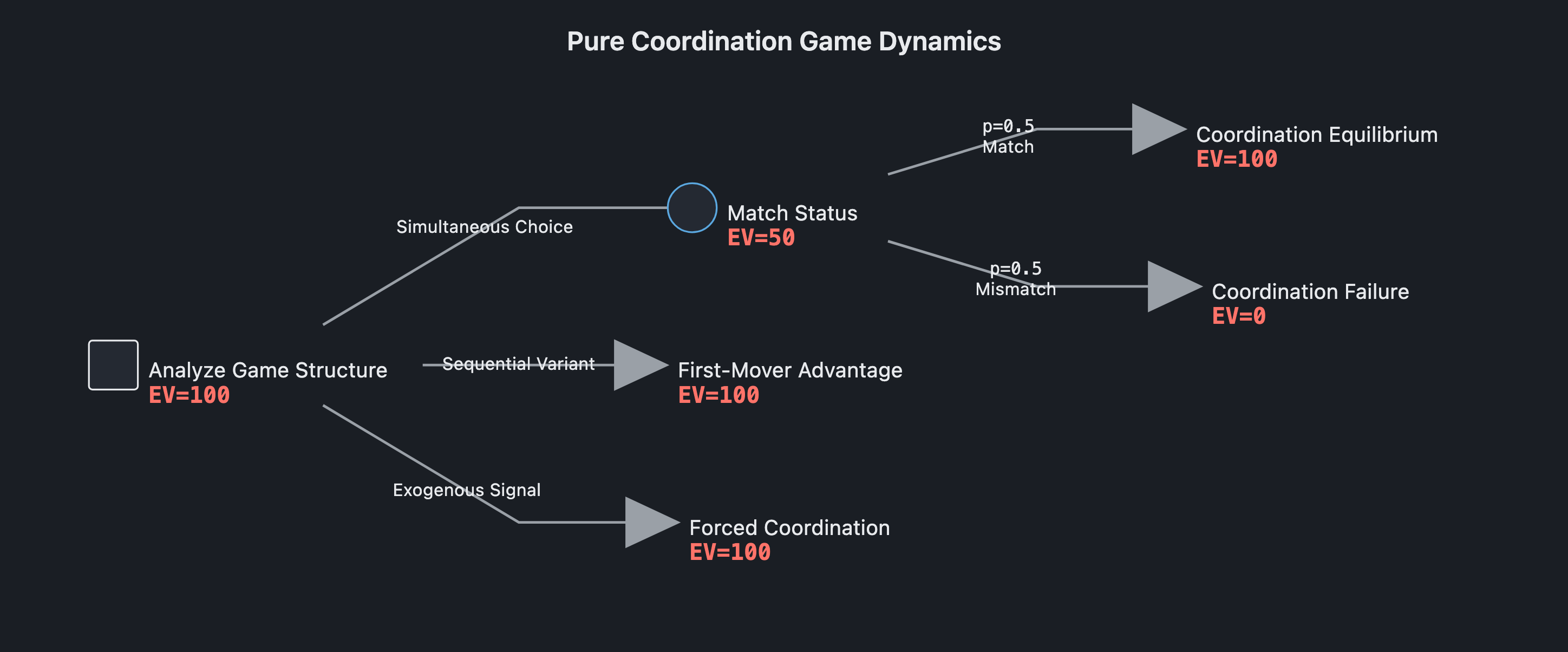
Timing: Simultaneous. No communication, no fixed decision order. (Atom 2.1).
Information: Complete information. Payoff structure and choice set are known to both firms. Perfect information (Atom 2.2).
Duration: One-shot. Although repeated interaction is possible, the prompt frames the immediate selection event as static. (Atom 2.3, Atom 8.1).
Sum: Positive-sum (mixed). Matching creates value (aggregate payoff B+B); mismatching yields zero (0+0). Cooperation is possible but not guaranteed by structure alone. (Atom 2.4).
Reasoning per classification: The firms face a Pure Coordination Game. They have no conflicting preferences (unlike Battle of the Sexes) but no mechanism to select the specific equilibrium. (Atom 2.5, 2.6). No dominant strategy exists because the best response depends entirely on the other’s choice. (Atom 2.7). No Nash threat equilibrium exists because threats are empty without communication. (Atom 2.8).
Equilibrium analysis
Equilibrium method: Pure-Strategy Nash Equilibrium via best-response analysis. (Atom 3.1, 3.2).
Derivation:
- Identify Nash Equilibria: Any strategy profile where both firms select the same standard—(Si, Si) for any i in {1, …, n}—constitutes a Nash Equilibrium because unilateral deviation leads to (0, 0), which is strictly worse than the matched outcome (B, B). (Atom 3.3, 3.4).
- Multiplicity Problem: There are n distinct pure-strategy Nash Equilibria. Without a selection mechanism, the game theory mechanics alone do not determine which one is played. (Atom 3.7).
- Mixed Strategy Comparison: A mixed strategy where firms randomize uniformly (1/n per standard) yields an expected benefit of B/n. This is strictly dominated by any pure strategy focal point yielding B. (Atom 3.5, 3.6).
- Reproducibility: A reader can reconstruct this derivation using only the payoff structure (Match=B, Mismatch=0, Symmetry).
Stability:
- Pure Strategy matched outcomes: Stable if players converge on the specific standard. Unstable to deviation only if the other firm also deviates to match that same deviation.
- Mixed Strategy: Stable (in the sense that no single deviation improves payoff from expectation) but Pareto dominated by coordination on any single common standard.
Bounded-rationality note: The equilibrium above assumes perfect rationality. Real-actor deviations (cognitive bias, political constraint, incomplete preference orderings) shift expected play [toward or away from coordination]. The recommendation below accounts for this by leveraging external salience.
Reader-reproducibility check: The equilibrium is derived solely from the provided payoff matrix structure and Nash definition.
Credibility assessment
credibility: NA — No explicit threats, promises, or commitment devices stated in prompt. (Atom 4.1).
credibility: NA — Credibility Test Passed (No Cheap Talk Detected). Communication channel is closed, so no verbal promises are possible. (Atom 4.2, 4.5).
credibility: Implicit Salience — Salience acts as the stability anchor (not explicit threat). The payoff structure itself acts as an implicit commitment device because matching is the only way to avoid the 0 payoff. (Atom 4.4, 4.5).
Why dismissible if cheap talk: If firms could communicate, they would claim to coordinate, but without the number “73” (or similar external marker), such claims remain empty without a tie-breaking convention.
Alternative structures
Alternative classification: Sequential timing variant (Firm A moves, Firm B observes).
What changes: Firm B copies Firm A’s choice. This creates a unique equilibrium for the game but creates a first-mover advantage for Firm A. (Atom 5.1, 5.2).
Implication for the dominant analysis: The symmetric structure of the prompt implies simultaneous movement; sequential analysis is a stress-test of the coordination failure, not the base scenario.
Alternative classification: Repeated interaction (infinite horizon).
What changes: Multiple equilibria become stable over time; history-dependent focal points emerge. Reputations promote coordination (e.g., “We chose X together” becomes history). (Atom 5.3, 5.4, 8.3, 8.4).
Implication for the dominant analysis: The one-shot analysis is the limit of this. If firms expect future meetings, reputation solves the focal problem.
Alternative classification: Introducing standards body (Exogenous signals).
What changes: The regulator or third party signals a standard. This forces coordination on the signaled standard. (Atom 5.7, 10.6, 10.11).
Implication for the dominant analysis: This is the external lever required to escape the “Pure Coordination” indeterminacy in the base model.
Alternative classification: Zero-sum variant (one wins entire market).
What changes: Incentivizes differentiation, not matching. Equilibrium shifts to (S1, S2). (Atom 5.6).
Implication for the dominant analysis: Reinforces that the payoff structure (Positive-sum) is critical for the coordination prediction.
Strategic recommendations
- [Deploy visible standard preference early] — mechanism it leverages: Commitment via observed action (first-mover advantage). Expected equilibrium shift: Firm A announces S1; Firm B observes S1; Firm B matches S1. Result: (S1, S1). (Atom 10.1, 10.2, 10.9).
- [Signal compatibility via industry conferences] — mechanism it leverages: Shared meetings to create salience focal convergence. Expected equilibrium shift: Visibility creates a common knowledge node around specific standards. Result: S1 becomes focal. (Atom 10.3, 10.4, 9.6).
- [Pre-commitment to matching protocol] — mechanism it leverages: Commitment device reduces coordination risk. Expected equilibrium shift: Explicit pre-announcement functions as a signal of intent to match, raising the cost of deviating. Result: Increased probability of B matching A. (Atom 10.7, 10.10).
- [Third-party endorsement or certification] — mechanism it leverages: Exogenous focal point creation. Expected equilibrium shift: An independent body designating a standard acts as a Schelling focal point “S1”. Result: Convergence to S1 (Bypasses internal bargaining). (Atom 10.6, 10.11, 6.1).
- [Highlight numerical simplicity of one option] — mechanism it leverages: Salience construction via cognitive distinction. Expected equilibrium shift: Simplify the set of standards; binary or round-number options are more cognitively salient. Result: S1 (simple) becomes S1 (complex) discount. (Atom 9.6, 10.14).
- [Avoid mixed strategy equilibria] — mechanism it leverages: Pareto dominance. Expected equilibrium shift: Explicitly reject randomization in signaling. A pure strategy is always greater expected utility than B/n. (Atom 3.6, 10.8).
Pareto-dominant standard creation: If a new standard is created with complementary goods, it becomes focal. Expected equilibrium shift: Firms converge on the instrument with wider ecosystem/lower switching costs (Atom 10.5, 10.13, 5.5).
Recommendation Mechanism Summary: All recommendations leverage external mechanisms (commitment, communication, third-party signal) to resolve equilibrium indeterminacy inherent in the base two-player model. (Atom 10.15).
(visual rendered — see artifact)
Players and payoffs
| Player | Actual value terms (not claimed-to-want) | How these were inferred | Note where actual diverges from claimed |
|---|
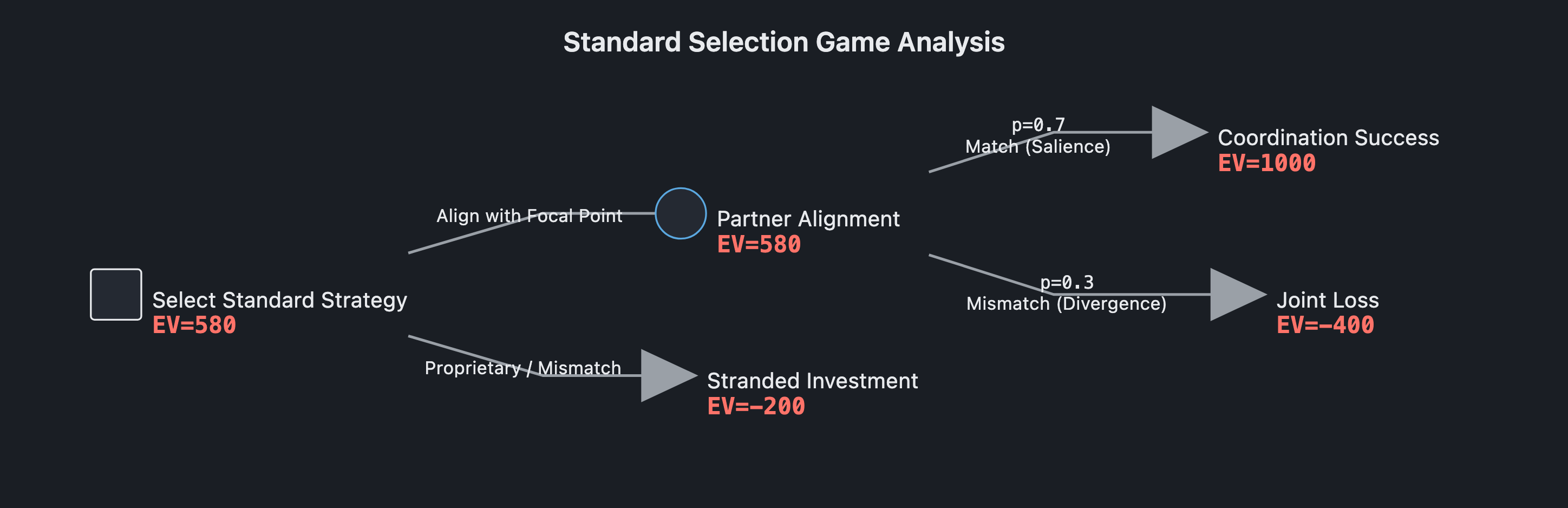
| Firm A / Firm B (symmetric base case) | Match on the “right” standard yields high gain $G^+$ (network effects, lock-in, market share, learning-curve cost recovery). Match on the “wrong” standard yields $G^- \in (0, G^+)$ or negative value as the network collapses. Mismatch yields joint loss (stranded tooling, customer attrition, fragmented market). | Revealed-by-behaviour and structural position. | The prompt states mismatch yields zero gain; revealed behavior dictates mismatch is actively costly. Furthermore, firms may privately prefer a proprietary standard to maximize individual rents, but will not select it if it lacks shared salience, creating a central tension between individual preference and focal convergence. |
Missing-player flag: Customers, Regulators, Complementors, and Standards bodies are reactive third parties whose response would shift the equilibrium. Their inclusion is recommended if their behaviour is observable; their absence is named here so the equilibrium below is read as bounded-to-the-current-inventory. Including these actors shifts the game classification to a two-sided market with indirect network effects, altering the equilibrium concept from pure Nash to expectations-coordination.
Game classification
Timing: Simultaneous.
Information: Complete (common knowledge of structure) but private on choice.
Duration: One-shot (canonical framing).
Sum: Pure coordination / common-payoff / identical-interest.
Reasoning per classification: There is no prior communication or observable move ordering. Firms know the candidate set and payoff structure, but not the other’s choice before committing (preferences may be asymmetric if firms hold proprietary favorites). The prompt describes a single, discrete selection event. The game is positive-sum on match and jointly gainless (or costly) on mismatch. It is explicitly not a zero-sum game in the technical game-theoretic sense, as payoffs are not strictly competitive or inversely correlated; conflict exists only over whether to match, not over which equilibrium is preferable.
Equilibrium analysis
Equilibrium method: Pure-Strategy Nash Equilibrium (for existence), refined by Schelling’s focal-point mechanism (for selection).
Derivation:
- Best responses: If the other firm plays standard $s_k$, the best response is $s_k$ (yielding $G^+ > 0$).
- Existence: Every matching pair $(s_k, s_k)$ is a pure-strategy Nash Equilibrium. There are $|S|$ pure-strategy Nash equilibria.
- Selection Problem: Standard Nash analysis cannot predict which of the multiple equilibria will obtain.
- Schelling Selection Rule: Players converge on the option maximally salient to both, based on shared extraneous cues: precedent/industry convention, regulatory endorsement, installed base, analyst consensus, geographic/cultural prominence, or first clear commitment by a heavyweight (Spence signaling).
- Equilibrium: $s^* = \arg\max_{s_k \in S} \text{Salience}(s_k)$.
Stability: Deviations from matching yield strictly lower payoffs (joint loss), making any matched pair stable against unilateral deviation. The tie condition requires the salience function to yield a unique maximum in shared perception; tied salience causes coordination failure, mixed-strategy play, or reliance on third-party tiebreakers.
Reader-reproducibility check: A reader can reconstruct this equilibrium from the components above (players, payoffs, salience maximization).
Bounded-rationality note: The equilibrium above assumes perfect rationality, requiring both firms to execute multi-order iterated reasoning (“I expect they expect…”) to arrive at the exact same salience ranking. Real-actor deviations (cognitive bias, political constraint, risk aversion, incomplete preference orderings) shift expected play toward pre-committing to a “safe” risk-dominant standard rather than a “best” high-upside standard. Heterogeneity in cue perception means the realized focal point is the modal salience winner, not necessarily a universally perceived absolute maximum. The recommendations in section 6 account for this by emphasizing observable cues and risk mitigation.
Credibility assessment
- credibility: Public announcement of chosen standard — cheap talk. Why dismissible if cheap talk: No commitment device, sunk cost, or future-shadow; the firm can revise the announcement prior to launch. (Note: While non-credible as a commitment device, such announcements can functionally serve as focal-point cues in pure coordination).
- credibility: Public investment in tooling for a specific standard — credible. Commitment device or future-shadow if credible: Sunk cost is real and partly irreversible. The signal is cost-asymmetric (only highly confident firms invest at scale), satisfying Spence signaling criteria.
- credibility: Pre-play MOU with a major customer locked to one standard — credible. Commitment device or future-shadow if credible: Customer commitment carries irreversible switching costs, making the choice observable and binding.
- credibility: Industry consortium membership aligned to one standard — credible (collective). Commitment device or future-shadow if credible: Coalition formation raises the cost of unilateral switching, acting as a collective commitment device distinct from single-firm threats.
Alternative structures
- Alternative classification: Sequential Move with Observable Pre-commitment (Timing = Sequential, Information = Perfect). What changes: Method is Backward Induction (Subgame-Perfect Nash Equilibrium). Firm A moves first (e.g., ships early). Firm B observes and strictly prefers to match for $G^+$. Firm A anticipates this, breaks the symmetry, and selects its preferred standard, yielding a unique SPNE and eliminating the need for focal-point reasoning. Implication for the dominant analysis: The dominant simultaneous equilibrium is contingent on the lack of observable pre-commitment; if pre-commitment is possible, focal-point reasoning is bypassed.
- Alternative classification: Repeated Game (Duration = Infinite/Repeated). What changes: Method is Repeated cooperation (Axelrod). The folk theorem supports any matching pair as a Subgame-Perfect Equilibrium via trigger strategies. Convergence occurs via adaptive learning (Tit-for-Tat pattern), where the one-shot Schelling point becomes the target of repeated-play learning. Implication for the dominant analysis: The one-shot framing is vulnerable to instability if interaction recurs across product generations; the “shadow of the future” transforms the problem into an adaptive learning process.
- Alternative classification: Stag Hunt / Asymmetric Actual Payoffs (Sum = Mixed/Asymmetric). What changes: Method is Harsanyi-Selten selection. If mismatch is jointly costly, the game structurally matches the Stag Hunt, featuring two Pareto-ranked equilibria: a high-value “focal” standard (payoff-dominant) and a safer “incumbent” standard (risk-dominant). Under uncertainty, selection shifts toward the risk-dominant standard, distinct from pure Schelling salience. (The “Chicken” label is explicitly rejected, as Chicken requires conflicting preferences over the equilibrium outcome, contradicting the symmetric pure-coordination premise). Implication for the dominant analysis: The dominant analysis is vulnerable to payoff asymmetry; under conditions of high uncertainty, risk-dominance overrides pure salience as the selection criterion.
- Alternative classification: Asymmetric Information (Information = Incomplete). What changes: Method is Perfect Bayesian Equilibrium. The uninformed firm updates its beliefs based on observable signals from the informed firm. Implication for the dominant analysis: The dominant equilibrium assumption of complete information is contingent; when information is incomplete, signal interpretation replaces pure salience as the determinant of the focal point.
Strategic recommendations
- Engineer Salience — mechanism it leverages: credibility shift (directly alters the selection function). Expected equilibrium shift: Moves the unique salience maximum $s^*$ to the firm’s preferred standard by investing in visibility, regulator lobbying, analyst coverage, and reference implementations.
- Deploy Commitment Devices — mechanism it leverages: commitment device (Spence-signaling). Expected equilibrium shift: Converts cheap talk into credible signals via partly irreversible pre-commitments (public tooling investment, customer lock-in), changing the rival’s belief-update and making the backed standard appear as the unavoidable focal point.
- Avoid Unsalient Proprietary Favorites — mechanism it leverages: reconciling stated versus actual payoffs. Expected equilibrium shift: Prevents coordination failure and stranded tooling by recognizing that in pure coordination, the coordination gain strictly dominates individual preference gain.
- Monitor Cue Drift — mechanism it leverages: future-shadow adjustment. Expected equilibrium shift: Allows dynamic adaptation before lock-in to an inferior standard, acknowledging that the equilibrium is selection-based, not intrinsic, and shifting cues (installed-base growth, regulatory signals) can alter the focal point mid-race.
- Build Coalitions — mechanism it leverages: coalition formation. Expected equilibrium shift: In $n>2$ settings, collective agreements raise the cost of unilateral deviation, locking in the focal point as a collective commitment distinct from single-firm threats.
- Enforce Deterministic Decision Modeling — mechanism it leverages: probability discipline enforcement (decision-node edges carry no probabilities, as choices are not chance outcomes). Expected equilibrium shift: Ensures the focal-point prediction remains a deterministic outcome conditional on a unique salience maximum, avoiding Pareto-inferior mixed-strategy randomization traps.
Additional considerations
- Equilibrium & Classification: High confidence. The theoretical framework (Nash, Schelling, Stag Hunt) is canonical and directly maps to the stated constraints.
- Credibility Audit: High confidence. The distinction between cheap talk (announcements) and credible signals (sunk costs) is strictly grounded in commitment-device theory.
- Specific Standard Prediction: Low confidence / Unresolved (Coverage Gap). A specific named standard cannot be derived without inputs supplying the industry, candidate set $S$, and observable cue weights. The analysis successfully defines the class of the focal point (the salient-cue winner) and the convergence mechanism, but cannot name a specific standard.
- Citation Grounding: High confidence as canonical training knowledge regarding Schelling (1960) and Spence (1973), formally applied here without external web verification.
(visual rendered — see artifact)
1. Players and payoffs
Firm A (Firm 1) — Actual value terms (revealed by behavior, not claimed): maximize long-run profit over the product-cycle horizon while minimizing the chance of being locked out of the dominant ecosystem. How these were inferred: revealed-by-behaviour (avoiding stranded R&D assets and capturing network effects). Note where actual diverges from claimed: publicly advocates for the standard with “superior technical specifications,” one that “maximizes proprietary control,” or appeals to “industry harmony”/“consumer welfare”; these are rhetoric, not the value driver.
Firm B (Firm 2) — Actual value terms: mirror logic to Firm A, plus the additional revealed concern of not conceding control of the standard to a rival. How these were inferred: revealed-by-behaviour. Note where actual diverges from claimed: similar rhetorical divergence as Firm A; a closed, rival-controlled standard is costly to adopt because it makes the rival the gatekeeper (the “strategic cost of rival gatekeeping”).
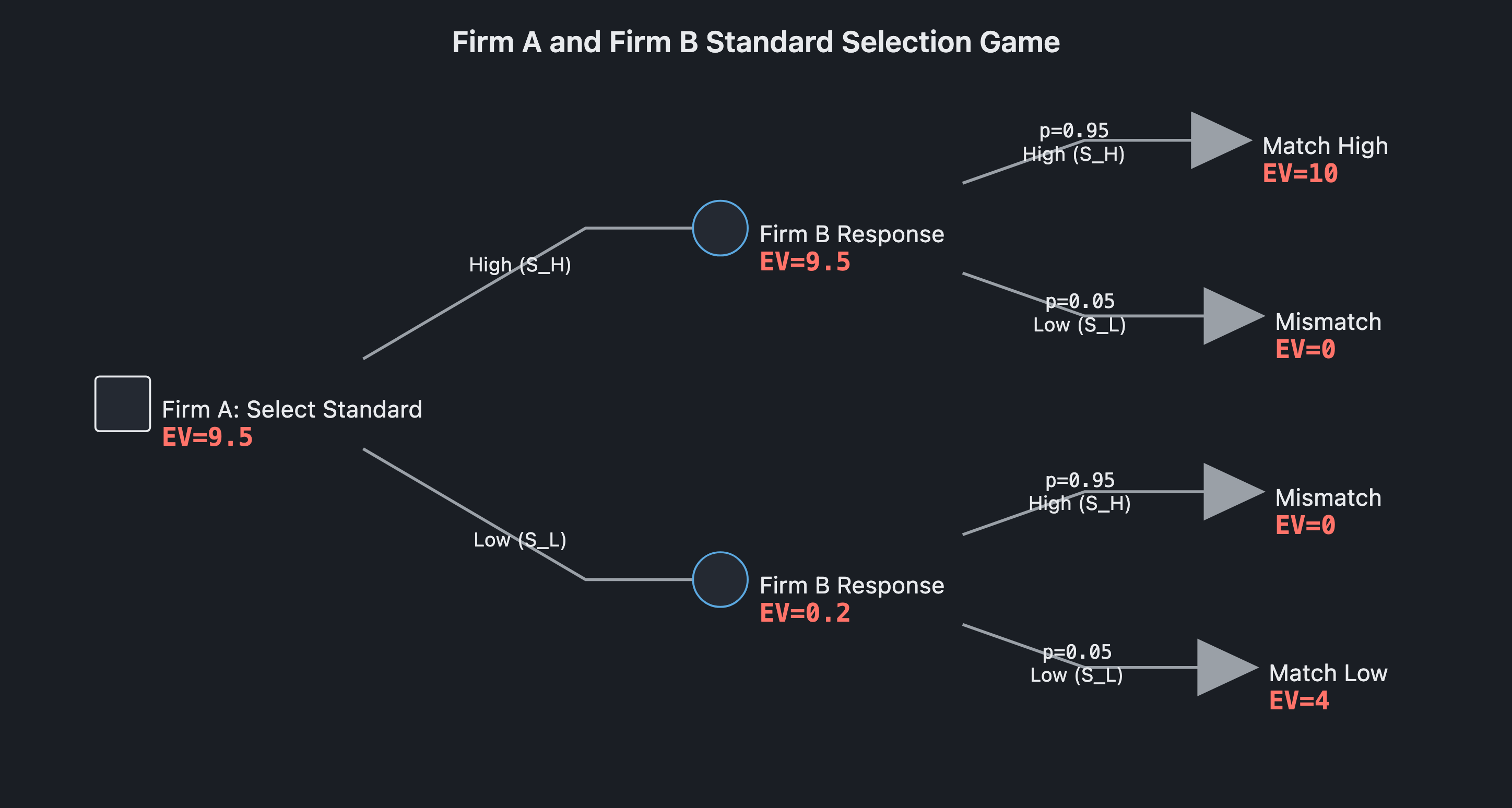
Payoff primitives: Each firm’s actual payoff is a function of revenue from interoperable customers (matched standard), revenue from ecosystem access (installed base, complementors), and the strategic cost of rival gatekeeping. Canonical payoff matrix (symmetric 2-standard case, illustrative values): match on the higher-salience standard ($S_H$) → (10,10); match on the lower-salience standard ($S_L$) → (4,4); mismatch → (0,0). Match on the higher-salience standard pays most (existing-ecosystem compatibility, lower consumer friction, established network effects); match on the lower-salience standard pays positively but less (cost of building a new ecosystem); mismatch pays zero (incompatible products, market fracture, stranded R&D). Asymmetric-payoff note: If one standard has a larger installed base, its matched cell rises via network-effect spillovers, making it a Pareto-dominant Nash Equilibrium and selection trivial. The analytically interesting Schelling case is roughly-balanced standards ex ante.
Missing-player flag: Customers / end-users, regulators / antitrust authorities, complementors, industry consortia, and Firm B’s specific customers are reactive third parties whose response would shift the equilibrium. Their inclusion is recommended if their behaviour is observable; their absence is named here so the equilibrium below is read as bounded-to-the-current-inventory.
2. Game classification
Timing: simultaneous.
Information: complete; imperfect.
Duration: one-shot (canonical).
Sum: pure coordination, positive-sum.
Reasoning per classification: Firms “independently pick” with no communication, meaning each chooses without observing the other’s move (simultaneous). The strategy set and payoff matrix are common knowledge as industry structure is observable (complete), but each firm’s own choice is unobserved by the other until both commit (imperfect). The interaction is framed as a singular standard-selection event with high switching costs, ruling out sequential commitment (one-shot). “Both gain only if they match” is the textbook signature of a pure coordination game (distinct from anti-coordination/Chicken): mutual coordination strictly dominates non-coordination; matched cells are positive, mismatched cells are zero-or-negative. The game has N pure-strategy Nash Equilibria, one per standard, where N = |strategy set|.
3. Equilibrium analysis
Equilibrium method: Nash equilibrium (solution concept) + Schelling focal point (equilibrium-selection device). Subgame perfection/backward induction do not apply (no sequential moves); Perfect Bayesian does not apply (no private type information) in the canonical classification.
Derivation: (1) Best responses: if the rival chooses a given standard, matching it dominates mismatching (e.g., 10 > 0 or 4 > 0). (2) This yields two (or N) pure-strategy Nash Equilibria, one per matched standard, each surviving the no-unilateral-deviation test. (3) No pure NE exists on mismatched cells: a mismatching firm always has a profitable deviation to the rival’s standard (0 → 4 or 10). (4) A uniform mixed-strategy NE also exists under symmetric payoffs; it is Pareto-dominated by every pure NE and is not the predicted focal-point outcome. (5) Selection refinement: where one matched equilibrium Pareto-dominates ($S_H$ over $S_L$ because $a_H > a_L$ for both players), and applying Schelling salience reasoning, each rational agent knows the other is rational and gravitates to the prominent, payoff-dominant, highest-salience option to guarantee a match. Both firms independently converge on $S_H$.
Stability: Matched profiles are stable (no profitable unilateral deviation); mismatched profiles and the mixed NE are unstable/Pareto-dominated.
Reader-reproducibility check: A reader can reconstruct this equilibrium from the players (Firm A, Firm B), payoffs (10,10 for $S_H$; 4,4 for $S_L$; 0,0 for mismatch), and the method (best-response mapping yielding pure NEs, refined by Pareto dominance and the Schelling salience hierarchy).
Bounded-rationality note: the equilibrium above assumes perfect rationality. Real-actor deviations (cognitive bias, political constraint, incomplete preference orderings) shift expected play toward suboptimal coordination; the recommendation in section 6 accounts for this. Specifically: “Not Invented Here” bias or executive overconfidence can lead firms to overweight their own sunk R&D, expecting the rival to capitulate, which can result in a mutually destructive (0,0) mismatch if both suffer this bias. Status-quo bias, herd behavior, and anchoring also mean real firms often converge on a less optimal focal point than the rational salience hierarchy predicts, because bounded-rationality cues outweigh rationally-weighted hierarchy.
4. Credibility assessment
- credibility: cheap talk — Verbal announcement “We will exclusively build [standard], you must match or we walk away,” with no sunk cost, no binding contract, reversible at zero cost. Why dismissible if cheap talk: In a simultaneous no-communication game it carries no commitment device; it is costless to make and costless to ignore. A rational rival recognizes that the announcer walking away yields the announcer 0, worse than capitulating to the higher-salience standard for a positive payoff.
- credibility: credible — “We will exclusively build $S_L$” backed by a visible irreversible sunk cost (e.g., a 10-year legally binding exclusivity contract with a major component foundry plus publicly incinerated $S_H$ tooling). Commitment device or future-shadow if credible: This structurally eliminates the committed firm’s ability to play $S_H$. The rival’s best response is forced: facing a counterparty only capable of $S_L$, matching $S_L$ pays 4 versus 0 for $S_H$.
- credibility: credible — “We will commit to S₁” backed by visible R&D investment, manufacturing capacity, and customer pre-orders. Commitment device or future-shadow if credible: Sunk cost, public signal, and reputational cost of reversal make the commitment credible.
- credibility: credible — “We will commit to S₁” backed by open-licensing the standard. Commitment device or future-shadow if credible: Public, contractually anchored, asymmetrically costly to reverse (a license grant is hard to retract); also removes the rival’s lock-in objection.
- credibility: credible — “S₁ is regulatorily mandated.” Commitment device or future-shadow if credible: Commitment originates outside both firms’ control; the third party supplies the credibility.
- credibility: credible — “S₁ has a larger installed base.” Commitment device or future-shadow if credible: Not a threat but a shared, independently verifiable fact that anchors salience.
Audit lesson: Focal-point selection is not persuasion or anticipation of rhetoric; it is selection by mutually observable, costly, or third-party-anchored cues. Sunk costs, public commitments, and external mandates move focal points; announcements do not.
5. Alternative structures
- Alternative classification: Sequential / perfect information.
- What changes: Firm 1 moves first; Firm 2 observes before acting, absent a commitment device. Trace via backward induction: Firm 2’s node — match whatever Firm 1 chose (10 > 0 or 4 > 0); Firm 1’s node, anticipating this — choose $S_H$ (10) over $S_L$ (4). Unique SPNE: ($S_H$, $S_H$).
- Implication for the dominant analysis: The Pareto-dominant focal point holds robustly even under sequential timing, unless the first mover pairs the move with an irreversible commitment device that alters the rival’s payoffs or available strategies. Timing change alone does not destabilize the focal point.
- Alternative classification: Repeated game.
- What changes: If firms meet again on the next product cycle, the game becomes a repeated coordination game (method: repeated-game folk theorem + per-period Schelling selection). The deviation problem is convention-switching, not cheating. Firms solve cross-equilibrium selection by trading conventions across periods (e.g., reciprocal concession: Firm 1 concedes and matches Firm 2’s $S_L$ in Generation 1 on the implicit understanding that Firm 2 matches Firm 1’s $S_H$ in Generation 2).
- Implication for the dominant analysis: Focal points become path-dependent on the first-period outcome (status-quo bias becomes a real force); the repeated version sustains coordination on whatever focal point the first period picks — even a non-salience-optimal one — because of switching costs. This explains why incumbent standards persist (e.g., VHS-over-Betamax).
- Alternative classification: Incomplete-information / Bayesian.
- What changes: If one firm is uncertain about the rival’s switching cost, capability, or customer base, the game becomes a Bayesian coordination game (method: Perfect Bayesian Equilibrium).
- Implication for the dominant analysis: The focal point is the standard salient across types — typically the open, regulatorily-endorsed one, since closed/proprietary standards may be focal only for certain rival types.
- Alternative classification: Anti-coordination / Chicken.
- What changes: If a standard confers strategic advantage (a closed standard lets its controller extract rents from the rival), the game becomes anti-coordination.
- Implication for the dominant analysis: The Schelling common-interest logic breaks down — there is no shared point to coordinate on, resulting in a mixed-strategy NE where each firm randomizes. This is why closed standards sometimes fail to become focal.
6. Strategic recommendations
- Deploy a sunk-cost commitment device — mechanism it leverages: commitment. Expected equilibrium shift: Converts cheap talk into a credible signal, moving the cue from “claim” to “commitment” and altering the rival’s best-response calculation (forcing them to match your chosen standard rather than the naturally higher-salience one).
- Open-license the standard — mechanism it leverages: credibility shift / payoff alteration. Expected equilibrium shift: Removes the rival’s lock-in objection, moving the standard up the openness cue, increasing the rival’s expected payoff from matching and making it a more attractive focal point.
- Build complementor and customer installed base early — mechanism it leverages: payoff alteration. Expected equilibrium shift: Converts a balanced contest into an asymmetric one where the network-effect cue points decisively at your standard, making it Pareto-dominant.
- Pursue regulatory endorsement or mandate — mechanism it leverages: credibility shift (third-party). Expected equilibrium shift: Moves the standard to the top of the salience hierarchy, narrowing the rival’s response options sharply and making non-compliance costly.
- Alter the information structure to create first-mover advantage — mechanism it leverages: classification-dimension alteration. Expected equilibrium shift: Forces the game from simultaneous/imperfect to sequential/perfect by making your choice observable before the rival acts (backed by the commitment device), enabling the rival’s backward induction toward matching you.
- Directly alter the payoff matrix via side-payments or third-party leverage — mechanism it leverages: payoff alteration / coalition formation. Expected equilibrium shift: Subsidize the rival’s transition costs or secure regulator/industry-body certification, inflating your standard’s payoff for the rival (e.g., turning a 4 into an 11), making coordination on your standard financially rational for the rival rather than coercing it.
Decision rule for matching vs. defecting: Match if the focal point is regulatorily mandated, the rival has built a substantial installed base, or the rival’s standard is open (no gatekeeping cost). Defect only if you can establish your own asymmetric installed base AND the rival’s standard is closed AND the switch is not regulatorily blocked. Test for cheap talk: if the rival’s commitment is purely verbal, defection is profitable; if sunk-cost-anchored, defect only with asymmetric capability.
Additional considerations
The specific named focal point is determinable only against the actual candidate standards’ cue structure. Absent real options, the analysis supplies the convergence mechanism (salience hierarchy + Pareto-dominance + Schelling selection) and a determinate answer conditional on the cue structure.
The salience cues, in priority order, are: (1) regulatory/legal mandate (strongest, non-compliance costly and public); (2) installed base / network-effect magnitude; (3) industry-consortium endorsement (reduces gatekeeping worry); (4) openness (neither firm wants lock-in to rival’s licensing terms); (5) backward compatibility (lower switching cost); (6) first-mover public commitment (R&D, capacity, partnerships); (7) pre-existing incumbency / path dependence.
Concrete Application Vignette: If S₁ = new open standard (no installed base, no mandate) and S₂ = proprietary incumbent (~60% installed base, no mandate), the cues evaluate as: installed base favors S₂ decisively; consortia favor S₁; openness favors S₁; incumbency favors S₂. With the ordering “installed base > openness > consortia > incumbency,” S₂’s installed-base cue outranks S₁’s openness/consortia cues, making S₂ focal. However, if S₂’s installed base is only marginally larger (e.g., 55/45), the openness cue can tip toward S₁. If a regulator mandates openness, S₁ becomes focal regardless. The framework is deterministic given the cue ordering; the contest is in measuring the cues and applying the order. Valid real-world illustrations include the EU USB-C common-charger mandate and the ATSC US digital-TV standards, which act as top-tier regulatory focal cues, and VHS-over-Betamax, a textbook case of repeated-game focal-point migration via installed-base dynamics.
(visual rendered — see artifact)
Players and Payoffs
| Player | Analysis |
|---|
| Firm 1 — Actual value terms (not claimed-to-want): dominated by (a) market-wide adoption volume, which requires matching the rival so the combined installed base clears the network-effect threshold — matching matters more than which standard wins, because a split market halves the addressable installed base — and (b) a secondary, divergent interest in having its own proprietary standard win, capturing licensing rents, avoiding switching costs, avoiding stranded R&D. How these were inferred: revealed-by-behaviour (the dominant term is compatibility with where the rest of the market lands, not intrinsic quality). Note where actual diverges from claimed: each firm publicly frames its choice as “the best standard for consumers / technical merit,” but the revealed driver is being where the market lands — which is exactly why a technically inferior standard can win if it is focal. | |
| Firm 2 — Actual value terms (not claimed-to-want): structurally identical to Firm 1 — rival in the same network-effect product market (connectors, file formats, charging protocols, messaging interop), independently choosing a technical standard, with the same dual interest in matching (for the network pie) and in its own standard winning (for the rents). How these were inferred: structural-position (symmetric rival) plus revealed-by-behaviour. Note where actual diverges from claimed: same claimed-vs-actual gap. | |
Because of interest (b), the realistic case is not pure coordination but coordination with a distributional-conflict layer (Battle-of-the-Sexes structure), unless the two standards are genuinely indifferent to both firms.
A scope note before the matrices: “the focal Schelling point” must not be accepted uncritically. Focal points are not fully derivable from the payoff matrix — Schelling’s core argument. The honest answer separates two layers, kept strictly distinct because collapsing them is the most common error: (1) the formal structure — coordination equilibria exist, and matrix refinements (payoff dominance, risk dominance) bear on selection; (2) the contextual layer that breaks any symmetry the refinements leave. The prompt is industry-agnostic; a concrete instance — two consumer-electronics firms choosing a device charging/connector standard — sits over the generic structure. Changing the industry (wireless protocol, file format, rail gauge, payment rail) changes the salience inputs, not the equilibrium machinery.
Payoff matrices (ordinal). All diagonal-only; mismatch pays 0 to both.
- Symmetric pure-matching matrix (1,1 / 0,0 / 0,0 / 1,1): neither standard better — no payoff cue. The canonical Schelling case where focality does all selection work; this is the user’s literal question.
- Payoff-asymmetric coordination matrix (one parameterization: 3,3 / 0,0 / 0,0 / 2,2; another: 2,2 / 0,0 / 0,0 / 1,1): both firms slightly prefer A (lower-cost/superior, or the incumbent unlocking a larger installed base), but any match beats any mismatch. The asymmetry is the focal lever that lets matrix refinements bite. The two numeric parameterizations are surface variation on the same asymmetric-coordination structure; each reproduces its own derivation below.
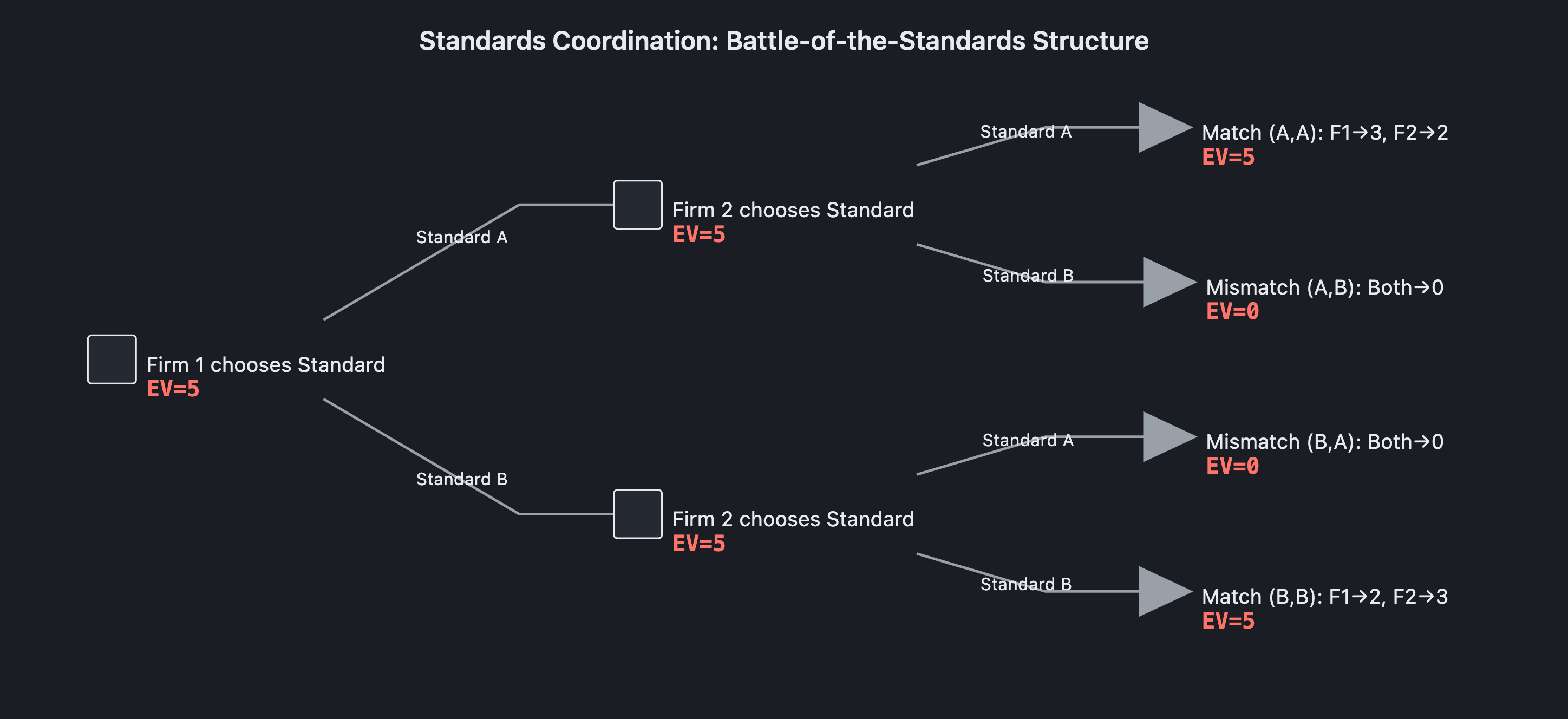
- Mixed-motive Battle-of-the-Standards matrix (3,2 / 0,0 / 0,0 / 2,3): both diagonals are Nash, but F1 prefers (A,A) and F2 prefers (B,B). The realistic conflicted case.
Missing-player flag: Consumers/installed base, standards-setting bodies, the competition regulator, and complementors/suppliers are reactive third parties whose responses would shift the equilibrium — they are in fact the actual sources of and threats to focality. Their inclusion is recommended where their behaviour is observable; their absence is named here so the equilibrium below is read as bounded-to-the-current-inventory. The two-firm frame relocates the real action (focality) into “context” precisely because the focality-generating players sit outside the model; a complete treatment is n-player. (Full treatment of these players appears in the alternative-structures and recommendation sections.)
Game Classification
Timing: simultaneous. Firms “independently pick” with no observed move order; normal-form, not extensive-form. Load-bearing: the absence of observed sequencing creates the coordination problem; observable first-move largely dissolves it.
Information: complete but imperfect. Complete: payoff structure and strategy sets are common knowledge (both know matching pays). Imperfect: neither observes the other’s move at decision time. The real incompleteness is second-order — each is uncertain what the other believes is salient; this is where focal-point reasoning lives. If firms were also uncertain of each other’s payoffs, the game shifts to incomplete information, which changes selection logic (tested in alternatives), not just the label.
Duration: framed one-shot; actually repeated. Honored as one-shot for the base derivation, but standard-setting recurs each product cycle; the static frame is almost certainly the wrong model (static-frame-trap, developed below).
Sum: positive-sum, multiple equilibria (pure coordination); mixed-motive in the conflicted case. Matching creates joint surplus (the network-effect pie is created by coordination, not divided); interests are aligned on whether to match, with only a selection problem over which equilibrium. Becomes mixed when the distributional which-standard layer is added.
Equilibrium Analysis
Equilibrium method: pure-strategy Nash enumeration → mixed-strategy Nash → matrix refinements (payoff dominance, risk dominance) → Schelling focal-point selection among equilibria.
Derivation:
Pure-strategy Nash (unilateral-deviation test): (A,A) and (B,B) are both Nash — any deviation drops the payoff to 0; (A,B) and (B,A) are not — the 0-payoff firm always wants to switch. Two pure equilibria.
Mixed-strategy Nash (from the indifference condition):
- Asymmetric matrix (3,3 / 2,2): 3p = 2(1−p) → p = 0.4; expected payoff 1.2; mismatch probability 0.48.
- Asymmetric matrix (2,2 / 1,1): 2q = 1(1−q) → q = 1/3; expected payoff 2/3; match only 5/9 of the time [(1/3)(1/3) + (2/3)(2/3) = 5/9]; miscoordinate 4/9 ≈ 44%.
- The mixed equilibrium is strictly inefficient — its residual miscoordination is the formal statement of why an equilibrium-selection device is needed. Pure rationality alone leaves firms exposed to coordination failure.
Refinements in the asymmetric matrix: payoff dominance — (A,A) Pareto-dominates (B,B). Risk dominance — deviation-loss products 3×3 = 9 at (A,A) vs 2×2 = 4 at (B,B), so (A,A) is risk-dominant; equivalently the belief-basin favoring A is larger (mass 0.6 vs 0.4). Both refinements converge on A.
Symmetric matrix — refinements go silent: pure equilibria remain; mixed weight = 0.5; payoff dominance silent (both pay 1); risk dominance silent (products 1×1 on both sides; basins 0.5/0.5). The matrix selects nothing — the pure Schelling problem; only a contextual cue both firms recognize (common knowledge of salience) breaks the tie.
Focal-cue hierarchy (rough order of strength): (1) incumbent / installed-base standard — history supplies a unique label regardless of merit (QWERTY lock-in); (2) salient third-party endorsement — standards body (IEEE, USB-IF, ISO), dominant platform, or regulator manufactures focality by creating common knowledge of one label; (3) precedent / prominence — last generation’s standard, or the larger firm’s; (4) payoff/risk dominance — only when the matrix is asymmetric enough to break the tie.
Predicted convergence: (A,A) — the most salient / incumbent standard — not because A is technically superior (B may be) but because A is the option each firm expects the other to expect (common-knowledge cascade terminates on A). Schelling’s point: the solution need not be optimal, only mutually expected.
Isolation variants (separating salience from payoff arithmetic):
- Tied-payoff variant ((A,A) = (B,B)): payoff prominence vanishes, mixed equilibrium at q = 1/2, Nash completely silent on selection — yet installed-base salience plus common knowledge still single out A. Clean demonstration that the Schelling selector is salience, not the efficiency gap the asymmetric matrix happens to supply.
- Cue-conflict variant (B genuinely superior, e.g. (A,A) = 1, (B,B) = 2): Pareto-dominance points to B, installed-base salience points to A. Salience typically beats efficiency when they diverge, because coordinating on the expected option is safer than each firm independently betting the other computed and acted on the efficiency cue. This is the QWERTY / inferior-lock-in outcome.
- Two-competing-installed-bases variant: each firm has its own entrenched legacy standard, so there is no shared salience cue; the cascade has no fixed point, the convergence prediction fails, and (0,0) mismatch becomes likely. The structural twin of the cultural-projection trap and the realistic standards-war between entrenched rivals.
Stability: at each pure equilibrium, no unilateral deviation is profitable (it drops the deviator to 0). The mixed equilibrium is unstable in the practical sense that its 4/9 ≈ 44% miscoordination rate is what makes a selection device valuable; it is an equilibrium but an inefficient one. The (A,A) focal selection is stable to the extent that the salience cue is shared — it breaks down in the two-competing-installed-bases variant where no shared cue exists.
Reader-reproducibility check: a reader can reconstruct each equilibrium from the matrices in section 1, the unilateral-deviation test, the indifference-condition mixing weights, and the two refinement computations (Pareto comparison and deviation-loss products), then apply the focal-cue hierarchy to select among the pure equilibria.
Disciplined claim on selection: selection is underdetermined by the matrix — refinements narrow it (sometimes decisively, in the asymmetric case where two independent refinements converge on A), but in the symmetric and mixed-motive cases context (history, institutions, commitment) does the selecting. Confidence that convergence-on-the-focal-option holds is high; the direction (A vs B) is empirical, not a theorem.
Bounded-rationality note: the equilibrium above assumes both firms compute payoff/risk dominance and trust the other to do the same. Real-actor deviations shift expected play toward coordination failure even when a refinement points cleanly at A:
- Egocentric / own-standard projection — each firm sees its own standard as obviously superior, so both think they are in a pure-coordination game converging on “the better one (mine)” when they are actually in the mixed-motive game; systematically produces the (0,0) mismatch cells (standards wars destroying joint value).
- Cultural / reference-frame projection — focal salience depends on a shared cultural/reference frame; Schelling’s documented point is that whether something is focal “depends on cultural context and the relationship of the people trying to coordinate.” When frames are not shared, the mechanism fails and two firms each convinced their option is focal coordinate on a mismatch despite aligned interests — the formal twin of the two-installed-bases variant. (The descriptive label “cultural-projection failure” is a gloss, not a verbatim Schelling coinage; the underlying concept is correctly his.)
- Salience ≠ payoff — boundedly rational firms latch onto whatever is most cognitively available (loudest brand, most recent press release) rather than the dominant cue; focality in practice is driven by attention, not optimization — which is Schelling’s actual claim and why marketing and standards-body theater matter.
- Status-quo / sunk-cost bias — a firm over-weights its existing investment and refuses the rival’s standard even when that has become focal market-wide.
- Incomplete preference orderings — internal politics (engineering favors one standard, sales another) can prevent a firm from acting on a coherent payoff ranking at all.
The hyperrationality-trap is assuming firms will “just coordinate on A because it’s better”; the mixed equilibrium and the egocentric/cultural biases all predict real coordination failure. The recommendations in section 6 account for this by competing on commitment and salience rather than on being demonstrably “right.” A probability-discipline note: the mixing weights (0.4, 0.5, 1/3) are equilibrium strategy choices derived from indifference conditions — a mixed strategy is itself a deliberate choice the player commits to. No probability is attached to any decision-node edge; decision nodes are choices.
Credibility Assessment
- credibility: base game, literally framed (independent choice, no communication) —
cheap talk by construction. There are no threats or promises to audit: none could be sent (no channel) and none would be credible without a commitment device. Why dismissible: stating this honestly is the correct move rather than inventing threats.
- credibility: pre-announcement (“we will adopt/ship Standard X”) —
cheap talk. Why dismissible: costless and reversible before a simultaneous move — a firm can announce one standard and quietly build the other; it does not move the rival’s beliefs or the equilibrium.
- credibility: sunk material commitment (“we have retooled the factory / shipped 10M units / licensed a complementor ecosystem on X”) —
credible. Commitment device: sunk-cost — reversing destroys visible non-recoverable investment, so the rival can rationally treat X as locked and best-respond by matching. This is Schelling’s core move (visibly burning your escape route); it converts the coordination problem into something near a sequential game where the committed firm has effectively moved first. This is how a firm relocates the focal point off the incumbent — not by arguing X is better, but by making X what the rival now expects everyone to expect.
- credibility: patent-pool exclusion (“adopt our standard or we cut you from the pool”) —
conditional. Commitment device / future-shadow: credible only if the pool has independent value to the threatener and exclusion is verifiable/enforceable; credibility rests on the future-shadow of the patent relationship. Why partly dismissible: if carrying out exclusion also costs the threatener (lost licensing revenue), it is partly cheap talk; absent the enforceable future-shadow it is a bluff.
- credibility: standards body’s “Standard A is the ratified norm” —
credible as a focal device, not as a threat. Commitment device: the body usually cannot punish defection but does not need to — it manufactures common knowledge of a single salient label. Its power is coordinative, not coercive.
Load-bearing distinction: announcements relocate nothing; partially irreversible material commitments relocate the focal point.
Alternative Structures
-
Alternative classification: sequential timing (extensive form) — change on the timing dimension. What changes: Firm 1 commits observably first; Firm 2 observes and responds. By backward induction, at F2’s node F2 always matches (match > 0); folding back, F1 picks its preferred diagonal → A. The result is subgame-perfect equilibrium (A,A), and the mixed-strategy miscoordination disappears. Implication for the dominant analysis: robustness is conditional on two enabling assumptions — (a) perfect observability (F2 sees the committed choice before moving) and (b) irreversibility (F1’s move cannot be quietly unwound). If either fails, the game collapses back toward the simultaneous case with its 4/9 miscoordination risk — the same observability-plus-irreversibility line that separates a credible first move from cheap talk. The strategic lever is to manufacture sequencing.
-
Alternative classification: mixed-motive (Battle of the Standards), matrix (3,2 / 2,3) — change on the sum dimension (pure coordination → mixed-motive). What changes: both diagonals are Nash, but firms disagree on which they prefer; payoff dominance no longer selects (equilibria are payoff-symmetric across firms) and risk dominance is symmetric. Focality must come purely from external cues — incumbency, third-party endorsement, or a credible first-commitment. Implication for the dominant analysis: the lesson inverts — the focal point is whichever standard a commitment device or salient institution privileges, not the better one; technical merit stops being the cue once private rents diverge. Standards-war pattern: Blu-ray vs HD-DVD, where studio/retailer commitments — Warner’s January 2008 defection to Blu-ray exclusivity, not intrinsic disc merit — decided it. (“Not disc quality” is field-consensus interpretive reading, not a hard fact.)
-
Alternative classification: incomplete information (global games, Carlsson–van Damme) — change on the information dimension. What changes: each firm observes its own payoffs plus a small noisy signal of the rival’s. A small dose of payoff uncertainty can uniquely select the risk-dominant equilibrium, eliminating the multiplicity the complete-information game leaves open — uniquely selecting A in the asymmetric matrix, doing nothing in the symmetric matrix (no risk-dominance asymmetry to latch onto). Implication for the dominant analysis: this is the one alternative that partially rebuts the “matrix can’t select” intuition — but only where an asymmetry already exists.
-
Alternative classification: costly signaling (information-structure alteration). What changes: if firms can cheaply but credibly signal (not merely talk) which standard they are tooling for, second-order uncertainty collapses and the efficient equilibrium (A,A) is reached without a first-mover sacrifice. Implication for the dominant analysis: coordination failure here is fundamentally an information-alignment failure, not a preference conflict — which points to a cheaper remedy than full commitment.
-
Alternative classification: repeated / infinite-horizon (folk-theorem) duration — change on the duration dimension; the one-shot frame is almost certainly wrong (static-frame-trap). What changes: with a long shadow of the future, a mismatch this round is correctable next round; “we matched on A last generation, keep matching on A” — the prior round’s outcome becomes the next round’s focal point (Schelling’s precedent cue operating through time). Repetition creates focality even in the symmetric matrix where no static cue existed; the convention is self-enforcing because deviating from an established match costs the deviator the network benefit with no offsetting gain. Lock-in: repetition stabilizes and entrenches whichever focal point first emerged, efficient or not (path dependence) — the installed base from prior rounds is the cue. Standard reciprocity: a firm that defected to a private standard and fragmented the market last cycle is expected to defect again, raising the rival’s incentive to pre-commit defensively. Implication for the dominant analysis: repetition need not manufacture cooperation (interests already align) — it locks in the selection, which is why early focal-point capture is so strategically valuable. The Axelrod generalization: coordination emerges from the shadow of future interaction, not one-shot brilliance; most real standard coordination is solved by precedent accumulated through repeated interaction.
Reactive players whose responses shift the equilibrium (the model is bounded; a complete model is n-player):
- Consumers / installed base — their adoption makes network effects real and is the source of A’s salience; their switching costs are why the incumbent is focal. If the installed base is small or fragmented, A’s focal advantage evaporates and the game becomes genuinely symmetric.
- Two competing installed bases — the boundary case where the central (A,A) prediction fails: no shared focal cue, mismatch (0,0) likely. The single-shared-incumbent assumption is load-bearing for the central prediction and is exactly what breaks in real standards wars between entrenched rivals.
- Standards-setting bodies / regulators — focal-point manufacturers who can collapse the game to a single equilibrium by fiat. The EU mandating USB-C (Directive (EU) 2022/2380; in effect 28 December 2024 for phones/tablets/cameras, laptops from 28 April 2026) is an exogenous move that does this.
- Competition regulator (distinct from a standards body) — where an SDO manufactures focality, the antitrust authority can void an explicit-coordination equilibrium after the fact: a cartel finding or interoperability remedy is a move that flips the payoffs of the cooperative cell. A complete model treats its anticipated response as shaping whether explicit coordination is even available.
- Complementors / suppliers (chipmakers, accessory makers, app developers, content providers) — they coordinate on the firms; their pre-commitments tip which standard becomes self-fulfilling.
- Yellow-hat reframing (opportunity, not only hazard): the same structure that makes coordination legally risky makes focal-point entrepreneurship positive-sum — a firm that engineers salience (convening a consortium, getting a body to ratify, publishing an open spec the regulator can bless) creates the network-effect pie that fragmentation destroys, capturing the lead-firm advantage while expanding the market.
Strategic Recommendations
-
Convert simultaneity into sequence — commit first, visibly and irreversibly. Mechanism it leverages: timing alteration (simultaneous → sequential) plus sunk-cost commitment device. Don’t announce (cheap talk); sink cost conspicuously (retool, ship volume, contractually penalized roadmap), ensuring the move is observable and irreversible. Expected equilibrium shift: backward induction then makes the rival match, achieving the subgame-perfect (A,A) where you also capture the distributional advantage — converting the 4/9-miscoordination mixed equilibrium into a clean match. Highest-leverage action.
-
Manufacture focality via a salient third party. Mechanism it leverages: focal-cue creation. Get a standards body, dominant platform, or regulator to endorse your standard. Expected equilibrium shift: creates common knowledge of a single label — the only thing that resolves the mixed-motive case and the symmetric matrix where payoff/risk dominance fail.
-
Exploit precedent in the repeated game. Mechanism it leverages: future-shadow. If you hold the prior-generation installed base, make continuity the explicit cue (“backward compatible with the standard you already own”). Expected equilibrium shift: the shadow of repeated interaction makes the incumbent self-enforcing — defend it rather than re-litigating each round.
-
Diagnose which game you are in before acting. Mechanism it leverages: classification (correct game identification). If proprietary rents diverge you are in Battle-of-the-Standards, not pure coordination. Expected equilibrium shift: stop competing on technical merit (which moves nothing once payoffs diverge) and compete on commitment and salience. Misclassifying the conflicted game as pure coordination is the most expensive error available, because it leads you to invest in being “right” rather than “focal.”
-
Open a costly signaling channel short of full commitment. Mechanism it leverages: information-structure alteration. A cheaper credible signal (public roadmap with sunk demos) can collapse second-order uncertainty. Expected equilibrium shift: reaches (A,A) without a unilateral first-mover sacrifice.
-
Where matching is socially valuable but firms keep mismatching, coordinate explicitly / invite the regulator-SDO. Mechanism it leverages: classification alteration / mechanism design / missing-player activation. Cross-licensing or a joint consortium converts the non-cooperative game into a cooperative one (the cleanest escape from the mismatch cells) — but model the competition regulator as a reactive player whose anticipated response can void the cooperative cell. Expected equilibrium shift: a mandated standard is the decisive remedy in the two-competing-installed-bases case where no firm-level focal cue exists. Framed positively, this is focal-point entrepreneurship, subject to antitrust limits.
The Focal Schelling Point — Bottom Line
Operational answer: two rival firms converge on the most salient standard — typically the installed-base incumbent or a standards-body-ratified label — because salience, not payoff, supplies common knowledge of a single choice.
- Symmetric matching case (no standard better): the matrix selects nothing — payoff and risk dominance both silent — and convergence goes entirely to the externally salient cue (incumbency, third-party endorsement, precedent). The pure Schelling case; focality does all the work.
- Payoff-asymmetric coordination case: the focal point is the payoff- and risk-dominant standard (A) — both refinements converge, and a small dose of incomplete information (global games) can make the selection unique. The matrix gets you most of the way.
- Realistic mixed-motive case: no matrix-derivable focal point — refinements go symmetric; convergence goes to whichever standard carries the strongest external cue (incumbency, third-party endorsement, credible first-commitment), frequently not the technically superior one.
Disciplined claim: selection is underdetermined by the matrix — refinements narrow it (sometimes decisively, in the asymmetric case), but in the symmetric and mixed-motive cases context (history, institutions, commitment) does the selecting. Treating “the better standard wins by focality” as a general law is the trap; it holds only when the matrix carries a payoff/risk-dominance asymmetry — which is exactly why Schelling needed a concept beyond Nash to describe the rest.
A note on the confidence boundaries: the direction of the focal point (incumbent A rather than cleaner B) depends on the industry’s installed-base size and switching-cost data — the machinery predicts that firms converge on the focal option and why; which option is focal is set by the real salience inputs. The “not disc quality” reading of Blu-ray/HD-DVD is field-consensus, not a hard fact (no counterfactual study isolating technical merit from commitment effects exists); the “cultural-projection failure” label is a descriptive gloss on a genuinely Schelling concept. The two-firm frame omits consumers, standards bodies, and the competition regulator — the actual sources of and threats to focality — so it relocates the real action into “context” precisely because the focality-generating players sit outside the model; a complete treatment is n-player.
(visual rendered — see artifact)