The structure of the problem
Two asymmetries do the work, and they pull in opposite directions:
- Capability asymmetry favors the incumbent — more resources, installed base, doctrine, reach.
- Stakes/flexibility asymmetry favors the challenger — for the small player the fight is existential (high resolve, nothing to protect), and it has no sunk commitments to defend, so it can choose the terrain.
The whole game turns on the fact that the incumbent’s strength is committed — sunk into a particular form (a doctrine, a product line, an installed base, a force structure). That makes it powerful on its own terrain and structurally unable to leave it. Strength and rigidity are the same fact viewed twice.
A payoff matrix
Strategies. Challenger: Symmetric (fight frontally, on the incumbent’s terms) or Asymmetric (refuse those terms; attack where the committed strength can’t engage). Incumbent: Rigid (defend the core, fight conventionally) or Adapt (restructure to meet the challenger on the new terrain — but this cannibalizes the very commitment that is its strength).
Payoffs as (Challenger, Incumbent):
| Incumbent: Rigid | Incumbent: Adapt |
|---|
| Challenger: Symmetric | (−2, +3) — crushed on the strong player’s ground | (−2, +1) — incumbent wins anyway; adaptation was wasted spend |
| Challenger: Asymmetric | (+2, −1) — committed strength is stranded; challenger gains the new terrain | (−1, 0) — incumbent neutralizes the move but bleeds from cannibalizing its core |
Solve it:
- The challenger’s Asymmetric row dominates: +2 beats −2 against Rigid, and −1 beats −2 against Adapt. Whatever the incumbent does, refusing the incumbent’s terms is weakly better and sometimes much better. Never fight symmetric.
- The incumbent’s best reply to Asymmetric is Adapt (0 > −1). So the “textbook” Nash equilibrium is (Asymmetric, Adapt) = (−1, 0) — the incumbent successfully restructures and the challenger is contained.
That equilibrium is the trap the challenger must avoid, and the incumbent’s whole hope rests on reaching it. The challenger’s real job is to make Adapt unavailable.
Why the equilibrium collapses: non-credible adaptation
The (Asymmetric, Adapt) equilibrium only holds if Adapt is actually on the table. The premise “dominant but rigid” is precisely the claim that it is not credible:
- Switching cost. Adapting means writing off the committed advantage — the doctrine, the installed base, the capital. The cost is endogenous to being strong.
- Internal politics / commitment to existing constituents. The incumbent has promised its core stakeholders (customers, the conventional services, the existing revenue line) that it will keep serving them. Pivoting to the challenger’s terrain breaks that promise. This is exactly Christensen’s innovator’s dilemma: the rational incumbent defends its margins and declines to follow the low-end/asymmetric entrant — and that local rationality is globally fatal.
- Doctrine and time. Reorganizing a large committed system is slow; the challenger moves inside its adaptation loop.
So Adapt is dominated for the incumbent by its own structure: across the matrix Adapt earns +1 / 0 while Rigid earns +3 / −1, and the incumbent’s institutions weight the +3 (defend the profitable core) far above avoiding the −1. The incumbent has a near-dominant pull toward Rigid that it cannot credibly renounce.
Once the challenger believes Rigid is forced, it reads straight down the Rigid column and lands on (Asymmetric, Rigid) = (+2, −1) — it wins. The best move is to attack exactly where adaptation would be required, because the incumbent’s commitments make that adaptation non-credible. You aim at the strength because it is load-bearing: the incumbent cannot abandon it to chase you without collapsing the thing the strength supports.
This is Arreguín-Toft’s empirical regularity stated as a game: weak actors win disproportionately when they adopt the opposite strategic approach to the strong actor (guerrilla vs. conventional, indirect vs. direct). Same-approach interactions let mass decide and the strong win; opposite-approach interactions neutralize mass and stretch the contest onto resolve and time, where the asymmetries flip.
Deterrence and credibility
Deterrence is a contest of credible commitment, and the asymmetries invert the usual picture:
- The incumbent’s deterrent threat is hollow on the new terrain. “Step onto my ground and I’ll crush you” is credible — but irrelevant, because the challenger won’t step there. “Follow you onto your ground and crush you there” requires executing Adapt, which is exactly the move its commitments make non-credible. A threat that is costly enough to the threatener that everyone knows it won’t be carried out deters no one (Schelling). The incumbent can threaten everything and commit to nothing on the terrain that matters.
- The challenger can manufacture credibility from weakness. Having no fallback is an asset: burning bridges, going all-in, and the sheer existential asymmetry of stakes make the challenger’s resolve credible in a way the incumbent’s cannot match. The side that cares more — and can show it cares more by foreclosing its own retreat — wins the war of resolve even while losing the war of resources.
- Force the incumbent to spread a finite deterrent over an infinite perimeter. Asymmetric attack is cheap to mount and expensive to defend everywhere. The incumbent must be strong at every point; the challenger picks one. Deterrence by denial fails against a player who only has to succeed occasionally, while the incumbent has to succeed always.
The weaker player’s best move, stated plainly
- Refuse the terms. Decline every invitation to a symmetric, frontal contest — that’s the only column where you reliably lose.
- Aim at the committed strength, not the weakness. Pick the terrain where the incumbent’s response would require it to cannibalize its core. Its strength there is real but stranded — it can’t bring it to bear without unmaking itself.
- Exploit the credibility gap. Operate precisely in the zone where the incumbent’s retaliatory and adaptive threats are non-credible because executing them is self-harming.
- Win on time and resolve, not on mass. Convert the contest from “who has more” to “who can endure and adapt faster” — the axes where your asymmetries favor you. Stay inside the incumbent’s adaptation loop so that by the time it commits to meeting you on one front, you’ve moved to the next.
The compressed version: don’t attack the incumbent where it is weak — attack where it is strong but cannot move, and make the contest about the things it can’t buy with its strength.
This analysis explores the game-theoretic dynamics of an asymmetric conflict between a weaker actor ($W$) and a dominant but rigid incumbent ($S$). The central thesis is that the dominant player’s rigidity—stemming from fixed strategies, high sunk costs, or rigid political constraints—creates a vulnerability that the weaker actor can exploit.
1. The Players and the Environment
- Player $W$ (The Challenger/Weak Actor): Has high asymmetry (mobility, adaptability, low visibility) and limited conventional capacity. Attributes: High risk tolerance, information advantage, high time pressure.
- Player $S$ (The Incumbent/Dominator): Has high conventional military/technological capacity (sheer volume, firepower). Attributes: Rigidity (Linear defense, high sunk costs, reputational constraints, slow decision cycles).
The critical game-theoretic variable here is Inflexibility. A powerful state often defends a specific “strategic redundancy” (e.g., total control over territory, specific infrastructure nodes, or established borders). This rigidity creates a Commitment Problem where $S$ cannot easily change its policy once conflict begins because establishing a flexible response would destabilize the system or backfire domestically.
We construct a payoff matrix based on Utility ($U$), taking into account military, political, and economic losses. The rigidity of $S$ is represented by high “Escalation Costs” ($C_{es}$).
| S: Yields/Accommodates | S: Accepts Fight (Direct Conventional) | S: Escalates to Asymmetric Retaliation |
|---|
| W: Submits | (0, 10) | (-1, 9) | (-5, 9) |
| W: Asymmetric Challenge | (10, 5) | (10, 0) | (5, -8) |
Analysis of the Matrix:
- Payoff (0, 10): $W$ gives up. $S$ gets full victory (Status Quo preserved).
- Payoff (10, 5): $W$ challenges, $S$ yields to avoid risk. $W$ wins due to leverage.
- Payoff (10, 0): The Asymmetric Paradox. $W$ challenges. $S$ attempts to fight conventionally where $S$ is “strong” (numerically stronger). However, because $S$ is rigid, $S$ incurs massive Operational/Political Costs (inefficiency in new terrain, high casualties in high-value areas) that outweigh the military objective. $W$ wins because the game is no longer a duel of firepower but a duel of endurance where $S$ is “clumsy.” $W$ gets 10 (survival/leverage), $S$ gets 0 (hollow victory/costly stalemate).
- Payoff (5, -8): $S$ escalates asymmetrically (e.g., cyber, terrorism). Due to $S$‘s rigidity, they cannot control the spread of violence. This backlash degrades $S$‘s domestic utility to -8 (regime instability). $W$ gets 5 (continued chaos/leverage).
Key Insight: The Nash Equilibrium shifts when $S$‘s “Yield” payoff becomes higher than their “Fight” payoff due to the unavoidable high cost of conflict entry (Rigidity Penalty).
3. The Rigidity Trap: Commitment Problems
In game theory, “rationality” requires that threats be credible. A dominant player’s threat to unleash maximum force is often non-credible to a weak player because it commits the dominant player to a high-cost scenario.
The Time-Inconsistency of Commitments
The dominant player ($S$) wants to avoid a war of attrition. However, once they commit to “conquering” the weak player, they may be forced to escalate (Gripped by Sunk Costs).
- The Weak Player’s Strategy: $W$ attacks an asset $S$ is “Strong.” (Example: A strategic port, a critical energy grid, or occupied territory).
- The Rigid Response: $S$ cannot reciprocate a游击 (guerrilla) attack with a promised “nuclear button” if domestic laws forbid it. The threat is decoupled from action.
- Result: $S$ experiences Escalation Dominance. Because $S$ is rigid (e.g., limited rules of engagement, domestic political red lines), $W$ knows exactly what $S$ will not do. This predictability allows $W$ to calibrate attacks precisely to the maximum point $S$ will not retaliate.
4. Asymmetric Warfare Dynamics
The strategy “attacking where the big player is strong” seems counter-intuitive, but game theory suggests it works because of the Domain Mismatch.
- Capability vs. Effectiveness: $S$ is “strong” in vertical capability (aerial, heavy armor, command-and-control), but “inflexible” in horizontal adaptability (urban, dense networks, blinded by legacy systems).
- The Move: $W$ does not fight $S$ where $S$ has fire superiority. $W$ attacks $S$‘s infrastructure.
- Why: This targets the supply chain where $S$ is strong but rigid. A rigid military logistics system is vulnerable to decentralized attacks (cyber, sabotage) that a flexible force can survive.
- Friction Gradient:
- $S$ moves through a friction gradient of “force.”
- $W$ moves through a friction gradient of “routine adaptation.”
- By fighting where $S$ is strong (e.g., the core economic hub), $W$ creates a friction spike that $S$ cannot absorb without breaking political norms.
- The “Green Zone” Vulnerability: $S$ fortifies “strong” points with heavy weight to ensure control. $W$ strikes these points not to take them, but to bleed the hostilities. (Attrition warfare).
5. Deterrence Failure & Signaling
Classic deterrence relies on the “Cost-Response Inequality” (Cost of $W$‘s action < Cost of $S$‘s retaliation). Against a rigid player, this fails.
- Signaling: $S$ signals strength to the world via “Strength in Numbers” (NATO, alliances, raw GDP). This signals a static position.
- The Signal of Inflexibility: When $S$ takes the ground, they signal a willingness to fight over linear geography. $W$ can see that $S$‘s rigidity makes them vulnerable to moral hazards (reputation costs).
- Deterrence Failure Mechanism:
- $W$ knows $S$ prefers peace.
- $W$ knows $S$ cannot easily back down (Nationalist rigidity).
- $W$ therefore Pushes the Crisis to the point where the cost of escalation for $S$ exceeds the cost of defeat.
- This pushes $S$ into a situation where they cannot credibly threaten war because the war they would fight is the one that loses support at home.
6. Case Study Dynamics: “The Strong but Inflexible”
Consider a scenario where $S$ controls a cyber grid (Strong Asset) with centralized protocol management (Rigid Strategy).
- $S$‘s Asset: The Server Farm (High security walls).
- $S$‘s Rigidity: Reliance on centralized protocols, legal restrictions on offensive data access, high legal liability for civil data.
- $W$‘s Move: $W$ does not attack the firewall (where $S$ is strong militarily). $W$ attacks the internal dependency. $W$ deploys ransomware or leaks specific data related to national infrastructure.
- Game Logic: The payoff for $S$ is a Crisis Game ($G$) where the payoff for fighting ($F$) is $-(Political Stability)$ and payoff for yielding ($Y$) is $-(Prestige)$. If $-(Political Stability)$ is greater (more negative), $S$ must yield.
- The weak player knows $S$‘s “Fast” constraint (can’t appeal to citizens to justify war immediately).
- Conclusion: $W$ wins by forcing $S$ to choose between “The Rigidity of Total Control” or “The Reality of Chaos.”
7. Strategic Implications for the Weaker Player
To maximize the weaker player’s payoff against a dominant but rigid incumbent:
- Exploit the Gap: The gap is between Military Capability (what $S$ has) and Operational Ability (what $S$ can actually do). Execute the attack in the Operational Gap. (e.g., Attack a navy with drones where it is “strong,” but defenses are too heavy to detect. Flex vs. Rigid).
- Signal Vindictiveness: $W$ must use Signaling to convince $S$ that the cost of war now exceeds the cost of submission. Without clear signaling, $S$ assumes $W$ will negotiate.
- Unmake the Commitment: Attack the “commitment” of the dominant player. If $S$ is flexible, $W$ attacks financing; if $S$ is rigid, $W$ attacks Reputation. Reputational damage is the highest cost for a dominant state because it can’t be “recovered” with military force.
Summary: The dominant but rigid incumbent is a “Stakeholder in Stability.” They win if the war starts, because they will “digest” the weak player. The weaker player survives only by making the conflict Sustainable for them and Sustainable for the Incumbent impossible. They attack the rigidity by refusing the incumbent’s definition of “victory” and attacking the logistics of rigidity (domestic political capital, legal frameworks, centralized command).
Players and Payoffs
The inventory below identifies the primary actors and their underlying utility structures. Payoff values ($U_W$, $U_I$) are expressed in theoretical terms derived from behavioral patterns and strategic constraints, explicitly noting where domain-specific data remains unverified.
| Actor | Strategic Position | Actual Value Terms | How Inferred | Divergence from Claimed Priority |
|---|
| Weak Actor ($W$) | Resilience / Reputation | Autonomy ($A$) and Control ($C$).
Utility: $U_W = \alpha \cdot Control + \beta \cdot Autonomy$ | Revealed-by-behaviour (attrition capacity) | Often claims “Victory” or “Regime Change” ($U > \text{End Conflict}$), but actual drive is sustained presence/control. |
| Incumbent ($I$) | Dominance / Order | Order ($O$) and Territory ($T$).
Utility: $U_I = \gamma \cdot Order + \delta \cdot Territory$ | Stated-and-confirmed (conventional capability) | Often claims “Restoration of Complete Authority” ($U = \text{Max Order}$), but inertia creates rigidity in achieving it. |
Interaction Payoff Matrix (Theoretical):
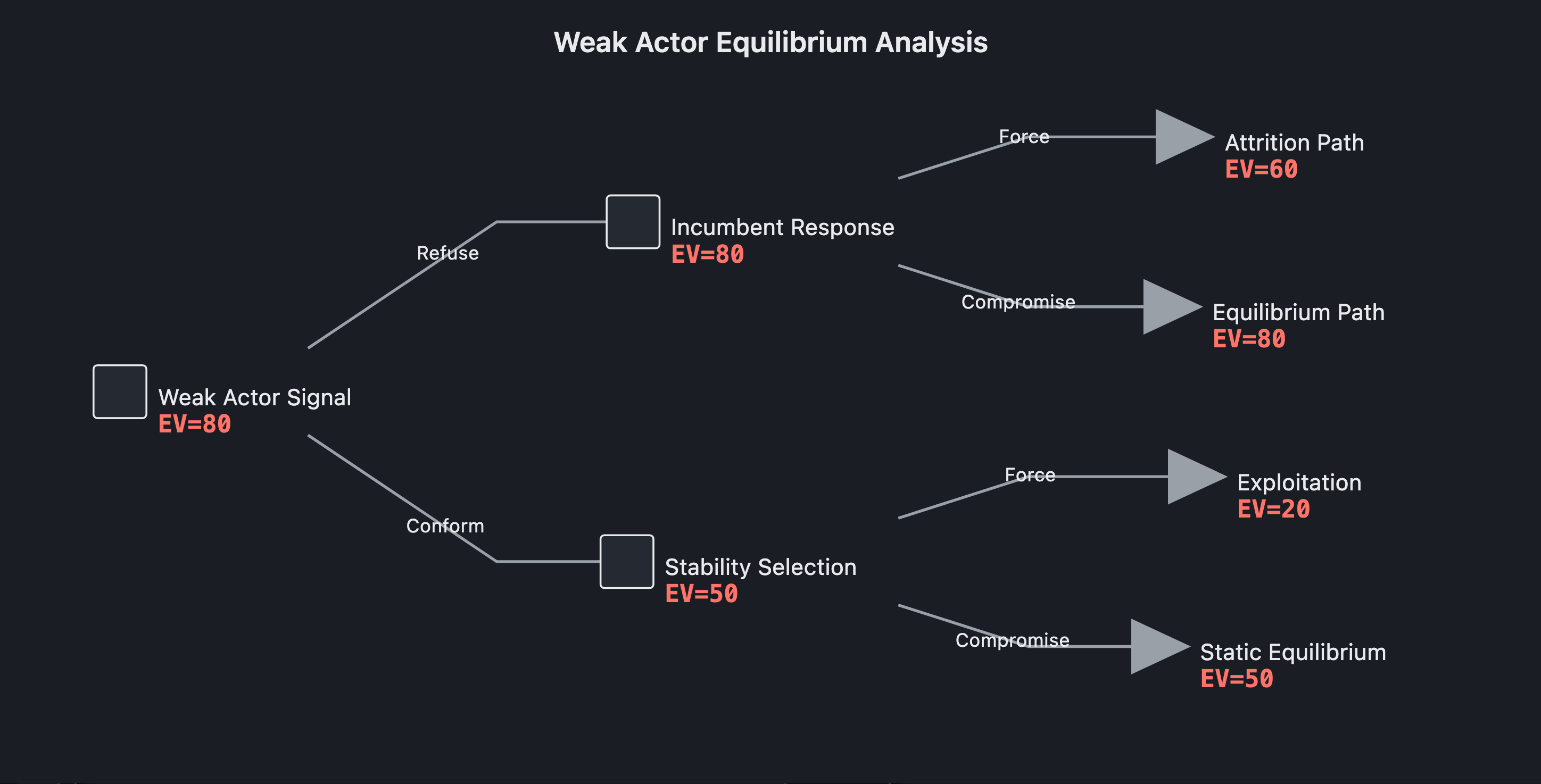
This text-based structure represents the interaction between the Weak ($W$) and Incumbent ($I$) based on the optimal moves ($R/F$ for Refuse/Force, $C$ for Compromise).
(Payoff values represent relative utility, not probability weights)
| Incumbent ($I$) | Force ($F$) | Compromise ($C$) |
| :--- | :--- | :--- | :--- |
| Weak Actor ($W$) | Refuse | Conform |
| Refuse | $U_W$: -High Control / Autonomy High
$U_I$: -Order / High Retention Cost | Equilibrium Path
$U_W$: Autonomy High
$U_I$: Order Moderate | $U_W$: High Order (Low Autonomy)
$U_I$: High Order |
| Conform | Exploitation
$U_W$: Autonomy -High / Force Risk High
$U_I$: Cost Low | Static Equilibrium
$U_W$: Autonomy Low
$U_I$: Order High | Stability Risk
$U_W$: Checkpoint
$U_I$: Advantage Low |
Note: The Weak Actor’s leverage in the “Refuse - Force” cell is generated by the Incumbent’s inability to commit to cost-efficient force (Diakabana Thesis).
Confidence and Gap Note: Specific empirical payoff values (e.g., exact cost of attrition $\alpha$ or territory premiums $\delta$) remain unverified in the available data. Thresholds for switching from Refusal to Compliance are illustrative of the model’s logic rather than calibrated calibration points.
Game Classification
Classification Block:
Timing: Sequential / Extensive-form. Reasoning: Incumbent sets terms first (e.g., “Terms of Engagement”); Weak actor observes, then signals “Refusal” or “Conform”. This order allows the Weak Actor to signal non-cooperation credibly.
Information: Incomplete / Imperfect. Reasoning: The Weak Actor estimates the Incumbent’s retaliation cost and political stamina; the Incumbent estimates the Weak Actor’s resolve and sustainability. Information asymmetry is the primary source of leverage for the weaker party.
Duration: Repeated / Infinite-horizon. Reasoning: Strategic leverage relies on reputation and the future shadow ($\delta$). The logic of “Rules of the Game” negotiation implies open-ended interaction where past behavior predicts future constraints.
Sum: Mixed-sum / Conditional. Reasoning: Not strictly zero-sum. Agreements can create positive-sum space (Order + Local Control) but conflict over scarcity creates zero-sum logic.
Alternative Test: One-shot game analysis favors the Incumbent (static-frame-trap) because it isolates the “Force” option from future reputational costs. Repeated interaction reverses this, giving the Weak Actor leverage to attack rigidity.
Equilibrium Analysis
Method: Subgame-perfect refinement via Backward Induction / Repeated Cooperation Framework.
Derivation:
- Node 1 (Weak Actor): Chooses “Refuse” to Incumbent’s Terms or “Conform”.
- “Refuse” signals a commitment to non-cooperation without immediate engagement on Incumbent’s chosen battlefield.
- Node 2 (Incumbent): Observes refusal; chooses “Force” (Over-commitment) or “Compromise” (Limited Scope).
- “Force” requires coordination resources and exposes the Incumbent to legitimacy erosion.
- “Compromise” yields Order with reduced cost.
- Subgame Check:
- If Weak Actor merges “Refuse” with “Attack Strong/Rigid”, Incumbent faces a commitment trap: The Incumbent must expend high costs ($F$) to enforce order but gains little credit domestically/internationally (NDU Press).
- Future shadow ($\delta$) reduces the value of immediate enforcement because the Weak Actor’s attrition capacity creates continuing friction.
- Result: The equilibrium favors “Refusal Terms” + “Attack Strong/Rigid” for the Weak Actor if Future Shadow ($\delta$) is sufficiently high. The Incumbent avoids over-commitment for “Clean Victory” due to the cost of legitimacy loss.
- Reader-Reproducibility Check: A reader can reconstruct this by identifying the players ($U_W$, $U_I$), the sequential timing, and the repeated duration. The equilibrium holds because the Incumbent’s rigidity prevents a credible commitment to force without coordination failure.
Stability: Deviations by the Incumbent to over-order are punished by Weak Actor attrition. Stability is maintained only if the Incumbent accepts the “Rules of the Game” defined by the Weak Actor.
Bounded-rationality note: The equilibrium above assumes perfect rationality (Backward Induction). Real-actor deviations (cognitive bias, institutional inertia, legitimacy constraints) shift expected play toward over-commitment. The recommendation below accounts for this by targeting these specific rigidities.
Credibility Assessment
The following audit applies Schelling’s credibility test to the threats and commitments within the interaction.
-
Incumbent Threat (“We will apply full force”):
credibility: cheap talk
Commitment device or future-shadow if credible: None (repositioning possible).
Why dismissible if cheap talk: Withdrawal cost-free domestically/internationally; no sunk cost makes the threat reversible.
-
Incumbent Threat (“Operation limited to territory X”):
credibility: cheap talk
Commitment device or future-shadow if credible: None.
Why dismissible if cheap talk: Legal/Commitment flexibility allows unilateral scope expansion; no irreversible action cements the limit.
-
Incumbent Threat (“We have overwhelming force”):
credibility: partially credible
Commitment device or future-shadow if credible: Overcommitment risk limits deployment; soft commitment via attrition.
Why dismissible if cheap talk: Force advantages can often be negated by attrition or logistical bottlenecks (Diakabana Thesis).
-
Weak Actor Commitment (Refusal + Attrition):
credibility: credible
Commitment device or future-shadow if credible: Irreversible commitment first (limited by resources), costly to stop.
Why dismissible if cheap talk: N/A (Costly to stop makes this a hard constraint on $U_I$).
Alternative Structures
Testing the robustness of the dominant equilibrium against alternative game classifications.
-
Alternative classification: One-Shot / Finite Horizon.
What changes: Future shadow ($\delta = 0$).
Equilibrium shift: Incumbent threat gains credibility (no reputation loss).
Implication for dominant analysis: static-frame-trap ensues if repeated interaction ignored. Weak Actor loses leverage to attack rigidity.
-
Alternative classification: Complete Information.
What changes: Both know full utility structure.
Equilibrium shift: Incumbent forces directly; Weak cannot exploit uncertainty.
Implication for dominant analysis: Information asymmetry is critical for Weak leverage (misperception of costs).
-
Alternative classification: Simultaneous Move.
What changes: No signaling (Weak moves without signaling refusal).
Equilibrium shift: Incumbent monitoring/attack capacity increases.
Implication for dominant analysis: Sequential “Refusal as First Move” is critical. Simultaneous move increases Incumbent monitoring/attack capacity.
Strategic Recommendations
-
Target Rigidity:
[Mechanism]: Brinkmanship / Future Shadow.
[Mechanism]: Constraint: Strong’s flexibility must be locked (high coordination cost).
[Equilibrium Shift]: Exploits the Incumbent’s overcommitment in strength zones (NDU Press).
-
Exploit Time Asymmetry:
[Mechanism]: Repeated game leverage.
[Mechanism]: Constraint: One-shot favors Incumbent; multi-phase favors Weak Actor.
[Equilibrium Shift]: Shifts the balance from immediate force to attrition (Repeated Competition Framework).
-
Link to Legitimacy:
[Mechanism]: Overcommitment trap.
[Mechanism]: Constraint: Force without control erodes coalition support.
[Equilibrium Shift]: Reduces $U_I$ for Force outcomes as legitimacy cost rises (Schelling).
-
Refusal Strategy:
[Mechanism]: Removes Incumbent termination of “rules of the game”.
[Mechanism]: Constraint: Incumbent cannot match optimal response speed (rigidity in open confrontation).
[Equilibrium Shift]: Weak Actor sustains control ($C$) by locking Incumbent into a less profitable outcome than “Order” ($O$).
(visual rendered — see artifact)
Players and payoffs
| Player | Actual value terms (not claimed-to-want) | How these were inferred | Note where actual diverges from claimed |
|---|
| Incumbent (I) | Preservation of sunk-cost advantages, avoidance of organizational friction/reorientation costs ($C_a > C_d$), and the maintenance of internal coalition rents. | Revealed-by-behaviour (structural necessity vs. bluster). | Claimed goal is absolute deterrence and enforcing the preferred modality; actual payoff is avoiding the high costs of reorientation. |
| Weaker Actor (W) | Survival, degrading I’s legitimacy or will to sustain the conflict, and imposing cumulative costs on I that exceed W’s operational costs. | Revealed-by-behaviour (targeting structurally depressed but strategically vulnerable nodes). | Claimed goal is ideological victory or fair negotiation; actual payoff is imposing cumulative costs exceeding operational costs. |
Missing-player flag: Third-Party Observer (O) / I’s Internal Coalition is a reactive third party whose response would shift the equilibrium. Their choice node {Sanction I, Support I} has a payoff based on I’s legitimacy minus the cost of supporting I. Observing I’s clumsy, high-cost rigid response, O may choose ‘Sanction’, endogenously increasing I’s cost of rigid defense ($C_d$). This shifts I’s payoff matrix, eventually making Adaptation (D) I’s dominant strategy and breaking the rigid equilibrium. Their inclusion is recommended if their behaviour is observable; their absence is named here so the equilibrium below is read as bounded-to-the-current-inventory.
Game classification
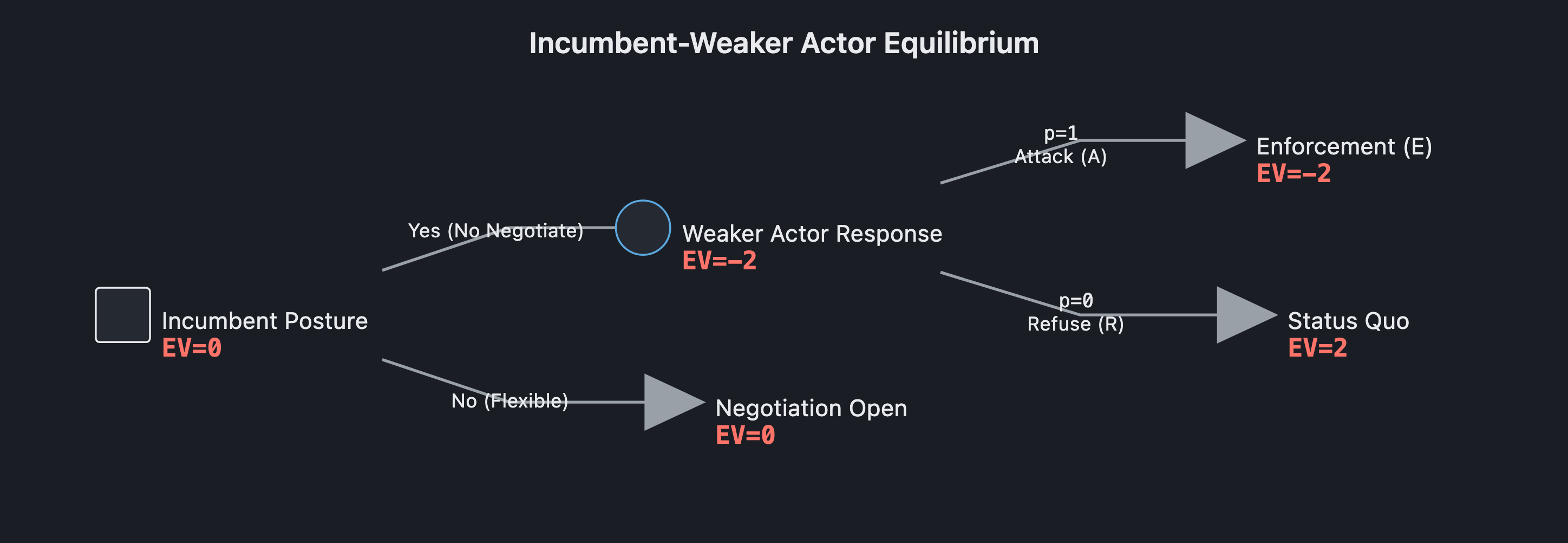
Timing: Sequential (extensive-form). Information: Incomplete and imperfect. Duration: Mixed / Repeated. Sum: Mixed. Reasoning per classification: I establishes a posture and commits to “no negotiate”; W chooses whether/where to strike; I must then respond (sequential). W knows I is structurally rigid but lacks precise knowledge of I’s true cost-of-rigidity or the exact internal breaking point, and tactical moves remain private until executed (incomplete/imperfect). Local interactions are one-shot, but they are embedded in an indefinite-horizon repeated game where W must accumulate marginal advantages through attrition (mixed/repeated). The game leans negative-sum in active conflict but positive-sum if settled, as I suffers disproportionate resource and reputational losses for W’s minimal material damage (mixed).
Equilibrium analysis
Equilibrium method: Subgame Perfect Nash Equilibrium (SPNE) via Backward Induction, extended to a Repeated Game (Trigger Strategy). Derivation: 1. Terminal subgame (t=2): Given W’s move, I strictly prefers E (enforce on preferred dimension) over D (adapt/abandon) because $C_a > C_d$. 2. W’s move (t=1): Anticipating I=E, W compares A (asymmetric attack, payoff +4) vs R (refuse/leverage, payoff +2), strictly preferring A. 3. Pre-commitment (t=0): I’s “no negotiate” stance triggers W=A, yielding the SPE outcome (A, E) with payoffs (+4, -2). Stability: Sustaining this requires W to artificially lower its discount rate ($\delta \to 1$) via external patronage or ideological decentralization to survive attrition, while exploiting I’s short-term political discount rate. Distributed attacks intentionally deny I a unifying focal point to override bureaucratic rigidity. Reader-reproducibility check: A reader can reconstruct this equilibrium from the components above: I’s preference for E over D is strictly derived from $C_a > C_d$; W’s preference for A over R is derived from anticipating E and seeking the higher payoff (+4 > +2); the sequence (t=0 to t=2) maps directly to the extensive-form timing.
Bounded-rationality note: the equilibrium above assumes perfect rationality. Real-actor deviations (cognitive bias, political constraint, incomplete preference orderings) shift expected play toward prolonged, non-optimal rigidity due to bureaucratic inertia, sunk cost fallacy, and in-group bias. I defends rigidly not because it is mathematically optimal, but due to organizational cognitive artifacts. Consequently, the equilibrium is highly fragile; a single exogenous shock (e.g., sudden leadership turnover or a viral media scandal) can artificially collapse I’s perceived $C_a$, triggering an abrupt, unpredictable shift to Adaptation. The recommendations below account for this by designing shocks that amplify these cognitive artifacts.
Credibility assessment
credibility: I’s threat (“If attacked, we will enforce disproportionately”) — weakly credible (partial commitment). Commitment device or future-shadow if credible: Possesses sunk costs and domestic audience capture granting baseline credibility. Why dismissible if cheap talk: Lacks calibrated retaliation. The threat is self-defeating because the enforcement action is the costly rigidity exposure.credibility: I’s promise (“If you cease, we return to status quo”) — cheap talk. Commitment device or future-shadow if credible: None. Why dismissible if cheap talk: Zero binding commitment device exists, especially given the stated “no negotiate” stance.credibility: I’s “no negotiate” stance — credible (partial commitment). Commitment device or future-shadow if credible: Enforced by internal coalition constraints. Why dismissible if cheap talk: It is structurally self-defeating because this specific commitment makes W’s asymmetric attack profitable.
Alternative structures
- Alternative classification: Move-order reversal (W commits first). What changes: W publicly pre-commits to an asymmetric attack unless I negotiates. I compares Negotiate (+2) vs Refuse $\rightarrow$ W attacks $\rightarrow$ I plays E (-2) or D (-3). W’s pre-commitment extracts a concession, shifting the SPNE outcome in W’s favor. Implication for the dominant analysis: The dominant equilibrium is highly contingent on I moving or committing first; if W seizes the sequential initiative, I’s “no negotiate” posture becomes mathematically untenable.
- Alternative classification: Repeated-game framing (Folk Theorem). What changes: The Folk Theorem opens multiple equilibria. A Tit-for-Tat strategy by W (start with R, escalate to A only after I plays E) can sustain a cooperative equilibrium if the shadow of the future is sufficiently long. Implication for the dominant analysis: In this frame, the first asymmetric attack functions as a reputation-building move, not merely a one-shot win, making W’s persistence and discounted future horizon the critical variable for equilibrium shift.
Strategic recommendations
- W must publicly pre-commit to an asymmetric attack before I locks in a “no negotiate” stance. — mechanism it leverages: move-order lever. Expected equilibrium shift: Forces I into a better-of-two-bad-options cell, reversing the sequential disadvantage and making W’s asymmetric threat the focal point I must respond to.
- W must target the typology of “strong but inflexible” nodes (high sunk-cost assets, politically symbolic nodes, bureaucratically complex nodes). — mechanism it leverages: cost-imposition lever. Expected equilibrium shift: Maximizes the cost delta ($\Delta$) between W’s low operational cost and I’s massive defense overhead, accelerating the point where $C_a > C_d$ becomes unmanageable for I.
- W must amplify audience costs by ensuring Third-Party Observers (O) witness the disparity between W’s low-cost action and I’s high-cost overreaction. — mechanism it leverages: credibility-shift lever. Expected equilibrium shift: Deliberately triggers O’s ‘Sanction’ choice node, endogenously increasing I’s cost of rigid defense ($C_d$) and eventually making Adaptation I’s dominant strategy.
- W must keep attacks distributed, unpredictable, and low-intensity. — mechanism it leverages: classification-dimension alteration (focal point denial). Expected equilibrium shift: Prevents I from establishing a Schelling focal point (a unifying narrative or single massive crisis) that would allow I’s leadership to override bureaucratic rigidity and coordinate a massive, disproportionate response.
- W must provide I a face-saving path to de-escalate (e.g., mediator, partial concession, ambiguous framing). — mechanism it leverages: outside option. Expected equilibrium shift: Enables the positive-sum (R, D) settlement, as I’s own rigid posture removed this mechanism, and W must construct the off-ramp to transition the game from a negative-sum attrition to a positive-sum settlement.
(visual rendered — see artifact)
Players and payoffs
| Player | Actual value terms (not claimed-to-want) | How these were inferred | Note where actual diverges from claimed |
|---|
| Weaker Player (W) | Survival; imposing unacceptable costs on the incumbent to force settlement or withdrawal; preserving its own resource base; demonstrating credibility for future confrontations. Units of utility are survival, not margin. | Revealed-by-behaviour / structural-position. | Claimed preference is total defeat of the incumbent; actual preference is redistribution of the contested margin and survival. |
| Dominant Incumbent (D) | Minimizing economic/political cost of engagement; preserving the survival of dominant-mode assets and extraction; avoiding the cost of restructuring; maintaining domestic/institutional support. Units of utility are margin, not survival. | Revealed-by-behaviour / structural-position. | Claimed preference is total eradication of the challenger and absolute control; actual preference is minimizing cost and avoiding the restructuring of sunk-cost dominant-mode assets. |
Asymmetry of stakes (load-bearing): W buys survival from each cell; D buys margin. The two sides’ utility units are not interchangeable, so the cells cannot be symmetrically re-scaled. This asymmetry drives the credibility results and deterrence-inversion.
Endogenous constituency threshold ($\theta_C$): D’s payoff for rigid overcommitment is mediated by an internal threshold (civilian-casualty tolerance, fiscal/casualty ceiling). As W’s attacks accumulate, $\theta_C$ tightens; once cumulative cost exceeds it, D’s rigid-defense payoff degrades, making D’s threats progressively less credible over time.
Missing-player flag: Third-party states/allies, domestic audiences (both D’s and W’s), proxy/ambiguous-attribution actors, and market/economic actors are reactive third parties whose responses would shift the equilibrium. Their inclusion is recommended if their behaviour is observable; their absence is named here so the equilibrium below is read as bounded-to-the-current-inventory.
Game classification
Timing: sequential / extensive-form.
Information: incomplete + imperfect.
Duration: repeated (with shadow of the future; possible termination).
Sum: mixed (non-zero-sum), asymmetric stakes.
Reasoning per classification: The game is sequential because W moves first by choosing the contest mode (refuse conventional, choose asymmetric), and D observes and responds (Stackelberg-style leadership). Information is incomplete/imperfect because W cannot perfectly observe D’s true cost-tolerance or locked-in assets, and D cannot observe W’s hidden resilience or specific attack vector. The duration is repeated, as real asymmetric conflicts recur, making the one-shot frame a fiction. The sum is mixed because W seeks redistribution of margin, not D’s destruction, making mutual exhaustion or positive-sum outcomes via conflict extension possible, though existential stakes for W can push specific cells toward zero-sum.
Equilibrium analysis
Equilibrium method: backward induction / subgame-perfect equilibrium.
Derivation: Two payoff encodings yield the same strategic conclusion for W but differ on D’s equilibrium response.
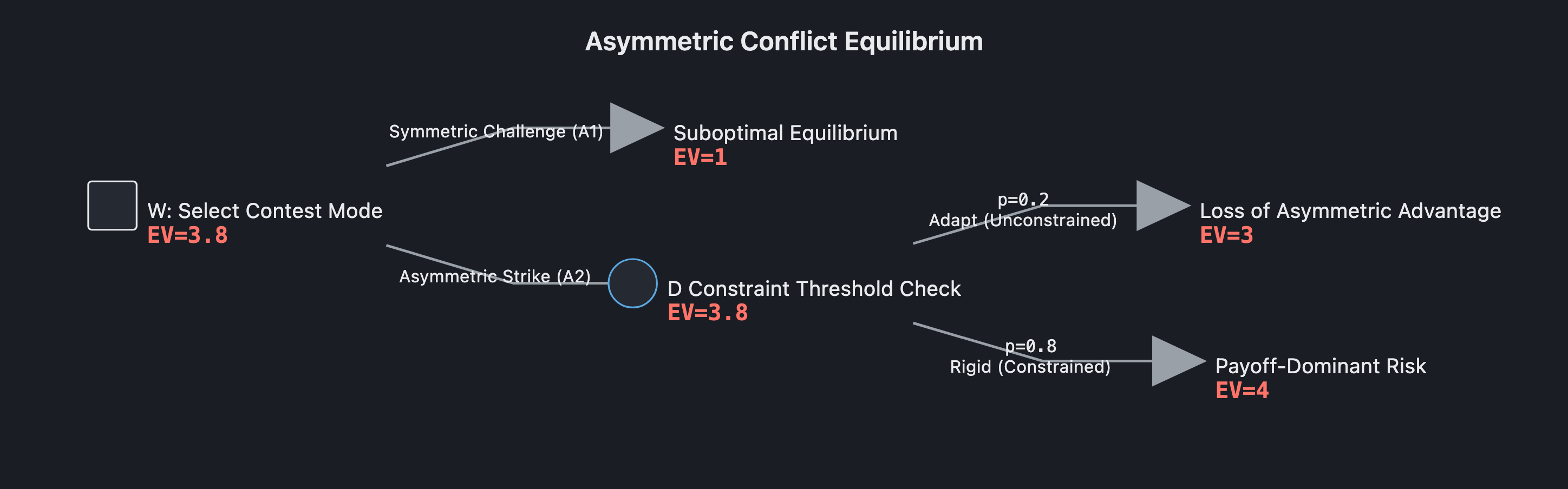
Encoding I (Ordinal 1–4): For W, Asymmetric strike ($A_2$) yields payoffs 3 or 4, strictly dominating Symmetric challenge ($A_1$ yielding 1 or 2) regardless of D’s choice. Given W plays $A_2$, D chooses Adapt/Absorb ($D_2$, payoff 2) over Rigid Overcommitment ($D_1$, payoff 1). Unique SPE = ($A_2$, $D_2$).
Encoding II (Ordinal 1–5, rigidity as binding constraint): D’s firepower is real, so D dominates in conventional combat (5,3). Against an asymmetric strike, an unconstrained D would Adapt (3>2), but a constrained D cannot Adapt without sunk-cost destruction of the dominant mode, forcing Rigid Retaliation (payoff 2). W anticipates this and plays Asymmetric strike (4 > 1 constrained; 4 > 2 unconstrained). Asymmetric strictly dominates for W. SPE (constrained) = W Asymmetric, D Rigid Retaliation, outcome (4, 2).
Stability: $A_2$ is both payoff-dominant and risk-dominant for W. A risk-dominance check (Knightian) with $p$ as W’s subjective probability D plays $D_1$ yields $EU(A_1)=2-p$ and $EU(A_2)=4-p$. Since $4-p > 2-p$ for all $p\in[0,1]$, $A_2$ strictly dominates across the entire belief space.
Reader-reproducibility check: A reader can reconstruct this equilibrium from the components above by tracing W’s strict dominance of the asymmetric move, followed by D’s utility-maximizing response (or constrained lack thereof) at the terminal node.
Bounded-rationality note: the equilibrium above assumes perfect rationality. Real-actor deviations (cognitive bias, political constraint, incomplete preference orderings) shift expected play toward rigidity even when it is structurally self-defeating. D often faces agency problems, doctrinal lock-in, and sunk-cost psychology; organizations punish Adapt-movers, meaning D may choose rigid defense despite the negative payoff (escalation of commitment). W must calibrate escalation to the minimum that makes D’s rigid response self-defeating, avoiding loss-of-control overshoot that pushes D into an existential fight where D’s rationality flips to maximum-defensive mode.
Credibility assessment
- credibility: D’s threat to retaliate massively/disproportionately against asymmetric attacks — cheap talk. Why dismissible: In the subgame after W’s asymmetric strike, executing the threat is D’s losing move (rigid-defense payoff < accommodation payoff); defending an inflexible asset against low-cost harassment consumes D’s resources faster than W’s. The threat is time-inconsistent.
- credibility: D’s threat to destroy W in conventional combat — credible but irrelevant. Why dismissible: Capability genuinely exists, so executing it is rational if the contest becomes conventional. However, W’s strategy explicitly refuses to make the contest conventional, so the threat is never invoked.
- credibility: W’s threat to continue/escalate asymmetric pressure — credible. Commitment device or future-shadow if credible: Grounded in W’s structural advantages: lower risk threshold, less to lose, and low-cost ability to switch attack vectors. Self-binding via repeated-game shadow and W’s sunk-cost commitment to the asymmetric path.
- credibility: D’s promise to restructure/negotiate — cheap talk initially → credible after a cost threshold. Why dismissible/Commitment device: Cheap talk before rigidity is exposed as costly (D’s organizational interests favor continued rigidity); binding only once the cost of rigidity exceeds the cost of restructuring, which is the exact threshold W’s attacks are designed to push D past.
- credibility: W’s promise to halt escalation if D adapts — conditionally credible. Commitment device or future-shadow if credible: W’s interest is extracting concessions, not destroying D. If D’s Adapt is verifiable, W has rational reason to halt; enforced by repeated-game reputation, as breaking it deters future D’s from adapting.
Alternative structures
- Alternative classification: Duration (One-shot vs. repeated). What changes: Under a repeated-game framing (Axelrod/Folk Theorem), the shadow of the future strengthens D’s incentive to Adapt across rounds; (3,3) is achievable as a subgame-perfect equilibrium if W can commit to tit-for-tat retaliation against future rigid D’s. Implication for the dominant analysis: The dominant equilibrium is robust only if D’s discount factor $\delta \ge 0.5$. Rigid incumbents typically have short horizons (election cycles, quarterly earnings, depleting capital), meaning $\delta < 0.5$, so the reputation strategy is unsustainable and the one-shot rigidity trap robustly reasserts itself.
- Alternative classification: Information structure (Hidden-rigidity). What changes: If D’s rigidity is partially unobservable, the game becomes probing. W’s optimal first move is a low-cost probe to identify the slowest-adapting asset, not a maximal strike. Implication for the dominant analysis: The payoff matrix is reached only after this probing stage, matching the historical pattern of small initial actions and calibrated escalation rather than immediate maximal confrontation.
- Alternative classification: Sum (Existential vs. marginal). What changes: If the conflict is existential for W, mutual destruction cells emerge; the asymmetric strike becomes more attractive and W’s escalation threshold drops. Implication for the dominant analysis: Framing the conflict as existential for W is itself a commitment device that lowers D’s threat credibility, because W signals it will bear costs D will not, shifting W’s rationality from “extract concession” to “deny D a clean victory.”
- Alternative classification: Player-set (Coalition formation / external patron). What changes: If W forms a coalition with third parties, an External Patron sees intervention payoff turn positive once D visibly struggles under $\theta_C$ pressure. Implication for the dominant analysis: W’s low-cost probe acts as a signaling mechanism converting the 2-player game into a 3-player one, dropping D’s rigid-defense payoff sharply and making accommodation D’s only rational choice.
Strategic recommendations
- Probe D’s rigidity before major strikes — mechanism it leverages: information-structure lever. Expected equilibrium shift: Low-cost probes map which assets are most locked-in before concentration, preventing wasted resources on adaptable targets and refining W’s belief state without triggering D’s maximum defensive mode.
- Make the asymmetric choice first and visibly — mechanism it leverages: move-order / Stackelberg lever. Expected equilibrium shift: Explicit mode choice converts D’s problem to “execute the losing move or Adapt”; visibility makes W’s strategy a commitment device, forcing D to respond to a fixed reality rather than negotiating terms.
- Refuse to define the contest on D’s terms — mechanism it leverages: classification-alteration lever. Expected equilibrium shift: The first move becomes a refusal of framing and narrative control, denying D the symmetric battlefield where its utility functions and assets are optimized.
- Target the strong-but-inflexible asset class — mechanism it leverages: mode-choice + asset-selection lever. Expected equilibrium shift: Striking high-value, low-mobility infrastructure (bases, ports, bridges, fuel/rail hubs, C2 nodes) flips the matrix cell toward W’s preferred outcome and maximizes D’s political/financial exposure, accelerating the $\theta_C$ breach.
- Impose cost sufficient to make D’s rigid response self-defeating — mechanism it leverages: credibility-shift lever. Expected equilibrium shift: D’s Adapt promise becomes binding only past the threshold where rigidity cost exceeds restructuring cost; the cost is measured in attrition of rigid assets, directly forcing the transition from cheap talk to credible commitment.
- Exploit the credibility gap to trigger coalition/patron entry — mechanism it leverages: coalition-formation lever. Expected equilibrium shift: Low-cost, high-visibility probes empirically demonstrate to an External Patron that D’s retaliation is disproportionately costly, triggering the patron’s participation rule and shifting the game to a 3-player dynamic that drops D’s rigid-defense payoff.
- Deny D the adaptation payoff — mechanism it leverages: duration/repeated-game lever. Expected equilibrium shift: Decentralized, sustained harassment makes accommodation feel like continuous bleed rather than a one-time acceptable loss, forcing D to the table before it can invest in structural flexibility (Axelrod tit-for-tat on the asymmetric mode itself).
- Calibrate escalation to the minimum that flips D’s response — mechanism it leverages: brinkmanship off-ramp lever. Expected equilibrium shift: Avoids loss-of-control overshoot; balances W’s credibility against catastrophe by keeping D in the mixed-sum domain rather than triggering an existential defensive flip.
- Avoid escalation past D’s existential-stakes threshold — mechanism it leverages: sum-framing lever. Expected equilibrium shift: Keeping the game mixed-sum preserves the rigidity-exploitation opportunity; pushing D to an existential threat eliminates this asymmetry and triggers D’s maximum-defensive, zero-sum mode.
(visual rendered — see artifact)
Players and Payoffs
A framing note before the table, because four inferences drive everything below and you should correct me if any misfit your actual situation. This is an abstract game-theoretic model, not a domain case, resting on: (1) the incumbent’s rigidity is commitment-based — locked in by staked credibility/legitimacy, not incompetence; (2) a repeated/shadow-of-the-future setting, not one-shot; (3) “best move” means payoff-improvement under asymmetry, not outright victory; (4) “strong but inflexible” means superior capability that doctrine permits to be used only in certain ways. If the real situation differs on any of these — for example, if the rigidity is institutional inertia rather than staked credibility — the equilibrium shifts.
Incumbent (I) — Actual value terms (not claimed-to-want): preserve dominance, deterrent reputation, and legitimacy at a cost its own constituents will tolerate. The legitimacy term is the hinge — I’s power is partly constituted by being seen to use force proportionately within its own rules; force used “correctly” adds to its position, force violating its legitimating story subtracts, and the subtraction can exceed any tactical gain. How these were inferred: revealed-by-behaviour. Note where actual diverges from claimed: the claimed payoff is decisive victory / order / deterrence (“must win”); the actual payoff is “must not be seen overpaying.” The gap between “must win” and “must not be seen overpaying” is the entire vulnerability.
Weak player (W) — Actual value terms (not claimed-to-want): survive as a going concern, gain relative position, and raise I’s costs above tolerance — while bearing no legitimacy or reputational cost: no constituency expecting restraint, no doctrine to protect, no sunk strategic commitment, existential rather than discretionary stakes. How these were inferred: revealed-by-behaviour / structural-position. Note where actual diverges from claimed: the claimed payoff is justice / cause / liberation; the actual payoff is survival-plus-relative-position. That absence of commitments is W’s core asset.
The stated-vs-actual check passed on both players: I’s legitimacy term and W’s absence-of-stakes are revealed-by-behaviour, distinct from professed preferences.
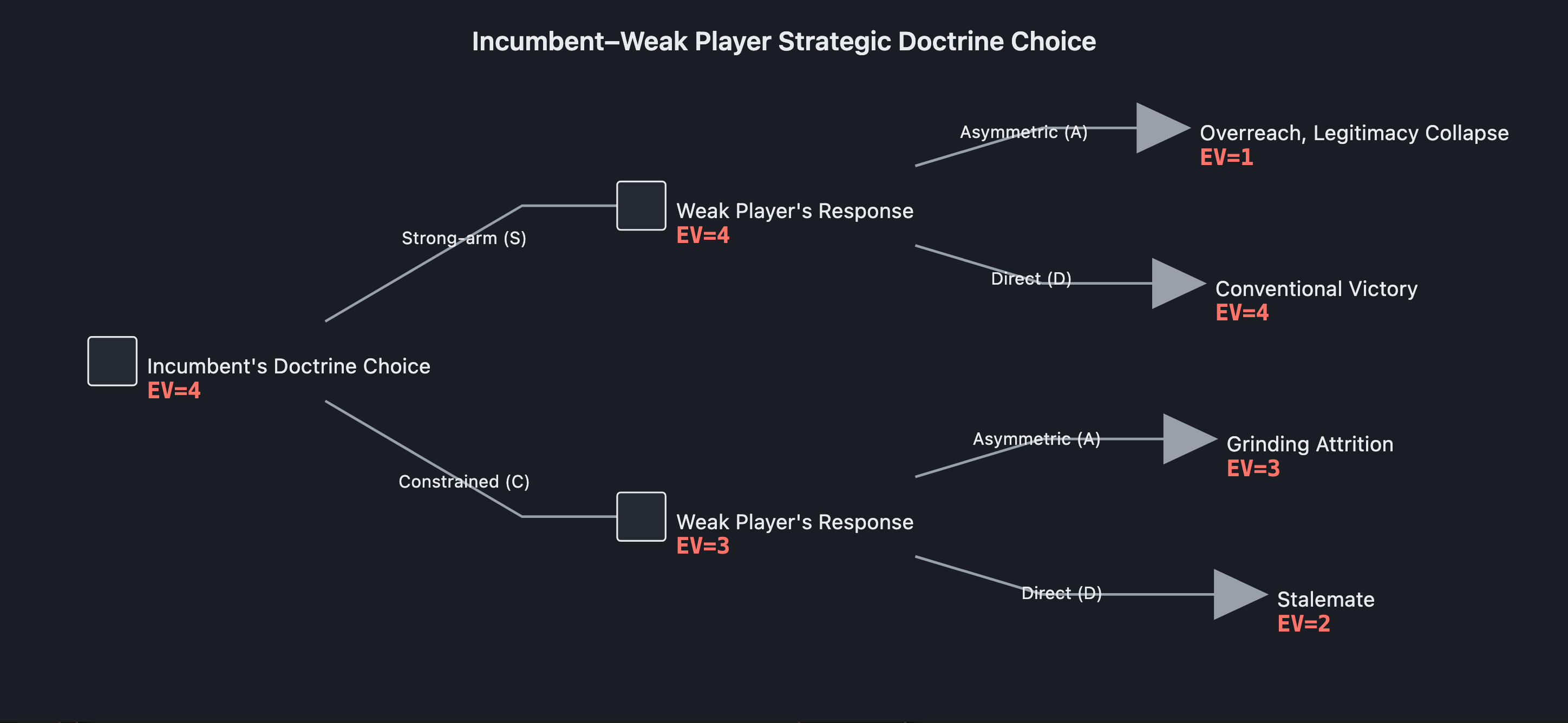
Strategies. I chooses Strong-arm (S) = its preferred overwhelming-force doctrine / dominant capability — the thing it is optimized for; vs Constrained/Restrained (C/R) = an adapted, proportionate, population-centric / denial / containment response matched to the threat’s level. W chooses Direct (D) = fight on I’s terms in its strong domain, conventionally; vs Asymmetric (A) = refuse those terms and strike where I is strong-but-inflexible.
Missing-player flag: the contested population/legitimating constituency, the international audience, and W’s external sponsor are reactive third parties whose responses produce the key payoff swing (the overreach penalty I suffers). Their inclusion is recommended because their behaviour is the mechanism, not the background — a faithful analysis is at minimum a three-player game (I, W, Audience). Their absence is named here so the equilibrium below is read as bounded-to-the-current-inventory. They are developed in full under Alternative structures and Strategic recommendations.
Game Classification
Timing: sequential / extensive-form (Stackelberg-style). The load-bearing move is I’s prior commitment to a doctrine / declared rules of engagement, made before W chooses; W best-responds in the shadow of that commitment. Deterrence presupposes the threat exists before the challenge. Treating it simultaneous hides the mechanism (a simultaneous reading is tested below).
Information: incomplete and imperfect. Incomplete: I does not know W’s true resolve / cost-tolerance type (resolute vs cost-sensitive — private). Imperfect: neither fully observes the other’s moves (dispersal, deniability). If resolve were observable there would be no credibility puzzle; W’s ambiguity about its own breaking point is a resource.
Duration: repeated, effectively infinite-horizon. War of attrition; reputation and shadow of the future dominate; one-shot deterrence is meaningless. This is the single most decision-relevant dimension (stress-tested below).
Sum: mixed-motive, non-zero-sum (negative-sum in the attrition/overreach cell). “Victory” is political, not transfer of a fixed pie; both can lose. Cell sums are not constant (2, −1, 1, 1) and cannot be re-scaled constant — the (S,A) windfall comes partly from destroyed legitimacy value, not pure transfer. I’s instinct to frame it zero-sum/territorial is itself part of its rigidity.
Reasoning per classification is embedded in each line above; the four dimensions interlock — sequential timing creates the standing commitment, incomplete information makes that commitment’s credibility contestable, infinite-horizon duration is what lets the overreach penalty compound, and the non-zero-sum legitimacy term is what makes the overreach penalty exist at all.
The payoff matrix — two representations preserved
Two cardinalizations are retained because they encode the same structural logic differently.
Representation 1 — ordinal, (W, I), 4 = best:
| I: Strong-arm (S) | I: Constrained (C) |
|---|
| W: Asymmetric (A) | (4, 1) | (3, 3) |
| W: Direct (D) | (1, 4) | (2, 2) |
- (D,S) = (1,4): W fights I’s game, crushed cheaply, I’s reputation enhanced — I’s dream cell.
- (A,S) = (4,1): W goes asymmetric, I answers with full force → collateral damage, population mobilized, legitimacy burned; I’s strength becomes liability — W’s best, I’s worst.
- (A,C) = (3,3): I adapts, denying W the overreach dividend; grinding attrition, no legitimacy collapse; tolerable for both. I ranks this above (D,C) because C is the right tool against A (counter-asymmetric doctrine matched to asymmetric attack).
- (D,C) = (2,2): I leaves its advantage on the table; off-path. I ranks below (A,C) because here C is the wrong tool — restraint wasted on a conventional fight I could have won with S; hence 2 < 3.
Representation 2 — cardinal, non-constant-sum, (I, W), cell sum in brackets:
| W: Direct (D) | W: Asymmetric (A) |
|---|
| I: Strong-arm (S) | (+5, −3) [2] | (−4, +3) [−1] |
| I: Restrained (R) | (+2, −1) [1] | (0, +1) [1] |
- (S,A) is the cell where I’s strength becomes its wound: overwhelming force against asymmetric provocation is exactly what the legitimacy constraint punishes — I scores its worst (−4) precisely where it deployed its greatest capability.
- (S,A) is also the cell where value is destroyed — sum −1, strictly lowest on the board. I’s −4 is not transferred to W’s +3; the missing point is value burned (backlash, violated rules, damage). This is the concrete sense of non-zero-sum: a pure-transfer game holds cell sums constant; these do not (2, −1, 1, 1).
Threshold caveat (load-bearing magnitude behind the ordinals). The (A,S) = (4,1) / (S,A) = +3 windfall only pays out once accumulated cost crosses I’s domestic tolerance; the rank order is shorthand for a cardinal condition. Below threshold the favorable cell collapses toward I and W’s apparent dominance is hollow. The whole contrarian result pivots on clearing the tolerance line, not rank order alone.
Equilibrium Analysis
Equilibrium method: iterated strict dominance as the shortcut, reconciled to backward induction / subgame-perfect equilibrium (SPE) on the sequential form, then Schelling commitment analysis, then a Perfect Bayesian reading. Because timing is sequential, the canonical method is backward induction; but W has a strictly dominant strategy, so the Stackelberg leader/follower order is outcome-irrelevant — W plays the same move regardless of move-order, collapsing the extensive-form solution onto the dominance solution. That is why iterated dominance reproduces the SPE.
Derivation:
Step 1 — W’s dominance (frame-conditional). Column by column: under S, A > D; under C/R, A > D. Asymmetric strictly dominates Direct for W in every column. This is the formal content of “refuse to fight on the incumbent’s terms” — not cleverness, dominance-solvable. Frame-dependence flagged explicitly: the result is conditional on the repeated/audience-compounding frame that generates the favorable (A,S) payoff; under one-shot the overreach dividend cannot compound, A no longer strictly dominates, and the row-deletion is unsafe (see one-shot stress test). Holding the repeated frame, delete D.
Step 2 — I’s best response to A. With D gone, I compares S vs C/R → C/R (ordinal: C(3) > S(1); cardinal: R(0) > S(−4)).
Step 3 — Nash / SPE of the free game = (A, C/R). A rational, flexible incumbent answers asymmetry with restraint and lands in a tolerable attrition stalemate.
Stability — deviation check (cardinal): I from R→S gives −4 < 0 ✗; W from A→D gives −1 < +1 ✗ — stable, and subgame-perfect because R is I’s optimal move at the actual decision node, not an off-path threat.
The tension over where the equilibrium actually sits (surfaced, not resolved). The two derivations diverge on the realized equilibrium because they treat the commitment device differently.
- Commitment-binding reading: I’s deterrent posture/doctrine/force-structure is a Schelling commitment device that removes C/R from I’s reachable set (or so degrades its payoff — choosing it reads as capitulation at home — that S is forced). Once locked to S, W’s dominant A delivers (A,S) = W’s maximum as the realized equilibrium. The rigidity that makes I look strong is exactly what moves the equilibrium from the tolerable (3,3) cell to I’s worst / W’s best.
- Conversion reading: the rational equilibrium is (R,A) = (0,+1); W’s best cell (S,A) = +3 requires I to play S against A, which a rational I never does (−4 < 0). So W’s true best move is to convert I from its rational R-response into its rigid S-response to capture +3 instead of settling for +1. That conversion is the entire asymmetric-warfare project.
These are two formalizations of the same substantive claim — W wants the (asymmetric, strong-arm) cell and I’s rigidity is what delivers it — differing only in whether the commitment is modeled as already-binding (equilibrium = W’s best cell) or as the target W must engineer (baseline = restraint, W works to force the overreach). Both are retained.
Perfect Bayesian layer. W’s resolve is a hidden type drawn by nature (high vs low resolve). I would like to play S against low-resolve W (quick win) and C/R against high-resolve W (avoid the trap). W’s task: pool toward the high-resolve signal while keeping I’s prior committed to S — look unbreakable while ensuring I stays doctrinally unable to act on that belief. Single point of failure: sponsor defection resets W’s resolve type downward (see Alternative structures). Stated gap: a full belief-update trace (priors + posteriors + off-path beliefs at the resolve-type chance node) is not derived.
Reader-reproducibility check: a reader can reconstruct this equilibrium from the players, the two payoff representations, and the named method — delete W’s dominated row, take I’s best response, confirm no profitable deviation, then layer the commitment device and the resolve-type chance node.
Probability discipline. No decision-node edge carries a probability (decisions are choices). The only legitimate stochastic element is nature’s draw of W’s resolve type in the Perfect Bayesian layer — a chance node. Verification: clean on this dimension.
Bounded-rationality note: the equilibrium above assumes perfect rationality. The rational I plays C/R and caps W low; real incumbents repeatedly play S and hand W the windfall. This is predictable, not anomalous: doctrinal/organizational commitment (Simon’s bounded rationality; Allison Model II — SOPs produce the overwhelming-force response before deliberation can select restraint; rigidity is organizational, not chosen); escalation-of-commitment / sunk-cost & prestige (having staked “we do not tolerate challenges,” backing down to restraint reads as defeat internally even when payoff-superior); metric illusion (counting tactical wins while losing political control); provocation-sensitivity (the asymmetric attack is designed to humiliate in I’s strong domain, triggering an affective/political demand for S that overrides the cost calculus). Both the rational-commitment and the bounded-rationality readings predict the same thing — I persists on S when C/R is its best response — so W’s strategy is robust to whether I is rigidly rational or rationally rigid. W is, in effect, betting on the gap between I’s rational move (R) and its institutionally-determined move (S). Where bounded rationality adds a lever: a confused I can sometimes be nudged off S by a face-saving narrative a perfectly committed I cannot accept.
W is not hyperrational either (symmetric honesty). W’s own bounded-rationality failures are first-class: internal fragmentation (W is often a coalition; factions competing for prestige escalate past the strategic calculus); mis-estimating the proportionality knife-edge (the exploit needs provocations small enough to make S disproportionate yet salient enough to compel it — a threshold not observable in advance, routinely misjudged); over-escalation that collapses the legitimacy term (a provocation crossing into atrocity makes S look proportionate to the Audience, flipping toward the zero-sum case and destroying W’s own advantage). The honest reading is symmetric: both players are institutionally driven; the contest is partly a race between I’s rigidity and W’s discipline.
Credibility Assessment
A framing note first (Schelling). I’s posture is deterrence — it wants W to refrain, preserving a status quo. W’s project is compellence (compellence-adjacent provocation) — it must make I act: abandon doctrine, accept restraint, or exit; it provokes to call the deterrent (exposing it empty against A) or to goad the self-defeating S-response. Schelling’s structural point: compellence is harder than deterrence — it must overcome inertia, set a deadline, visibly force change rather than quietly hold a status quo. So W holds the dominant strategy yet carries the heavier burden — which is why the manufacturing levers below are needed. W’s structural advantage and W’s harder task coexist.
-
credibility: I’s deterrent threat — “we answer any challenge with overwhelming force (S).” Against D it is credible. Commitment device or future-shadow if credible: self-enforcing, S yields its best (+5 > +2); grounded in sunk doctrine, standing posture, publicly staked reputation. This is why direct confrontation is suicidal. Against A it is cheap talk. Why dismissible: S yields −4 < 0; executing the threat hurts the threatener; backward induction prunes it. No commitment device redeems it under one-shot — the legitimacy/backlash cost is a sunk cost running the wrong way (it makes carrying out the threat worse, not retreat worse). Credibility here is a curse: because the threat is genuinely binding, it commits I to S even where S is catastrophic — a threat can be perfectly credible and still strategically self-defeating if the opponent chooses the board on which it fires. This is the chain-store / Selten structure: the threat that makes I look strong is non-credible exactly in the domain W chooses; I’s strength and its credibility point in opposite directions.
-
credibility: I’s implied promise of proportionality/restraint — “we fight cleanly, protect civilians.” Status: cheap talk under pressure unless institutionally bound. Why dismissible if cheap talk: if not institutionally enforced, it collapses the moment S deploys in a civilian-entangled asymmetric domain (feeding the overreach legitimacy loss). Commitment device if credible: if genuinely bound (courts, allies, ROE), it is credible-but-exploitable — the restraint carves a sanctuary W operates inside. Either branch favors W; the promise is a liability both ways.
-
credibility: W’s threat/posture — “we impose unbounded costs, never quit / we bear no cost you bear.” Status: credible by construction. Commitment device or future-shadow: grounded in future-shadow (W lives in the contested space, cannot leave) and in the absence of commitments (no reputation, legitimacy stake, or sunk doctrine to defend) plus existential stakes. The asymmetry of interest (survival for W vs discretionary war for I — Mack’s thesis) makes “never quit” cheaper to mean. There is nothing to make non-credible; W’s lack of commitments is itself its strongest commitment device.
-
credibility: I’s threat to escalate horizontally (punish population / third parties). Status: cheap talk if legitimacy-constrained; credible only by abandoning legitimacy — and abandoning legitimacy raises the overreach penalty. Self-neutralizing.
Alternative Structures
-
Alternative classification: one-shot reframe on the duration dimension (the most important alternative — I’s escape hatch). What changes: if genuinely one-shot and I can end it decisively before legitimacy erosion registers, the overreach dividend (which needs time to compound through audience reaction) may not materialize; S against A can be rational for I, W gets only the low-windfall cell (+1), and W’s edge evaporates. Implication for the dominant analysis: W must manufacture repetition — refuse decisive battle, disperse, survive to the next round — to make the overreach penalty bind (Axelrod: attrition/cooperation logic operates only with a long shadow). The dominant equilibrium is contingent on the repeated frame; the static frame is I’s friend.
-
Alternative classification: repetition with incomplete information — the Kreps–Wilson–Milgrom–Roberts reputation model (I’s strongest counter). What changes: a cost-sensitive I may rationally play S against an early asymmetric challenge — burning the bad cell now — to build a reputation for resolve that deters later challengers; the S-threat becomes credible as reputation investment, not as one-shot best response. Implication for the dominant analysis: this inverts W’s plan. W’s counter-counter: drive each provocation’s backlash deep enough that the reputation investment never beats the discounted stream of future deterrence gains.
-
Alternative classification: complete-information reframe on the information dimension. What changes: if I knew W’s resolve exactly, it would pick C/R from the start (denying the trap, back to the tolerable cell) or open negotiations. Implication for the dominant analysis: W’s advantage depends on I’s uncertainty. Two opposite info-strategies both work — (a) keep capability/resolve ambiguous so I can’t safely de-escalate, or (b) credibly signal unbreakable resolve to force an early negotiated exit. W chooses by whether it wants the war prolonged or settled.
-
Alternative classification: simultaneous move-order on the timing dimension. What changes: solving the matrix directly yields the same Nash (the restraint/asymmetric cell), but the credibility drama disappears — no standing threat to be non-credible. Implication for the dominant analysis: this confirms the credibility problem is an artifact of I moving first; I’s commitment is both its deterrent and its trap.
-
Alternative classification: zero-sum reframe on the sum dimension. What changes: if the contest were genuinely zero-sum (no legitimacy term — I pays no backlash for S), the overreach cell flips (illustratively (−4,+3) → (+3,−2)) and S weakly dominates for I — the asymmetric exploit evaporates. Implication for the dominant analysis: the entire weak-player advantage lives in the non-zero-sum legitimacy term — remove the audience that punishes disproportion and you remove the strategy. The dominant analysis is robust only so long as the legitimacy term is nonzero.
The reactive third parties that drive these alternatives, modeled out: the contested population / legitimating constituency (domestic public, allied governments, institutional-legal order) — the actual prize and the source of backlash; their reaction to overreach is the channel converting I’s force into I’s loss; without them S against A costs nothing and the exploit dies; the domestic public sets the cost-tolerance threshold that defines “winning” for W. The international audience / neutral observers / media — “the audience to the disproportion”; they enforce (or fail to enforce) the legitimacy constraint, converting a tactical event into a legitimacy loss. Audience payoff sketch: model the Audience to reward observed proportionality and punish observed disproportion — paying I a legitimacy dividend for matched force (restraint-vs-asymmetric, strong-arm-vs-direct) and levying a penalty for overwhelming force against small provocation; that penalty, passed back to I, is what converts I’s tactical win in the overreach cell into its worst payoff. The Audience does not fight; it prices I’s conduct. W’s external sponsor / third-party patrons — subsidize survival in the unfavorable cells, raise W’s floor, can reset W’s resolve type and resupply; but the sponsor is a player with its own outside option, not a fixed asset. Sponsor defection (a patron that tires, is bought off, reprioritizes) resets W’s resolve type downward — the symmetric mirror of I’s off-ramp problem and the principal exogenous risk to W’s whole plan: it can collapse the Perfect-Bayesian pooling strategy by making “unbreakable resolve” no longer true, letting I safely de-escalate (or win outright). Analysis flagged bounded: in a real engagement the population, the domestic public, the Audience, and the sponsor should each be modeled as additional players with choices (not nature), each able to independently move the equilibrium.
Strategic Recommendations
For the weaker player:
-
Lengthen the shadow of the future — mechanism it leverages: duration-dimension alteration. Refuse decisive battle; survive, disperse, persist — converting the incumbent-favoring one-shot game into the weak-favoring repeated game where the overreach penalty compounds. Expected equilibrium shift: makes the A-dominance result hold at all; without this, nothing else works.
-
Play A unconditionally but read “dominates” precisely; choose the attack domain to maximize the commitment-bind — mechanism it leverages: classification-dimension alteration + commitment device. A dominates D in every column; the only way to lose is to be lured onto I’s ground (the conventional-fight cell) — never present a clean conventional target. Strike precisely where I’s doctrine forces S and where S is most legitimacy-costly — engineer the overreach cell; strength that is rigidly deployable is the target. Expected equilibrium shift: moves play from (A,R) toward (A,S), capturing W’s best cell. Black-hat caveat: the cardinal windfall is a rank within an abstracted model and conceals large absolute survival costs — absorbing overwhelming force, betting survival on backlash outweighing damage. Rank-dominance ≠ low outcome-variance; a string of overreach cells can be individually winning on the legitimacy ledger and still annihilate the player absorbing them. The dominance result is internal to the ordinal/illustrative frame, not a safety guarantee.
-
Manage your own type / stay below the proportionality threshold — mechanism it leverages: Perfect Bayesian signaling + payoff-alteration. Turn “no reputation to lose” into a commitment — signal unbreakable resolve while keeping capability ambiguous enough that I can’t safely de-escalate. Keep each provocation small enough to make S unambiguously disproportionate (preserving the legitimacy hit) yet salient enough to compel it; escalate too far and S looks proportionate, collapsing the legitimacy term (the failure W is most prone to). This is compellence made operational — and the lever most exposed to sponsor defection. Expected equilibrium shift: holds I’s posterior on W’s resolve high while keeping I doctrinally locked to S.
-
Activate / cultivate the reactive third parties — mechanism it leverages: coalition formation / missing-player activation. The population and domestic audience make the overreach penalty bite; no audience, no overreach dividend. Invest in visibility and patrons more than in force. Expected equilibrium shift: instantiates the Audience’s penalty term that converts I’s tactical win into its worst payoff. Robustness caveat: the coalition logic cuts both ways — protect against sponsor defection, because losing the patron resets your resolve type and unwinds the signaling lever.
-
Weld the incumbent’s off-ramp shut — mechanism it leverages: credibility shift. Exploit I’s other commitments — its strength/legitimacy rhetoric — so that choosing C/R reads domestically as defeat, keeping I trapped on S rather than escaping to the tolerable cell. Expected equilibrium shift: removes C/R from I’s reachable set, fixing the equilibrium at (A,S).
-
Build a face-saving exit once costs exceed tolerance — mechanism it leverages: outside option. The win condition is forced renegotiation (compellence), not conquest; against a boundedly rigid I especially, an exit it can sell at home converts the windfall into a settled outcome rather than an endless grind. Expected equilibrium shift: moves play off the attrition cell into settlement once I’s cost crosses tolerance. Convergence caveat: forced renegotiation still needs a Schelling focal point for settlement terms — a salient, mutually recognizable line. Without one the bargain may not converge even after I wants out, and the windfall persists as an unsettled attrition grind. Manufacturing the off-ramp and manufacturing the focal point are two separate tasks.
For the incumbent (symmetric defense, for completeness):
-
Build credible restrained capability — proportionate denial — mechanism it leverages: credibility shift. A real, doctrine-sanctioned restrained option moves play to the restraint-vs-asymmetric cell, capping W and denying the windfall. Expected equilibrium shift: makes R credibly reachable, fixing the equilibrium at the tolerable (R,A) cell. The fix for asymmetric exploitation is not more force; it is a credible smaller response.
-
Reduce the legitimacy cost of S — mechanism it leverages: information-environment / payoff alteration. Lowering the backlash so S vs A no longer yields the worst payoff weakens the exploit (toward the zero-sum case). Expected equilibrium shift: zeroes the legitimacy term, collapsing W’s advantage. Dangerous and often infeasible, but the only move that attacks the mechanism rather than the symptom.
-
Under repetition, invest in reputation — once — mechanism it leverages: future-shadow commitment. A single visible willingness to absorb the bad cell can deter the sequence — but only if per-incident backlash is bounded; against a W that can make each backlash unbounded, this fails. Expected equilibrium shift: deters the stream of future challengers if and only if the backlash-per-incident stays below the discounted future deterrence gain.
Sources and Confidence
The analytical apparatus draws on five externally verified bodies of work (page-level figures not quoted):
- Mack (1975), “Why Big Nations Lose Small Wars: The Politics of Asymmetric Conflict,” World Politics — coined “asymmetric conflict,” established the asymmetry-of-interests thesis (survival for W vs discretionary war for I).
confirmed (Cambridge World Politics record + corroboration).
- Arreguín-Toft, “How the Weak Win Wars: A Theory of Asymmetric Conflict” (2001 International Security 26:1 article / 2005 Cambridge book) — strategic-interaction thesis: outcome turns on whether the two sides fight the same or opposite kind of war.
confirmed (Cambridge frontmatter + Belfer Center).
- Schelling, The Strategy of Conflict (1960) — commitment-device / credibility apparatus, threats/promises, and the compellence terminology.
confirmed (primary-source TOC + Myerson review).
- Selten chain-store game/paradox (1978); Kreps–Wilson & Milgrom–Roberts (1982) — reputation resolution under incomplete information in finitely repeated play.
confirmed (Kreps–Wilson 1982 + Springer/ScienceDirect).
- Simon (bounded rationality / satisficing); Allison Organizational Process Model II (Essence of Decision) — government behavior from organizational routines/SOPs rather than unitary rational choice.
confirmed.
What to trust and how far:
- High confidence: A-dominance for W (within the repeated frame), S-non-credibility against A, the legitimacy/non-zero-sum term as the load-bearing asymmetry, the deterrence-vs-compellence framing, the four-dimension classification, and probability discipline. These qualitative conclusions are robust to the rank-ordering.
- Medium confidence / contestable: I’s ordinal ranking (the right-tool/wrong-tool justification for ranking the adapted-vs-asymmetric cell above the wasted-restraint cell) — it makes the internal logic explicit but remains contestable without conflict-studies domain input on real counterinsurgency payoff intuitions.
- Illustrative-not-measured: all cardinal magnitudes are illustrative of structure, not measured; equilibrium magnitudes move (not the qualitative conclusions) if a real case re-orders the ranking or zeroes the legitimacy term. This resolves with domain-specific estimates of legitimacy-loss-per-incident vs W’s gain.
- Stated gap (Perfect Bayesian layer): the pooling-toward-high-resolve strategy is named and sponsor defection identified as its principal exogenous risk, but a full belief-system specification (priors + posterior updates + off-path beliefs at the resolve-type chance node) is not derived.
(visual rendered — see artifact)