The setup as a game
Two platforms, A and B, each choose a price level each period: Hold (keep prices high, fat margins) or Cut (slash prices to grab share). Strip it to a one-shot payoff matrix and you get the classic structure — but with a twist that matters for the MAD framing.
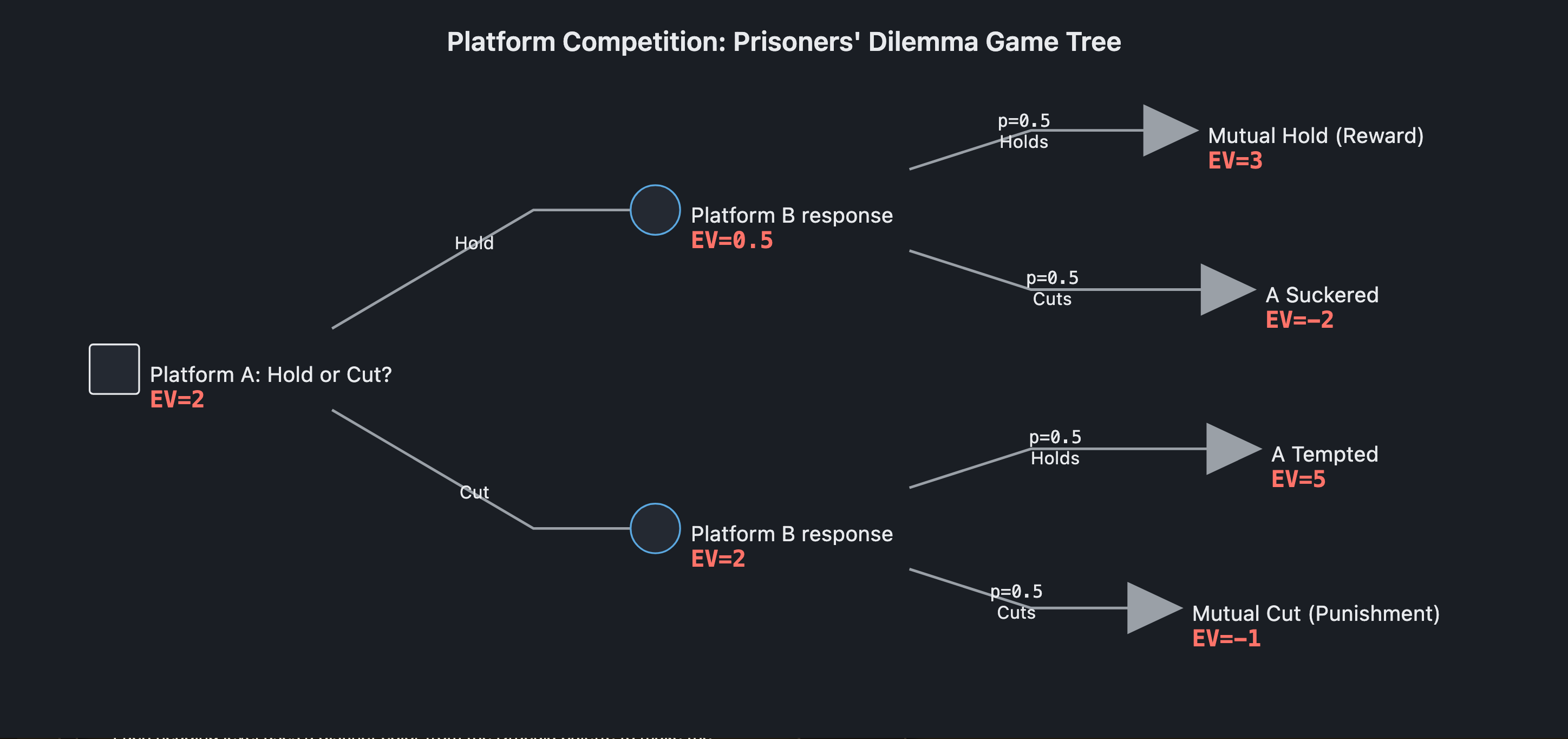
| B Holds | B Cuts |
|---|
| A Holds | (3, 3) — split the rents | (0, 4) — A bleeds share |
| A Cuts | (4, 0) — A grabs share | (1, 1) — mutual ruin |
In a single play, this is a Prisoner’s Dilemma: Cut strictly dominates for both, so the unique Nash equilibrium is (Cut, Cut) → the price war happens and both end at (1,1). One-shot game theory predicts the war, not the peace.
The peace you’re describing is not a property of the one-shot game. It only exists because the game repeats indefinitely and the threat of retaliation is credible. That distinction is the whole analysis.
Why MAD is the right analogy — and where it bends
Nuclear MAD works because of three structural features, and the platform price war shares the first two but breaks the third:
- Second-strike capability. Each side retains the ability to retaliate after being attacked. A platform that’s been undercut can match the cut next quarter — pricing is reversible and fast, so the “arsenal” is never destroyed in the first strike. ✔ Holds.
- Mutual ruin from full exchange. If both fully commit (Cut, Cut), margins collapse toward marginal cost and both are worse off than the cooperative split. ✔ Holds.
- The retaliation is automatic / pre-committed. Nuclear doctrine uses launch-on-warning, dead-hand systems, delegated authority — machinery specifically built to remove the defender’s choice at the moment of truth. ✘ Platforms can’t credibly pre-commit this way; retaliation remains a discretionary business decision each period.
That third gap is exactly where game theory does its sharpest work, via the credibility problem.
The credibility problem: why “I’ll ruin you back” must be subgame-perfect
A threat only deters if the threatened party believes you’ll actually carry it out. In the one-shot game, “if you cut, I’ll cut forever” is an empty threat — once B has already cut and grabbed share, A’s best response in that single moment might be to cut too (defensive) or even to accommodate. The threat has to be one that’s in your own interest to execute when the time comes — i.e. subgame perfect, credible at every node, not just announced at the start.
Repetition supplies the credibility. In the infinitely (or indefinitely) repeated game, the standard device is a grim-trigger strategy:
Hold prices as long as the rival held last period; if they ever cut, cut forever.
Now the threat is self-enforcing, because reverting to permanent (Cut, Cut) is itself a Nash equilibrium of every subgame — nobody has an incentive to deviate from the punishment once it’s triggered. That’s what makes the “credible threat of mutual ruin” actually credible rather than bluster.
The condition for peace: the discount factor
Peace holds only if the future matters enough. Let δ ∈ (0,1) be the per-period discount factor (how much each platform values next quarter’s profit relative to this quarter’s). Compare the two streams for a potential defector:
- Cooperate forever: 3 + 3δ + 3δ² + … = 3 / (1 − δ)
- Defect once, then eat punishment forever: 4 + (1 + 1δ + 1δ² + …) − 1 = 4 + δ·1/(1 − δ)
Cooperation is sustainable when the cooperative stream beats the deviation stream:
$$\frac{3}{1-\delta} ;\geq; 4 + \frac{\delta}{1-\delta} \quad\Longrightarrow\quad \delta \geq \tfrac{1}{3}$$
This is the entire theory of the uneasy peace in one inequality. The war is deterred only when each platform weights the future heavily enough (δ above the threshold) that the one-time grab from cutting (4 − 3 = 1) is outweighed by the discounted stream of lost rents from triggering permanent war (3 − 1 = 2 per period thereafter). By the Folk Theorem, when δ is high enough, the cooperative (Hold, Hold) outcome is one of many sustainable equilibria — peace is possible but not guaranteed, and which equilibrium you land in depends on expectations and history.
What this predicts you’ll actually observe
The MAD framing isn’t just decoration — it generates falsifiable predictions about platform duopolies:
- Tacit, not explicit, coordination. Because (3,3) is an equilibrium of the repeated game, the platforms reach it without communicating — no smoke-filled room, no antitrust-triggering agreement. Parallel pricing, price-matching guarantees, and fast public follow-the-leader moves are the signaling apparatus of deterrence (the equivalent of visible missile tests): “I see your move and I will match it.”
- Price-matching guarantees are deterrence infrastructure, not consumer gifts. A public “we’ll match any competitor’s price” pre-commits you to retaliation and removes the incentive for the rival to cut in the first place — it raises δ-effectively by automating the second strike. It looks pro-consumer; it functions as a doomsday device.
- The peace is fragile precisely at the margins that move δ or the payoffs. Watch for:
| Destabilizer | Effect | Mechanism |
|---|
| Finite/visible endgame (a platform about to exit, be acquired, or IPO-pump) | War | Backward induction unravels cooperation — last-period defection is dominant, and it cascades backward |
| Asymmetric war chests (one platform VC-subsidized, can absorb (1,1) longer) | War of attrition | MAD requires mutual ruin; if one side survives the exchange, the threat stops being mutual and the stronger side cuts to force exit — this is predatory pricing, the Uber/Didi pattern |
| New entrant | War or realignment | A third player isn’t bound by the bilateral trigger; the duopolists may cut to kill the entrant, or the deterrence lattice has to re-form as a 3-body problem |
| Imperfect monitoring (you can’t tell a price cut from a promotion or a demand shock) | Accidental war | Green-Porter: cooperation now requires occasional punishment phases triggered by noise — periodic price wars are an equilibrium feature, not a breakdown |
| Falling δ (rising interest rates, short-tenure CEOs, activist investors demanding this-quarter margins) | War | The future stops being worth protecting; the deviation gain dominates |
The honest caveats
Three places the model oversimplifies, which you should hold in mind rather than let me paper over:
- Pricing isn’t binary. Real platforms choose a continuum of prices and can cut partially, enabling gradual, deniable probing rather than a single Hold/Cut decision. This makes the “exchange” graduated and the monitoring problem worse — most platform “price wars” are slow bleeds, not Pearl Harbors.
- Margins aren’t the only weapon. Platforms compete on take-rates, subsidies to one side of a two-sided market, feature lock-in, and exclusivity deals. MAD on price can coexist with hot war on, say, creator subsidies — the deterrence equilibrium is weapon-specific.
- MAD assumes both sides prefer the status quo. If one platform genuinely believes it can win the war (achieve tipping/monopoly via network effects before its war chest empties), then (1,1) isn’t really mutual ruin for them — it’s an investment. That’s when deterrence fails by design, and it’s the single most important thing to check before trusting the “uneasy peace”: is the threat actually mutual, or does one side think it can survive the exchange?
Bottom line: the uneasy peace is a high-δ, symmetric-payoff, grim-trigger equilibrium of an indefinitely repeated Prisoner’s Dilemma — credible because retaliation is self-enforcing (subgame-perfect), sustained because both sides discount the future lightly enough that protecting the rent stream beats grabbing share once. It collapses the moment the future stops mattering, the ruin stops being mutual, or the monitoring stops being clean.
Two dominant platforms—think Amazon and Walmart, or Apple and Google—can interact like rational actors in a strategic game where neither can unilaterally undercut the other without risking mutual financial devastation. Game theory offers powerful tools to analyze why they often avoid a price war despite being technically capable of one.
1. Strategic Environment and Players
Players: Two dominant platforms (A and B)
Strategic Choices:
- Cooperate: Maintain high prices and retain margins.
- Defect: Initiate price cuts to gain short-term market share.
Key Assumptions:
- Both platforms hold significant market power.
- Demand is price-sensitive, but volume growth from price cuts is limited due to saturation.
- Fixed costs and capital expenditure are high (e.g., logistics, R&D, infrastructure).
- Marginal drawdowns in profitability per unit cut are significant.
- Re-entry costs are high, making it costly to start a war.
2. Payoff Structure (收益矩阵)
| B Cooperate (High P) | B Defect (Low P) |
|---|
| A Cooperate | (10, 10) | (-5, 15) |
| A Defect | (15, -5) | (-20, -20) |
Payoffs in millions of annual earnings; higher is more profitable.
Key Observations:
- (10, 10): Mutual cooperation yields best joint outcomes.
- (15, -5) / (-5, 15): A price-cutting player gains short-term volume, while the other loses margin.
- (-20, -20): Both undercut each other—mutual erosion of profits, akin to MAD.
3. Game-Theoretic Mechanisms Creating “Uneasy Peace”
3.1. Prisoner’s Dilemma Propensity
In a one-shot game, both players have incentives to defect for a short-term advantage, leading to the worst joint outcome. However, real-world platforms typically engage in repeated interactions.
3.2. Repeated Game Dynamics – Shadow of the Future
Using the Folk Theorem, repeated interaction allows for strategies like Tit-for-Tat:
- If A defects, B retaliates in the period.
- If A plays cooperatively, B reciprocates.
- This enables sustained cooperation even without enforceable contracts.
3.3. Trigger Strategies
Rational players may choose a Grim Trigger strategy:
- If either platform undercuts margins below a threshold, the other maintains punitive pricing permanently.
- The fear of perpetual retaliation prevents defecting unless there’s a better long-term strategy.
3.4. Irreversibility and Strategic Incentives
- Price cuts are easily communicated and hard to “undo.”
- Loss of brand value or service quality from cash-squeeze strategies can be irreversible.
- This creates credibility: It’s in a player’s interest to one
- High fixed costs and capital investment enhance the cost-benefit of avoiding price cuts.
4. Equilibrium Outcomes
| Equilibrium Type | Conditions | Outcome |
|---|
| One-Shot Nash | Independent, finite interaction | Price war |
| Repeated Nash | Repeated play, retaliation strategies | Cooperation |
| Grim Trigger | High retaliation cost, infinite horizon | Sustained pricing |
| Threat-Mitigated | Market entry barriers, entrenched infra | Avoidance of price war |
5. Real-World Parallels
- Airline Industry: Major carriers agoand back prices aggressively on short notice, but major routes remain covered in fare wars to prevent mutual loss.
- E-Commerce Rivals: Amazon and Walmart compete in delivery time and logistics rather than direct price slashes, but still offer subtle price concessions.
- Payment Providers: Visa and Mastercard maintain a stable two-card fee structure but innovate in credit card tiers instead of engaging in tariff wars.
- SaaS Platforms: Salesforce and HubSpot compete through feature differentiation and bundled services, limiting price-disabling vulnerability.
6. Credibility and Game Stability
- Credibility of Threats: The belief that each platform will retaliate if undercut is critical.
- Blocking Factors: Barriers like exit barriers, customer lock-in (data, ecosystem), and deep infrastructure investment.
- Signaling: Platforms may avoid initiating price cuts to signal long-term commitment to profitability, reinforcing the cooperative outcome.
7. Strategic Implications
| Observation | Strategic Advice |
|---|
| Price cuts lead to mutual loss | Avoid first-mover in price war |
| Commitment to margin stability | Signal loyalty to profitability |
| Reputational damage | Ugly signaling effects (loss of trust) |
| Product/service innovation | Prefer differentiation from price wars |
8. Conclusion: Uneasy Peace Through Threat
Dominant platforms can reach a de facto equilibrium where neither commits to destructive price cuts. This is not driven by altruism but rational threat-assumption:
- If all platforms engage in destructive pricing, profits collapse.
- Retaliation is costly and credible.
- Marginal gains in market share from short-term price cuts do not compensate for long-term margin deterioration.
As such, the structure of competition resembles Mutually Assured Destruction: the strategic risk of unlimited hurt forces cooperative behavior unless a platform can safely signal outside the equilibrium through innovation, ecosystem control, or technological differentiation.
Result: Rare price wars in mature duopolies. Instead, competition settles into a stable, muted state where profitability and service quality become the true battlegrounds—peace bought on the promise of mutual ruin.
Players and payoffs
| Entity | Actual value terms | Inference mechanism | Divergence from claimed |
|---|
| Player A / B Platform 1 / 2 | Long-term competitive positioning and recurring revenue stability. | Revealed-by-behaviour. | Claimed to maximize short-term profit or market share. |
| Aggregate System | Market share allocation (Zero-sum); Aggregate welfare (Negative-sum during war). | Structural position. | Partially claimed as positive-sum on aggression, actually negative-sum on total welfare. |
| Punishment Cell (P) | Existential margin collapse ($P=-100$). Can be raised to non-negative ($P \ge 0$) by regulatory floor. | Structural model definition / Regulatory analysis. | Raw financial ruin vs antitrust-constrained floor. |
Missing-player flag: The Equilibrium Analysis in this section is bounded-to-the-current-inventory. A potential New Entrant (Platform C) presents a “Prize Race” structure that destabilizes the two-player MAD equilibrium by offering an outside option to the duopoly. Substitutes (Non-Platform) cash economy options provide exit options for users, adding a “burn” option to the strategy set. The Regulator vanishes the previous equilibrium by prohibiting below-cost pricing and acting as an enforcing meta-player that alters the sum variable. These parties are reactive third parties whose response would shift the equilibrium. Their inclusion is recommended if their behaviour is observable; their absence is named here so the equilibrium below is read as bounded-to-the-current-inventory.
Game classification
Timing: Simultaneous — Public price adjustments occur without guaranteed prior observation of the opponent’s move.
Information: Imperfect-Complete — Players observe public prices but possess hidden information regarding precise cost thresholds, liquidity reserves, and regulatory compliance fatigue.
Duration: Repeated-Infinite-Horizon — Digital platforms operate indefinitely, ensuring the Shadow of Future exists as a binding variable.
Sum: Mixed-sum — Short-term price wars create negative-sum outcomes per Axelrod literature, while long-term duopoly stability supports positive-sum welfare.
Reasoning per classification:
- Timing classification: The simultaneous-move structure reflects market dynamics where announcements (price cuts) are public signals that cannot be temporally sequenced with perfect precision or certainty by rivals before reaction.
- Information classification: Imperfect because specific financial resilience and cost structures (needed to determine if margin destruction is actually possible) are private information held by the platforms.
- Duration classification: The infinite horizon is the critical structural feature enabling the “Shadow of Future” to function, distinguishing this model from one-shot bargaining failures.
- Sum classification: Short-term deviations yield negative-sum results (aggregate welfare declines); long-term cooperation yields positive-sum results (stable margins).
Equilibrium analysis
Equilibrium method: Subgame-Perfect Nash Equilibrium — Derived via Backward Induction on Finite Horizons vs. Grim Trigger Strategies on Infinite Horizons.
Derivation:
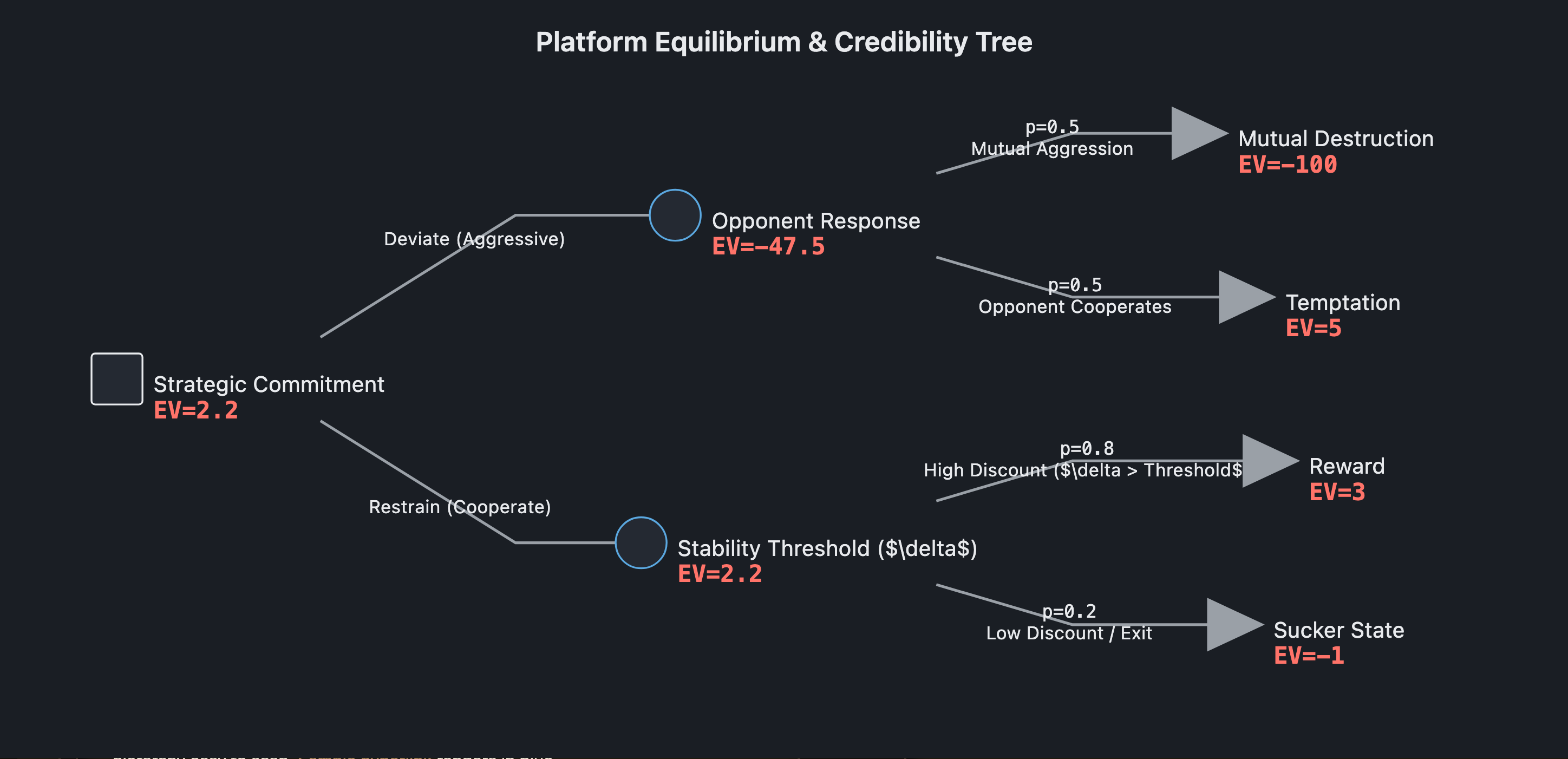
- Payoff Matrix Setup: Establish Ordinal relationships strictly ordered as Temptation ($T$) > Reward ($R$) > Punishment ($P$) > Sucker ($S$).
- Cooperative Restraint: Stable margins ($R=3$).
- Single Deviation: Temporary market share capture ($T=5$); result in Sucker state ($S$) if caught.
- Mutual Destruction: Existential margin collapse ($P=-100$).
- Deviation Logic: A single-period gain from deviation ($T-R$) is weighed against the multi-period cost of future punishment ($P$).
- Deterrence Mechanism: The threat of Mutual Margin Destruction functions as a stability anchor because deviation triggers a punishment subgame where expected continuation values fall below cooperative baselines.
- Folk Theorem Logic: Cooperation sustains only if the discount factor ($\delta$) exceeds the critical threshold $\delta \ge \frac{T-R}{T-P}$.
Stability:
- The equilibrium holds if the Valuation of Future Cooperation (Shadow of Future) outweighs the Marginal Gains of Immediate Aggression.
- Rational deviation is mathematically inhibited by the high stakes of Mutual Margin Destruction ($P$).
- Stability exists if and only if $\delta$ exceeds the calculated threshold, provided the endpoint of the game is uncertain.
Bounded-rationality note: The equilibrium above assumes perfect rationality. Real-actor deviations (cognitive bias, political constraint, incomplete preference orderings) shift expected play; cognitive myopia may cause executives to underestimate $\delta$, while organizational incentives (short-term targets) drive deviation even when collective outcomes worsen. This creates a principled-agent failure within the platform.
Credibility assessment
- credibility: Threat (Ruins) — Credible. Commitment device or future-shadow named: Structural capability. Platforms possess sunk-cost operational capacity to sustain a price war without immediate collapse. Observable financial signals (liquidity reserves, burn rates, R&D budgets) act as verification mechanisms for the ability to sustain the threat without breaking the core structure.
- credibility: Promise (Restraint) — Cheap talk (current period) / Binding (future punishment). Dismissible if cheap talk: Announcements are cheap talk because of the permanent temptation to defect. Binding because commitment to future punishment is made under the equilibrium path where the subgame perfect logic holds.
- credibility: Threat dissolution (Exit Threshold) — Threshold dependent. Commitment device is at risk if asset separability or liquidity depth is insufficient to support the stated retaliation capacity. E.g. debt-heavy firms cannot credibly promise infinite fight. Threat dissolves to Cheap Talk if assets are insufficiently deep to prevent immediate collapse during war.
Alternative structures
- Alternative classification: From Infinite-Repetition to One-Shot.
- What changes: Changing duration to finite/unknown removes the Shadow of Future. The equilibrium collapses into (Fight, Fight).
- Implication for dominant analysis: The Price War becomes the dominant strategy; the MAD framework into immediate conflict if the endpoint is certain.
- Alternative classification: From Symmetric Capacity to Asymmetric Capacity.
- What changes: If one platform holds greater liquidity, the Symmetric MAD equilibrium breaks. The ‘Stronger’ side forces Terms rather than Mutual Ruin.
- Implication for dominant analysis: The equilibrium is contingent on perceived parity in “Destructive Capacity”. Asymmetry increases the incentive to ‘finish the fight’.
- Alternative classification: From Market-Only Sum to Regulatory Intervention.
- What changes: Introducing Antitrust constraints modifies the Payoff Matrix (Fight costs become higher).
- Implication for dominant analysis: Potentially shifts the equilibrium from Strategic Restraint to Regulatory Compliance, effectively raising the $P$ floor.
- Alternative classification: From Negative-Sum to Positive-Sum Coordination.
- What changes: Collaboration mechanisms (standards, interoperability) alter the sum variable.
- Implication for dominant analysis: Softens the MAD pressure by sustaining cooperation regardless of $\delta$.
Strategic recommendations
- [Increase Delta ($\delta$)] — mechanism leverages: Commitment / Classification-dimension alteration.
- Expected equilibrium shift: Building legal contracts and long-term SaaS commitments that bind revenue streams past 10+ periods raises the valuation of the cooperative state, favoring consent.
- [Raise Retaliation Certainty] — mechanism leverages: Credibility shift.
- Expected equilibrium shift: Publicly announce price-exchange protocols and enforce price-matching penalties in advertising makes the threat of future punishment transparent, making deviation riskier.
- [Commitment Device: Cost-Cutting Thresholds] — mechanism leverages: Commitment device.
- Expected equilibrium shift: Pre-announce cost-cutting thresholds; legitimate “below cost” cannot be dropped below if anti-squeeze regulations or internal codes are legitimized. This hard-wires the Punishment Cell.
- [Communication Protocol: Exit Rituals] — mechanism leverages: Credibility shift / Crash prevention.
- Expected equilibrium shift: Establish explicit de-escalation rituals (exit mechanisms) to prevent accidental escalation to “Fighting” by reducing effective punishment risk.
- [Liquidity Visibility] — mechanism leverages: Commitment device verification.
- Expected equilibrium shift: Maintain visible liquidity and cash reserves to signal the ability to sustain a fight without personal risk exceeding market share gain. Dropping liquidity renders the threat cheap talk.
- [Avoid Asymmetry Traps] — mechanism leverages: Classification-dimension alteration (capacity parity).
- Expected equilibrium shift: Sustain perceived parity in “Destructive Capacity” by reducing visible debt differentials, preventing the dominant party from being tempted to ‘finish the fight’.
- [Enterprise Board Oversight] — mechanism leverages: Bounded-rationality countermeasure.
- Expected equilibrium shift: Mandate quarterly look-ahead pricing oversight to enforce $\delta$ discipline and counteract organizational myopia.
(visual rendered — see artifact)
Players and payoffs
| Player | Actual Value Terms (Not Claimed-to-Want) | Inference Method | Divergence from Claimed |
|---|
| Platform A & Platform B (Dominant Incumbents) | Sustainable profit margins (which fund R&D, acquisitions, and sustain enterprise valuation). | Revealed by behaviour and structural position. | Diverges from publicly stated objectives like top-line revenue growth or raw market share, which are often rhetorically claimed but structurally subordinate to margin preservation. |
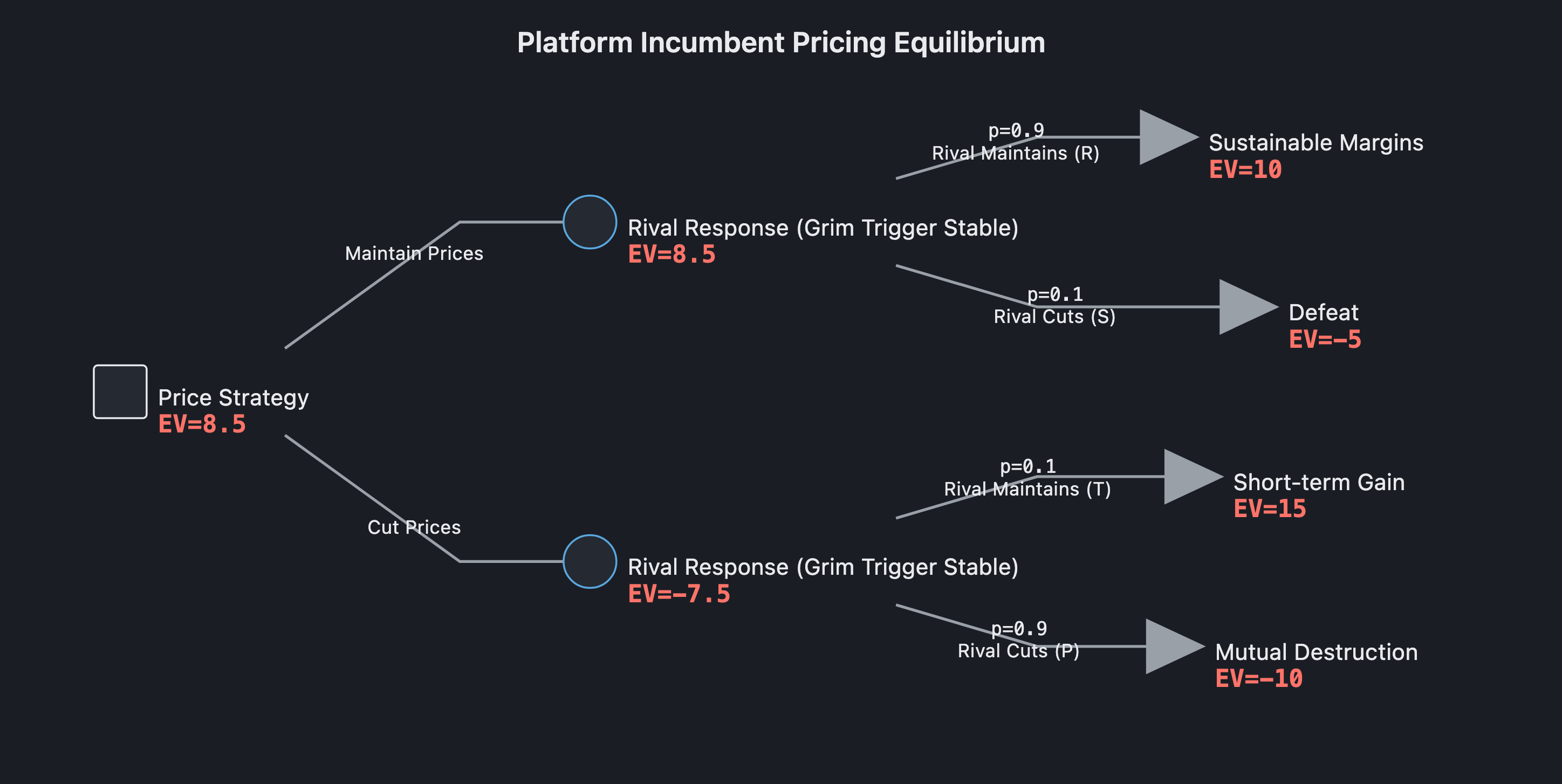
Payoff Ordering & Values: T > R > P > S (Prisoner’s Dilemma structure). This is grounded in a “contestable-volume” assumption: low switching costs, undifferentiated offerings, and visible pricing make undercutting rationally tempting.
Canonical Example: Peace/Maintain (R, R) = (10, 10); Betrayal/Defect (T, S) = (15, -5); MAD/Punishment (P, P) = (-10, -10).
Note on Alternative Context: In high-switching-cost, highly differentiated duopolies, the game inverts to a Stag Hunt (R > T), yielding coordination-based peace rather than deterrence-based MAD. The analysis proceeds under the contested-volume Prisoner’s Dilemma framing implicit in the “price war” scenario.
Missing-player flag: Antitrust regulators, capital markets, customers, suppliers/complementors, and new entrants are reactive third parties whose responses would shift the equilibrium. Their inclusion is recommended if their behaviour is observable; their absence is named here so the equilibrium below is read as bounded-to-the-current-inventory.
Game classification
Timing: Simultaneous / Sequential. Rapid, asynchronous algorithmic pricing moves function as simultaneous within a strategic cycle, though observable retaliation occurs sequentially in subsequent periods.
Information: Complete on actions (public prices), but incomplete/imperfect on intent, internal cost structures, and capital reserves.
Duration: Indefinitely repeated. This is the load-bearing dimension; the dyad interacts continuously with no terminal round.
Sum: Mixed. Positive-sum during Peace (joint sustainable margins), strictly negative-sum during MAD (joint margin and valuation destruction).
Reasoning per classification: The indefinite duration is the sole mechanism that transforms the structurally dominant destructive strategy of a one-shot game into a cooperative equilibrium. The timing reflects modern algorithmic pricing environments, while the mixed-sum nature captures the dichotomy between joint value creation (peace) and joint value destruction (war).
Equilibrium analysis
Equilibrium method: Subgame-Perfect Nash Equilibrium (SPNE) of the infinitely repeated game (Folk Theorem), contrasted with the one-shot Nash Equilibrium.
Derivation:
- One-Shot Derivation: (Cut, Cut) is the unique pure-strategy Nash Equilibrium. Unilateral deviation from (Cut, Cut) to Maintain yields S, which is strictly worse than P. Mutual defection is the dominant strategy.
- Repeated Derivation: Strategy = Grim Trigger (“Maintain unless rival cuts; if rival cuts, cut forever”).
- Present value of cooperation: V(M) = R / (1 − δ).
- Present value of defection: V(deviate) = T + δP / (1 − δ).
- Cooperation is incentive-compatible when δ > (T − R) / (T − P).
- Threshold Stability: For the canonical payoffs (10, 15, -10), the mechanical threshold is δ ≥ 0.2. Qualitatively, cooperation holds when the discount factor exceeds this structural bound. Empirically, mature platforms with long reinvestment horizons exhibit implied discount factors of δ ≥ 0.9 annually, making the cooperative equilibrium robust.
- Strategy Refinement: While grim-trigger cleanly proves SPNE existence, forgiving triggers (e.g., Tit-for-Tat, N-period punishment) are the realistic equilibrium strategies. They remain subgame-perfect while mitigating the fragility of permanent retaliation.
Probability discipline: No probabilities are assigned to decision nodes. Decision nodes represent strategic choices (Maintain or Cut), not chance outcomes. The discount factor δ is a parameter of player time preference, not a probability. (Chance nodes, such as regulatory shocks or new-entrant launches, would carry probabilities but are excluded from this core dyadic derivation).
Bounded-rationality note: The equilibrium above assumes perfect rationality. Real-actor deviations (quarterly earnings pressure artificially lowering institutional δ, loss aversion/escalation of commitment weighting the certain -10 MAD payoff less than the perceived need to avoid signaling weakness, incomplete preference orderings driven by founder ego or market-share religion, misperception of a “tough” rival as “soft”, and communication noise from localized A/B testing) shift expected play toward escalation spirals. The recommendations in Section 6 account for these deviations.
Credibility assessment
- credibility: “If you cut price, I will cut price and sustain it until you stop.” — credible. Commitment device or future-shadow if credible: Multi-period interaction horizon (long future-shadow), observable reputation for past retaliation, reasonable cost symmetry, and functional communication channels.
- credibility: Purely verbal rhetoric absent algorithmic, contractual, or reputational commitment devices. — cheap talk. Why dismissible if cheap talk: Announcements without commitment are not threats. It is unenforceable without a commitment mechanism or observable past behavior.
- credibility: Threat to sustain ruin under asymmetric cost structures. — mixed. Commitment device or future-shadow if credible / Why dismissible if cheap talk: The cost-advantaged platform’s threat is credible (collapsing MAD into one-sided deterrence), but the disadvantaged platform’s reciprocal threat is cheap talk due to an inability to sustain the attrition.
- credibility: Unbounded algorithmic price-matching. — mixed (dual-use risk). Why dismissible if cheap talk / Commitment limitation: While it removes discretion (establishing commitment), it creates hyper-reactive feedback loops (“flash crashes” in margin). Credibility of survivability requires bounded magnitude and human override; otherwise, the threat is self-destructive and destabilizing.
- credibility: Price-matching without back-channels. — mixed (conditional on communication). Why dismissible if cheap talk: Absent back-channels, algorithmic noise or localized A/B testing can be misread as a first strike. Without a channel to clarify intent, the dyad cannot absorb the noise, triggering accidental escalation and breaking the deterrence equilibrium.
Alternative structures
- Alternative classification: One-Shot Sequential (Stackelberg). What changes: Setup: Platform A moves first (cuts). Platform B observes. If B holds, payoff = -20 (catastrophic collapse); if B matches, payoff = -10 (MAD). Backward induction: B matches (-10 > -20). A anticipates this, so A’s choice is between cutting (yielding -10) or maintaining (yielding 10). Equilibrium: Peace. Implication for the dominant analysis: Rigid application here is classification-lock. Tech platform pricing is inherently repeated, not a single irreversible move. The repeated-game framing is the load-bearing correct model.
- Alternative classification: Static One-Shot Framing. What changes: A static framing yields a classic Prisoner’s Dilemma where defection is strictly dominant, guaranteeing the (-10, -10) mutual ruin outcome. Implication for the dominant analysis: The “uneasy peace” only emerges when correctly framed as an indefinitely repeated game. The “shadow of the future” is the sole mechanism transforming a destructive dominant strategy into a stable cooperative equilibrium. Any strategic or regulatory move that shortens the interaction horizon destabilizes this equilibrium.
- Alternative classification: Asymmetric Cost Structure in Repeated Game. What changes: The Folk Theorem threshold δ* = (T − R) / (T − P) becomes platform-specific. The cost-advantaged platform has a lower δ* and can sustain attrition longer. Implication for the dominant analysis: The bilateral MAD equilibrium is contingent on cost symmetry. If asymmetry emerges, the equilibrium shifts from mutual deterrence to one-sided deterrence, where the cost leader compels higher prices from the disadvantaged rival.
Strategic recommendations
- Implement algorithmic price-matching with bounded magnitude and human override — mechanism: commitment device + reactivity bound. Expected equilibrium shift: Transforms rhetoric into automated response (establishing credibility) while preventing flash-crash hyper-reactivity, preserving the credible threat without triggering accidental mutual ruin.
- Establish private back-channel communication — mechanism: credibility shift / information clearing. Expected equilibrium shift: Prevents accidental escalation from localized pricing moves or A/B testing being misread as first strikes, preserving the cooperative equilibrium against communication noise.
- Adopt forgiving triggers (e.g., N-period punishment) rather than grim-trigger — mechanism: equilibrium-strategy selection. Expected equilibrium shift: Bounds the blast radius of communication noise or mistaken defections, maintaining subgame-perfect cooperation while absorbing temporary shocks.
- Avoid strategic moves that shorten the rival’s shadow of the future (e.g., forcing divestitures, appointing short-tenure CEOs) — mechanism: classification-dimension alteration (Duration). Expected equilibrium shift: Maintains the high discount factor (δ) necessary for the Folk Theorem cooperative equilibrium to hold; shortening the horizon destabilizes the repeated-game equilibrium back to one-shot defection.
- Continuously monitor the rival’s cost structure — mechanism: information structure refinement. Expected equilibrium shift: If the rival possesses a structural cost advantage, the MAD threat is asymmetric. Recognizing this shifts strategy from seeking mutual deterrence to recognizing compelled cooperation.
- Cultivate regulatory exposure as deterrent reinforcement — mechanism: coalition formation / outside option expansion (incorporating missing players). Expected equilibrium shift: A visible antitrust framework raises the joint cost of price war, supplementing bilateral triggers with external enforcement. Conversely, treat third-party entrants as destabilizers whose presence breaks bilateral deterrence and invites mutual defection.
- Use focal-point construction for market-wide pricing adjustments (e.g., publishing new price floors) — mechanism: Schelling point coordination. Expected equilibrium shift: Serves as an obvious coordination target to transition to a new equilibrium without requiring explicit (and potentially illegal) negotiation.
Analytical Confidence and Limits
- Equilibrium Derivation: High confidence. The SPNE repeated-game derivation via the Folk Theorem is mathematically sound and standard for iterated Prisoner’s Dilemma.
- Credibility Assessments: High confidence in the conditional nature of the threat. The dual-use risk of unbounded algorithms and the necessity of cost symmetry are well-established Schelling failure modes.
- Empirical Threshold Calibration: Moderate confidence. While δ ≥ 0.9 is consistent with corporate discount-rate literature for mature platforms, the exact structural threshold δ* = (T − R) / (T − P) requires platform-specific margin-volatility data to compute definitively.
(visual rendered — see artifact)
Players and payoffs
Two symmetric dominant platforms (A and B) — Actual value terms (not claimed-to-want): Margin preservation, market-share defense, cash-flow runway, and signaling to capital markets. Survival, equity value, and strategic optionality are weighted heavily. How these were inferred: revealed-by-behaviour and structural-position. Note where actual diverges from claimed: The claimed value is “we compete on price for users,” “maximize long-run profit,” or defeat-the-competitor/market-share/user-growth language. The actual (C, C) catastrophe is worse than the static W/P figure implies—it includes equity dilution from emergency raises, talent attrition, regulatory attention, and erosion of the “we don’t need to undercut” reputation. The actual (C, C) payoff is lower than reported, which strengthens the credibility of the mutual threat.
Stage-game payoff structure (Prisoner’s-Dilemma parameterization):
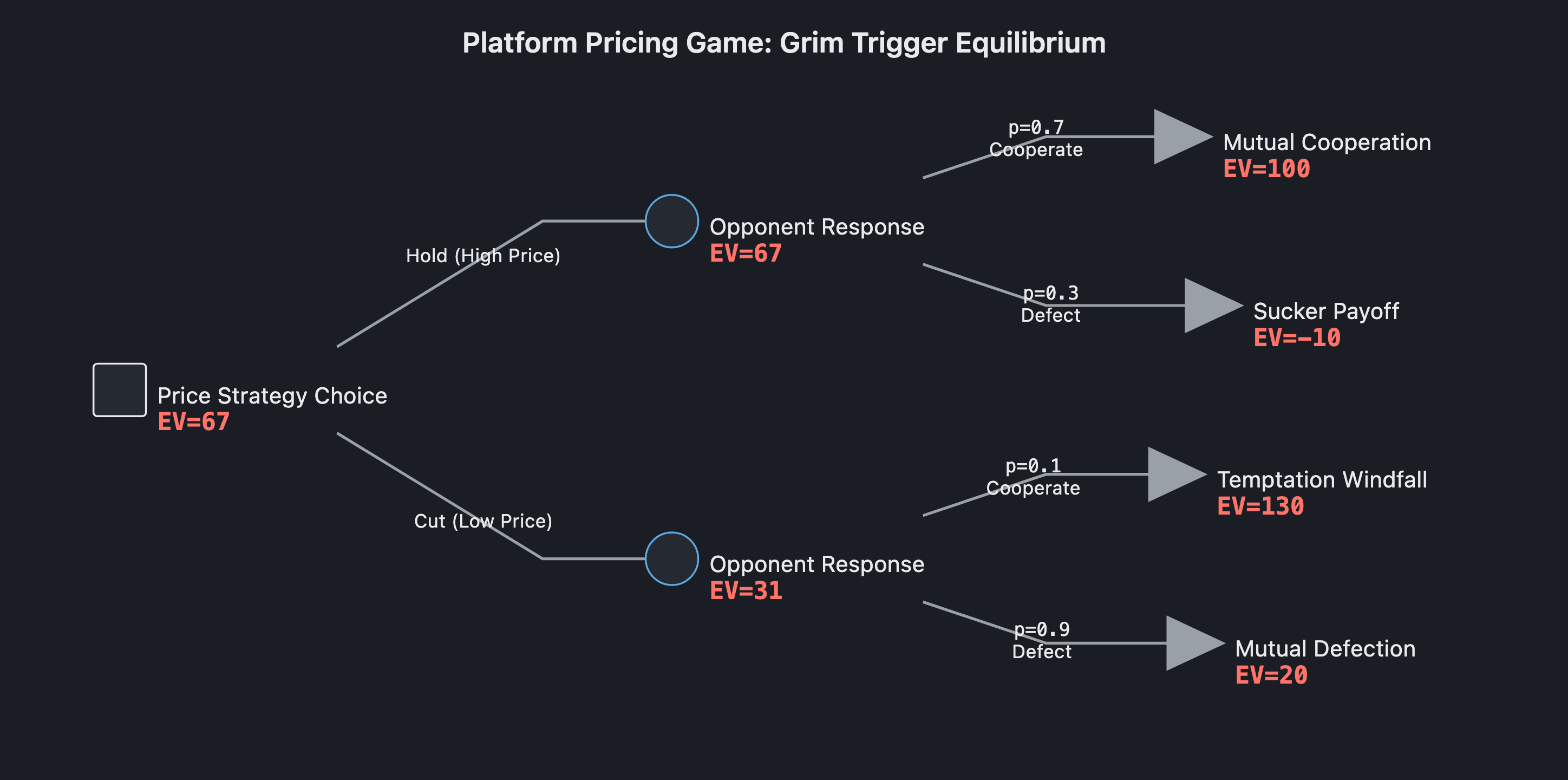
- Mutual cooperation / Hold (both high price): stable sustainable margin, full network value. M = R = 100.
- Unilateral deviation / Cut (one cuts, one holds): deviator captures temporary share and retains margin in the short window before retaliation (temptation windfall H = T = 130); cooperator suffers margin compression and catastrophic share loss (sucker payoff L = S = −10). The sucker’s-payoff amplification in a two-sided structure creates a death spiral—producers abandon the platform as transaction volume falls, degrading utility for remaining users and accelerating network collapse. The network effect that generated margin is destroyed; franchise value is at risk, not merely a single period’s contribution margin.
- Mutual defection (price war / MAD): both slash price to/below marginal cost, burning cash and triggering capital-markets re-rating. W = P = 20.
- Ordering: H > M > W with L < W (130 > 100 > 20 > −10). Mutual-cooperation efficiency: 2M > H + L (2R = 200 > T + S = 120).
Reactive-actor value positions: Capital markets (revealed value: re-rating risk; stake: discount rate, follow-on financing); users/producers (revealed value: switching costs vs. arbitrage, network density); regulators (revealed value: anti-competitive-pricing enforcement; stake: stability of the market structure).
Missing-player flag: Capital markets (along with antitrust regulators, algorithmic pricing agents, third platforms/fringe, complementors, and users) are reactive third parties whose responses would shift the equilibrium. Their inclusion is recommended if their behaviour is observable; their absence is named here so the equilibrium below is read as bounded-to-the-current-inventory.
Game classification
Timing: simultaneous (within period).
Information: complete about payoffs; imperfect about within-period timing.
Duration: repeated, infinite/indeterminate long horizon.
Sum: mixed.
Reasoning per classification:
- Timing is simultaneous in the standard Bertrand sense within a period, as both set price without observing the other’s contemporaneous move. The period is short; the sequence of periods is the relevant strategic horizon.
- Information is complete regarding cost structure, demand, and likely response, though the within-period move is simultaneous. However, pricing moves are immediately observable post-announcement, converting the interaction into a repeated game with public histories.
- Duration is repeated and effectively infinite. The “uneasy peace” is not sustainable as a one-shot; the shadow of the future (δ near 1) is what makes cooperation rational. The MAD dynamic collapses entirely in a one-shot game.
- Sum is mixed: positive-sum in the cooperative zone (2M > 2W; mutual cooperation creates the largest joint surplus), with zero-sum market-share-shift elements and a negative-sum/Pareto-inferior defection zone. The game’s sign depends on the equilibrium selected. A multi-sided complication exists: real platform duopolies subsidize one side while monetizing another; cross-side subsidization can make unilateral defection genuinely positive-sum in certain dynamics, complicating the standard PD framing assumed in the base stage game.
Equilibrium analysis
Equilibrium method: Subgame-Perfect Nash Equilibrium of the infinitely repeated Prisoner’s-Dilemma, sustained by grim-trigger strategies, justified by the Folk Theorem. (Attribution: Friedman 1971; formal treatments include Rubinstein 1979 and Fudenberg-Maskin 1986).
Derivation: In period 1, both play Hold/High. In any later period: play Hold if no deviation has ever occurred; if any deviation has been observed, play Cut/Low forever (the punishment phase). The (C, C) price war is the punishment-phase equilibrium the grim trigger reverts to. With discount factor δ ∈ (0,1), the cooperation value is V_C = M/(1−δ); the deviation value is V_D = H + δW/(1−δ). The condition V_C ≥ V_D reduces to δ ≥ (H−M)/(H−W) = (T−R)/(T−P). Numerically: (130−100)/(130−20) = 30/110 ≈ 0.273. Each platform cooperates if it weights the future at least ~27% as much as the present.
Stability: Because H > M > W, the threshold is strictly in (0,1). For digital platforms with locked-in users and effectively infinite horizons, δ ≈ 1, so the threshold is easily met and the cooperative equilibrium is robust over wide parameter ranges. The (H, H) “uneasy peace” is Pareto-superior to (C, C) but is not a one-shot Nash Equilibrium because Cut strictly dominates Hold in a single period. The Folk Theorem guarantees many equilibria once δ clears the threshold, including more forgiving strategies (Tit-for-Tat, Pavlov). Grim Trigger is highlighted as the harshest credible punishment that sustains cooperation, not the unique prediction. Equilibrium selection is a separate problem, typically resolved by Schelling focal points (e.g., the industry’s “fair platform fee” norm of ~15–30%). The “uneasy” character means cooperation holds but is not robust to large shocks. A large one-period defection gain (valuable share theft from market entry, a government subsidy, a regulatory change) raises the threshold and can break the equilibrium. A mistaken deviation locks the grim trigger into permanent punishment, which is why real platforms use Tit-for-Tat with forgiveness rather than pure grim trigger.
Reader-reproducibility check: A reader can reconstruct this equilibrium from the players, payoffs, and the δ threshold formula provided above.
Probability-discipline note: The derivation uses pure-strategy SPNE. Decision-node edges carry no probabilities—pricing choices are deliberate strategic decisions, not chance outcomes. The only probabilities appearing are belief-updating in the incomplete-information (Perfect Bayesian) alternative, which is appropriate to that context.
Static-vs-repeated framing: The MAD framing is coherent only as a repeated-game analysis. In a one-shot, mutual defection is the unique NE and there is no peace to explain; with δ above the threshold the cooperative equilibrium is sustainable. The “uneasy peace” is one Folk-Theorem equilibrium among several, selected because it is Pareto-superior to punishment, salient, and robust to small perturbations—but its selection depends on imperfect industry-level coordination, which is the deeper sense in which the peace is “uneasy.”
Bounded-rationality note: the equilibrium above assumes perfect rationality. Real-actor deviations (hubris/asymmetric cost perception where a CEO wrongly believes they can outlast the rival, principal-agent misalignment/career concerns mechanically triggering war for short-term share, level-k cognitive-hierarchy mismatch causing pre-emptive defection, loss aversion making executives fight harder than model predictions once a war starts, and time-inconsistent preferences overriding long-run margin discipline for quarterly revenue) shift expected play toward more price wars than the rational model predicts; the recommendations in section 6 account for this.
Credibility assessment
- credibility: “If you cut price, I will cut to a level that destroys both our margins, sustained indefinitely.” — credible.
Commitment device or future-shadow if credible: Subgame-perfect (the punishment phase, Low forever, is itself a Nash equilibrium of the stage game; neither can unilaterally improve by raising price, making execution rational in the subgame); sunk-cost retaliation capability (fixed short-run infrastructure and near-zero marginal cost make retaliation cheap to execute even when ruinous); future-shadow (δ ≈ 1 in practice, making the present value of a ruined relationship exceed any single-period margin gain); second-strike capability (algorithmic pricing lets each platform match a cut in real time, eliminating first-mover advantage); reputation cost of backing down (backing down signals weakness to capital markets, employees, and complementors, making the cost of not retaliating exceed the cost of retaliating); communication-channel reliability (public pricing signals like earnings calls provide low-cost ways to communicate resolve and avoid accidental escalation).
Why dismissible if cheap talk: N/A.
- credibility: Honest caveat on sustainability — credible but not unbreakable. A sufficiently large one-time gain (subsidy to one side, deep-pocketed entrant, regulatory change) can raise the temptation payoff enough that the sustainability condition fails.
- credibility: Honest caveat on renegotiation-proofness. Although subgame-perfect, grim-trigger equilibria are not generally renegotiation-proof. Once punishment begins, a forward-looking punisher may accept a side-payment or face structural pressure to return to cooperation, which can undermine the threat’s long-run credibility in practice.
- credibility: Mode-standard tension resolution. It is unresolved whether the mode’s “credible” bar is satisfied by subgame perfection alone, or whether Schelling-style commitment-device credibility (including renegotiation-proofness) is strictly required. One reading treats subgame perfection as sufficient (threat credible on all five Schelling components); the renegotiation-proofness caveat suggests the stricter standard is not fully met.
Alternative structures
-
Alternative classification: One-shot / static frame.
What changes: Single-period pricing; Cut strictly dominates; unique dominant-strategy NE = (C, C), payoff (20, 20). No “uneasy peace” is possible—the price war is the unique outcome.
Implication for the dominant analysis: This is wrong as a platform model because platforms operate over a long horizon; it serves as the falsification confirming the repeated-game framing is correct.
-
Alternative classification: Finite horizon (known terminal period).
What changes: By backward induction, the final period is effectively one-shot → Cut; with no future shadow to protect, the unique SPNE is Cut in every prior period.
Implication for the dominant analysis: Explains why price wars erupt near known market transitions, end-of-quarter earnings, or anticipated entry. The peace evaporates entirely.
-
Alternative classification: Sequential / Stackelberg (backward induction).
What changes: In a strict one-shot sequential game, the follower’s dominant strategy is Cut (130 > 100), so (H, H) is not subgame-perfect and the static-sequential SPNE is (C, C). Cooperative (H, H) obtains only when the sequential move is embedded in a repeated framework or the leader holds a binding commitment device (algorithmic price-matching, public margin floors) that structurally alters the follower’s payoff matrix.
Implication for the dominant analysis: MAD is preserved as a threat point, not as a one-shot SPNE, conditional on a commitment device or repeated embedding.
-
Alternative classification: Incomplete information / signaling (Perfect Bayesian).
What changes: One platform is uncertain about the other’s type (weak/high-cost that folds vs. strong/low-cost that fights); a price cut signals type. In a separating equilibrium, the weak type cannot profitably mimic the strong type’s aggressive pricing (signal cost of margin destruction exceeds the gain). In a pooling equilibrium, a war is hard to start because testing is indistinguishable from a war declaration.
Implication for the dominant analysis: The “uneasy peace” is harder to maintain under incomplete information; misperception destabilizes, and real price wars often start as misread defensive moves rather than deliberate attacks.
Strategic recommendations
- Increase the shadow of the future (raise δ) — mechanism it leverages: credibility shift / classification-dimension alteration. Expected equilibrium shift: publicly commit to multi-year sunk-cost infrastructure, dividend policies, and capital-allocation frameworks. Signaling an infinite game lowers the rival’s incentive to deviate and expands the parameter range over which peace holds.
- Enforce perfect monitoring / eliminate secret deviations — mechanism it leverages: information structure alteration. Expected equilibrium shift: make pricing transparent (public tiers rather than hidden negotiated B2B discounts) so a defection is instantly detected and punished, shrinking the windfall window and reducing V_D.
- Make retaliation automatic and visible — mechanism it leverages: commitment device. Expected equilibrium shift: implement algorithmic pricing, board-approved public margin floors, or codified “match any cut within X hours” rules, converting the threat from announced cheap talk to a built-in system constraint.
- Invest in communication/signaling channels — mechanism it leverages: credibility shift / information structure alteration. Expected equilibrium shift: earnings commentary, analyst guidance, and bilateral signals reduce the probability a defensive move is misread as a war declaration, preventing misperception spirals.
- Construct a focal-point pricing norm — mechanism it leverages: Schelling-point selection (coordination). Expected equilibrium shift: establish industry benchmarks and “fair platform fee” norms (e.g., the historically cited 15–30% app-store range) as focal points both parties converge on, resolving Folk-Theorem multiplicity.
- Build outside options symmetrically — mechanism it leverages: outside option. Expected equilibrium shift: symmetric outside options (new geographies/categories) make the threat of mutually forswearing the duopoly more credible; asymmetric outside options destabilize, as one side may abandon the duopoly while the other stays committed.
- Asymmetric cost / pain-tolerance signaling (if deterrence fails) — mechanism it leverages: payoff alteration / credibility shift. Expected equilibrium shift: credibly signal a lower W (deeper cash reserves, lower marginal cost) than the rival, altering the rival’s (H−M)/(H−W) calculation so deviation is mathematically irrational for them. Offset caveat: a strong balance sheet makes one’s own retaliation credible but cheap capital also raises the rival’s threshold by making P more tolerable; avoid letting one-sided capital advantages grow the temptation payoff T asymmetrically.
- Pre-commit to exit triggers — mechanism it leverages: commitment device / renegotiation-proofness. Expected equilibrium shift: a pre-agreed exit rule (“if both margins fall below X%, return to prior price within Y days”) prevents an accidental war from locking into permanent grim-trigger reversion, functioning as the analogue to nuclear arms-control treaties.
Confidence and structural limits
Parameter values (T = 130, R = 100, P = 20, S = −10) are illustrative. They produce a clean Prisoner’s Dilemma and a δ ≥ 0.273 threshold, but the qualitative structure—a Prisoner’s Dilemma where the cooperative outcome is sustainable for δ above a threshold—is what generalizes and is robust to specific numerical choices. Resolving exact figures requires firm-level margin and share data, which is out of scope.
Confidence in equilibrium derivation is high, as the threshold algebra is standard and reproducible. Confidence in the credibility verdict is high on the five Schelling components, qualified by the renegotiation-proofness caveat and the unresolved credibility-standard tension noted above. Confidence in alternative structures is high that each alternative shifts the equilibrium as derived; the Stackelberg result is conditional on whether a commitment device or repeated embedding is present.
The Mutually Assured Destruction lens correctly identifies that the peace is enforced by mutual vulnerability rather than goodwill or trust; the game-theoretic apparatus specifies the conditions under which that vulnerability sustains cooperation and the mechanisms by which it fails. The analysis is internally valid for the dominant-duopoly assumption, but its external validity is bounded by the stability of that assumption. Capital markets are the reactive actor most able to break the equilibrium by changing the cost of (C, C) for one party (e.g., cheap capital making the punishment payoff P less negative, which raises the cooperation threshold and forces the rival to weight the future more heavily to maintain peace).
(visual rendered — see artifact)
In a single-shot reading, the prompt’s “credible threat of mutual ruin enforces peace” is exactly backwards: the threat of mutual ruin deters nothing, because launching the war is the dominant-strategy Nash outcome — the threat produces the war rather than preventing it. The peace is entirely an artifact of repetition. And the MAD label needs one more correction before it can do any work. Nuclear deterrence is credible despite retaliation being pure self-harm (a second strike gains nothing but the deterrent). In a price war, retaliation is incentive-compatible — matching a rival’s cut is the best response, not a sacrifice. That makes price-war deterrence structurally more credible than nuclear MAD, and it means the operative model is the infinitely-repeated Prisoner’s Dilemma / Bertrand game sustained by trigger strategies, not literal MAD. “MAD” is the right vocabulary for how the standoff feels; folk-theorem cooperation is the mechanics.
Players and payoffs
Platform A — Actual value terms (not claimed-to-want): rent preservation — sustained supernormal margin, preserved market dominance, avoidance of capital destruction, rivals’ costs kept high. How these were inferred: revealed-by-behaviour. Note where actual diverges from claimed: the claimed payoff is vigorous price competition, consumer-welfare maximization, innovation; the revealed payoff is rent-seeking dressed as competition.
Platform B — Actual value terms (not claimed-to-want): identical structural position — supernormal margin, preserved dominance, capital preservation, high rival costs. How these were inferred: structural-position (symmetric dominant firm in a high-barrier market — payment networks, app marketplaces, ride-hail duopoly, cloud). Note where actual diverges from claimed: same divergence as A.
The divergence is the whole story: a stable mutual-Hold outcome is revealed collusive rent-seeking dressed as competition. If the firms genuinely valued competition over margin, the “uneasy peace” would be a failure, not an equilibrium; their willingness to maintain it reveals the operative payoff. (CQ5)
Strategy per period: Hold (maintain high price / restrained subsidy) or Cut (aggressive price war / subsidy blitz).
Payoff scope. Payoffs are long-run enterprise value / sustained supernormal margin — the existential reading the MAD metaphor demands — not per-unit margin.
Stage-game ordinal structure. Temptation > Reward > Punishment > Sucker (T > R > P > S), with 2R > T+S — canonical Prisoner’s Dilemma. Mutual Hold = duopoly rents intact, share split; unilateral Cut = cutter grabs share, holder bleeds; mutual Cut = the “mutual ruin” cell where margins are destroyed on both sides. The PD classification is itself a finding: the peace is not self-enforcing within a single period.
Illustrative cardinal values (the two derivations below use different illustrative scales; both are ordinally PD and both yield the same threshold). One scaling: T=5, R=3, P=−1, S=−2. Another: T=4, R=3, P=1, S=0. Both satisfy T>R>P>S and 2R>T+S; both produce the critical δ = (T−R)/(T−P) = 1/3. The cardinal numbers are illustrative, not transferable.
Payoff tension (named, load-bearing for CQ5). The existential enterprise-value scope the MAD metaphor demands sits in tension with an illustrative P that encodes a survivable rent loss (P > S — mutual cutting still beats being unilaterally suckered). These numbers model sustained rent compression, not literal ruin. A genuine MAD game requires P to be near-fatal. The label “mutual ruin” is the metaphor; the PD payoffs are “mutual rent compression.” Whether the real game is PD or Chicken turns entirely on how close P sits to existential — a single specification choice that changes the equilibrium (see Alternative structures: Chicken / attrition).
Missing-player flag: entrants, regulators, capital markets, and multi-homing users are reactive third parties whose responses would shift the equilibrium. Their inclusion is recommended where their behaviour is observable; their absence is named here (and detailed in Alternative structures and the dedicated reactive-player discussion below) so the equilibrium that follows is read as bounded-to-the-current-inventory of the two platforms.
Game classification
Timing: simultaneous within a period, repeated across periods. Neither platform sets price knowing the rival’s current move (public list prices are observed only after the fact; pricing commitments are made on planning cycles), but each observes past moves — which is what enables conditional strategies. A sequential/Stackelberg reading is stress-tested separately.
Information: complete but imperfectly monitored. Both know the payoff structure (complete). Neither can cleanly separate a deliberate strategic cut from a promotion, regional pricing, cost shock, or demand noise (imperfect). This imperfection is load-bearing — it is the crack through which accidental wars start, and it determines whether grim or forgiving punishment is correct.
Duration: infinite-horizon / indefinitely repeated. No commonly-known final period. This is the single most important classification: two dominant platforms expect to face each other indefinitely, and that expectation is what converts the mutual-ruin cell from “the answer” to “an off-equilibrium threat.” Flip this dimension (finite horizon) and the truce collapses by backward induction.
Sum: mixed-motive / non-zero-sum. Mutual Hold Pareto-dominates mutual Cut: a common interest in avoiding the war overlaid on a distributive conflict over share. A zero-sum framing would predict perpetual war; the positive-sum core is exactly what the truce captures.
Reasoning per classification: each dimension above carries its own justification inline; together they fix the game as a simultaneous-move, complete-but-noisily-monitored, indefinitely-repeated, mixed-motive interaction — the precise configuration under which the folk theorem can sustain cooperation that the stage game cannot.
Equilibrium analysis
Equilibrium method (one-shot): strict dominance → Nash. Derivation: for A, if B Holds, Cut > Hold; if B Cuts, Cut > Hold. Cut strictly dominates; symmetric for B. Unique one-shot Nash = (Cut, Cut) = the mutual-ruin cell, Pareto-inferior. The static prediction is the price war: the MAD threat deters nothing in one shot because launching the war is itself the dominant action. MAD-as-deterrence is a repeated-game phenomenon.
Equilibrium method (repeated, perfect monitoring): subgame-perfect equilibrium via grim-trigger (folk theorem). Derivation: strategy is “Hold while the other has always Held; on any defection, Cut forever.” With per-period discount factor δ (patience × interaction frequency × survival probability), cooperation is sustained iff R/(1−δ) ≥ T + δP/(1−δ), i.e. δ ≥ (T−R)/(T−P) = 1/3. When platforms are patient enough / interact frequently enough that δ ≥ 1/3, mutual Hold is subgame-perfect. The uneasy peace is the cooperative branch of an infinitely-repeated PD, enforced by the shadow of the future — not by anything in the stage game. The mutual-ruin cell sits off-path as the punishment that makes peace rational; that off-path threat is the entire deterrent and is the formal content of “credible threat of mutual ruin enforces peace.” (CQ2)
Calibration caveat (CQ5 / calibration). The 1/3 threshold is an artifact of the illustrative payoffs, not a transferable real-world bar. The critical discount factor is (T−R)/(T−P): widening the temptation gap (T−R) or softening the punishment (P closer to R) drives the threshold toward 1, making peace far harder to sustain. The qualitative result — a sufficiently open horizon sustains cooperation — is robust; the number is specification-dependent and must not be carried to a specific platform pair. Treat the condition, not the figure, as load-bearing.
Equilibrium method (repeated, imperfect monitoring): Perfect Bayesian / public-monitoring trigger-price equilibrium (Green–Porter, in its Abreu–Pearce–Stacchetti optimal-penal-code form). Derivation: the grim-trigger derivation assumes clean observation of the rival’s move, but monitoring is imperfect — an observed price/volume drop can be a strategic cut or an unobservable negative demand shock. Firms see a public signal (own sales, market price) only probabilistically linked to the rival’s hidden action, agree on a trigger price / sales threshold, Hold while the signal stays above it, and revert to a finite-length price war when it falls below — whether caused by real defection or a bad demand draw — then return to cooperation. Qualitative results unavailable to perfect-monitoring grim-trigger:
- Price wars occur on the equilibrium path — not failures of the equilibrium but part of it; periodic reversion-to-war episodes are the price of sustaining cooperation when a cheater cannot be told from a slump.
- Some wars are triggered by no defection at all — a demand shock that pushes the signal below the trigger detonates a war both firms know may be innocent; tolerating occasional false-positive wars is the cost of deterrence under noise.
- Punishment is finite, not grim — permanent reversion is unnecessary and self-defeating under noise; optimal punishment is just long enough to make defection unprofitable.
Consequence: the “uneasy peace” is not a smooth truce but a truce punctuated by recurring, equilibrium-consistent skirmishes, and an outside observer cannot distinguish “the deterrent working as designed” from “the cartel breaking down.” The peace and the recurring wars are two faces of the same equilibrium.
Stability: profitable deviation exists only in the stage game. The repeated equilibrium is stable against unilateral deviation when δ ≥ critical δ under clean monitoring, and stable in expectation under noisy monitoring through finite trigger-price punishment.
Reader-reproducibility check: the one-shot Nash, the grim-trigger δ ≥ (T−R)/(T−P) = 1/3 closed form, and the Green–Porter on-path-finite-war result are each reconstructible from the players, the T>R>P>S payoff matrix, and the named method.
Bounded-rationality note: the equilibrium above assumes perfect rationality. Real-actor deviations shift expected play toward war relative to the rational truce — noise misread as defection, horizon-compressing managerial incentives, and dominance/hubris all push effective δ below threshold or reframe the game as zero-sum. The recommendations in section 6 account for this (forgiving triggers, fixing the internal incentive horizon). The detailed deviations:
- Noise misread as defection. Under imperfect monitoring a holder’s regional promotion or a demand-shock-driven price drop reads as a Cut; grim trigger then fires a war nobody intended (Green–Porter). Real firms need forgiving triggers — tit-for-two-tats / forgiveness (Axelrod: nice, provocable, forgiving, clear), retaliating only on confirmed, sustained cutting. Grim trigger is too brittle for a noisy channel; even the optimal Green–Porter response accepts some innocent wars as unavoidable.
- Short managerial / horizon-compressing incentives. Quarterly-comp executives or a CEO chasing a share-growth mandate discount the future steeply (low effective δ), pushing below the critical threshold even when the firm’s true horizon is long. The war starts in the C-suite incentive plan, not the strategy room; short-termism breaks peace the firm’s fundamentals would sustain.
- Dominance preference / hubris / misperceived symmetry. Winner-take-all narratives make some CEOs’ actual payoff winning the platform, not maximizing profit, converting a mixed-motive game into a subjectively zero-sum (or Chicken brinkmanship) contest. Each side also tends to overestimate its own staying power, nudging both toward the attrition war one of them will lose.
Static-vs-repeated framing. Applying one-shot logic to this game is the central error: the static dominant-strategy equilibrium is the war, and only the indefinitely-repeated framing produces the truce. The deterrent, the credibility of retaliation, and the entire “MAD enforces peace” result are repeated-game phenomena; any analysis that treats the standoff as one-shot predicts perpetual war.
Probability discipline. No probabilities attach to the Hold/Cut decision-node edges — they are choices. The only legitimate chance/nature nodes are the demand shock / public monitoring signal, which carry probabilities; the strategy edges may not.
Credibility assessment
- credibility: credible — “Cut my price and I will match / sustain it” (immediate retaliation). Commitment device / future-shadow: matching is the stage-game best response (once the opponent Cuts, Cut is dominant), so the threat needs no external commitment device — retaliating is self-interested the moment defection occurs. This is exactly what makes the punishment phase a Nash equilibrium, the whole construction subgame-perfect, and price-war deterrence sturdier than nuclear MAD. Future-shadow (δ ≥ critical δ) is the commitment.
- credibility: credible — demonstrated war-chest plus a past episode of retaliatory matching. Commitment device / future-shadow: sunk-cost commitment device plus reputational record; the rival has observed the second-strike capability fire.
- credibility: partly cheap talk — “Cut once and I will wage a margin-destroying war forever” (grim trigger). Why dismissible: perpetual mutual ruin is not renegotiation-proof — once both sit at the punishment cell, both strictly prefer to return to cooperation, and a rational opponent anticipates the punisher would want to forgive, eroding the deterrent. The eternal-war threat is the rhetorically potent but commitment-thin part of MAD. Even tit-for-tat is not generally subgame-perfect in this stage game — carrying out a one-period punishment can cost the punisher more than forgiving, so the threat to execute it is not automatically credible. The renegotiation-robust form is a limited-retaliation stick-and-carrot strategy (Abreu): punishment severe enough to deter but structured so that administering it is itself incentive-compatible (the punisher is rewarded for inflicting it and further punished for shirking it).
- credibility: conditionally credible — “I’ll keep prices up if you do” (the cooperative promise). Commitment device / future-shadow: credible only when δ ≥ critical δ and moves are observable; remove observability and it degrades toward cheap talk because defection can’t be reliably detected to trigger punishment — which is why the imperfect-monitoring world runs on trigger-price thresholds rather than clean defection-detection.
- credibility: cheap talk — public “we will not be undersold” press statement with no capacity/cost backing. Why dismissible: no commitment device, no sunk cost, reversible at zero cost. An announcement is not a threat.
- credibility: credible (and counterintuitive) — price-match guarantee to customers / most-favored-nation (most-favored-customer) clause. Commitment device / future-shadow: a contractual commitment device that mechanically raises the cost of a rival’s cut and removes one’s own temptation to cut, stabilizing the high-price equilibrium. A commitment that looks pro-consumer functions as a collusion-sustaining device — an established IO/antitrust result (also framed as raising rivals’ costs or deterring entry).
Commitment devices that convert talk into deterrent: public, posted pricing (fast detection); price-match guarantees / MFN clauses (automate retaliation as a sunk contractual commitment, making “I will match” mechanical rather than discretionary, and removing own temptation); multimarket contact (defection in one market punishable in all, raising the reach of punishment). (CQ3)
Alternative structures
- Alternative classification: duration flipped — finite, known horizon. What changes: a commonly-known endpoint (acquisition or wind-down in N periods, founder cash-out, sunsetting category, pending regulatory ban). Method: backward induction. In the last period Cut dominates; knowing that, the second-to-last has no enforcement value, and the war unravels backward to period 1. Unique SPE = price war from period one; the truce collapses entirely. Implication for the dominant analysis: any visible endgame — an exit, acquisition, or CEO on the way out — is a peace-breaker independent of payoffs; the dominant equilibrium is contingent on the horizon staying open. (Distinct from Selten’s chain-store paradox, a separate entry-deterrence reputation game reserved for the entrant/regulator discussion; what is derived here is finite-repeated-PD unraveling.)
- Alternative classification: payoffs and δ flipped — asymmetric second-strike / asymmetric discount factors and objectives (the MAD-breaker). What changes: one platform is venture-subsidized or cross-subsidizes from a separate profit pool (ads funding a war on a subscription rival; cash-rich parent) and pursues growth/dominance, not profit. A war chest means the deep-pocketed firm doesn’t experience the punishment cell as ruin (a bruise, not death), and a winner-take-all objective makes “destroy the rival’s margin” a goal, not a cost. Method: war of attrition. The deep-pocket’s threat to outlast is credible; the weak firm’s retaliation is not (it bleeds out first), so predatory pricing becomes rational and the weak firm exits or accepts a subordinate niche. Implication for the dominant analysis: MAD requires symmetric second-strike; remove it and the model is deterrence-by-the-strong, not mutual assurance. This is the dominant real-world breaker of platform truces, since real platform pairs are rarely symmetric — and it is also where a P<S re-specification lands the game.
- Alternative classification: timing flipped — sequential / Stackelberg. What changes: a recognized price leader moves first and the follower best-responds. A first-mover commitment to a low price (capacity build-out, signed long-term low-price contracts) can deter, or a commitment to restraint can invite reciprocity — but only with a genuine commitment device. Implication for the dominant analysis: an announced price the leader can revise is credibility: cheap talk; added move-order doesn’t help unless it also sinks a commitment, so the dominant equilibrium is robust to mere re-sequencing absent a commitment device.
- Alternative classification: stage-game ordinal structure flipped — Chicken / brinkmanship / war of attrition (P<S). What changes: the canonical Schelling reading of “mutually assured destruction” is Chicken, not Prisoner’s Dilemma — in MAD proper, mutual destruction is the worst cell (P < S), giving the ordering T>R>S>P. If the price war is capacity-constrained or below-cost predatory, such that fighting to the death is more ruinous than being undercut once (one war chest exhausts; one firm is bankrupted), method: Nash on the 2×2. With P<S there is no dominant strategy; Chicken has two asymmetric pure-strategy equilibria (one firm Cuts while the other Holds) plus a mixed equilibrium. Each firm wants to commit irreversibly to Cut and force the other to yield; the logic is brinkmanship — a visible, irreversible commitment (sunk war chest, public “we will never be undersold” pledge, burning the bridge of retreat) wins by making one’s Cut credible and the other’s Hold the only best response. Implication for the dominant analysis: prediction inverts from PD — not an “uneasy peace” but asymmetric domination, decided by who commits first and most visibly.
Why PD is retained as primary (and the divergence that makes the choice load-bearing). In most platform price wars margin-cutting is reversible and a destroyed-margin duopoly still beats persistently ceding the platform (a zero-margin survivor outranks a dead firm), so P > S and the game is a PD; the MAD label is then a metaphor for the deterrent, not a literal payoff claim. Where mutual cutting is truly existential — capacity-constrained supply, predatory below-cost pricing one balance sheet cannot outlast — Chicken governs. The two models diverge on prescription: PD says automate retaliation; Chicken says commit first and burn your bridges. Distinguishing them empirically requires domain input (see Confidence and remaining uncertainty).
Strategic recommendations
- Raise δ — lengthen the shadow of the future. Increase interaction frequency and observability (public, granular pricing), use long-term enterprise contracts and signaling of permanence, and build multimarket contact so defection is punishable everywhere at once. Mechanism it leverages: classification-dimension alteration (duration) + reach of punishment. Expected equilibrium shift: lowers the δ threshold for cooperation, moving the truce inside the sustainable region.
- Automate retaliation via commitment, not promises. Adopt public price-match guarantees / MFN clauses and a visible war-chest. Mechanism it leverages: commitment device — converts the retaliation threat from discretionary into a sunk contractual commitment, credible deterrence without a decision, and mechanically removes own temptation. Expected equilibrium shift: stabilizes the high-price equilibrium. (Caveat: this is exactly the conduct regulators scrutinize; and under a Chicken specification it is the wrong move — see rec. 5.)
- Use a forgiving, incentive-compatible trigger, not grim. Move toward tit-for-two-tats or an explicit Green–Porter trigger-price band; prefer an Abreu stick-and-carrot punishment that is itself credible to administer (plain tit-for-tat is not automatically subgame-perfect here). Mechanism it leverages: credibility shift. Expected equilibrium shift: matches punishment to imperfect-monitoring reality, preventing noise-triggered perpetual wars while preserving deterrence and ending unavoidable wars on schedule.
- Build a re-coordination focal point. A salient norm — round-number pricing, “match but never undercut” — gives both sides a Schelling point to return to after an accidental skirmish without illegal explicit talk. Mechanism it leverages: equilibrium selection. Expected equilibrium shift: faster return to the cooperative branch after a noise-triggered war.
- Monitor second-strike symmetry continuously and diagnose PD-vs-Chicken. If the rival gains a cost or funding asymmetry (subsidized rival), the MAD equilibrium is already broken — stop playing deterrence; either invest to restore symmetry or change the battlefield by differentiating out of price competition (alter the sum dimension toward a positive-sum niche). Before choosing rec. 2, establish whether the war is PD (reversible cutting, P>S) or Chicken (existential/capacity-constrained, P<S): in Chicken, automating retaliation is self-defeating — the lever is to be the side that visibly commits first (sunk war chest, public irrevocable pledge), forcing the rival into the yielding equilibrium. Mechanism it leverages: classification alteration / outside option. Expected equilibrium shift: realigns strategy with the actual game (deterrence vs. brinkmanship) rather than the assumed one.
- Watch for endgame signals. An impending acquisition or founder exit on the other side is an early warning that backward induction is about to unravel the truce; pre-empt by locking in commitments before the horizon becomes finite. Mechanism it leverages: classification-dimension alteration (duration). Expected equilibrium shift: keeps the horizon effectively open, preserving the cooperative branch.
- Fix your own incentive horizon. If quarterly mandates are compressing internal δ below the critical threshold, the war risk is endogenous and self-inflicted — repair compensation timelines. Mechanism it leverages: bounded-rationality correction. Expected equilibrium shift: restores effective δ above threshold, removing a self-inflicted defection.
- (Opportunity lever — for the weaker incumbent.) If you have less to lose from a destroyed-margin world, the reactive players are coalition partners to recruit against the truce: deliberately invite regulatory scrutiny of the tacit-collusion pattern, or sponsor multi-homing / interoperability that erodes switching costs, detonating the dominant rival’s supernormal margin while costing you comparatively little (your rents were thinner). Mechanism it leverages: coalition formation + classification-dimension alteration — convert a missing player (regulator, complementor) into a recruited ally and turn the positive-sum core against the incumbent who depends on it more than you do. Expected equilibrium shift: this is the mirror image of recs. 1–3 — the player set the strong incumbent manages defensively, the weak incumbent weaponizes offensively.
Reactive third players and the bounded equilibrium
The two-player MAD equilibrium is bounded: with regulators, entrants, and capital markets included it is a slice of a larger game, and its stability is overstated in isolation — it describes the standoff conditional on a stable duopoly and tolerant antitrust.
- Entrants / the umbrella problem. The high margins of the cooperative cell are an entry magnet (umbrella pricing); the truce is self-undermining over a longer horizon because it funds the entry that resets the game — unless barriers (network effects, scale) hold. This is also the home of Selten’s chain-store paradox: an incumbent’s threat to fight each sequential entrant is not credible under backward induction unless reputation, incomplete information, or a commitment device restores it.
- Regulators. A stable mutual-Hold that looks like tacit collusion is observationally identical to price-fixing; the better the peace works, the greater the antitrust exposure, and explicit coordinating signals are illegal. The regulator is a latent third player who can impose a large negative payoff on both — paradoxically a force that can push firms back toward genuine price competition. This cap on clean communication deliberately worsens the imperfect-information problem, which in turn forces the Green–Porter dynamics.
- Capital markets. Investor patience is δ; markets that fund growth-at-all-costs lower each firm’s effective discount on the future war, can convert a rival into the subsidized/asymmetric structure, and can manufacture a price war by pushing δ below the critical threshold.
- Multi-homing users / complementors. If customers can cheaply switch or use both platforms, switching costs and lock-in fall, demand becomes price-elastic, the temptation payoff T rises, and the rents the truce protects erode — destabilizing the truce. Single-homing (lock-in) stabilizes it.
Confidence and remaining uncertainty
High confidence: the one-shot equilibrium is mutual Cut; the truce is a repeated-game phenomenon; the grim-trigger / subgame-perfect derivation and the δ ≥ (T−R)/(T−P) closed form; the Green–Porter on-path-finite-war result under imperfect monitoring; the credibility verdicts above. The three flagged claims (Green–Porter equilibrium price wars, Axelrod tit-for-tat/forgiveness descriptors, the δ closed form) and the MFN-as-collusion-device claim were web-verified and confirmed.
Calibration-limited: the specific 1/3 figure is a payoff-specification artifact, not a transferable bar — the qualitative condition is robust, the number is not.
Remaining uncertainty (CQ5): whether P>S (PD) or P<S (Chicken/attrition) governs a specific target market is not resolvable without domain input on whether the price war is capacity-constrained / below-cost predatory (existential, P<S) or reversible margin-cutting (survivable, P>S). The two branches yield divergent prescriptions (automate retaliation vs. commit first). It resolves with a platform-economics reviewer specifying, for the named market, whether mutual price-cutting is more or less ruinous than persistent unilateral undercutting.
(visual rendered — see artifact)