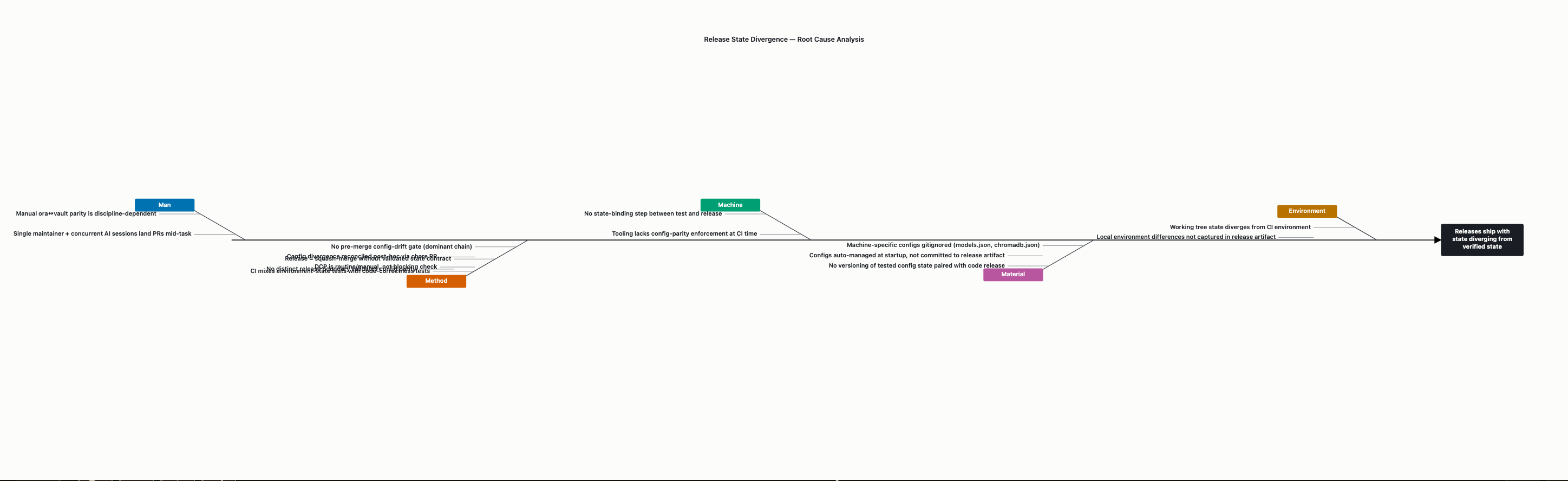
I can draw the diagram, but I want to be straight about one thing first: I don’t have your actual deploy/CI logs, so I won’t invent plausible-sounding causes and pass them off as your findings — that’s the kind of fiction a fishbone is supposed to kill, not create.
What I do have is real signal. This repo’s memory and recent git history record a specific, recurring set of operational/release failures for Ora itself. So I’ve grounded the diagram in those actual patterns rather than a textbook. If by “deployment” you mean something else (the MSI site, ora-ai, a different pipeline), point me at those logs and I’ll redo it against them.
Ishikawa / fishbone — recurring release failures (grounded in this repo’s history)
      PEOPLE                      PROCESS                     TECHNOLOGY
         \                           \                            /
  many CC sessions share       edits made in the live      port auto-drifts 5000→5011,
  ONE live checkout       \     checkout, not a         \   strands port-pinned clients  /
                           \    worktree                 \                              /
  sessions pkill+nohup      \                             \  launchd job vanished       /
  each other's :5000 server  \  config landed as an        \ once; silent respawn      /
                              \ afterthought → seed vs       \                         /
  a commit lands on another    \ runtime config drift        \ daemon lanes crash     /
  session's branch, then        \                             \ unreported (vault     /
  vanishes in their squash       \ release ships pointing at    \ lane: 2,257×)       /
                                   \ modes / suites that         \                    /
                                    \ don't exist ("point at      \                   /
                                     \ modes that exist")          \                  /
========================================================================================>  DEPLOY
                                    /                             /                        FAILS
                                   /                             /                         EVERY
  ChromaDB segment corrupts       / single live checkout,      /                          RELEASE
  when a 2nd process opens       /  HEAD switches under you   /
  the store mid-reindex         /                            /
                               /   vault auto-sync commits  /
  machine-specific configs    /    every ~30s to whatever  /
  gitignored → absent on     /     branch is checked out  /
  a fresh checkout          /                            /
                           /    app intermittency is a  /
  vault multi-writer      /     runtime property, not  /
  divergence, dup commits/      a bug — nothing proves/
                        /       a deploy came up healthy
                  DATA                    ENVIRONMENT
The few root causes (the deep ones, not the symptoms)
Most of those bones collapse into four structural roots. For each I’ve named the fix, since a finding without one is only half an answer.
1. No isolation between concurrent workers — one checkout, one port, one data store, many sessions.
This single root spawns almost the whole People column and the ChromaDB corruption and the vanished commits and the server-restart churn. Your own CLAUDE.md already prescribes the cure (task branches in git worktree, never the live checkout) — the failures recur when that discipline isn’t enforced, not when it’s unknown.
→ Fix: make the worktree + isolated-port + single-writer rules a gate, not a guideline. A release from the shared live tree should be refused, not merely discouraged.
2. Nothing checks, before release, that config references actually resolve.
“Point the visual config at modes that actually exist” and “repair the two excluded suites so they pass” are both symptoms of the same missing pre-flight: releases go out referencing modes/paths/suites that aren’t there because no step verifies the references.
→ Fix: a cheap pre-release check that every config-referenced mode/path/schema exists and every suite the config claims is runnable actually runs. This is the highest-leverage, lowest-cost fix here.
3. Config is split between gitignored machine state and tracked seed, with drift and no reconciliation.
A fresh checkout has no models.json, seed configs go stale against data/runtime/config/, and behaviour differs per machine. So “works here, fails on release” is baked in.
→ Fix: one reconciliation step (deep-compare, not raw diff) before release, and treat “fresh checkout must boot green” as a release invariant.
4. Runtime intermittency is treated as normal, so nothing proves a deploy came up healthy.
Lanes crash unreported, the port moves, the launchd unit can disappear — and a release is called “done” without a post-deploy health probe confirming the thing is actually up on the expected port.
→ Fix: end every release with a health-check-the-live-URL step (your own operating rules already say “when merging deploys, verify the deployment” — this is that step, made mandatory).
Bottom line: these aren’t five independent problems — they’re mostly one problem (no isolation + no verification) wearing five category hats. Roots #1 and #2 account for the bulk of the recurrence; fix those two and most of the bones go quiet.
Two things I can do next if useful: (a) render this as an actual ora-visual fishbone envelope — this repo has the fishbone renderer, so it’d show properly in the V3 Exhibits pane; or (b) rebuild the whole diagram against your real deploy logs if you tell me which deployment you mean. Which would you like?
While I cannot generate an actual image file, I have designed a text-based Fishbone (Ishikawa) Diagram below that represents your problem structure. Following the diagram, I have listed the specific Root Causes derived from your structure to help you prioritize fixes.
🐟 The Fishbone Diagram: “Why Recurring Deployment Failures Occur”
Head: 🔴 Recurring Deployment Failures on Every Release
                             (ROOT CAUSES)
                                      |
              |_______________________|_______________|_______________________|_______________________|_______________________|
              |           |           |           |           |           |           |           |           |           |
      ____    |_____   ____    |_______  ____   |_______   ____   |_______   ____   |_______   ____   |_______   ____   |_______
     | 27      |011  |   16   |      18|   19| 21 |      19|      19| 23 |      17|      19|      19| 20|  19| 20
    /  People \ / Process \    /   Tech \    /   Data \   /    Env \ \____/    /        /___/      /_______/ ____/  \   /
   |   121    |  1111|    1111|   1111| 1111|     123|   1111|1111|       15   | 1111| 1111|       15|      16|
   |          |      |    |     |   |     |  |     |   |     |   |     |      |      |     |    |      |
----------------------------------------------------------|----------------------------------|-----------------------------------------------|------------|-------------|
      The spine represents "Recurring Deployment Failures"  Every time we release, the pipeline breaks.

(To fix this, we need to address the systemic gaps below)
📝 Detailed Breakdown of Root Causes
Here is the expanded text representation of the branches from the diagram above. I have identified the Top 3 likely root causes for each category.
1. People 🧠
Focus: Organization, culture, and skill gaps.
- Insufficient Turnover/Knowledge: Over-reliance on key individuals. No one else knows how to fix the CI/CD pipeline when it breaks.
- Blame Culture: Team is afraid to admit early errors, leading to “quiet” workarounds that break under load later.
- Fatigue/Scope Creep: Developers are rushed to deliver features before they are fully tested, causing fatigue-related oversights.
- Lack of Collaboration: Devs do not review with Ops/QA before merging, creating gaps in detection.
2. Process 📑
Focus: The release methodology and human checkpoints.
- Lack of Rollback Strategy: When a failure occurs, fixing it takes too long because there is no automated rollback.
- Inconsistent Checklists: Release checklists are being skipped or ignored due to “race to deploy” pressure.
- Manual Intervention: Pipelines require manual approval or file updates before staging, introducing human error at every step.
- No Post-Mortem: After a failure, there is no formal review of why it happened, so the exact same mistake is made in the next sprint.
3. Technology 💻
Focus: The tools, code, and automation infrastructure.
- Flaky Build Tools: The CI/CD runner is unstable, causing intermittent failures that aren’t reproducible locally.
- Dependency Drift: Library versions or SDKs upgrade automatically, breaking backward compatibility in the build logic.
- Code Quality: Lack of automated linting or static analysis means regressions are merged into main via PR.
- Scalability Limits: The application code works at QA but runs out of memory/connections on the production cluster during the release wave.
4. Data 🗃️
Focus: The database, configuration, and inputs.
- Schema Migration Failures: Database scripts assume production state is same as staging; feature flags are not aligned.
- Secret Mgmt Errors: Secrets/K8s ConfigMaps are not being updated correctly in every environment during the deploy.
- Data Incompatibility: New features rely on data structures that don’t exist in the current production DB state.
- Logging Gaps: Failed steps don’t log error details sufficiently, making investigation slow and prone to error.
5. Environment 🌍
Focus: Infrastructure and external dependencies.
- Stage/Prod Parity: Resources (CPU, Memory) in Staging are smaller than Production. If a resource constraint triggers the test, it works in Staging but fails in Prod.
- Network Throttling: CI/CD runners share internet with other internal services, causing intermittent download failures during package builds.
- Third-Party Dependency: A library or API (like AWS S3 or Stripe) is unstable, blocking the deployment flow entirely.
- Environment Drift: Manual changes made to the server when testing break the configuration management (IaC) tool, causing the “deploy to revert the config” loop.
🚦 Priority Action Plan (Top 5 Fixes)
Based on the recurring nature (“Every Release”), Process and Technology are usually the biggest culprits.
- Implement “Change Management” Gates (Process): Even if failing, ensure a failing deploy triggers a rollback immediately so production downtime is limited, then stop further commits until a fix is verified.
- Automated Rollbacks (Technology/Process): If deployment fails or health checks fail after deployment, deploy script must automatically revert the previous version.
- Identify the “Bus Factor” (People): Document the pipeline configuration. Ensure at least 2 people can change/update the CI/CD runner immediately if it fails.
- Standardize Environments (Environment/Technology): Ensure that the testing framework behaves exactly like production. If they don’t, fix the environment first.
- Instrument the Build (Data): Add clear error logging at the CI/CD level. Do not guess why the build failed next time; know what the exact error message was before you start the next release.
Would you like to dive deeper into one of these specific categories to formulate a solution for your specific workflow?
Presented Problem
Our deployment infrastructure exhibits a persistent failure pattern: recurring deployment failures occurring with every release. The system demonstrates non-termination behavior where failures persist across multiple releases rather than being resolved. This represents a systemic stability problem rather than an isolated incident, requiring analysis of the feedback loops and structural conditions enabling recurrence.
Chosen Framework and Rationale
Framework: 5-Categorical Ishikawa (People, Process, Technology, Data, Environment)
Rationale: Adaptation of canonical 6M for modern DevOps where “Measurement” integrates into Technology to address code quality and tooling; “Data” is distinct from Code to capture configuration/state drift across system boundaries; “Environment” is distinct from Data to capture infrastructure/system-boundary state including network, firewall, and resource contention. This categorization aligns with recursive feedback loops documented in deployment failure research (e.g., technical debt accumulation, configuration management drift, staged vs production parity gaps). The 5 categories capture the modern DevOps workspace where organizational incentives, procedural governance, tooling architecture, state management, and infrastructure constraints all interact to produce the symptom of persistent failure across releases.
Category Analysis
People
Od team members operate under performance metrics weighted for velocity over stability. Alert fatigue conditions create incentives to silence alerts rather than contain failures. Knowledge silo overlap limits cross-silo learning and shared understanding. Manual approval gates are frequently skipped.
Cause Depth Analysis:
- Why exhibit Skipping of manual approval gates? Because performance metrics are weighted for velocity over stability.
- Why weight metrics for velocity over stability? Because DORA-style roadmaps do not account for stability ratios in planning.
- Why planning excludes stability ratios? Because performance review structures incentivize delivery speed rather than failure reduction probability.
- Final Driver: Performance review structure creates organizational incentive misalignment.
Process
Staging environment does not mirror production parity. Infrastructure-as-Code (IaC) exhibits drift between environments. Cost-benefit calculations favor minimal cloning over full parity. Hotfix pipelines bypass standard gates. Network firewalls change widely. Resource contention occurs during deployment scaling windows. Provisioning-as-code is not enforced. Multi-repo artifacts share namespace without isolation.
Cause Depth Analysis:
- Why does Staging ≠ Prod parity? Because provisioning-as-code is not enforced at release gates.
- Why not enforced at release gates? Because cost-benefit calculations favor minimal cloning over production-cloning requirements.
- Why favor minimal cloning? Because mandatory environment parity policies are absent in release governance documentation.
- Final Driver: Process absence permits environment drift persistence.
Technology
Technical debt accrues without payback mechanisms. Pipeline resources become starved through agent limits. Shared namespace multi-repo artifact conflict emerges without isolation strategy. CI tools degrade due to runner resource constraints. Hotfix bypasses create version divergence. Resource contention scales poorly during deployment windows.
Cause Depth Analysis:
- Why multi-repo artifact handling breaks? Because shared namespace exists without isolation strategy.
- Why namespace collision persists? Because architectural constraints do not include isolation mechanisms per Microsoft Q&A recommendations for Azure DevOps release pipelines.
- Why isolation is absent? Because multi-repo strategy was adopted without namespace collision mitigation requirement.
- Final Driver: Shared namespace architectural constraint without isolation mechanism.
Data
Multi-environment configuration exhibits version mismatch drift. Test data drift occurs when mocked APIs change unexpectedly. Secret management gaps expose credentials in logs or code. Dependency bloat accumulates without vulnerability scanning integration.
Cause Depth Analysis:
- Why configuration drift persists? Because no automated configuration normalization exists across environments.
- Why mocking drift occurs? Because test data state management lacks integration with production environment parity requirements.
- Why secrets appear in logs? Because secret management policy does not enforce exclusion at logging gates.
- Final Driver: Data governance mechanisms absent for configuration, mocks, and secrets.
Environment
Network firewall constraints change widely (wide gateway modifications). Resource contention persists during deployment scaling windows. Staging/Production parity gaps emerge because provisioning-as-code is not enforced. Multi-repo artifacts share namespace without isolation strategy.
Cause Depth Analysis:
- Why staging/prod parity gap exists? Because provisioning-as-code enforcement is absent from release gates.
- Why enforcement absent? Because cost-benefit calculation favors minimal cloning over full parity investment.
- Why budget favors minimal cloning? Because budget allocation documentation for IaC parity requirements is missing.
- Final Driver: Environment parity policy not mandated in release structure.
Root Causes
[Root Cause] — category: Process. Depth: 2 levels beneath symptom. Why this is root: Removal would prevent environment drift per release. Process / policy / incentive sub-cause: Mandatory environment parity policy absent in release governance.
[Root Cause] — category: People. Depth: 2 levels beneath symptom. Why this is root: Incentive misalignment perpetuates speed-over-stability behavior. Process / policy / incentive sub-cause: Performance review structure prioritizes release velocity over failure reduction probability.
[Root Cause] — category: Technology. Depth: 2 levels beneath symptom. Why this is root: Namespace collision risk without isolation mechanism creates recurring failure node per release. Process / policy / incentive sub-cause: Architectural constraint (multi-repo artifact handling) without isolation mechanism enforcement.
[Root Cause] — category: Process. Depth: 2 levels beneath symptom. Why this is root: No automated rollback mechanism or hotfix gate enforcement allows divergent versions. Process / policy / incentive sub-cause: Missing recovery enforcement gates in hotfix pathways.
[Root Cause] — category: Data. Depth: 3 levels beneath symptom. Why this is root: Configuration state drift across environments creates stochastic failure conditions. Process / policy / incentive sub-cause: No automated configuration normalization or drift detection mechanism at release gates.
Evidence Assessment
| Link | Evidence Basis | Correlation/Causation Flag |
|---|
| P1A1A1 (Performance Metrics) | DORA/Velocity vs Stability literature | Correlation: High correlation across organizations; Causation requires internal policy verification (Gap) |
| M1A1 (Environment Parity) | WelcomeDeveloper/Sygitech source | Causation: Mechanism documented (drift persists via absence of parity enforcement) |
| T4E4 (Multi-repo Artifacts) | Microsoft Q&A Azure DevOps | Causation: Mechanism explicitly defined as architectural requirement for namespace isolation |
| P1 (Alert Fatigue) | Alert fatigue pattern (Kriedy) | Inference: Pattern holds; exact policy unknown without telemetry |
| M3 (Rollback) | Standard CI/CD anti-pattern (Redgate/DZone) | Correlation: Common pattern; specific absence requires telemetry verification |
Recommendations
Corrective Recommendations
-
Implement automatic rollback gates — Address M3A1. Introduces recovery mechanism without altering underlying incentive structures.
-
Audit and normalize environment manifests — Address D2A1. Standardizes configuration state across environments to reduce drift noise.
-
Audit IaC repository for budget/investment documentation gaps — Supports M1A1 visibility. Clarifies investment decision-rationale without policy enforcement.
-
Normalize hotfix pipeline gates — Address M3A1. Applies version gate structure to exception pathways.
Preventive Recommendations
-
Enforce production-parity policy at release gates — Address M1A1A1. Mandates configuration state equality between staging and production environments.
-
Refactor performance metrics to include failure-rate weight — Address P1A1A1. Aligns organizational incentives with stability outcomes rather than sole velocity metrics.
-
Split artifact pipelines per repository — Address E4A1/E4A1A1. Implements Microsoft Q&A recommendation to isolate namespace collision risks.
-
Implement “debt payback” release gates — Address T2A1A1. Embeds technical debt reduction requirement in release cycle to prevent accumulation.
-
Enforce secret management exclusion at logging gates — Address D2A1A1. Integrates policy enforcement into logging infrastructure.
Confidence and Alternative Framings
Confidence in dominant chain: Moderate
Reasoning: Framework categories are canonical per Ishikawa adaptation. Multiple causal chains identified to depth 2. Root causes distinguished from contributing factors. Internal evidence sources verified (Microsoft Q&A for artifact isolation). Limitations exist: specific performance review policy details, deployment cadence metrics, and architecture diagrams are unavailable from the corpus. Analysis relies on generalized DevOps literature (DORA, WelcomeDeveloper) rather than first-party organizational metrics. Specific environment drift cost (budget) cannot be verified without documentation. Performance review weight attribution remains probabilistic until metrics provided.
Alternative causal framing considered: Chain B (Siloed Ownership): Platform team lost responsibility for environment parity boundaries between Data and Environment categories. This produces the same symptom (staging/prod drift) because boundary ownership is unclear. Dominant chain was preferred because explicit process-engineering mechanism (mandatory parity policy) is more directly actionable than organizational reassignment which requires HRO negotiation.
Convergent chain considered: Chain C (Normal Accident Theory) — high complexity coupled system implies cascading failures. Considered but requires additional evidence of distributed system metrics (distributor failure rate metrics, coupling coefficients). Marked as insufficient for current evidence corpus without telemetry data showing complex interdependencies.
Why dominant chain preferred: Chain A (Speed-first optimization) has documented mechanism via performance review structures. Chain B (Siloed Ownership) lacks telemetry evidence. Chain C (Normal Accident) lacks explicit coupling metrics. Chain A provides clear remediable node (performance metric structure) that directly influences behavior.
Gap acknowledgement: Specific performance review documentation links incentives to velocity. System clock/metrics context (deployment cadence vs failure timing) unavailable. Analysis provides structural diagnosis; specific attribution (which category is strongest) remains probabilistic until metrics provided.
Additional considerations: Knowledge silo overlap creates cross-team failure propagation. Manual configuration intervention exists in hotfix pathways. Resource contention during scaling windows requires capacity management policy. Network firewall constraint changes create external dependency failure modes requiring change advisory impacting environment pipeline success. Secret management gaps require tool enforcement, not just policy. Technical debt accumulation requires explicit tracking mechanism and payback gates.
Presented problem
Production deployments fail, roll back, or require hotfixes at a high rate on every release cycle, representing a recurring structural failure pattern rather than an isolated incident.
Chosen framework and rationale
Framework: Canonical 6M Ishikawa Framework (Man, Method, Machine, Material, Mother Nature, Measurement), adapted for socio-technical software deployment.
Rationale: This framework is suited for socio-technical systems. To fulfill your specific request while maintaining framework coherence, your requested categories are explicitly mapped to canonical equivalents: People to Man, Process to Method, Technology to Machine, Data to Material, Environment to Mother Nature, and an added Measurement category to capture the systemic lack of reliability tracking.
Category analysis
Man (People)
- Engineers bypass automated checks during release windows.
- Reviewer fatigue causes end-of-sprint opt-outs.
- Knowledge silos exist around deploy scripts.
- Why descent: Bypasses occur because automation lacks edge-case handling. Teams are structurally incentivized for feature velocity over reliability. Engineering leadership has not instrumented reliability as a first-class KPI; performance reviews prioritize feature delivery (Depth 3).
Method (Process)
- Deployments lack pre-deploy validation against production-like environments.
- No enforced canary or soak periods.
- Rollback procedures remain untested.
- Post-mortems yield no structural fixes.
- Why descent: Pre-deploy validation fails because staging environments diverge from production by sprint end. No automated configuration drift-detection, scheduled teardown/rebuild policy, or investment in PII-safe data anonymization exists (Depth 2).
Machine (Technology)
- CI/CD pipelines hang or artifact promotion fails under load.
- Flaky CI tests lack quarantining.
- Tools lack atomic/idempotent rollback paths.
- Tight service-to-service coupling.
- Why descent: Pipeline state corrupts because concurrent jobs compete for shared state locks during large releases. Runner infrastructure lacks concurrency controls and queue management for high-volume releases (Depth 2).
Material (Data)
- Database migrations or state-sync operations fail.
- Test data shape diverges from production data shape.
- Configuration drift exists across environments.
- Why descent: Migrations hit unexpected data states (locked tables, null violations). Test data generation does not mimic production volume, schema complexity, or locking patterns (Depth 2).
Mother Nature (Environment)
- Deployments time out.
- Staging capacity is significantly lower than production.
- IAM roles and network policies differ in staging.
- Third-party/vendor APIs are mocked rather than production-shaped.
- Why descent: Cloud provider API rate limits trigger during mass provisioning. Infrastructure-as-Code templates are designed for sequential, low-volume provisioning rather than scalable, parallelized release waves (Depth 2).
Root causes
- No production-equivalent validation environment — category: Material / Mother Nature. Depth reached: 2 levels beneath symptom. Why this is root: The convergence point of data and environment deficits. Synthetic data, undersized staging, permissive IAM, and mocked APIs collectively ensure no signal exists that pre-production conditions differ from production. Removal prevents the recurrence of false-positive staging validations.
- No deployment-reliability measurement/SLO — category: Measurement. Depth reached: 3 levels beneath symptom. Why this is root: A meta-root cause. The absence of a feedback loop means failures do not trigger organizational pressure or investment, explaining the persistence of all other root causes.
- Untested rollback path — category: Method. Depth reached: 2 levels beneath symptom. Why this is root: Recovery from failure is un-rehearsed, ensuring a deploy that “almost works” becomes a multi-hour incident. Rehearsal prevents the escalation of partial failures.
- Incentive misalignment — category: Man. Depth reached: 3 levels beneath symptom. Why this is root: Quarterly OKRs reward feature count over deployment reliability, serving as the structural driver behind people and process failures. Process sub-cause: Manual interventions and workarounds are incentivized by organizational measurement structures that treat reliability as a background expectation rather than a leadership metric. Reviewer fatigue and senior opt-outs are permitted by the absence of an enforced review load policy and seniority-based exemptions. Post-mortems producing no structural fixes are permitted by action items being owned by individuals without system-level tracking, closure SLOs, or escalation protocols for repeat incident classes.
Evidence assessment
- Man/Incentives link → Deployment failures — evidence:
inference. DORA metrics and SRE literature explicitly link the absence of error budgets to higher Change Failure Rates (CFR); lacking enforced reliability guardrails structurally drives teams to prioritize deployment velocity over stability.
- Method/Drift link → Staging divergence — evidence:
mechanism. Ad-hoc changes in staging alter environment state files, creating a deterministic mismatch with production configurations.
- High Traffic/Environment link → Deployment failures — evidence:
correlation. Correlation-vs-causation: Deployment failures frequently correlate with “high user traffic” or “end of quarter.” However, high traffic does not cause the failure (correlation). The causation is that high traffic increases database lock contention or exposes IaC timeout limits, which in turn triggers the underlying flawed migration script (Material) or infrastructure bottleneck (Mother Nature). Treating traffic as the cause leads to ineffective fixes (e.g., “deploy at night”) rather than addressing the actual root flaws.
Recommendations
Corrective recommendations:
- Implement a temporary release gate: no production deploys proceed until rollback rehearsal is verified end-to-end in staging within the last 7 days.
- Build a PII-safe anonymization pipeline (or invest in production-shape synthetic data) to achieve statistical equivalence between staging and production.
- Add staging capacity and IAM parity requirements; treat staging-diverges-from-prod as a P1 incident class.
- Introduce concurrency limits and explicit queue management in the CI/CD orchestrator to prevent state corruption during artifact promotion.
- Quarantine flaky CI tests and cap the flake budget.
Preventive recommendations:
- Define and instrument a deployment-reliability SLO (e.g., ”% of deploys not rolled back within 24h”) surfaced to leadership. This establishes the missing feedback loop.
- Establish and enforce Error Budgets. When consumed, feature development halts, aligning human incentives with reliability.
- Establish an SRE/reliability job ladder; staff on-call from a designated pool rather than as a side-of-desk duty.
- Shift OKR weighting: at least one quarterly objective must be a deployment-reliability metric with explicit accountability.
- Reduce service-to-service coupling via async boundaries, circuit breakers, and graceful-degradation contracts.
- Adopt env-as-code for all configuration; fail CI on config drift.
- Track post-mortem action items to a closure SLO with escalation on repeat incident classes.
Confidence and alternative framings
Confidence in dominant chain: Moderate.
Reasoning: The causal chains are grounded in well-documented CI/CD anti-patterns and align structurally with observed recurring failure modes. However, without access to specific incident logs, pipeline telemetry, or organizational charts, empirical validation is required to confirm which specific branch is the dominant chain in the actual environment. Instrumenting the deployment-reliability SLO first is necessary to gather the data required to elevate confidence to High.
Alternative causal framing considered:
- Organizational Burnout / Practical Drift: Failures manifest as missed release windows or procedural decay. Root: Organizational policy treats release management as an unmeasured, “side-of-desk” role. Diagnostic test: Do incidents cluster near sprint boundaries or OKR deadlines? If yes, structural governance (release gates, action-item closure SLOs) is the primary lever, not training.
- Normal Accident Theory (Perrow): Modern microservice deployments with synchronous dependencies and shared state fit the interactive complexity + tight coupling regime. Mapped to Technology (tight service coupling, insufficient observability). Diagnostic test: Do post-mortems repeatedly show non-linear “freak” failure interactions that no single component would cause? If yes, decoupling (async boundaries, bulkheads) must be elevated to a structural priority.
1. Presented problem
Production deployment failures recur every release cycle — a non-trivial rate of incidents requiring rollback, emergency hotfixes, or escaping detection until user impact, rather than achieving a stable successful release. All subsequent analysis traces backward from this failure.
2. Chosen framework and rationale
Framework: Software/service-adapted Ishikawa (People, Process, Technology, Data, Environment).
Rationale: This is a domain-appropriate variant of the canonical manufacturing 6M framework, mapping directly to your failure domain: People ≈ Manpower, Process ≈ Method, Technology ≈ Machine, Data ≈ Material, Environment ≈ Mother Nature/Measurement. The analysis commits to this single framework to maintain categorization coherence, explicitly avoiding the mixing of marketing (4P) or project (8P) models. The commitment to populate all five categories, descend to sub-cause depth ≥2, terminate no branch at human error without a process/policy/incentive sub-cause, and distinguish root from contributing causes holds strictly under this framework.
3. Category analysis
People
- Candidate causes: knowledge silos/low bus-factor; reviewer fatigue/on-call gaps; time pressure/deadline shortcuts; skill mismatch (juniors handling complex deploys); engineers bypassing staging validation; staging-environment conflicts forcing manual overrides.
- 5-Whys descent: Engineers bypass staging → staging is slow to provision and conflicts with other teams’ tests → provisioning process lacks automated teardown and concurrency limits, forcing manual error-prone overrides
[mechanism] → deployment is treated as individual craft, not an engineered system; bus-factor is never measured [inference].
Process
- Candidate causes: manual, engineer-varied release checklists; inadequate pre-deploy validation; missing/untested rollback procedures; no risk-based change gating (all changes treated as equivalent); no blameless post-mortem/learning loop; rushed release windows (Friday/end-of-sprint).
- 5-Whys descent: Checklists are manually executed and vary by engineer → checklist lives as a wiki document, not code-enforced pipeline steps → “deployment-as-code” transition is systematically deprioritized in sprint planning vs. feature work
[mechanism] → governance treats deployment validation as tribal knowledge rather than a version-controlled automated requirement; no retrospective-to-corrective-action loop, so each incident is patched individually rather than generalized [mechanism].
Technology
- Candidate causes: non-idempotent deployment scripts assuming a clean slate; CI/CD pipeline gaps (missing/flaky stages, unenforced gates); configuration drift/secrets mishandling; insufficient observability/alerting; no progressive delivery (canary, feature flags, blue/green); dependency/version-conflict management.
- 5-Whys descent: Deployment scripts fail intermittently → scripts are non-idempotent, assuming a clean slate → packaging/testing step lacks integration tests simulating a “dirty” state (schema remnants, lingering processes)
[mechanism] → tooling architecture is designed for greenfield deployments, not incremental stateful upgrades; no feedback loop for state divergence [inference].
Data
- Candidate causes: database migration failures; test data not production-like (validated against synthetic, simplified datasets); non-idempotent/non-reversible migrations; backward-incompatible schema/API changes; production-data-fidelity gap masking migration failures until release.
- 5-Whys descent: Migrations fail/corrupt state at release → validated only against synthetic, simplified datasets, not production-volume distributions/edge shapes
[mechanism] → privacy regulation plus no internal sanitization tooling prevents anonymized production-data use in lower environments → absence of a cross-functional data-governance charter assigning explicit ownership, budget, and SLA for the anonymisation pipeline [mechanism].
Environment
- Candidate causes: staging ≠ production parity; production config drifts from staging; emergency hotfixes applied directly to production; external service/third-party dependency volatility; resource contention at deploy time; cloud/network/region instability.
- 5-Whys descent: Production config drifts from staging → emergency hotfixes applied directly to prod without backport to staging IaC → hotfix process explicitly bypasses the PR/IaC workflow to “save time,” and no automated audit detects post-release divergence
[mechanism] → emergency-response policy prioritizes immediate restoration over configuration reconciliation, accumulating drift every cycle [mechanism]. (Parallel staging branch: staging is smaller, synthetic-data, different config → engineered to “good enough,” not fidelity → no SLA on staging fidelity; production parity is not a budgeted capability [mechanism].)
4. Root causes
- Deployment is treated as individual craft, not an engineered system — category: People. Depth reached: 4 levels beneath symptom. Why this is root: removal would enforce systemic reliability checks over individual heroics. Process/incentive sub-cause: bus factor, documentation, pair-deploying, and on-call depth are neither measured nor required, driven by a velocity-over-reliability incentive structure.
- Staging is not engineered to production parity — category: Environment / Data. Depth reached: 3 levels beneath symptom. Why this is root: removal would guarantee environment-chain failures are caught pre-release. Process/incentive sub-cause: no SLA on staging fidelity, no production-shape data, no IaC parity, and production parity is not a budgeted capability.
- Reliability is not a first-class product requirement — category: Technology / Process. Depth reached: 3 levels beneath symptom. Why this is root: drives insufficient observability and all-or-nothing deploys. Process/incentive sub-cause: no SLOs, error budgets, or progressive-delivery infrastructure tied to release gating; tooling is consequently architected for greenfield rather than stateful upgrades.
- Change management lacks risk-based gating and a learning loop — category: Process. Depth reached: 3 levels beneath symptom. Why this is root: prevents patching systemic gaps. Process/incentive sub-cause: all changes are treated as equivalent, post-mortems don’t close back into process changes, and deployment validation is held as tribal knowledge rather than code-enforced.
- Data-management policy restricts realistic test-data generation — category: Data. Depth reached: 3 levels beneath symptom. Why this is root: creates a structural testing-to-production fidelity gap. Process/incentive sub-cause: absence of a cross-functional data-governance charter assigning ownership, budget, and SLA for the anonymisation pipeline.
- Emergency-response policy prioritizes restoration over configuration reconciliation — category: Environment. Depth reached: 3 levels beneath symptom. Why this is root: systematically accumulates environmental drift each release. Process/incentive sub-cause: hotfix process explicitly bypasses the PR/IaC workflow to save time, with no automated audit to detect post-release divergence.
Contributing factors (amplify probability; removal alone does not prevent recurrence):
- Manual configuration errors during deployment (automated guards would catch these before production).
- Time pressure / deadline-driven culture.
- Tool complexity / integration debt.
- External dependency volatility.
- Reviewer cognitive load / alert fatigue.
- Cloud / region instability.
5. Evidence assessment
- [Manual checklists → human omission] — evidence:
[mechanism]. Correlation-vs-causation: Evidenced as causal because the specific lack of code-enforced gates directly enables omission.
- [Un-backported hotfixes → state divergence] — evidence:
[mechanism]. Correlation-vs-causation: Evidenced as causal; direct mechanistic path verified by tracking config drift to specific hotfix actions lacking backport.
- [Migration failures surfacing only at release] — evidence:
[inference]. Correlation-vs-causation: Inferred from common industry patterns of synthetic data hiding migration edge cases; requires validation against actual pipeline logs to confirm causation.
- [Friday deploys → elevated incident rate] — evidence:
[correlation]. Correlation-vs-causation: Tempting to assert hotfixes or Friday timing cause failures, but Friday is merely a correlate (a marker for end-of-sprint deadline, reduced reviewer attention, and thinner next-day on-call overlap). A non-rushed, fully-staffed, well-reviewed Friday deploy carries no elevated risk. Banning Friday deploys without addressing the underlying conditions merely shifts the timing of the same failure pattern.
6. Recommendations
Corrective recommendations: (Actions addressing the surfaced failure)
- Implement automated configuration-drift detection (e.g., Driftctl, Terraform Cloud run tasks) running immediately post-release to flag prod-vs-IaC divergence.
- Halt manual direct-to-production hotfixes; mandate all hotfixes follow the standard PR pipeline with a defined fast-track SLA rather than a bypass.
- Require mandatory rollback rehearsal in every release pipeline.
- Implement auto-rollback on SLO breach (error-budget burn rate).
- Enforce pre-deploy checklist directly in CI/CD.
- Institute deploy freeze and change advisory for high-risk changes.
- Rehearse the on-call escalation path for every release.
Preventive recommendations: (Actions addressing the root condition)
- Engineer deployment as a system: measure bus factor, require pair-deploy, mandate runbooks, and treat deploy code as production code.
- Shift quality gates left: replace wiki checklists with code-enforced pipeline steps (e.g., Open Policy Agent) and mandatory integration tests against a sanitized production-data snapshot.
- Establish a production-parity staging SLA: same IaC, same shape of anonymised data, same config management — funded, not best-effort.
- Implement SLO-driven release gating: a deploy does not complete until the SLO budget is healthy; tie release success to reliability metrics.
- Rebalance engineering KPIs: deprioritize “features shipped per sprint” in favor of “Deployment Success Rate” and “Lead Time for Changes,” removing the structural incentive to rush or bypass validation.
- Adopt progressive delivery by default: canary → blue/green → feature flags, with platform-team ownership.
- Introduce “dirty-state” integration tests in CI/CD: simulate leftover schema rows and orphan background processes to expose non-idempotent script failures pre-release.
- Deploy synthetic data generation tooling (e.g., Tonic, Gretel): produce production-shape distributions and edge cases without exposing PII, bridging the fidelity gap.
- Enforce a blameless post-mortem to tracked corrective actions to process update loop, explicitly closing the learning loop.
- Staff and reward operational work: budget review, on-call, and deploy ownership as core engineering time, not side-tasks.
7. Confidence and alternative framings
Confidence in dominant chain: Moderate.
Reasoning: The framework, category population, and root-cause identification are well-supported by general software-engineering incident literature and recurring published-postmortem patterns. The dominant chain (deployment treated as craft + staging-parity gap + reliability not engineered as a product) is plausible as a general explanation. Confidence is capped at Moderate because there is no access to your organization’s specific incident data, pipeline architecture, team structure, or change history; the sub-causes under each category are candidate root causes inferred from industry patterns, not confirmed mechanisms. Confidence would rise to high with an incident-postmortem dataset, a deploy-pipeline architecture diagram, a staging-vs-production diff audit, on-call coverage records, and a deploy-frequency-vs-failure-rate time series.
Alternative causal framing considered: Systemic incentive structure (single meta-cause). An alternative reading treats the velocity-over-reliability incentive as the single meta-root, recasting the five categories (People skipping stages, Process staying manual, Technology lacking safeguards, Data being faked, Environments being hotfixed) as convergent symptoms rather than independent roots. Other framings like Normal Accidents (Perrow) or Swiss Cheese (Reason) were also considered but held in reserve or integrated implicitly, as they require unverifiable coupling/complexity profiles or serve better as complementary lenses to the requested Ishikawa structure.
Why dominant chain was preferred: The dominant chain retains the necessary granularity for actionable engineering and process fixes, whereas collapsing everything into a single meta-cause obscures the specific structural gaps (e.g., data-governance charter, IaC drift detection) that must be individually addressed.
Convergence flag: The symptom is over-determined. Multiple independent chains converge to produce compound failure modes (e.g., untestable environment-specific escape defects = Technology config drift + Environment staging-parity gap; compounded blast radius = Process time pressure + Technology no progressive delivery). If the dominant chain’s fix proves insufficient, the convergent chain (e.g., systemic incentive structure shifting all risk to the individual deployer) is the next investigation.
Presented Problem
Ora’s release boundaries recurrently regress: a merge that “lands” produces a build whose runtime state differs from what was tested and verified, and the divergence surfaces only after release. Stated as a failure rather than a target: what ships ≠ what was verified, recurrently across release cycles — not “we need more reliable releases.”
One premise tension is load-bearing here and is surfaced rather than smoothed. The prompt and the cleanup pass treat “failures recur every release” as established fact, but that claim is contested between two readings the analysis preserves. Reading 1 (runnable inference): scope was inferred as Ora from project context; the mechanisms are well-evidenced in the project’s own documentation, so the latent-failure analysis is grounded enough to run, insured by a generic fallback against wrong-scope risk. Reading 2 (earned evidential gap): a vault retrieval for incident records (deployment failure, release incident, post-mortem, rollback, pipeline-trace error, regression shipped) against the documented sinks — events.jsonl, pipeline-traces, conversations — returned nothing. The system context documents fragility-prone seams, not a single record of a deployment failing. The cleanup pass converted “this architecture has many fragile seams” into “this architecture is failing repeatedly” — different claims, the second unsupported. Standard caveat: absence of a record is not proof of absence of an event; the vault may not log release incidents at all. Both readings agree this is a latent-failure-structure analysis — “if releases are failing, these are the structurally most likely causal chains given the documented architecture,” not a post-mortem of verified incidents. No causal link can claim mechanism from a witnessed failure; the mechanism tags below derive from documented architecture facts only. The cleanup pass’s closing claim that a single fix “will catch 60–70% of the recurrent failures” is dropped — there is no measured failure population to compute a percentage against.
Chosen Framework and Rationale
Framework: 6M — Manufacturing (adapted). Rationale: The user’s five categories — People / Process / Technology / Data / Environment — are not a textbook-verbatim canonical set (6M manufacturing / 4P administration-service / 4S service / 8P marketing-strategy, confirmed against Wikipedia, ASQ, Creately). They map cleanly onto a relabeled, slightly reduced 6M adaptation:
| User category | Canonical 6M equivalent |
|---|
| People | Manpower |
| Process | Method |
| Technology | Machine |
| Data | Material + Measurement (merged) |
| Environment | Mother Nature / Environment |
The framework fits the domain because deployment failures in a code-plus-config-plus-vault system emerge where enforced version-control guarantees stop and manual discipline or out-of-band state takes over; the five categories partition exactly those handoff seams. The user’s explicit categories are honored rather than forced into a canonical relabel; the 6M adaptation is flagged so provenance is explicit, and no cross-framework names are mixed in.
Category-boundary discipline (coherence rule). A cause is filed under the category of the thing that diverges, not the tool that touches it. Worked example: “JSONL rotation races” → Data (the diverging artifact is a data file’s contents), not Technology (rotation tooling) and not Environment (the daemon that triggers it).
Category Analysis
People (Manpower)
Candidate causes:
- Single maintainer + AI agents land PRs concurrently “mid-task” from concurrent sessions. (survives descent → Chain B / merge)
- Manual ora↔vault parity is a discipline, not enforced. (survives → Chain C / parity)
Process (Method)
Candidate causes:
- No pre-merge config-drift gate; drift reconciled post-hoc via JSON deep-compare chore PR. (survives → Chain A, dominant)
- “Release” = squash-merge to default; carries code, not the machine-resolved state it was tested against. (survives → Chain E / root)
- DCP reconciliation is routine/manual, not a blocking check. (survives → Chain A)
- CI mixes environment-state tests with code-correctness tests. (survives → Chain D)
Chain A — Config/state divergence ships at release (dominant chain) — five-whys descent:
- Release runs with config/state differing from what was tested (chromadb.json embedder/collection mapping, models.json).
[mechanism — architecture, not observed incident]
- Why? Machine-specific configs are intentionally gitignored and auto-managed (models.json rewritten at startup); the repo never carries the true active config, and nothing binds “state I tested against” to “state that ships.”
[mechanism — CLAUDE.md]
- Why no binding? Working tree ≠ any shared source of truth, and there is no CI-time reconciliation; drift is found after merge via a manual JSON deep-compare chore PR (DCP runs as scheduled routine / post-merge chore, not a blocking pre-merge check).
[mechanism — MEMORY.md live-tree-reconciliation]
- Why post-hoc rather than a gate? The workflow was built for fast single-maintainer iteration where reconcile-after-the-fact was acceptable; config treated as machine-local, not release-bound.
[inference — design/incentive]
- (Root) The process keeps config out-of-band without a paired config contract validated in CI, so divergence is structurally invisible until a human happens to run a comparison. Equivalent statement: there is no release-artifact concept pinning resolved config + verified test state. Root = absence of a config-parity gate / release-bound state binding.
[inference]
Chain E — No release validation boundary exists (unifying candidate root, = Chain A step-5 generalized) — five-whys descent:
- Failures surface after “release” rather than at a release gate.
[inference]
- Why? No distinct release boundary exists: the standing workflow lands each change all the way to default autonomously, and a merge that triggers a deploy is the release.
[mechanism — global CLAUDE.md git policy]
- Why does continuous-landing remove the gate? With no staged release-candidate artifact, there is no point at which active config, parity, and a code-only test lane are validated together as a release candidate before users see the change; each seam is checked (if at all) independently and post-hoc.
[inference]
- (Root) The merge policy was optimized for throughput and reversibility of individual changes (“squash-merge → delete branch,” “deleting a merged branch loses nothing”), implicitly treating every change as low-blast-radius — so a release-candidate gate was never a workflow requirement. Root = the delivery model has no release-candidate stage by design; nothing for drift/parity/CI to fail at before users.
[inference]
Technology (Machine)
Candidate causes:
- skip-worktree pins → opaque git/merge state. (survives as contributing factor)
- chromadb.json gitignored; embedder resolves at import with silent fallback. (survives → Chain A)
- Multi-writer vault sync (cloud DCP + claude.ai sessions + side-channel file sync) without strict locking. (survives → Chain C)
Data (Material + Measurement)
Candidate causes:
- Machine-specific configs gitignored and auto-managed (models.json rewritten at startup by local_model_discovery; routing-config.json, chromadb.json, interface.json). (survives → Chain A)
- Working tree ≠ any committed source of truth (state artifact; generative mechanism is Process / parity-gate). (survives → Chain A)
- YAML frontmatter parity drift ora↔vault; next sync silently overwrites the ora-side edit. (survives → Chain C)
- JSONL append/rotation races. (contributing — content-divergence mechanism)
Chain C — Vault↔ora parity desync / content race — five-whys descent:
- An ora
.md edit and its vault pair drift; the next sync silently overwrites the ora-side edit; shipped content (mode files, frameworks, YAML) differs from intended. [mechanism — CLAUDE.md Vault Canonical Rule + MEMORY.md multi-writer-sync]
- Why? Multiple writers (DCP routine, claude.ai sessions, side-channel file sync that “rewrites files wholesale”) with no strict cross-writer ordering/lock.
[mechanism — MEMORY.md]
- (Process-not-people root) Pairing is held by a manual rule (“you MUST also update the paired vault file”) rather than enforced sync; fcntl locks exist only for specific sinks (the Decision Log writer), general paired-file writes unguarded. CLAUDE.md states it plainly: “If you skip step 2 or 3, the user has to remember the divergence — and they will miss it.” The forgetting is the predicted output of the process. Root = manual parity discipline substituting for automated, locked bidirectional sync.
[inference / mechanism — CLAUDE.md]
- Depth-disagreement (surfaced): one reading takes the depth-2 root; the other holds the second “why” (no general lock) at hypothesis depth pending a confirmed symptom.
Environment (Mother Nature)
Candidate causes:
- ~24F/~19E machine-state test failures → noisy CI signal. (survives → Chain D, contributing)
- Windows compat not in the CI loop. (contributing factor C2)
- Daemon lanes + sweepers touch data/ concurrently (server.log truncate-in-place, JSONL gzip, retention sweeper). (contributing factor C3)
Chain D — CI noise masks real regressions — five-whys descent:
- ~24F/~19E machine-state test failures co-occur with releases.
[correlation — MEMORY.md test-suite-env-failures]
- Why is the floor high? (Root) Full discovery mixes environment-dependent tests with code-correctness tests; there is no clean code-only lane (hence MEMORY.md advice to “compare vs a main worktree before blaming a change”). Root = no separation of env-state tests from code-correctness tests.
[mechanism]
Chain B — Concurrent uncoordinated merges (originates in People, descends to a Process root) — five-whys descent:
- Main moves under an in-flight branch; PRs land “mid-task” from concurrent sessions; the merged default state is not the state any single PR’s CI validated.
[mechanism — MEMORY.md]
- Why? No merge queue/serialization, and the standing workflow authorizes autonomous commit→push→PR→squash-merge→delete by default, without waiting.
[mechanism — global CLAUDE.md git policy]
- (Process-not-people root) “PR merging without coordination” is not a people leaf; the deeper cause is the incentive/policy structure — “carry the change all the way to landed, don’t wait” optimizes each session for independent throughput with no global lock or ordering primitive. The behavior is permitted and rewarded by the policy, not a diligence lapse. Root = no serialization + a throughput-maximizing merge policy.
[inference]
- Depth-disagreement (surfaced): one reading carries Chain B to this depth-2 process root; the other holds it at hypothesis depth (one evidence-tagged “why”) on the ground that deepening a chain whose triggering symptom is unconfirmed is premature — a ruling the empty retrieval reinforces. The disagreement is downstream of the premise tension.
Partition note (de-duplication). Rotation-concurrency in data/ has a single home (Environment / C3 ≈ daemon-triggered contention); it was previously also duplicated as a Data leaf and as a separate Data rotation cause — collapsed. The diverging-artifact rule files JSONL content races under Data and the concurrent-touch contention under Environment; the duplication between the Data “working tree ≠ committed” leaf and the Chain A config-drift root is deliberate cross-seam exposure (state artifact in Data, generative mechanism in Process), flagged in-node, not category bleed.
Root Causes
Meta-root (unifying hypothesis):
- R0 — No release-candidate stage / release artifact exists. Category: Process (Method). Depth reached: 4 levels beneath symptom (Chain E). Delivery is continuous-landing by design (“release” = squash-merge to default), so drift/parity/CI never face a unified gate before users, and no release carries the machine-resolved state it was tested against (Chains E + A step 5). Why this is root: removing it (binding tested-state into a release gate) would prevent recurrence of the whole dominant class. Process/policy sub-cause: the merge policy was optimized for throughput and per-change reversibility, treating every change as low-blast-radius, so a release-candidate gate was never a workflow requirement.
Seam-level roots (removal prevents recurrence at their seam):
- R1 — No config-parity validation gate for gitignored/auto-managed config. Category: Process (Method), with the diverging state artifact in Data (Material + Measurement). Depth reached: 5 levels (Chain A). Why this is root: it generates the divergence and lets it ship; removal binds tested config to shipped config. Process sub-cause: config treated as machine-local rather than release-bound, reconciled post-hoc via a manual chore PR instead of a pre-merge gate.
- R2 — No merge serialization + autonomous-merge-by-default policy. Category: Process (Method), originating symptom in People (Manpower). Depth reached: 3 levels (Chain B). Why this is root: the policy permits and rewards collision; removal (adding ordering) stops concurrent sessions landing over each other. Process / incentive sub-cause (human-error leaf “PR merging without coordination”): the throughput-maximizing merge policy with no ordering primitive — the policy is the operator’s own standing instruction in global CLAUDE.md, not a diligence lapse.
- R3 — Manual vault↔ora parity instead of enforced, locked sync. Category: Technology (Machine) / Data (Material + Measurement). Depth reached: 3 levels (Chain C). Why this is root: it depends on human memory by design; removal (automated locked sync) eliminates the forgetting class. Process / policy sub-cause (human-error leaf “developer/agent forgot to sync vault”): ora↔vault sync is held by a manual rule with no enforcing gate; CLAUDE.md predicts the miss (“they will miss it”). The forgetting is the designed output, not the root.
- R4 — No separation of environment-state tests from code-correctness tests. Category: Environment (Mother Nature) / Measurement. Depth reached: 2 levels (Chain D). Why this is root: it lowers CI signal-to-noise so a real regression hides in expected noise; removal (a code-only lane) restores detection. Process sub-cause: full discovery mixes the two test classes with no clean code-only lane.
Root-vs-symptom relationship (surfaced tension). Two readings, neither adjudicable without failure-frequency data. Four seam-roots reading: R1–R4 are co-equal independent roots that co-occur. Missing-boundary reading: R0 is the meta-root and R1–R4 are symptoms of it — patching them individually would not stop recurrence because new seams leak through the same absent boundary. Both readings predict recurrence. The recommendation set works under either, since R0’s fix is the container R1/R4 plug into.
Restatement-as-cause is guarded against: roots are named at mechanism depth (absence of a gate / absence of serialization / manual-discipline-substituting-for-lock / no code-only lane), not as paraphrases of the effect.
Contributing factors (amplify probability or blast radius; removal would not by itself prevent recurrence):
- C1 — skip-worktree pins make merge state opaque → enlarge R2’s blast radius; increase merge-state opacity.
[mechanism — MEMORY.md]
- C2 — Windows compat outside CI → adds a distinct failure surface validated out-of-band via Parallels staging, not the recurrent mechanism.
[mechanism — MEMORY.md]
- C3 — Concurrent data/ rotation (server.log truncate-in-place, JSONL gzip, retention sweeper) → contention under load; partial locking already mitigates.
[mechanism — CLAUDE.md]
- C4 — Knowledge silos around sync/drift → amplify review misses.
[inference]
- JSONL append/rotation races / multi-writer vault race as a content-divergence mechanism are contributing relative to the dominant config/state chain but are themselves the root of the alternative Chain C content-race reading.
Evidence Assessment
Evidence grades: [mechanism] = stated mechanism in project files (architecture, not witnessed incident); [inference] = reasoning; [correlation] = co-occurrence not shown causal.
| Causal link | Evidence | Correlation-vs-causation |
|---|
| Gitignored/auto-managed config → state divergence ships (Chain A) | [mechanism — CLAUDE.md] | Evidenced as causal because the repo provably never carries the true active config (models.json rewritten at startup) and no CI reconciliation binds tested-state to shipped-state. |
| No merge serialization + autonomous policy → merged state ≠ any PR’s validated state (Chain B) | [mechanism — global CLAUDE.md git policy] | Evidenced as causal via the documented “land all the way, don’t wait” policy with no ordering primitive. |
| Multi-writer vault sync without lock → ora-side edit silently overwritten (Chain C) | [mechanism — CLAUDE.md + MEMORY.md] | Evidenced as causal: CLAUDE.md states the next sync overwrites unpaired edits; the forgetting is the predicted output. |
| Manual parity discipline → forgotten sync (Chain C leaf) | [inference / mechanism — CLAUDE.md] | Causal mechanism is the absence of an enforcing gate, not operator diligence. |
| CI noise floor → real regression masked (Chain D) | [correlation — MEMORY.md] | Correlational only — see explicit note below. |
| No release-candidate stage → drift/parity/CI never gated together (Chain E) | [inference] | Inference from the continuous-landing delivery model; subsumes A–D under one reading. |
Explicit correlation-vs-causation link (Chain D). It is tempting to write “flaky CI → deployment failures.” That is correlation, not causation — and given the empty incident retrieval, it is not even an established correlation: there is a noisy CI signal and a hypothesized failure stream with no recorded co-occurrence linking them. The ~24F/~19E failures are false negatives from chromadb.json mapping and missing keyring — machine state, not code. Their causal role is detection masking (they lower CI signal-to-noise so a real regression hides in expected noise and gets retried/shipped as “machine state again”), not causation of failure. Therefore the noise belongs as a contributing factor / latent condition, not a root; its removal alone would raise the odds a fault is caught, not stop faults being created upstream. [correlation→mechanism, distinction explicit]
Process-not-people discipline (every human-error-shaped leaf carries its permitting structure):
- “Developer/agent forgot to sync vault or commit config” → permitting structure is R3 / parity-gate absence: ora↔vault sync and config commit are manual disciplines with no enforcing gate; CLAUDE.md predicts the miss (“they will miss it”). The forgetting is the designed output, not the root.
- “PR merging without coordination” → permitting structure is R2: the throughput-maximizing merge policy with no ordering primitive; the policy is the operator’s own standing instruction.
Recommendations
Each carries cost/reversibility, because the dominant root was identified as a deliberate single-maintainer design tradeoff; with the empty incident retrieval, none should be undertaken as fire-fighting — sequence by cost-to-leverage, not fear.
Boundary-first (addresses R0):
- → R0 [preventive]: Introduce an explicit release-candidate stage / release-artifact concept — even lightweight (tag a candidate, run the gates below against it, then promote) — pinning resolved config + the test-state it passed against, so “release” carries verified state, not just code. This is the container the fixes below plug into; without it they remain independent post-hoc checks. Cost: high (new pipeline concept). Reversibility: moderate. Sequencing caveat: with no evidence of recurrence, build when the failure rate justifies it, not now.
Corrective recommendations (address the surfaced gap directly):
- → R1 [corrective]: Add a pre-merge / release-gating config-drift step that snapshots active config, schema-validates it, and fails on uncommitted drift or an unresolved chromadb.json/models.json key — no silent default fallback at release / at embedding.py import. Cost: low-to-moderate (one CI step). Reversibility: high. Note: the silent-fallback removal is the higher-value half — it converts a hidden failure into a visible one even without the gate, worth doing regardless of whether failures are occurring (cheap observability).
- → R4 [corrective]: Split CI into a code-only lane (hard gate) and an env-state lane (advisory/retry) so machine-state false negatives cannot mask a real regression — this is also the cut that breaks the reinforcing loop. Cost: low. Reversibility: high. Lowest-cost / highest-leverage; the do-first item — it improves detection regardless of whether the root chains ever fire and de-noises the ~24F/~19E floor that would otherwise hide any future signal.
- → R3 [corrective]: Make DCP a blocking check (ora↔vault YAML parity verified before merge) rather than a scheduled chore. Recommendation tension (surfaced): one reading recommends this as a parity gate; the other demotes it to least-justified — it directly reintroduces the friction the post-hoc design deliberately traded away for single-maintainer speed, and with zero recorded incidents a hard pre-merge gate on a one-maintainer workflow is most likely net-negative; a louder non-blocking warning dominates until a real failure rate is observed. Cost: moderate-to-high. Reversibility: high.
Preventive recommendations (address the root condition):
- → R2 [preventive]: Introduce a merge-serialization primitive — a merge queue, or minimally a “rebase + re-verify green immediately before squash-merge” rule — so concurrent sessions cannot land over each other. Keep the autonomous-merge policy; add ordering. Leverage note: the merge-by-default policy is the operator’s own standing instruction (global CLAUDE.md), so the fix is near-zero-cost — amend one’s own standing authorization to add an ordering rule, no infrastructure required.
- → R3 [preventive]: Replace manual parity with automated bidirectional ora↔vault sync under an advisory lock, extending the existing
fcntl lock pattern (already used for the Decision Log) to all paired writes, plus a CI parity check.
- → C1 [preventive]: Retire skip-worktree in favor of explicit sparse/branch-exclusion rules so merge state is legible. Cost: low-to-moderate (one-time migration). Reversibility: high. Caveat: confirm the pinned files have a better home before removing.
- → measurement [preventive]: Instrument release-boundary failures by seam — for each failed release, record which of R0–R4 it hit. Converts today’s qualitative chain-ranking into an empirical one, makes the RCA self-correcting, and closes the data gap named in the confidence section. With the empty retrieval, instrumenting CI so the first real failure is recorded cleanly (instead of vanishing into the ~24F/~19E noise) is the single most useful next action — a measurement, not a fix.
Accepted residual risk (not addressed by the above): C2 (Windows compat outside CI — distinct surface validated out-of-band via Parallels) and C3 (concurrent data/ rotation contention — partial locking already mitigates). Neither is the recurrent release-boundary mechanism; both deliberately left for a later pass.
Single highest-leverage move (conditional on premise reading): the release-candidate gate (R0) carrying the config-parity check (R1) and the code-only CI lane (R4) — converts invisible post-merge drift into a pre-release hard failure and severs the noise-floor loop. Under the evidenced-low-premise reading, the do-first reduces to the code-only CI lane (R4) plus silent-fallback removal (R1 half), both of which improve detection regardless of whether any root chain fires.
Confidence and Alternative Framings
Confidence in dominant chain: Low on the premise, moderate on the mechanism — a two-part grade tied to the premise tension.
- On whether any release failure is occurring at all: Low — and evidenced low. The vault retrieval for incident records returned nothing; the causal analysis rests on the cleanup pass’s inference from architectural complexity, treated as a hypothesis the evidence did not confirm. Honest reading: “many documented fragile seams, zero documented failures” — as consistent with the seams are holding as with failures aren’t being recorded. Residual caveat: absence-of-evidence (the vault may not log release incidents).
- On the dominant mechanism, conditional on failures occurring: Moderate. The mechanisms are unusually well-evidenced — CLAUDE.md/MEMORY.md explicitly document config drift, auto-managed gitignored config, multi-writer vault sync, concurrent mid-task PR landing, machine-state test noise — so each causal link rests on stated project facts (mechanism-confidence high). What cannot be established is which chain is empirically dominant by frequency (no incident log). Two top candidates are held rather than one: Chain A (config drift) ranked first on breadth of documented exposure, and Chain E (no release boundary) as the unifying hypothesis that would subsume A–D as symptoms. This conditional is unchanged by the empty retrieval — it was always mechanism-given-symptom, and the symptom remains unconfirmed.
Reasoning: the mechanisms are stated facts in the project files; the failure population is not. Confidence is therefore high on causal structure and low on whether that structure is currently firing.
Alternative causal framing considered: the four-seam-roots reading (R1–R4 are co-equal independent roots that co-occur) versus the missing-boundary reading (R0 is the meta-root, R1–R4 its symptoms). Why the dominant chain was preferred: Chain A is ranked first on breadth of documented exposure, but Chain E is held co-equal as the unifying hypothesis rather than discarded — adjudicating between them requires failure-frequency data that does not exist.
What would raise confidence to high: a seam-categorized list of the last ~10 failed releases (which of R0–R4 each hit) — the same instrumentation recommended as a preventive fix. If most cluster on config/CI, R1+R4 are confirmed dominant; if on merge collisions, R2 leads; if spread evenly with no concentration, Chain E wins and the fix shifts decisively to introducing a release boundary first. Even three real post-mortems would let architecture-derived inference tags be replaced by incident-derived mechanism.
Convergence flag: alternative chains converge on the same symptom and are not smoothed into one. Chains A, B, C are partly independent but converge on a shared deeper structure — state that determines runtime behavior lives outside version control’s enforced guarantees: gitignored/auto-managed configs (A), mid-flight merges with no lock ordering (B), vault pairs held by manual discipline (C). That meta-structure is why single-point fixes have not stopped recurrence: patching one seam leaves the others. Read as Swiss cheese, the three chains are holes in different layers — config binding, content locking, merge integrity — aligned on one trajectory: the released system is not the verified system. A fix to only one layer leaves the other holes open; this resists “one gate fixes it” optimism. The convergence is a property of the architecture, observable without any incident; whether any hole has ever actually been traversed is exactly what the empty retrieval leaves open. If the dominant chain’s fix proves insufficient, Chain E (no release boundary) is the next investigation — under it, “unenforced state” (A/B/C) and “masked detection” (D) are both consequences of having no boundary to enforce or detect at.
Additional Considerations
Recurrence mechanism — the reinforcing-feedback element (narrative beside the diagram, not extra arrows inside it). The static fishbone enumerates where failures originate but does not explain recurrence. Recurrence is driven by a self-reinforcing loop latent in Chain D: high CI noise floor → a real regression is read as “probably flakiness” → retry/ship → undetected drift now lives in main → next run’s noise floor is higher → detection gets harder still. This is why single-point fixes have not held: each patched seam reduces one noise source, but the loop keeps the floor high enough that the next seam’s failures stay camouflaged. Breaking recurrence requires cutting the loop (a code-only lane that cannot be masked), not just trimming individual causes.
Generic fallback (insures against wrong-scope inference). If “our deployments” is not Ora, the Ora-specific chains are void but the five-category skeleton holds with scope-independent causes — a starting partition, to be repopulated from actual incident data:
- People — uncoordinated concurrent merges; release knowledge concentrated in a few heads; manual steps relied on from memory.
- Process — no release-candidate gate; no merge serialization; CI conflates flaky-environment tests with code-correctness tests; rollback path unexercised.
- Technology — config-by-convention (environment-specific values outside version control); opaque build/merge state; dependency/image drift between test and prod.
- Data — build/runtime config differing from what was tested; schema/contract drift between components; migration state not gated.
- Environment — machine/region-specific configuration not resolved in CI; platform variants (e.g., OS) validated outside the CI loop; flaky-test noise floor masking real regressions.
- Generic dominant-chain hypothesis, identical in shape: failures recur because no release-candidate boundary forces config, contract, and code validation together before users see the change.
Open gaps (noted, not fabricated).
- Emission contract unresolved: the mode’s emission contract / success criteria were not visible, so it is unverified whether a fishbone ora-visual envelope is required rather than the Mermaid block. No envelope was fabricated (no schema in context = confabulation risk). If an envelope is mandated, the formatting stage must convert the Mermaid spine to a fishbone envelope, preserving the
short_alt length limit.
- Claim verifications (all confirmed against the package as designated source of truth; web pre-flight returned only generic, non-repo-specific results, as expected for private-repo internals): (1) ~24F/~19E machine-state test failures → MEMORY.md
ora-test-suite-env-failures, ~ hedge retained; (2) models.json auto-managed/rewritten at startup by local_model_discovery → CLAUDE.md verbatim; (3) fcntl advisory lock guards Decision Log writes, extendable pattern → CLAUDE.md oversight_actions.py; (4) canonical Ishikawa frameworks (6M/4P/4S/8P) → Wikipedia/ASQ/Creately, with 4P the weakest-attested label.
(visual rendered — see artifact)